
Meeting
Naruto listens without offering easy forgiveness as Nagato traces his first pain from a wartime mistake to the fragile companionship of Yahiko and Konan.
What happens in Naruto Shippuden Episode 172?
Naruto Shippuden Episode 172, "Meeting," returns to the hidden paper tree where Naruto stands before Nagato and Konan. Naruto has defeated the Six Paths of Pain, but he refuses to decide Nagato's fate without hearing how another student of Jiraiya came to believe that suffering was the only path to peace.
Nagato tests Naruto's anger with his chakra and asks whether the destruction of the Leaf deserves forgiveness. Naruto does not offer it. He admits that he wants to kill Nagato, then holds himself still because Jiraiya believed understanding had to begin somewhere.
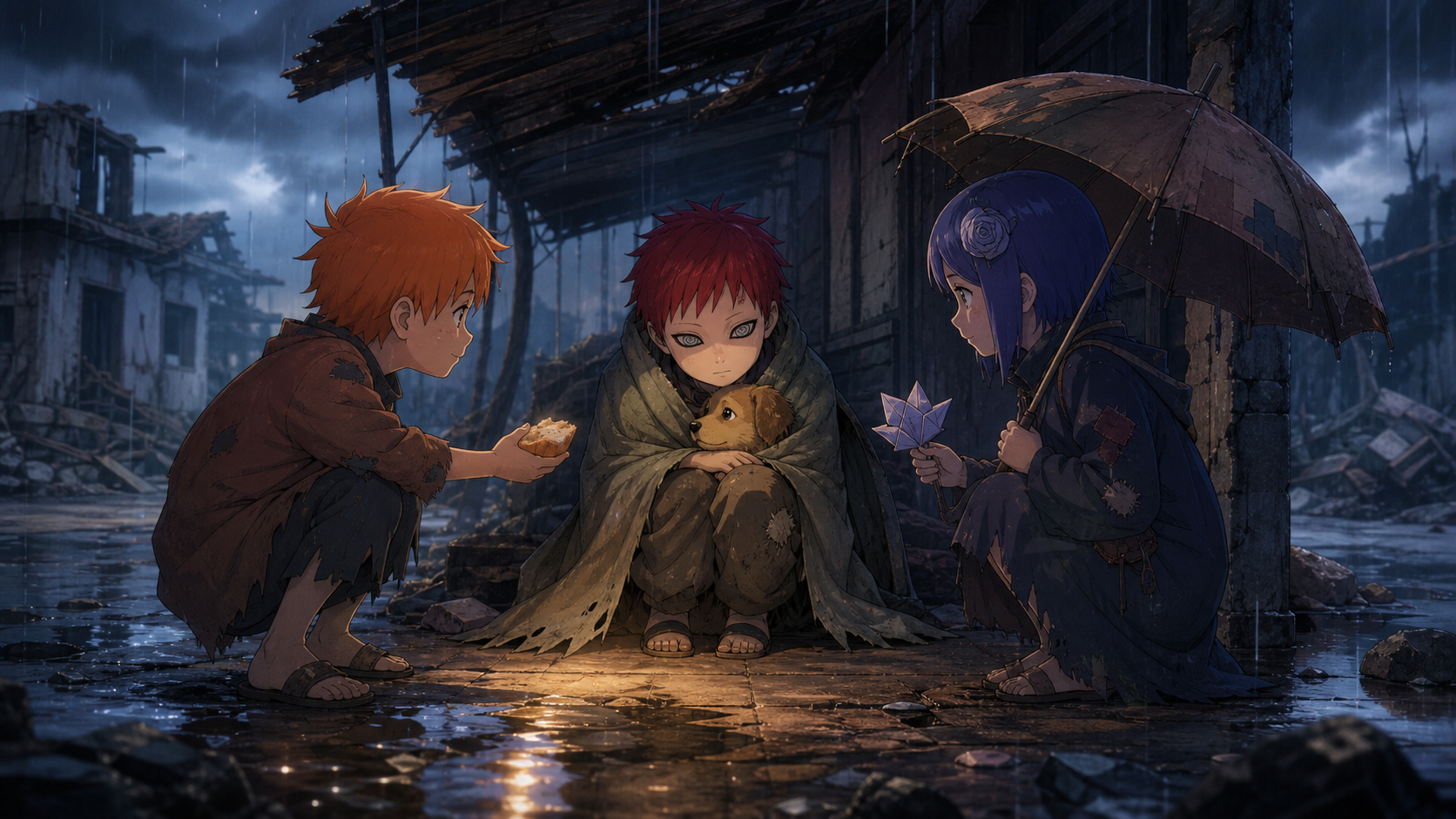
Nagato starts with his childhood in the Hidden Rain. War between larger nations reached his home, Leaf ninja killed his parents in a terrible mistake, and the Rinnegan awakened through grief. Alone and starving, he eventually met Yahiko, Konan, and the little dog Chibi. Their first meeting gave his pain companionship before it gave him a cause.
Naruto listens without pretending to be calm
The most important action in the present-day chamber is restraint. Naruto is close enough to attack the person responsible for the village's destruction. Every memory in his body tells him that violence would be justified.
He does not become peaceful simply because the story needs a moral hero. His hands shake. He grips Jiraiya's book. He says plainly that forgiveness is beyond him. Listening costs him something in every second.
That honesty protects the scene from becoming sentimental. Naruto is not erasing the dead to prove he is better than Nagato. He is delaying judgment long enough to understand what judgment would continue.
Nagato begins with the first pain
Nagato describes two great pains that shaped him. The first begins with his parents. They are civilians trying to survive a war that has entered their home. Leaf shinobi mistake them for enemies, realize the error too late, and leave a child with a loss no apology can repair.
This is not an abstract complaint about the shinobi system. It is a room, a mistake, and a boy watching the people who protected him disappear. The nations conducting the war can call the event collateral damage. Nagato has to live inside its permanent result.
The Rinnegan appears at that moment, tying extraordinary power to an experience of helplessness. Nagato's strength does not arrive as liberation. It arrives after the world has already taught him that safety can vanish without warning.
The Hidden Rain is treated as somebody's home
The great nations often describe the Hidden Rain as territory between more important powers. Nagato's story changes the scale. Streets, kitchens, shelters, and hungry children exist inside the place strategic maps reduce to a battlefield.
That perspective is crucial to Pain's argument. The Leaf remembers its own losses vividly while treating the damage beyond its borders as background. Naruto cannot answer Nagato if he believes only the village's grief deserves a name.
Listening does not require Naruto to accept that Nagato's later choices were inevitable. It requires him to recognize that the cycle did not begin when Pain arrived at the Leaf.
Chibi gives loneliness a living shape
The little dog Nagato meets after losing his parents is a small detail with enormous emotional weight. Chibi cannot explain the war or promise a future. He is simply another hungry, vulnerable life that stays close.
Nagato shares what little he has because care gives him something to do with grief besides disappear inside it. For a child who has lost every stable relationship, the dog's trust becomes a temporary home.
The story knows that this bond is fragile. That fragility is why it matters. Nagato's later belief that attachment only produces pain begins among relationships that genuinely kept him alive.
Yahiko enters with motion and audacity
Yahiko approaches survival differently. He is loud, practical, and willing to take risks. Where Nagato has turned inward, Yahiko reaches outward. He believes the children can steal, bargain, organize, and someday change the country that abandoned them.
His confidence is not proof that he has suffered less. It is another response to the same environment. Yahiko turns pain into movement before Nagato learns to turn it into ideology.
That energy gives the group a future tense. They are no longer only surviving the next meal. They can imagine becoming strong enough to protect one another.
Konan makes the first circle feel possible
Konan's kindness is quieter than Yahiko's ambition, but it gives the group shape. Her paper flowers transform scraps into evidence that beauty can still be made inside a ruined place.
She does not ask Nagato to earn care before offering it. Food, shelter, and company come first. That order matters because every later political dream rests on the simple fact that the three children chose not to leave one another alone.
Konan's presence in the current chamber carries this memory. She is still beside Nagato, still protecting the bond formed in the rain, even though the form that loyalty takes has changed beyond recognition.
The Rinnegan does not explain Nagato by itself
It would be easy to treat Nagato's eyes as the reason he became Pain. The episode resists that simplification. The Rinnegan gives him capacity, but war supplies the fear, institutions supply the repeated losses, and relationships supply both hope and vulnerability.
Power magnifies the answers Nagato chooses. It does not choose them for him. That distinction preserves his responsibility while refusing to pretend his history is irrelevant.
Naruto has lived a parallel danger. The Nine-Tails gives him devastating capacity, but people who reach him shape whether that power becomes protection or destruction.
Two students are measuring Jiraiya's promise
Nagato tells his story to test Naruto, not merely to confess. He wants the younger student to understand the evidence against Jiraiya's dream. Every grave in the Rain becomes part of the argument that people only recognize pain after experiencing it themselves.
Naruto listens because he cannot inherit Jiraiya's hope as a slogan. If the promise of peace cannot face Nagato's history, it is not an answer. The meeting requires Naruto to hold the teacher he loved beside the student that teacher could not save.
Jiraiya's failure is present without becoming an excuse. He gave the Rain orphans skills and hope, then returned to his own village. What happened afterward belongs to the next part of Nagato's testimony.
Naruto enters with murder still feeling reasonable
He does not approach Nagato from emotional safety. Jiraiya is dead, the village is rubble, Kakashi appears lost, and Hinata was struck down in front of him. Killing the person responsible feels like an answer his body already understands.
The scene earns its moral weight by refusing to make that desire shameful. Naruto’s restraint matters because the anger has reasons, not because he has transcended grief.
The paper chamber removes Pain’s theatrical distance
The Six Paths towered over victims through borrowed bodies and shared eyes. Nagato sits thin, scarred, and attached to machinery inside a shelter Konan built. Godhood becomes production.
Seeing the operator does not soften the massacre. It makes responsibility human again. A person chose the orders that corpses carried into Konoha.
Nagato provokes before he explains
His chakra surges through the receiver and tests whether Naruto can resist immediate retaliation. This is not a neutral invitation to dialogue. Nagato wants evidence that the younger student will eventually answer pain exactly as he did.
Naruto feels the trap and does not pretend the temptation disappeared. He holds still because he needs an answer more than Nagato deserves comfort.
Jiraiya’s book becomes something Naruto can physically grip
The story Jiraiya wrote carries an imagined hero named Naruto who refuses to give up on peace. Holding the book anchors the living Naruto to a promise created before either student reached this chamber.
Words cannot erase fury. They can remind him that fury is not the only inheritance available from the teacher Nagato killed.
“I can’t forgive you” is an ethical boundary
Naruto does not purchase moral superiority by absolving Nagato on sight. Forgiveness offered before testimony would make the village’s dead into props for his goodness.
He separates listening from pardon. That distinction allows Nagato’s history to matter without requiring Naruto to declare the resulting choices acceptable.
Nagato calls this history his first great pain
The phrase organizes trauma into turning points, but childhood loss does not remain neatly contained in one event. His parents’ deaths shape hunger, distrust, the Rinnegan’s awakening, and every bond that follows.
Nagato tells the story as evidence. Naruto has to hear the child inside that argument without treating childhood as automatic acquittal.
A larger war enters one family’s home
Nagato’s parents are civilians hiding while shinobi from a powerful nation move through Amegakure. The battle maps call the Rain strategic territory. The family experiences soldiers in the kitchen and death inside the place meant to be safest.
National language makes this damage sound incidental. A child’s memory restores the room, voices, fear, and irreversible result.
The Leaf shinobi realize the mistake too late
They did not enter planning to murder civilians. Misidentification, fear, and war produce the deaths before recognition can stop them. Regret follows immediately and changes nothing for Nagato.
This is how systems create enemies without requiring every participant to be personally cruel. Good intentions cannot resurrect the people killed by armed assumptions.
The Rinnegan awakens through helplessness
Nagato’s extraordinary eyes appear when ordinary safety has failed completely. Power enters his life beside bodies he could not protect. That association will haunt every later attempt to use strength against suffering.
The Rinnegan gives capacity. It does not heal the moment that activated it or teach a child what to do next.
Memory fractures around what Nagato cannot bear
He does not initially understand everything his awakened power did in the room. Trauma, grief, and the sudden deaths blur into an experience larger than a child can process.
That uncertainty matters. Nagato’s later certainty about pain grows from a beginning where control and comprehension were both absent.
The rain keeps falling after the soldiers leave
No institution arrives to house Nagato, explain the mistake, or repair the damage. The war machine moves on. The orphan remains inside the territory larger nations used.
Abandonment after violence is part of the violence. Survival becomes a private problem handed to the child least equipped to solve it.
Chibi offers companionship without ideology
The dog cannot explain nations or promise justice. Chibi stays close, shares hunger, and gives Nagato another life to care about when his own future feels empty.
That small bond interrupts isolation before any teacher or political dream arrives. Care begins as food divided between vulnerable bodies.
Sharing with Chibi restores one available choice
Nagato cannot reverse his parents’ deaths or end the war. He can decide not to let another hungry creature face the rain alone. The action is tiny beside the Rinnegan and enormous beside despair.
Agency returns through care before it returns through combat.
Yahiko brings a future tense
He is loud, suspicious, resourceful, and determined to survive through motion. Nagato has been collapsing inward. Yahiko imagines stealing food today and changing the country later.
His confidence does not mean he is less wounded. It is another orphan’s method of refusing disappearance.
Konan turns scraps into welcome
Her paper flowers transform poor material into deliberate beauty. The gesture cannot feed Nagato, yet it tells him the group’s life contains more than emergency.
Konan offers care before asking him to prove usefulness. That order establishes the emotional foundation beneath everything Akatsuki will later claim to represent.
The trio begins as survival, not revolution
Yahiko, Konan, and Nagato first need shelter, food, and people who will return. Their political dream grows from the practical discovery that cooperation can keep children alive.
The later organization should never erase this beginning. Akatsuki’s first meaning was connection among people abandoned by war.
Konan’s present loyalty carries this first meeting
She stands beside Nagato in the paper tree because the bond formed in hunger never stopped mattering. Loyalty preserved him and eventually helped protect choices that harmed thousands.
The same relationship can be lifeline and enclosure. Love does not remove the need for moral judgment.
RaeRae's reaction
I kept thinking about how hard it is for Naruto to remain seated. The episode does not make listening look gentle. It looks like holding a door shut while every reason for revenge pushes from the other side.
Nagato's childhood hurts because the first loss comes from a mistake. Nobody planned to create Pain in that room. The shinobi realize too late that they killed civilians, but being sorry cannot restore the parents or protect the child they leave behind.
The meeting with Yahiko, Konan, and Chibi is the breath inside the story. Before they are symbols, founders, or bodies used by Pain, they are hungry children sharing what little they have. Their dream begins with companionship, not conquest.
Naruto still owes Nagato no forgiveness at the end of this episode. What he offers is attention. That may sound smaller, but it is the first thing in this cycle that is not trying to overpower another person's pain. The answer has not arrived. The conditions for an honest answer finally have.
The episode makes national innocence impossible
Konoha’s citizens suffered terribly under Pain. Amegakure’s civilians suffered while Leaf shinobi fought wars across their homes. Neither history cancels the other.
Naruto cannot build peace by demanding Nagato recognize Leaf pain while refusing to name what the Leaf helped create.
RaeRae’s final word on Meeting
Naruto sitting still is the action. Every part of him has a reason to attack, and the episode lets those reasons remain valid while he asks Nagato to speak.
The death of Nagato’s parents wrecks me because nobody intended the exact outcome. War does not require a villain in every room. Armed fear, foreign occupation, and one mistake are enough to leave a child carrying permanent consequences.
Chibi, Yahiko, and Konan do not erase that pain. They give it company. Before Nagato becomes Pain, another hungry life and two orphaned children prove that connection can interrupt despair without solving the world.
Naruto offers no forgiveness here, and he should not. He offers attention strong enough to hold Nagato’s suffering beside Konoha’s dead. That is the beginning of understanding, not the end of accountability.
Nagato’s testimony changes who gets to define the war
The great nations record campaigns through leaders, victories, borders, and official losses. Nagato remembers footsteps inside his home, his mother’s fear, his father’s attempt to protect them, and soldiers realizing too late that the people they killed were civilians. Both accounts describe the same war. Only one centers the people whose country became somebody else’s route to battle.
Naruto has grown up inside Konoha’s version of itself as a village worth protecting. That love is real. It cannot require innocence. If he wants Nagato to recognize the humanity of Leaf residents, Naruto must recognize the humanity that Leaf operations failed to protect beyond their border.
This is where empathy becomes harder than identification. Naruto knows parental absence, hunger, isolation, and being feared for power he did not request. Those parallels help him enter Nagato’s story. They do not make their experiences identical or give Naruto ownership of what happened in Amegakure.
He must listen for difference too. Naruto’s village harmed him and eventually produced relationships that reached him. Nagato’s village was repeatedly used by larger powers while war killed the people who formed his first safety. Similar loneliness can grow toward different conclusions because the surrounding structures are not interchangeable.
Jiraiya’s later arrival will matter because he offers training, food, and belief. His care is genuine. His departure also returns the children to the political conditions that created their need. A mentor can change lives and still be unable, or unwilling, to dismantle the system waiting outside the shelter.
Nagato tells this history as though it proves the path to Pain was unavoidable. The episode gives us enough tenderness to challenge him. Chibi interrupts isolation. Yahiko imagines a future. Konan makes beauty from paper. Even inside brutal conditions, other responses existed and briefly kept him alive.
That does not mean love should have magically defeated war. It means Nagato’s final ideology was a choice shaped by trauma, not trauma’s only possible output. Naruto needs that distinction because Pain keeps trying to turn explanation into inevitability.
I appreciate that Naruto does not interrupt the testimony with a speech about his own suffering. He has parallels available and lets Nagato retain the floor. Listening becomes a refusal to compete over whose pain grants greater authority.
The meeting will not become meaningful if Naruto merely gathers facts and returns to the judgment he brought inside. It becomes meaningful if the facts complicate what justice requires without erasing justice. That is uncomfortable work, which is exactly why the episode spends so much time on a child, a dog, some bread, and rain instead of racing toward another fight.
Meeting earns its title because Naruto does not arrive to win another contest. He arrives willing to let Nagato’s memories alter the shape of the question. The answer remains unsettled, and forgiveness remains unavailable. Yet one student has stopped treating the other as a target long enough for a dead teacher’s hope to enter the room again. That pause cannot restore Nagato’s parents, Jiraiya, or Konoha. It can prevent their deaths from becoming automatic permission for the next killing, which is the first honest movement toward peace anyone has made here today.
RaeRae’s call
Naruto cannot forgive Nagato, but he refuses to kill before hearing him. “Meeting” returns Pain’s philosophy to a hungry child whose first answers were grief, Chibi, Yahiko, and Konan.