
Tale of Naruto Uzumaki
Naruto cannot promise a finished solution, but he can return Jiraiya’s story to Nagato and refuse to let justified anger choose another killing.
What happens in Naruto Shippuden Episode 174?
Naruto Shippuden Episode 174, "Tale of Naruto Uzumaki," asks Naruto to answer after hearing every step that turned Nagato into Pain. Nagato dismisses Jiraiya's dream as wishful thinking and challenges Naruto to offer something stronger than the same promise that failed once already.
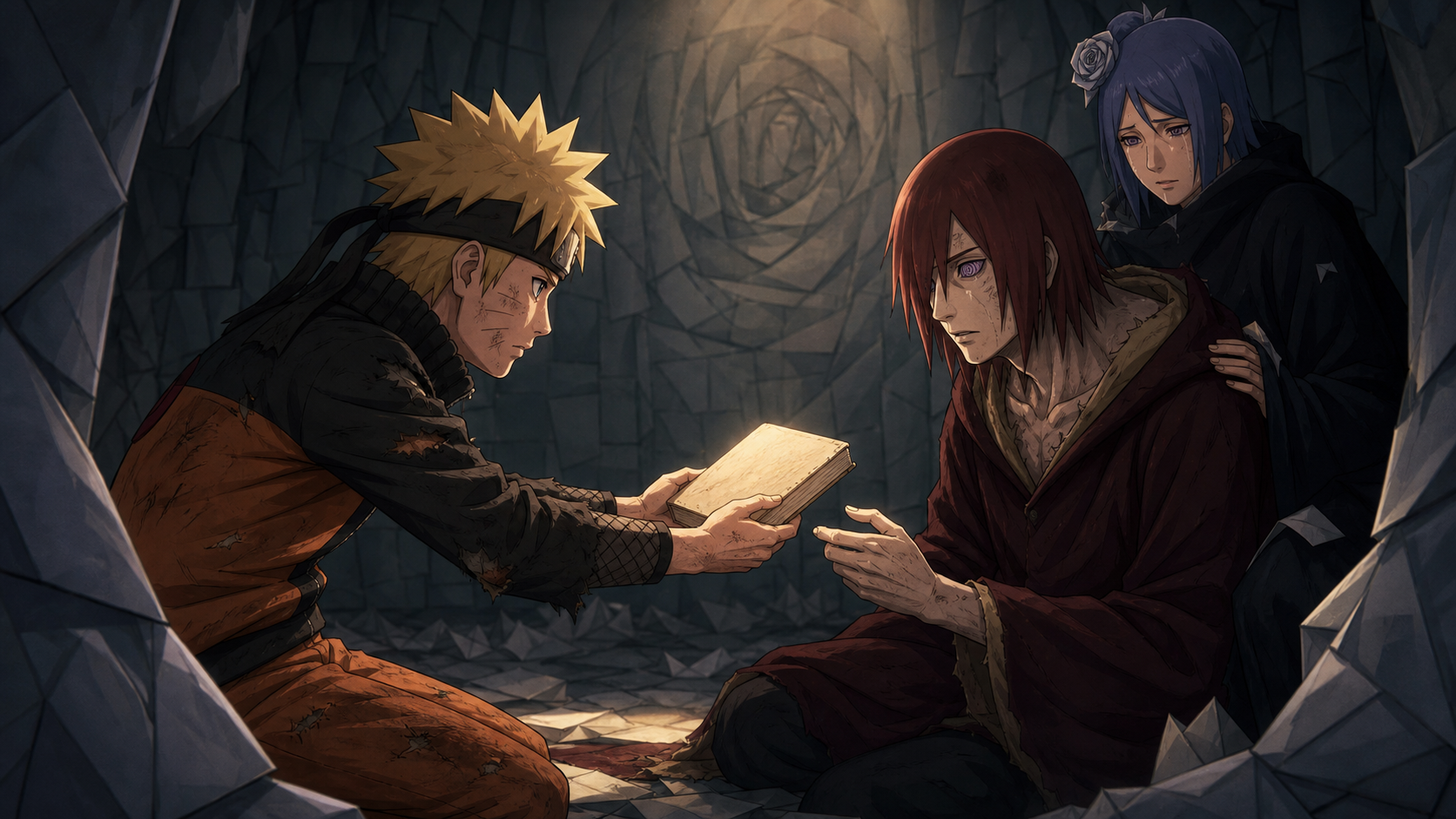
Naruto does not invent a perfect plan. He takes out Jiraiya's first novel and recognizes that its hero carries his name. Nagato remembers that he inspired the character through words he once gave Jiraiya about breaking hatred's curse.
Naruto tells Nagato that he will continue believing in their teacher and will not kill him. He refuses to abandon the promise even while admitting he still does not know how to achieve it. The answer is not certainty. It is a decision about what Naruto will not become.
Silence is Naruto's first honest response
After Nagato finishes his story, Naruto cannot answer immediately. The silence matters because anything quick would be too small for what he has heard. Nagato's parents, Yahiko, the original Akatsuki, Hanzo, and Danzo have all shown how easily a promise of peace can be manipulated or destroyed.
Naruto has spent the arc speaking through action. Here, action has to wait. He cannot punch an argument out of Nagato, and he cannot pretend the Leaf stands outside the history that produced Pain.
The pause is not emptiness. It is Naruto refusing to use confidence as a disguise for not knowing.
Nagato expects Jiraiya's hope to fail twice
Nagato does not mock Jiraiya because the dream meant nothing to him. He mocks it because he once believed it deeply. Hope became dangerous after Yahiko's death because it created the conditions for trust, and trust became the doorway Hanzo used.
From Nagato's perspective, Naruto is repeating the younger version of his own mistake. A student hears Jiraiya speak about understanding and mistakes desire for a method. The world eventually teaches the lesson with blood.
That is why Naruto cannot answer by insisting he is different. Nagato was once different too. Naruto needs a reason not to let future pain transform his promise in the same way.
Jiraiya's book returns an earlier Nagato to the room
The novel is a physical link between the students and their teacher. Jiraiya wrote its hero after listening to Nagato speak about confronting hatred. The words Nagato now rejects helped give Naruto both his name and the story he wants to live.
That loop changes the conversation. Nagato is not facing a stranger who borrowed Jiraiya's ideal. He is facing a person shaped by hope Nagato once contributed to the world.
The book does not prove the ideal will succeed. It proves that Nagato's younger self was not meaningless. His belief traveled farther than his despair expected.
Naruto chooses inheritance without claiming ownership
Naruto does not say Jiraiya's dream belongs to him because he is the better student. He takes responsibility for continuing something both students received.
That humility is important. Nagato has shown him the cost of assuming one person's pain can define peace for everyone. Naruto's answer cannot become another claim to exclusive authority.
He inherits an unfinished task, not a throne. The promise remains open enough for other people's histories to change how he understands it.
Refusing to kill Nagato is a concrete answer
Naruto still lacks a complete theory of peace, but he can decide what happens in this room. Killing Nagato would satisfy revenge, protect the village from one enemy, and confirm Nagato's description of the cycle.
Naruto refuses. The choice does not erase consequences or grant forgiveness. It interrupts the expected sequence between injury and retaliation.
This is where Naruto's answer becomes more than speech. He is close enough to take revenge and chooses not to. Whatever peace means later, it begins with preventing pain from making this decision for him now.
Faith is risky after betrayal
Nagato learned that trust creates vulnerability. Naruto does not disprove that. Trust is still dangerous. Jiraiya trusted the Rain orphans and could not protect their movement. Yahiko trusted negotiations and walked into an ambush.
Naruto's response is not that faith guarantees safety. It is that abandoning faith guarantees a world built only from coercion. Someone has to accept the risk of not controlling the next person through fear.
That makes his promise frightening rather than naive. He is choosing uncertainty over the reliable machinery of revenge.
Naruto's name carries more than family lineage
Minato and Kushina named Naruto after the hero in Jiraiya's book. Episode 174 expands that inheritance beyond blood. Nagato's earlier hope helped inspire the character, Jiraiya wrote it, Naruto's parents believed in it, and Naruto now returns it to Nagato.
The name is a chain of people placing faith in someone who comes after them. It does not make Naruto destined to succeed. It makes him responsible for what he does with belief other people carried before he could understand it.
Naruto's life has become the tale Jiraiya could not finish on the page.
Konan witnesses a different use of loyalty
Konan has remained beside Nagato through the transformation of their movement. She knows loyalty can preserve a person and preserve their worst conclusion at the same time.
Watching Naruto refuse revenge gives her another model. He honors Jiraiya without copying him perfectly. He honors the village without denying its wrongdoing. He recognizes Nagato's pain without accepting Pain's methods.
That flexibility is what their own loyalty lost after Yahiko died. The bond remained, but its meaning could no longer be questioned.
Nagato is asked to believe without proof
Naruto cannot show Nagato a peaceful future. He can only show him a present choice that does not follow the predicted path. Nagato has to decide whether one interruption is enough to risk belief again.
The request is enormous. Pain's entire system is designed to avoid depending on another person's conscience. Naruto offers conscience and a promise, the exact things Nagato considers fragile.
Yet fragility is not the same as worthlessness. The original Akatsuki mattered because people chose it before its success was guaranteed.
Nagato demands a method Naruto does not possess
After laying out war, parental loss, Yahiko’s death, Hanzo’s betrayal, and Danzo’s interference, Nagato asks what Naruto will do differently. It is a fair question sharpened into a trap. If Naruto cannot produce a complete peace plan now, Pain wants uncertainty treated as proof that terror is the only realistic answer.
Naruto refuses to fake expertise. Not knowing everything does not require accepting the worst available certainty.
A quick answer would insult the testimony Naruto just heard
Nagato’s history contains structural violence, personal betrayal, grief, and political manipulation across generations. One inspiring sentence cannot solve it without flattening the people involved.
Naruto’s silence shows that listening changed the problem. He cannot return to the simple answer he might have offered before entering the chamber.
Jiraiya’s book is evidence, not a magic argument
The novel cannot resurrect anybody or prove nations will choose peace. Its power lies in the route it traveled. Nagato’s younger words inspired Jiraiya’s hero, the hero inspired Naruto’s name, and Naruto brings that hope back to the person who abandoned it.
The object proves that belief can outlive the believer’s despair and affect people he never expected to reach.
The fictional Naruto connects four acts of faith
Nagato once described refusing hatred’s curse. Jiraiya shaped that conviction into a protagonist. Minato and Kushina named their son after the character. Naruto grew into someone holding the book before Nagato.
No single person owns the chain. Hope moves through relationship, changes form, and returns carrying responsibilities none of them could complete alone.
Nagato has to confront his own abandoned voice
Pain presents terror as knowledge earned through suffering. The book reminds Nagato that suffering once led him toward a different conclusion. His current certainty cannot dismiss that earlier self as ignorant without explaining why Yahiko trusted that self.
Naruto does not lecture Nagato from outside. He returns Nagato’s own possibility to him.
Yahiko’s legacy belongs in this decision
Nagato preserved Yahiko’s body as the Deva Path and claimed to continue his dream. The living Yahiko built collective support, negotiation, and independence for Amegakure. Pain imposed obedience through catastrophe.
The book forces another comparison between preserving an image and carrying a value. Naruto chooses the unfinished value over the impressive monument.
Naruto admits revenge still feels right
He does not announce that anger vanished because he heard a tragic childhood. Jiraiya remains murdered. Konoha remains destroyed. Nagato’s context explains his decisions without reversing their consequences.
Naruto’s promise matters because he makes it while the desire to kill remains present. Restraint is a choice against a justified feeling, not the absence of one.
Not killing Nagato is a complete action inside an incomplete plan
Naruto cannot describe how every village will end war. He can stop one expected killing in this room. That decision narrows the distance between ideal and practice.
Peace does not begin as a global solution. It begins when somebody with power and reason to retaliate refuses to make retaliation automatic.
Mercy does not erase accountability
Naruto’s refusal to kill is not a declaration that Nagato did nothing wrong or owes nothing to the people harmed. It prevents execution by the most emotionally injured person at the moment of confrontation.
Accountability can require survival, testimony, repair, and choices beyond the clean finality revenge promises.
Forgiveness and interruption are different acts
Naruto says he cannot forgive Nagato. He still interrupts the cycle. Fandom often collapses those positions because forgiveness sounds morally complete and restraint sounds temporary.
The episode understands that a person can protect the future without absolving the past. That distinction makes Naruto’s answer stronger.
Nagato’s ideology avoids dependence on conscience
Catastrophic weapons produce peace through fear whether leaders are compassionate or not. Pain prefers that reliability because people he trusted used vulnerability against him.
Naruto offers the fragile alternative Nagato despises: one person choosing not to exploit power. Fragility does not make the choice meaningless. It makes repetition necessary.
Faith remains dangerous and still necessary
Yahiko trusted negotiation and died in an ambush. Jiraiya trusted students and was killed by one. Nagato has evidence that faith creates openings for betrayal.
Naruto cannot promise safety. He argues through action that a world without trust leaves only coercion, preemption, and permanent preparation for revenge.
Konan watches loyalty become capable of correction
She stayed beside Nagato after Yahiko’s death, preserving relationship while Pain’s methods hardened. Naruto demonstrates another form of loyalty to Jiraiya. He carries the teacher’s hope without pretending every inherited answer was complete.
Love can honor a person by allowing their values to challenge what survivors do in their name.
The promise is powerful because Naruto knows it may fail
He does not guarantee that pain will never change him. Nagato’s story proves good intentions can collapse under enough loss. Naruto promises to keep returning to Jiraiya’s ideal when collapse becomes tempting.
Persistence is not certainty about the road. It is refusing to declare the destination impossible after one route breaks.
Naruto’s answer includes Nagato without surrendering to him
The younger student acknowledges that Nagato’s suffering belongs inside any honest account of peace. He refuses the conclusion that suffering grants Nagato authority to terrorize everyone else.
Understanding becomes a way to expand judgment, not replace judgment with sympathy.
The title moves Naruto from named character to author
He was named after Jiraiya’s fictional hero before he could choose what the name meant. In this chamber, Naruto begins authoring the tale through a decision no parent, teacher, prophecy, or village can make for him.
Inheritance becomes responsibility when the receiver writes the next action.
Jiraiya’s failure does not make his hope worthless
He could not save Yahiko, prevent Nagato from becoming Pain, or finish the answer himself. Those failures expose the limits of his method and the shinobi world he served.
A failed attempt can still generate knowledge, relationships, and language the next person uses differently. Naruto carries a revision, not a flawless doctrine.
RaeRae's reaction
The book broke me because it lets Nagato meet the person he was before Pain. His hopeful words did not vanish when he stopped believing them. They traveled through Jiraiya, Minato, Kushina, and Naruto, then returned to the room in another person's hands.
Naruto's answer works for me because he does not pretend it is complete. He still wants revenge. He still has no political blueprint. He knows that killing Nagato would feel justified, and he decides that justification is not enough.
I do not read this as instant forgiveness. Naruto promises not to kill him. That is a boundary against repetition, not a claim that the damage no longer matters.
The title is exactly right. This is the point where Naruto stops being only the reader of Jiraiya's story and becomes its continuation. The tale is not about a hero who never doubts. It is about someone who reaches the place where another student surrendered hope and chooses to carry it one step farther without knowing where the road ends.
Nagato receives proof that his younger self mattered
Pain’s philosophy requires treating the hopeful orphan as naive and dead. Naruto stands before him because that child’s words survived. They gave a fictional hero a name, parents a reason to choose that name, and a real boy language for refusing despair.
Nagato’s past is not erased by what he became. It remains capable of questioning him.
RaeRae’s final word on Tale of Naruto Uzumaki
The book is not a cure, and I am glad the episode does not make it one. Paper cannot repair Konoha or return Yahiko. It can place Nagato’s abandoned belief back in his hands.
Naruto’s answer is deliberately incomplete. He has no treaty, no institution, and no guarantee that future grief will not break him. He has one decision available now, and he refuses to kill.
That is not instant forgiveness. It is the opposite of emotional dishonesty. Naruto names his anger, keeps the dead present, and prevents justified pain from becoming permission for another automatic death.
The tale becomes his when he accepts an unfinished promise without claiming he already knows the ending. Jiraiya could not solve peace. Nagato surrendered it. Naruto chooses to keep writing while uncertainty is still frightening.
The episode separates hope from optimism
Optimism would tell Naruto that everything will work because his intentions are pure. Hope lets him admit the road may fail, people may betray him, and pain may tempt him toward the same conclusion Nagato reached. He continues anyway because surrendering the possibility guarantees a world organized by fear.
That distinction matters after Yahiko. The original Akatsuki did not fail because its members cared too much or because negotiation was childish. Powerful men deliberately destroyed a movement that threatened their control. The betrayal exposes the need for stronger structures around trust, not proof that trust itself was the mistake.
Naruto has no blueprint for those structures yet. His honesty about that absence protects him from becoming another leader who disguises domination as certainty. He can commit to learning without claiming authority over every community his future choices will affect.
The book also challenges the way stories simplify heroes. Jiraiya wrote a protagonist capable of breaking hatred’s curse. Real Naruto stands in front of consequences no fictional ending had to administer. He must translate an ideal into action while victims, perpetrators, institutions, and incomplete information remain present.
He begins with the scale he can govern: his own hand, his own rage, and the person within reach. Refusing to kill Nagato does not end war. It prevents Naruto from using the absence of a global solution as permission to repeat the local harm he understands.
Nagato’s response requires humility too. He has spent years turning personal pain into a universal theory and using immense power to force everybody inside it. Naruto’s decision offers contrary evidence. One person experiences devastating loss and does not complete the predicted retaliation.
Contrary evidence does not erase Nagato’s history. It makes certainty harder to maintain. Pain’s philosophy depends on inevitability because inevitability excuses the choices used to enforce it. If another choice exists, Nagato must face what he did as a decision rather than fate.
Konan witnesses that opening. She knows the child who supplied Jiraiya’s hero with conviction and the adult who buried that conviction beneath six bodies. Naruto places both versions in the same room and refuses to discard either one.
This is why the title belongs to Naruto without stealing Nagato’s contribution. Naruto’s tale contains voices from people who failed, believed, harmed, loved, and tried before him. He becomes the author by deciding how those voices shape the next page, not by pretending he wrote the story alone.
Naruto offers no painless ending. Nagato must still face the people he harmed, and Naruto must return to a village whose love does not erase its role in Amegakure’s history. The promise only establishes that neither man will use those truths to make the next death automatic. That is modest beside Planetary Devastation and radical beside the shinobi world’s habits. Jiraiya’s hero was never valuable because he possessed a secret answer. He was valuable because he kept searching after easy certainty failed. Naruto accepts that burden with anger intact, grief unresolved, and no guarantee of success. The tale moves forward because he chooses an unfinished responsibility over the finished logic of revenge, leaving Nagato to decide whether his own younger voice deserves to live again right now.
RaeRae’s call
Naruto returns Nagato’s own hope through Jiraiya’s book. He cannot forgive, cannot promise a finished solution, and still refuses the killing that Pain expected his grief to choose.