
The Eight-Tails vs. Sasuke
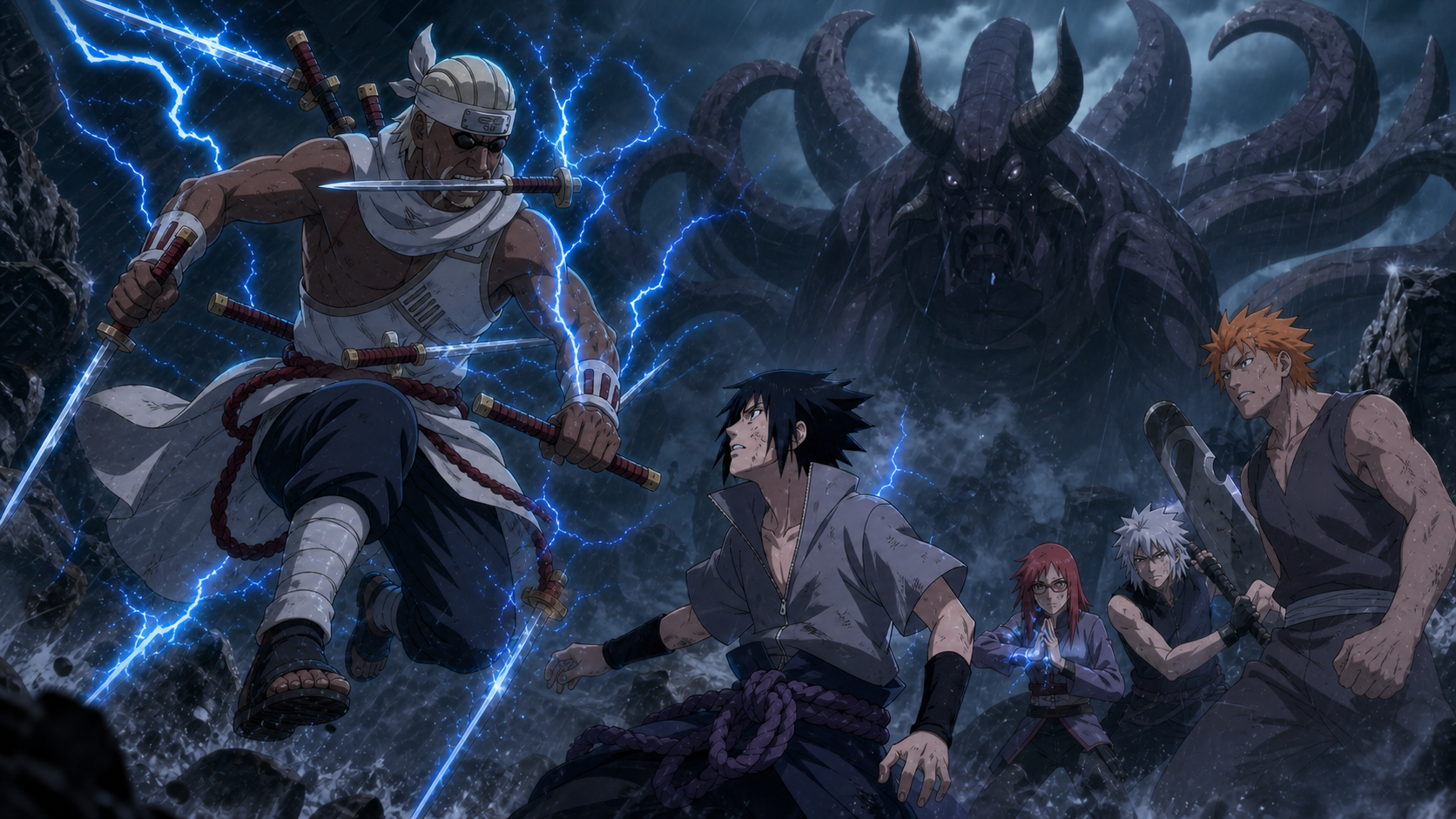
Killer Bee turns seven blades and a perfect jinchuriki bond into a brutal correction, forcing Taka to become a team before Sasuke can claim victory.
What happens
Taka confronts Killer Bee at Unraikyo, expecting an Akatsuki capture mission. Bee answers with an unpredictable Seven-Sword style, placing blades across his limbs and body while channeling Lightning Style through attacks that refuse Sasuke's normal reading of rhythm.
Sasuke is cut down early. Karin uses her healing ability, Suigetsu intercepts attacks with the Executioner's Blade, and Jugo transfers part of his own flesh to repair the damage from Bee's devastating Lariat.
Sasuke attempts to end the fight with Sharingan genjutsu, but Bee's partnership with the Eight-Tails lets the beast disturb his chakra and break the illusion. Bee then releases more of Gyuki's power until the complete ox-octopus form dominates the ravine.
Seeing Taka risk themselves for him reminds Sasuke of Team 7. He awakens Amaterasu against the Eight-Tails, controls the black flame long enough to save Karin, and appears to capture Bee, unaware that the jinchuriki has escaped through a severed tentacle substitution.
Killer Bee breaks Sasuke's visual advantage
Sasuke is accustomed to using the Sharingan to read movement, anticipate attacks, and convert an opponent's body into a pattern. Bee's Seven-Sword method overwhelms that process with angles that do not resemble conventional swordsmanship.
The blades are held at multiple contact points, and Bee changes rotation, range, and direction without settling into a familiar stance. His rhyming makes the performance look unserious, but the control beneath it is exact.
Sasuke can see the attacks and still struggle to organize what he sees quickly enough. That distinction matters. Superior perception is not the same as prior understanding.
Bee wins the opening exchange by presenting skill Sasuke's confidence has not accounted for.
Taka becomes a team under pressure
Sasuke assembled Hebi because each member provided a useful ability. This fight forces the renamed Taka to operate as more than a collection of specialists.
Karin tracks chakra and provides emergency healing. Suigetsu places his water-based body and enormous sword between Bee and the others. Jugo gives up part of his own physical substance to rebuild Sasuke after the Lariat.
Their responses are not abstract declarations of loyalty. Each person accepts direct risk when Sasuke's plan fails.
That makes the battle emotionally uncomfortable in a useful way. Sasuke has just committed himself to a path of destruction, yet the people beside him keep demonstrating bonds that resist his attempt to reduce life to revenge.
A perfect jinchuriki changes the rules of genjutsu
Sasuke's illusion briefly catches Bee, but the Eight-Tails is a conscious partner rather than a silent source of chakra. Gyuki can recognize the interference and disrupt Bee's chakra from within.
The counter reveals a kind of cooperation Taka did not expect. A jinchuriki and Tailed Beast working together can cover vulnerabilities that would be fatal for an isolated fighter.
This is the opposite of Akatsuki's framing, which treats Bee as a container to be extracted. His strength comes partly from relationship, conversation, and mutual response.
Sasuke approaches with a team but initially fights as though individual superiority will decide the mission. Bee's partnership exposes that mistake.
Lariat makes the cost physical
Bee's Lariat nearly tears Sasuke apart. The attack removes any remaining illusion that this mission is a controlled demonstration of Taka's new status.
Jugo's repair is especially significant because it transfers life and body rather than simply applying a technique from a safe distance. Sasuke survives because another person gives up part of himself.
That sacrifice echoes the story Sasuke has just heard about Itachi, though on a smaller and more immediate scale. Again, someone absorbs a cost so Sasuke can continue.
The difference is visibility. Jugo's choice happens in front of Sasuke, leaving less room to rewrite it later as indifference.
Team 7 returns as an involuntary memory
When Sasuke sees Karin, Suigetsu, and Jugo protecting one another, Team 7 flashes through his mind. The memory appears without permission, interrupting the identity he is trying to build.
He has insisted that old bonds were severed, yet his emotional understanding of teamwork still comes from Naruto, Sakura, and Kakashi.
Taka does not replace Team 7 cleanly. It activates the part of Sasuke shaped by that earlier belonging.
The moment does not reverse his decision about Konoha, but it shows that revenge has not erased his capacity to recognize care. That recognition influences how he responds when Karin is endangered by his own black flames.
Amaterasu becomes protection and capture
Sasuke's use of Amaterasu connects him directly to Itachi's power while changing its immediate purpose. The black flame attacks the transformed Eight-Tails, but Sasuke also manipulates it to prevent Karin from being consumed.
That act matters after Tobi's revelation. Sasuke is not merely inheriting a weapon; he is beginning to use it inside his own choices about who must survive.
The apparent victory is still deceptive. Bee uses a severed tentacle to create an escape, allowing Taka and Akatsuki to believe the jinchuriki has been captured.
Sasuke ends the mission with a body-shaped result but without understanding the person who outmaneuvered him.
Bee refuses to become a supporting character in Sasuke’s tragedy
Taka arrives with enormous emotional stakes and assumes those stakes establish the importance of the mission. Bee does not care. He has his own goals, relationships, art, responsibilities, and appetite for freedom.
That refusal is healthy. Sasuke’s pain explains why he came, but it does not give him narrative ownership over the person he intends to capture.
The notebook is a power move before the swords appear
Bee pauses to record lyrics while armed strangers identify him as their target. The gesture says their intimidation has not earned his full attention.
It also establishes creativity as part of his combat rhythm. Rhyming is not decoration pasted onto a fighter. Bee organizes timing, identity, and pleasure through language even when the situation turns lethal.
Seven-Sword Style defeats prediction through disciplined weirdness
The blades occupy joints, limbs, mouth, and body angles that conventional training rarely rehearses. Sasuke’s Sharingan receives abundant information but lacks the learned model needed to translate it instantly.
Bee proves unpredictability is not randomness. He built a repeatable system so unusual that an elite observer cannot rely on familiar categories.
Sasuke’s perception is excellent and still insufficient
The Sharingan can track motion, but seeing a blade begin its path does not guarantee the body can answer seven simultaneous threats. Processing, physical position, and prior experience still matter.
That limit protects the eye from becoming magic certainty. Ability expands what Sasuke can notice; it does not make every noticed problem solvable.
Taka’s first real battle exposes the difference between assembly and trust
Sasuke recruited each member for a skill. Bee forces those skills into an emergency network where one person’s delay becomes another person’s death.
The team survives because members respond before a formal plan exists. Utility begins turning into attachment through action.
Karin’s healing makes dependence unavoidable
Sasuke cannot posture his way past the wounds Bee inflicts. He must receive Karin’s chakra and acknowledge that his body continues because another person provides access to hers.
The scene carries uncomfortable power dynamics, but it also destroys the fantasy that Sasuke’s new path rests on solitary strength.
Suigetsu’s defense is more loyal than his sarcasm admits
He can mock the mission and still place himself between overwhelming force and the team. His fluid body offers unusual resilience, not immunity.
Standing against the transformed Eight-Tails with the Executioner’s Blade turns personality into commitment. Suigetsu complains and remains.
Jugo’s body transfer makes sacrifice literal
He gives Sasuke flesh and energy after Lariat tears through him. The rescue is not symbolic support. Jugo becomes smaller so Sasuke can become whole enough to continue.
Sasuke has just learned that Itachi spent himself for a brother. Jugo repeats the pattern openly, giving Sasuke a chance to recognize sacrifice before death hides its meaning.
Lariat is the correction Sasuke’s confidence needed
Bee does not narrowly outscore him. The attack demonstrates that Sasuke entered without understanding the target’s speed, partnership, durability, or combat culture.
The wound forces humility through the body. Taka’s mission briefing reduced Bee to a retrieval task, and Bee answers by nearly ending the person who accepted it.
Gyuki and Bee model cooperation rather than containment
The Eight-Tails speaks, observes, warns, and disrupts the genjutsu. Bee listens without disappearing inside the beast. Their partnership preserves both voices.
Akatsuki sees a vessel and its contents. The episode shows a relationship whose shared agency produces the strength Sasuke fails to anticipate.
RaeRae reaction
Killer Bee's entrance is one of the best corrections to Sasuke's confidence. He is funny because he chooses to be, not because he lacks danger, and the seven blades make his skill impossible to dismiss.
I also appreciate how thoroughly Taka has to save Sasuke. Karin's healing, Suigetsu's defense, and Jugo's physical sacrifice prove that the group already contains more mutual attachment than Sasuke's cold mission language admits.
The Team 7 memory is brief but honest. Sasuke can rename a team and announce a new target, yet he cannot prevent care in the present from recalling care in the past.
The apparent capture is exactly the kind of victory this stage of Sasuke's story deserves: spectacular, expensive, and incomplete. Taka survives because they cooperate. Bee escapes because his partnership with Gyuki is even deeper. The real contest is not just whose technique is stronger, but whose bonds can respond when the plan breaks.
Genjutsu fails because Bee is not alone inside himself
Sasuke attacks individual perception. Gyuki recognizes the disturbance and restores the chakra flow from a position the illusion cannot isolate.
The counter is emotional architecture made tactical. A trusted partner can reach Bee where an external teammate could not intervene quickly enough.
Team 7 returns when Taka behaves like people rather than tools
Sasuke remembers Naruto, Sakura, and Kakashi because Karin, Suigetsu, and Jugo risk themselves without calculating whether his survival remains useful.
The memory exposes how deeply Team 7 shaped his definition of care. He can reject the village and still carry those people as the standard by which present loyalty becomes legible.
Remembering care does not automatically repair how Sasuke gives it
The flash tells us he recognizes the bond. It does not mean he has stopped assigning goals, withholding context, or asking others to enter danger for his revenge.
Emotional recognition is a beginning. Ethical relationship requires reciprocity after the crisis ends.
Saving Karin from Amaterasu matters because Sasuke caused the danger
The black flame catches her during his attack. Sasuke controls it enough to prevent her death, showing technical growth and immediate concern.
Rescue does not erase responsibility for choosing a weapon that endangered the team. Care includes saving someone and learning from how one’s own action placed them at risk.
Inheriting Itachi’s flame does not require inheriting Itachi’s control
Sasuke receives Amaterasu alongside grief and a revised understanding of his brother. The technique carries emotional weight, but he decides how to use it.
Directing the flame away from Karin hints at a different possibility: power associated with family violence can be controlled in service of someone else’s survival.
Bee’s full transformation changes the scale without erasing character
The ox-octopus form is enormous, but the personality inside it remains the man who wrote rhymes and coordinated with Gyuki. Transformation expands Bee rather than replacing him.
That continuity is why the jinchuriki framing fails. The beast and human cannot be reduced to separable inventory without destroying a working relationship.
The tentacle substitution is a victory for freedom, not cowardice
Bee recognizes an opening to escape both Taka and the surveillance surrounding his ordinary life. He lets the attackers believe the mission succeeded.
Outthinking capture preserves his body and creates room to pursue desire on his own terms. A target owes kidnappers no honest conclusion.
Taka learns teamwork while performing organized abduction
Their mutual sacrifice is genuine. The mission remains an attempt to deliver a person to an organization that will extract his beast and kill him.
Good bonds inside a group do not automatically make the group’s work good. The episode lets loyalty and wrongdoing occupy the same action sequence.
Sasuke’s trauma explains the tunnel without excusing the target
He is grieving, manipulated, and desperate to move. Bee did not kill the Uchiha, command Itachi, conceal the massacre, or recruit Sasuke.
Accountability begins by refusing to make the nearest available body pay for a system’s distant crime.
Bee is what a supported jinchuriki can become
Naruto spent childhood treated as contamination, while Bee built an active partnership with the being sealed inside him and retained meaningful connection to his brother and village. Neither life is painless, but the difference in support changes what power can become.
Gyuki is not only emergency chakra. He is a second perspective able to interrupt isolation. Bee’s defense against genjutsu grows from relationship, not domination.
The battle exposes why Akatsuki’s language is politically useful
Calling Bee the Eight-Tails compresses two thinking beings into one collectible unit. It removes the need to discuss consent, kinship, citizenship, or the death caused by extraction.
Taka can complete a capture more easily if the target remains a label. Bee’s personality makes the label impossible to maintain without deliberate moral numbness.
Sasuke briefly recognizes community while attacking somebody else’s
Team 7 flashes through his mind because Taka’s sacrifice restores a feeling of belonging. At that same moment, he is trying to sever Bee from Gyuki and from the Cloud relationships waiting beyond the ravine.
The contradiction is not subtle, and it should not be. Pain can sharpen a person’s understanding of their own need while leaving another person’s need outside the frame.
Jugo’s sacrifice deserves consent after the emergency
In crisis, he chooses to repair Sasuke because losing him would devastate the team. The act carries love and significant bodily cost.
If Taka wants to become a real community, Sasuke must value that cost after he can stand again. Receiving sacrifice creates responsibility, not entitlement to the next sacrifice.
Karin is more than the healing station the battle requires
Her sensory ability and chakra keep Taka alive, but reducing her to those functions repeats the instrumental logic surrounding every body in the arc.
Sasuke saving her from Amaterasu acknowledges a person beyond utility. The team needs that recognition when nobody is actively dying too.
Suigetsu proves fear and courage can share a sentence
He understands the transformed Eight-Tails is beyond anything the plan anticipated. He still raises the Executioner’s Blade and buys the others time.
Courage is not ignorance of danger. It is a choice made with enough knowledge to be scared. His sarcasm never cancels that commitment.
Bee escapes by exploiting the captors’ desire for a clean result
Taka wants proof the mission is complete, and a severed tentacle shaped by transformation provides it. They verify the object they expect rather than the person they failed to understand.
The deception works because Akatsuki taught them to think in cargo. Bee uses that dehumanizing assumption as the door to freedom.
The part I refuse to romanticize is Sasuke discovering teamwork while the team is kidnapping someone. Emotional growth does not automatically produce ethical growth. He remembers Team 7, protects Karin, depends on Jugo, and trusts Suigetsu. Those are meaningful movements away from total isolation. They occur inside a mission that would kill Bee if completed honestly. The episode is strong enough to hold the contradiction without asking us to call the entire operation redemptive.
Bee’s escape also protects the comedy from becoming decoration. His rhymes, notebook, and casual disrespect create the impression that he refuses seriousness, yet he has been reading everyone while they underestimate him. The severed tentacle is the final line of the joke, and Taka is the audience that realizes too late it misunderstood the setup. Bee preserves his life and steals space from the obligations surrounding him without giving his captors the dignity of knowing they lost.
Sasuke will leave believing Amaterasu and teamwork secured a victory. What he actually gained was a warning. Elite vision can be confused by unfamiliar form. Genjutsu can fail against an internal partner. Individual strength can collapse without a team. A target can use the captor’s categories against the captor. If Sasuke absorbs those lessons beyond technique, this defeat could challenge the way Tobi taught him to see people. If he learns only how to hit harder next time, Killer Bee’s freedom will remain the smartest outcome on the mountain.
And Naruto remains the echo Sasuke cannot hear. Another jinchuriki stands before him with the confidence and partnership Naruto was denied as a child. Capturing Bee should remind Sasuke what institutions tried to make Naruto become: a useful weapon stripped of personhood. The fact that it does not stop the mission shows how thoroughly grief has narrowed his empathy without destroying it completely.
RaeRae’s final word on Bee versus Sasuke
Bee wins me before the transformation because he refuses to accept Taka’s seriousness as authority. He writes, rhymes, moves strangely, and then demonstrates that every bit of apparent foolishness belongs to disciplined control.
Sasuke needed this correction. He arrived newly famous, newly furious, and surrounded by people willing to follow. None of that meant he understood the man Akatsuki called a target.
Taka’s rescues are beautiful and morally uncomfortable. Karin heals, Suigetsu blocks, and Jugo gives his body so Sasuke can continue an abduction. Love inside the team does not clean the mission.
The apparent victory belongs to Bee because he protects the partnership Taka came to tear apart and creates his own exit. Sasuke discovers that bonds can save him. Bee demonstrates that bonds can also refuse him.
RaeRae’s call
Killer Bee defeats Taka’s assumptions before he defeats their bodies. Seven blades punish Sasuke’s confidence, while Bee and Gyuki prove partnership is stronger than the container logic Akatsuki brought to Unraikyo.