
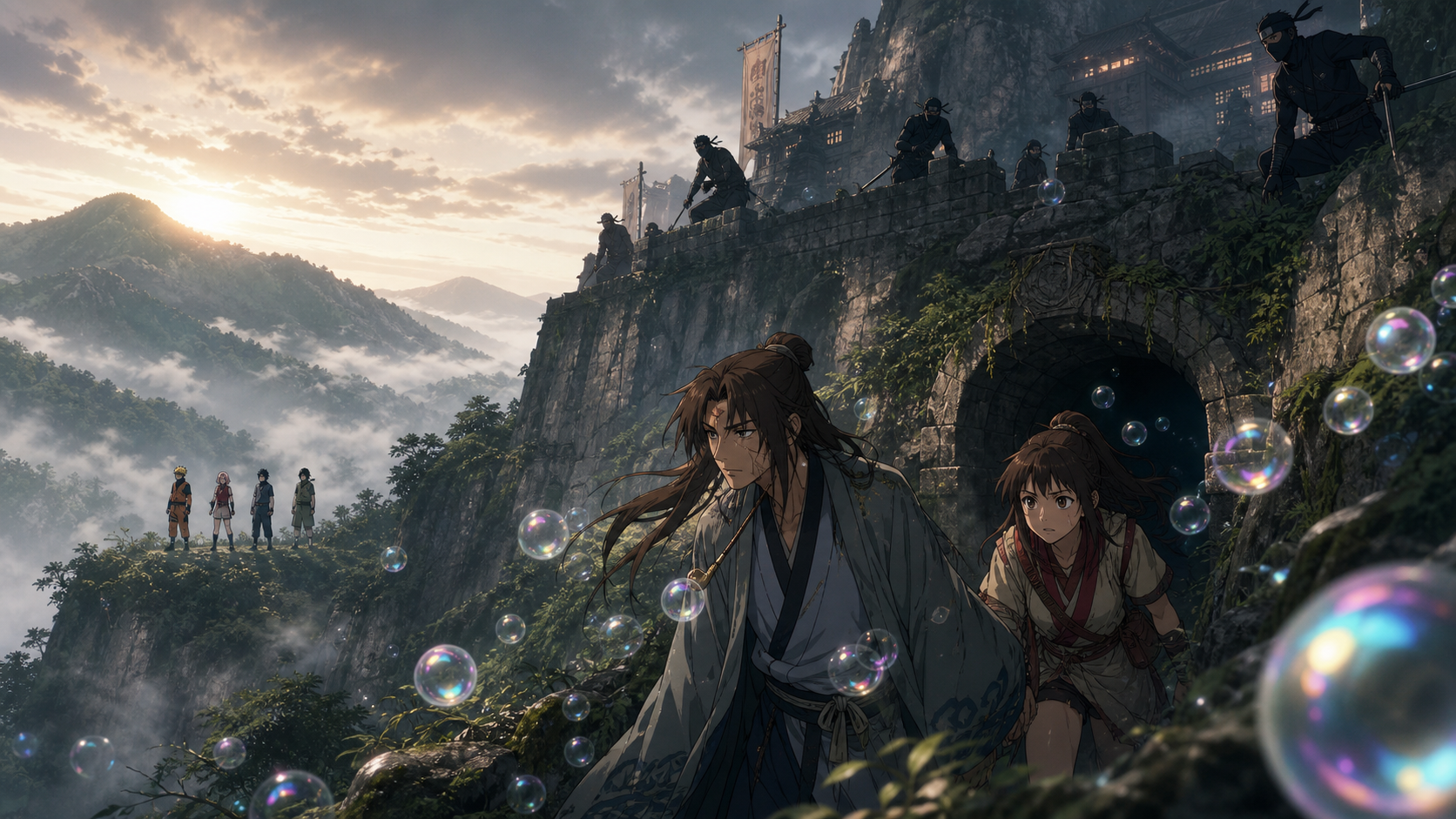
Wanderer
An old promise draws Naruto into Hotaru’s inherited danger while Utakata protects her through distance, bubbles, and a road he refuses to call belonging.
What happens
After failing to recover Sasuke or capture Itachi, Naruto, Sakura, Sai, and Yamato begin returning to the Leaf. An urgent message redirects them to a Tsuchigumo Clan fort under an old treaty made by the Third Hokage and the clan leader En no Gyoja.
En no Gyoja created a technique dangerous enough to be classified as forbidden. In exchange for banning its use, the Leaf promised aid if the clan or its inheritance came under threat.
At the fort, Tonbei recognizes that attackers are closing in and sends En no Gyoja's granddaughter Hotaru through a secret route. Her escort is Utakata, an aloof wanderer whose bubble techniques and guarded behavior suggest a past he does not want discussed.
The Leaf team reaches the fort after Hotaru has left. Naruto's pursuit of one distant person gives way to a mission protecting another young person whose future has been shaped by power inherited before she could choose its consequences.
An old promise becomes a present obligation
The Third Hokage's treaty matters because it turns historical trust into action after the people who made the agreement are gone. Tsunade does not treat it as optional simply because the crisis belongs to a small clan in a remote place.
The bargain also acknowledges the danger of the forbidden technique. The Leaf asked En no Gyoja to restrain power that could destabilize far more than his own community. In return, the village accepted responsibility for helping protect the people left with that burden.
That reciprocity distinguishes the mission from simple acquisition. The objective is not to claim the technique for Konoha but to honor the conditions under which it was set aside.
Promises between institutions become meaningful only when later leaders still carry them.
Hotaru inherits danger before authority
Hotaru is En no Gyoja's granddaughter, which makes her important to both loyal retainers and enemies seeking the forbidden technique. Her lineage gives her symbolic status without automatically giving her control over the forces gathering around her.
This is a familiar problem in Naruto: young people inherit names, abilities, and political expectations long before they receive enough information to evaluate them.
Hotaru's danger does not begin with a decision she made. It begins with what other people believe she contains, knows, or represents.
Tonbei's decision to send her away protects her body, but it also keeps the truth of her inheritance moving through secrecy and flight.
Utakata protects through distance
Utakata escorts Hotaru, yet he resists the language of teacher and student. His manner is detached, and he treats continued movement as safer than attachment.
The bubbles complicate that distance. They look fragile and gentle, but they can conceal, transport, misdirect, and defend. The technique suits someone whose calm exterior hides substantial power.
Hotaru appears to trust him more deeply than he is willing to name. That imbalance gives their journey emotional tension before the Leaf team catches up.
Utakata may reject formal responsibility, but accepting the escort already places him inside Hotaru's survival. His actions say more than the title he refuses.
Naruto carries the failure forward
The episode begins with Naruto leaving the Uchiha hideout without Sasuke. The search has ended, but Naruto does not receive time to resolve the frustration before a new assignment arrives.
That transition could make the Tsuchigumo mission feel like a distraction. Instead, it shows the ongoing nature of village duty. Naruto's personal pain remains real while another person still requires help.
Hotaru's situation also touches themes Naruto understands: being defined by dangerous power, watched by people who want to use it, and protected through decisions made by adults.
He does not know those parallels yet, but they make this mission more connected to his life than its remote location first suggests.
The fort is already an aftermath
When the Leaf team arrives, the fort is not a secure destination waiting for reinforcements. Tonbei has already made the necessary choice, Hotaru is gone, and the attackers have forced the mission into pursuit.
That structure repeats the frustration of the Uchiha hideout in a smaller way. Naruto reaches a place and finds that the person he needs has moved beyond it.
The difference is that this trail is still warm and the outcome is not complete. The team can act before Hotaru's story hardens into another irreversible loss.
The episode therefore converts “too late” from a conclusion into motivation.
A wanderer is someone between identities
The title points most directly to Utakata, who lives outside a stable village role and avoids the bond Hotaru wants to name. But several characters are between identities here.
Hotaru is leaving a protected fort without yet understanding what kind of successor she will become. Naruto is returning from a failed rescue while still defining what persistence means after another setback.
Even the Leaf team moves between missions without returning home. Their route changes because responsibility interrupts closure.
Wandering is not simple aimlessness. It can be the condition of people who know what they are leaving but have not chosen where belonging will settle next.
A quieter arc does not mean a smaller moral problem
The story leaves Mangekyo revelations and giant Tailed Beast combat for a treaty, a remote clan, and a girl moving through hidden tunnels. The scale contracts so responsibility becomes easier to see.
Konoha made a promise because it benefited from En no Gyoja restraining catastrophic power. Keeping that promise after his death tests whether the village treats cooperation as relationship or temporary convenience.
The treaty records mutual obligation instead of ownership
En no Gyoja agrees not to use the forbidden technique. Konoha agrees to protect the clan if enemies exploit the vulnerability created by restraint.
The village does not own the jutsu because it helped contain the danger. That boundary matters after an arc filled with institutions treating bloodlines, eyes, and jinchuriki as resources.
Tsunade honors a commitment she did not personally make
Institutional integrity depends on successors carrying obligations as seriously as benefits. The Third Hokage is gone, but the clan’s risk did not vanish with him.
Tsunade’s response says leadership is stewardship across time. A promise cannot expire merely because the person who gave it is no longer available to feel shame.
Hotaru inherits other people’s fear before she inherits knowledge
Enemies pursue her because of what they believe her grandfather left behind. Loyal retainers move her because of the same belief. Everyone’s plan begins with her relationship to power.
Her own understanding arrives later than the danger. That imbalance makes lineage a trap: responsibility attaches before informed authority.
Tonbei protects Hotaru by trusting movement over fortification
The fort carries history and symbolic safety, but remaining there would let attackers define the battlefield. The secret route preserves possibility.
Sending Hotaru away is painful because protection becomes separation from the place built to shelter her. Tonbei chooses the living person over the institution’s walls.
Utakata’s bubbles make fragility strategically useful
Bubbles appear temporary, delicate, and almost playful. In his hands they scout, conceal, carry, distract, and defend.
The technique fits a wanderer who survives without announcing permanence. What looks easy to break can move around force instead of meeting it where force expects resistance.
His refusal of the master title does not erase the relationship
Hotaru asks for recognition. Utakata answers through distance, correction, and a refusal to name himself her teacher. Yet he escorts her through danger and monitors her safety.
Actions create responsibility even when language resists it. He cannot receive her trust while pretending the bond has no claim on him.
Distance can be a trauma response disguised as independence
Utakata treats wandering as protection from obligations and from people who might become dangerous through closeness. That strategy may keep old wounds from reopening.
It also transfers uncertainty to Hotaru, who experiences care without assurance that the person giving it will remain. Avoiding abandonment by leaving first still creates abandonment for somebody else.
Naruto understands being valuable for what is sealed inside
He does not yet know Hotaru’s full burden, but the shape of the danger is familiar. Outsiders see access to destructive power before they see the young person carrying consequences.
That shared structure gives the mission emotional relevance beyond orders. Naruto knows protection can become another form of control if nobody asks what the protected person wants.
The failed Sasuke search changes how this pursuit feels
Naruto has just reached one empty site after the person he loves was taken elsewhere. Arriving at the Tsuchigumo fort after Hotaru leaves repeats the visual wound.
This time, movement is not proof of irreversible failure. The trail remains active, and intervention may still reach the person before someone else authors the outcome.
RaeRae reaction
I like the restraint of this arc opener. After several episodes of massive Uchiha revelations and Tailed Beast combat, the story returns to an old promise, a mountain fort, and two people moving quietly through mist.
The Third Hokage's treaty gives the mission moral weight without requiring immediate spectacle. Konoha benefited from En no Gyoja's restraint, so the village owes protection when that restraint creates vulnerability.
Utakata is interesting because his behavior contradicts his language. He may not want to be called a master, but he accepts the lonely, dangerous work of guiding Hotaru away from the people hunting her.
Naruto arriving after she has left creates a useful echo of Sasuke without repeating the same outcome. This time, he still has a chance to reach the person in motion. “Wanderer” begins as a detour, but it is really another story about what happens when inherited power makes a young life valuable to everyone except as a life of its own.
Naruto carries grief into duty without resolving it
The village sends another mission before he can metabolize failing to recover Sasuke. Work becomes continuity when personal closure is unavailable.
That can be resilience and avoidance at the same time. Helping Hotaru matters, but usefulness should not become the only condition under which Naruto is allowed to keep moving.
Sakura, Sai, and Yamato also cross the mission boundary tired
The team has spent days tracking, fighting, analyzing, and hoping. Redirecting them immediately asks professional discipline from people carrying disappointment.
Their ability to respond should not make exhaustion invisible. Competence is often used as permission to demand more before anyone receives care.
The fort functions as an archive of an agreement under attack
Its location, defenses, retainers, and secret route preserve the history of a clan that accepted limits on its own power. Attackers see storage rather than relationship.
When the Leaf arrives, protecting that archive means protecting living people, not merely securing a technique or document.
Forbidden power creates responsibility far beyond its inventor
En no Gyoja recognized that creating something does not guarantee the wisdom to use it safely. Restraint became part of his legacy.
Later generations inherit both capability and the enemies capability attracts. Ethical invention requires plans for the people forced to carry its aftermath.
Hotaru deserves more than being transported between protectors
Tonbei sends her away, Utakata guides her, and Konoha moves to recover her. Each choice may be necessary in immediate danger.
The longer question is whether anyone will give her information and authority rather than treating safety as a route adults choose around her.
The rogue ninja pursue access, not the clan’s survival
They understand the forbidden technique as portable advantage. The community that developed and restrained it becomes an obstacle around the prize.
This is extraction logic again: separate power from the people who carry its history, then call possession proof of deserving it.
Wandering can preserve freedom and prevent belonging
Utakata’s mobility keeps villages, hunters, and old relationships from fixing him in place. It also makes every bond provisional before the other person agrees to that condition.
Freedom becomes lonely when safety requires never letting care develop expectations.
Hotaru’s trust challenges Utakata’s preferred self-description
He calls himself unattached. She experiences him as the person who teaches, protects, and returns. Her interpretation does not force him into a title, but it reveals consequences his language avoids.
Identity is partly what we choose and partly what our repeated actions mean to people depending on us.
The arc begins with parallel promises
Konoha owes the Tsuchigumo Clan aid because of an old treaty. Utakata owes Hotaru honesty because his continued protection encouraged trust.
One promise is formal and one is relational. Both ask whether people will accept responsibility after the original moment of agreement becomes inconvenient.
A promise made to a small clan tests the village more honestly
Powerful allies can enforce agreements through consequence. The Tsuchigumo Clan depends on Konoha remembering an obligation after attention has moved elsewhere.
Honoring the treaty when nobody famous is watching reveals whether the village’s word is principle or branding. Duty becomes credible through the quiet commitments that produce no immediate prestige.
The Third Hokage’s agreement contains a better model of restraint
He recognizes dangerous power, negotiates nonuse, and attaches protection to the vulnerability restraint creates. That is more ethical than seizing the technique or eliminating everyone associated with it.
The model is imperfect, but it treats the clan as a partner capable of agreement. After the Uchiha history, that difference lands hard.
Hotaru’s secrecy protects her while increasing her isolation
A hidden route keeps pursuers from locating her. Limited information also means she cannot fully judge who is safe, why the technique matters, or what choices remain.
Security sometimes requires secrecy in the moment. It becomes harmful when emergency withholding hardens into the permanent structure of a young person’s life.
Utakata’s refusal sounds different when Naruto is nearby
Naruto understands unwanted bonds and desperate promises. He also knows the damage caused by teachers and institutions deciding distance is safer than truthful connection.
Watching Utakata deny the master relationship while performing its duties will press on Naruto’s belief that actions create bonds people cannot dismiss through vocabulary alone.
The bubble motif resists the idea that strength must look hard
Shinobi power often announces itself through blades, stone, flame, lightning, and impact. Utakata works through floating surfaces that reflect light and burst.
The softness is not weakness. It expands the visual language of competence and makes opponents underestimate a defense built around movement rather than collision.
Naruto’s second pursuit carries knowledge from the first
He could not reach Sasuke before Tobi controlled the aftermath. That failure may make him more attentive to who reaches Hotaru first and who gets to frame her inheritance.
Persistence grows when experience changes method. Repeating the chase without learning would turn devotion into ritual.
Belonging should not require surrendering mobility
Utakata acts as though attachment will trap him, while Hotaru acts as though naming him master will make him stay. Both fear losing control through the relationship.
A healthier bond would allow departure, return, honesty, and negotiated responsibility. Permanence is not the only proof that care exists.
The detail I want held at the center is that Hotaru did not create the conditions making her dangerous. She inherited a name, a technique, a treaty, loyal protectors, and determined enemies. Adults may call that legacy, but legacy feels different when somebody else can kill you for carrying it. Respecting her grandfather cannot mean asking her to disappear beneath his decisions.
Utakata understands the urge to move before another institution fixes a label onto the body. His wandering contains real wisdom about coercive belonging. The problem is that he extends freedom to himself while leaving Hotaru uncertain about the relationship she already experiences. Refusing a title does not automatically prevent dependency. Honest boundaries would tell her what he can offer, what he cannot, and why distance matters to him.
Naruto enters this story after watching Sasuke vanish into another person’s explanation. He is uniquely positioned to recognize that rescue requires more than locating a body. Hotaru needs safety, but she also needs access to the history determining who hunts her. Utakata needs freedom, but he also needs to acknowledge the consequences of repeated care. Konoha needs to honor its treaty, but honoring it must not become a claim over the forbidden technique.
That combination is why the quiet opening works. Nobody has thrown the largest attack yet, and the ethical stakes are already complete. Who owns inherited power? Who carries an old promise? When does protection become control? How much distance can a caregiver demand after encouraging trust? The mist is hiding pursuers, but it is also hiding answers the people in danger deserve to hear. The arc will earn its ending only if those answers eventually belong to Hotaru and Utakata, not merely to the officials, enemies, and protectors arranging their paths from safer rooms far away from them.
RaeRae’s final word on the wanderer
I like this opener because it does not try to outshout the Uchiha climax. It resets the emotional temperature and asks whether quiet obligations receive the same respect as spectacular battles.
Hotaru immediately matters as more than a successor. She is a young woman moved through danger because adults fear what her lineage contains. Protection must eventually include her voice or it will reproduce the control threatening her.
Utakata fascinates me because the bubbles and the personality tell the same story. He survives by remaining light enough to drift away, yet Hotaru’s trust gives that drifting a human cost.
Naruto arriving at another emptied place could feel cruelly repetitive. Here it becomes a second chance. He cannot change what happened at the Uchiha hideout, but he may still reach Hotaru before inherited power and interested adults decide her future without her.
RaeRae’s call
Konoha owes the Tsuchigumo Clan protection, and Utakata owes Hotaru honesty. “Wanderer” asks whether promises still count when keeping them requires people to stop treating distance as innocence.