
Battle of Unraikyo
Naruto reaches the ruins too late while Sasuke gives grief a new name, a new target, and an Akatsuki mission waiting in lightning country.
What happens
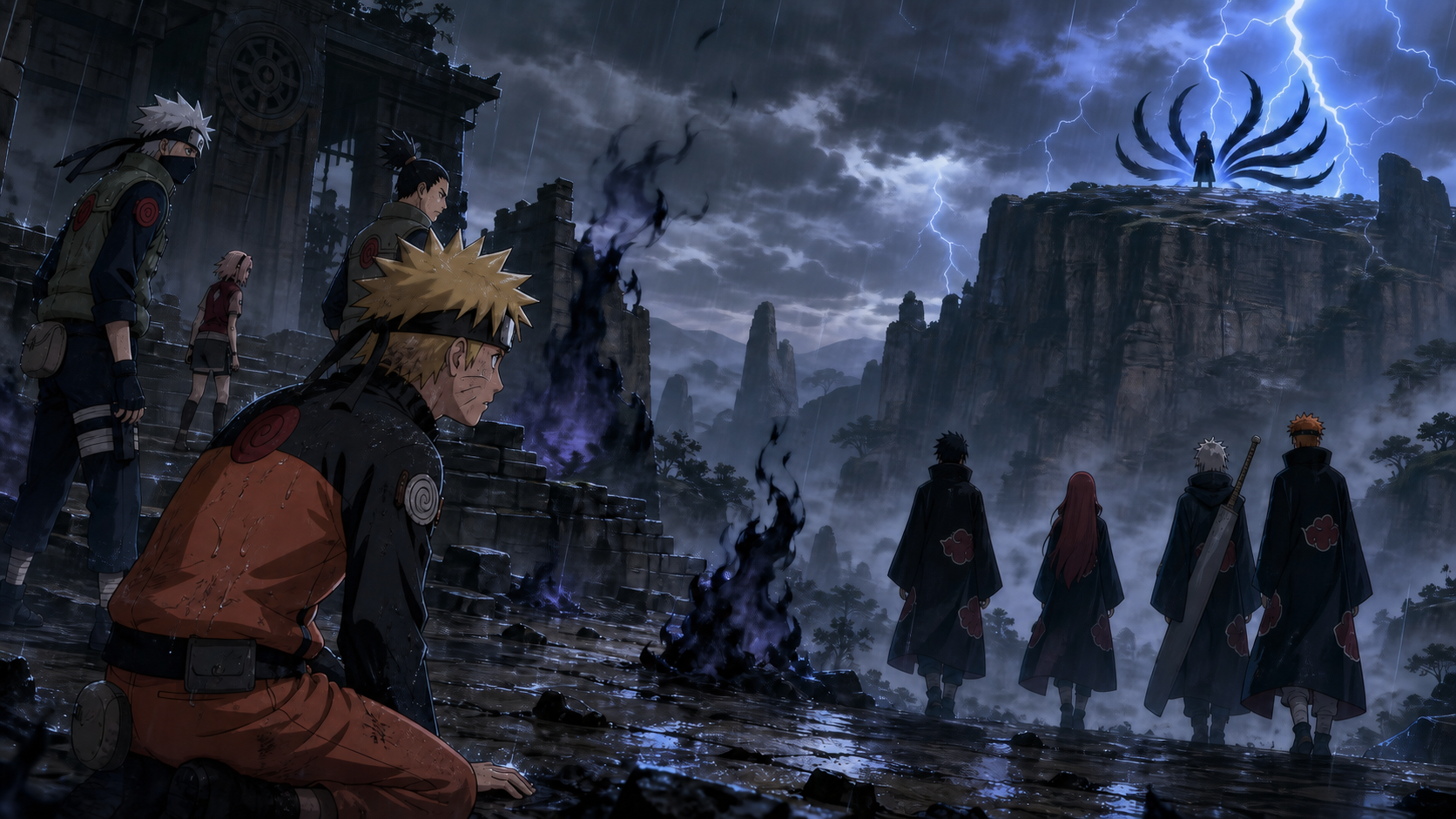
Naruto and the Leaf search team finally reach the ruined Uchiha hideout. The building is shattered, Amaterasu still burns across the stone, and Sasuke is gone. Their sensory skills find no trail that can close the distance Tobi created.
Elsewhere, Sasuke processes the history Tobi told him. He remembers Itachi's final forehead touch and decides that the brother he killed sacrificed everything for him. That love does not turn Sasuke back toward the Leaf; it redirects his revenge toward the village he now believes used Itachi.
Sasuke gathers Suigetsu, Karin, and Jugo, renames Hebi as Taka, and announces their new purpose: destroy Konoha. Tobi offers a working relationship with Akatsuki and assigns the team to capture the Eight-Tails jinchuriki in the Land of Lightning.
At Unraikyo, Taka meets Killer Bee. The target does not behave like prey, and the episode ends as Sasuke enters a fight whose scale and style he has badly underestimated.
Naruto reaches evidence instead of Sasuke
The hideout gives Naruto proof that something irreversible happened without giving him the person he came to save. He can see destruction, lingering black flame, and the place where the brothers fought, but not the meaning of the ending.
That absence is important. Tobi has already taken Sasuke to a controlled room and supplied an interpretation before Naruto can offer presence, grief, or another direction.
Naruto's search did not fail because he lacked commitment. It failed because delay was enough. Episode 139's apparently comic obstruction becomes devastating when the team stands inside the empty result.
The ruins are a message with its central subject removed.
Sasuke turns love into a new target
Learning that Itachi loved him does not dissolve Sasuke's capacity for revenge. It intensifies it and changes its destination.
For years, hatred of Itachi gave Sasuke a single structure: grow strong, find his brother, punish him. Tobi's account reveals that the structure was built around a false understanding, but it leaves the emotional force intact.
Sasuke decides the Leaf benefited from Itachi's sacrifice while allowing him to die as a criminal. Destroying the village becomes, in his mind, a way to honor the brother whose wishes he now understands too late.
The tragedy is that Itachi appears to have sacrificed himself to preserve both Sasuke and the village. Sasuke's new purpose protects one part of that love by attacking the other.
Hebi becomes Taka
The team's original name, Hebi, the snake,belonged to Sasuke's break from Orochimaru and his hunt for Itachi. That mission is finished, and Orochimaru's presence has been removed from his body.
Taka, the hawk,suggests a different direction. A hawk sees from above, chooses a target, and descends. Sasuke is no longer following the trail to one person; he is defining an institution as prey.
The renaming also asks Suigetsu, Karin, and Jugo to accept a purpose they did not originally join. Their bonds with Sasuke are personal, but his decision is political and potentially catastrophic.
The group stays together, yet the new name cannot guarantee they share the same reason for moving forward.
Tobi converts grief into Akatsuki labor
Tobi's account of Itachi gives Sasuke a new enemy, then Tobi offers the practical structure through which Sasuke can act. This sequence is not accidental.
Akatsuki provides information, access, clothing, and a mission. In return, Taka helps capture a jinchuriki for an organization whose larger plan Tobi does not fully explain.
Sasuke may believe he is using Akatsuki as a temporary route toward Konoha. Tobi has reason to believe the opposite: Sasuke's grief can advance the Tailed Beast hunt while keeping him close.
The partnership begins with overlapping objectives, not trust. Both sides expect to preserve their own agenda inside the arrangement.
Killer Bee refuses the role of victim
The mission briefing treats the Eight-Tails jinchuriki as a target to locate and retrieve. Killer Bee's entrance immediately resists that language.
He is confident, physically relaxed, and more interested in his rhymes than in performing fear for the strangers who have arrived to capture him.
That behavior matters because Sasuke has just emerged from a story in which institutions reduced people to functions: spy, traitor, weapon, sacrifice. Taka now approaches another person primarily as the container of power Akatsuki wants.
Bee's personality arrives before his full strength, insisting that the jinchuriki cannot be understood as an object in someone else's mission.
The episode changes emotional and geographic scale
The first half remains tied to the Uchiha hideout and the immediate aftermath of Itachi's death. The second moves into the Land of Lightning, a new target, and the broader politics of jinchuriki capture.
That movement could feel abrupt, but it reflects Sasuke's attempt to turn grief into action before he has to sit with it. A mission supplies direction, opponents, and measurable progress.
Naruto, meanwhile, is left at the place Sasuke has already abandoned. Their paths are not simply separated by distance; they are moving according to different accounts of what Itachi's death requires.
Unraikyo becomes the first test of Sasuke's new identity and the first consequence of choosing Tobi's route.
Naruto reaches the place where every answer has been removed
The black flame proves Itachi fought there. The ruined stone proves the confrontation ended violently. Neither tells Naruto where Sasuke’s mind went afterward or who reached him first.
Evidence without access becomes another kind of helplessness. Naruto can reconstruct motion and damage, but the conversation defining Sasuke’s next life has already happened elsewhere.
Arriving late is not the same as failing to care
Tobi deliberately consumed the team’s time, then used a space-warping ability to retrieve Sasuke. Naruto did not lose a fair race. The route was controlled by someone who understood both destinations.
The series often lets Naruto absorb blame for not reaching Sasuke quickly enough. This episode shows the machinery producing that distance.
Sasuke chooses revenge because revenge is the language he was taught
Itachi commanded hatred. Orochimaru offered power for hatred. Tobi reveals state violence and immediately translates grief back into hatred. No trusted adult taught Sasuke how accountability might look beyond destruction.
His decision is frightening, but it is not emotionally random. He reaches for the only action that has ever made unbearable information feel organized.
Honoring Itachi by destroying Konoha contains a genuine contradiction
Itachi sacrificed his reputation and life partly to preserve the village. Sasuke interprets that sacrifice as evidence the village deserves punishment for using him.
Both positions begin with love for the same person and produce opposite loyalties. Itachi protected the institution that coerced him; Sasuke protects Itachi’s memory by rejecting the institution he chose.
Tobi benefits from making contradiction feel like betrayal
If Sasuke pauses over Itachi’s wish to protect Konoha, anger might lose its single direction. Tobi emphasizes what the village did to Itachi and lets outrage overpower questions about what Itachi wanted afterward.
Manipulation does not require inventing injustice. It can isolate one moral truth until every competing truth looks disloyal.
Renaming Hebi lets Sasuke pretend the break is complete
The snake connected the team to Orochimaru and the hunt for Itachi. The hawk promises height, vision, and a target chosen from above.
A new name can mark intention without resolving history. Suigetsu, Karin, and Jugo still met through Orochimaru’s prisons, and Sasuke still carries habits built during the old mission.
Taka is asked to inherit a purpose it did not negotiate
The members joined for personal reasons: loyalty, fascination, freedom, swords, companionship, and their relationship with Sasuke. Destroying Konoha was not the original agreement.
Sasuke announces the new direction while emotionally overwhelmed. The team’s acceptance shows attachment, but attachment should not be mistaken for informed political consent.
Akatsuki offers logistics in exchange for moral compromise
Tobi has information, transport, targets, and an organization capable of moving against Konoha. Sasuke needs all of that if revenge is to become more than a declaration.
The first price is Killer Bee. Taka must help strip another person of bodily autonomy so Sasuke can gain access to the campaign he wants.
Sasuke is repeating the resource logic used against his clan
Konoha treated the Uchiha as a security problem and Itachi as a tool. Orochimaru treated Sasuke as a future container. Akatsuki treats jinchuriki as vessels carrying extractable power.
By accepting the capture mission, Sasuke steps into that same logic from the other side. His victimization does not prevent him from victimizing someone else.
Killer Bee arrives as a person before the Eight-Tails arrives as power
He writes rhymes, controls the rhythm of the meeting, and refuses the fear Taka expects. Personality interrupts the mission label.
That matters ethically. Akatsuki says jinchuriki, target, Eight-Tails. Bee insists on being an artist, fighter, brother, and irritatingly confident human being whom the category cannot contain.
RaeRae reaction
The quietest image in the episode is Naruto standing among the ruins too late. He spent several episodes pushing forward, and the reward is physical evidence that cannot tell him where Sasuke went emotionally.
Sasuke's decision to destroy Konoha makes painful sense without becoming inevitable. He has discovered that his hatred was engineered, but Tobi reaches him before he can imagine a response other than finding a new object for it.
I also like the discomfort of Taka's new mission. Sasuke believes he is acting for Itachi, yet his first step is helping the organization Itachi infiltrated capture another jinchuriki.
Killer Bee's relaxed entrance is exactly what the transition needs. Taka arrives carrying enormous grief and dramatic purpose; Bee refuses to treat that purpose as authority. The battle ahead will test more than Sasuke's strength. It will test how much he understands about the people his new revenge turns into targets.
Bee’s confidence exposes Taka’s dependence on reputation
Sasuke enters carrying the status of the man who killed Itachi. Suigetsu carries bravado. The Akatsuki robes imply a feared organization. Bee does not grant those symbols authority.
He evaluates the people in front of him and keeps writing. Refusing intimidation is his first tactical disruption.
The Cloud setting expands the consequences beyond Konoha
Sasuke’s grievance centers the Leaf, but his alliance immediately affects another village and another family. Political pain does not remain inside the borders where it began.
Capturing Bee threatens the Raikage’s brother, Cloud security, and the balance surrounding Tailed Beasts. Tobi turns one village’s suppressed crime into leverage against the wider world.
Grief creates urgency that Akatsuki can monetize
Sasuke does not want to wait, verify, recover, or build an independent network. Action keeps him from sitting with the brother he killed under false assumptions.
Akatsuki offers instant motion. The organization converts emotional urgency into labor before reflection can make that labor harder to obtain.
Naruto and Sasuke are now separated by competing histories
Naruto knows Itachi is dead and Sasuke missing. Sasuke knows a hidden account of the massacre and believes Konoha must pay. Neither possesses the other’s immediate experience.
The distance is informational before it is geographic. A reunion cannot succeed if one friend arrives with loyalty while the other carries evidence that loyalty has never addressed.
Sasuke’s choice makes sense without becoming morally correct
Understanding why a traumatized person selects destruction is not endorsement. It is the beginning of serious accountability.
He was manipulated, lied to, isolated, and recruited. Killer Bee did none of those things. Pain explains why Sasuke moves; it does not make the person placed in his path expendable.
Taka’s loyalty needs room for disagreement
Karin senses Sasuke’s condition, Jugo offers stability, and Suigetsu follows the mission. Their care appears through service.
A healthier team would also challenge the bargain with Akatsuki and the leap from grief to collective destruction. Loyalty that cannot question direction risks becoming another form of obedience.
The hawk image promises perspective Sasuke does not yet possess
A hawk sees the whole field from above. Sasuke has received one account from one interested narrator while physically and emotionally compromised.
The name expresses the clarity he wants, not the evidentiary position he has. Tobi still controls the map.
The mission tests whether liberation can coexist with captivity
Sasuke is free of the Curse Mark and free from the revenge command to kill Itachi. He immediately enters an Akatsuki arrangement requiring him to capture another captive body.
Freedom defined only as selecting the next target remains vulnerable to whoever supplies targets.
Bee exposes the danger of mistaking pain for rank
Taka enters with a tragedy, a mission, and the confidence of people who survived powerful enemies. None of that places Killer Bee beneath them. Suffering does not create authority over a stranger.
Bee’s casual attention to his notebook refuses the hierarchy Sasuke expects. He will judge their ability through what they do on the mountain, not through the importance they assign themselves.
Jinchuriki capture repeats the village habit of seeing containers first
Naruto knows what happens when a community reduces a child to the creature sealed inside. Sasuke once recognized Naruto as a lonely person carrying that burden.
Working for Akatsuki asks him to forget that knowledge. Bee becomes the Eight-Tails, a unit of power to extract, because the mission is easier if the human relationship disappears.
Tobi gives Sasuke a uniform before Sasuke builds a politics
The Akatsuki cloak provides immediate belonging and a visible enemy structure. Sasuke wears the symbol before understanding the organization’s full objective, internal history, or intended use of the Tailed Beasts.
That is recruitment through momentum. Identity arrives ready-made, saving the recruit from the slower work of deciding what justice should require.
Suigetsu, Karin, and Jugo become witnesses to Sasuke’s change
They knew the focused hunter pursuing Itachi. Now they watch him define a village as a target and accept work from the masked man who managed Itachi’s aftermath.
Their presence matters because transformation is relational. They can normalize the new direction through obedience or challenge it through the trust they earned on the old road.
The empty hideout and Unraikyo answer each other
Naruto stands where Sasuke used to be. Sasuke stands before a target whose life he has not tried to understand. Each scene contains a failed connection shaped by Tobi’s timing.
The episode moves between them to show that absence produces consequences elsewhere. Naruto cannot reach Sasuke, and Bee will pay for the route Sasuke takes through that isolation.
Revenge keeps promising control while transferring it
Killing Itachi was supposed to end Sasuke’s dependence on his brother’s commands. Destroying Konoha now feels like an independent choice, yet Tobi supplied the history, opportunity, organization, and first assignment.
Sasuke chooses within a field another person arranged. That does not erase agency, but it should make us ask who benefits from each available option.
A new target cannot metabolize old grief
Capturing Bee gives Sasuke a tactical problem and postpones the emotional problem of loving the brother he killed. Success on the mountain cannot create the conversation death made impossible.
Action can numb grief because it demands attention. It cannot guarantee that the grief has changed rather than waited.
What makes this transition work is that the story does not pretend Sasuke has become emotionally calm just because he sounds decisive. Renaming the team, choosing Konoha, and accepting a mission look like control. Underneath them is a young man who learned yesterday that the meaning of his entire life was manipulated. Certainty returns suspiciously fast because Tobi supplies it before grief can become a question.
I also cannot separate Killer Bee from Naruto when judging the mission. Sasuke knows a jinchuriki is a person because he has fought beside one, rejected one, hurt one, and been loved by one across years. The category is not abstract to him. Capturing Bee requires pushing that knowledge aside long enough to treat another man’s body as Akatsuki inventory. That moral failure matters even when Sasuke’s pain explains the numbness making it possible.
Taka therefore begins under a contradiction larger than its new name. Sasuke says the hawk has chosen its direction, but the route, target, equipment, and intelligence all come from Tobi. The team believes it is advancing Sasuke’s revenge while performing labor for a plan none of them understands. Bee’s resistance will expose the cost of entering somebody else’s machinery while calling the movement freedom.
Naruto arrives too late to interrupt that choice, yet his presence at the ruins still matters. It reminds us that another relationship exists beyond Tobi’s frame. Sasuke is isolated, not unloved. The difference may be invisible to him now, but it remains the possibility Tobi worked so hard to delay. That delayed connection will keep challenging every story that says Sasuke has only enemies left to choose from now.
RaeRae’s final word on Unraikyo
Naruto standing in the ruins hurts because his loyalty arrives at a crime scene after Tobi has taken both the survivor and the meaning. He did not stop caring. Someone weaponized the time required to reach the person he cared about.
Sasuke’s new purpose hurts for a different reason. He finally learns Itachi loved him and translates that recovered love into a promise to destroy what Itachi died protecting. Grief does not arrive with an instruction manual, and Tobi hands him the worst possible one.
I understand Taka’s loyalty, but the Killer Bee mission is the moral bill. Sasuke cannot avenge being treated as a tool by helping Akatsuki treat another man as a container.
Bee’s refusal to perform fear is therefore bigger than swagger. He breaks the emotional script Taka brought to the mountain. Their tragedy does not make them the center of his life, and their mission does not make him prey.
RaeRae’s call
Sasuke renames his team and redirects his revenge, but accepting Akatsuki’s hunt for Killer Bee shows that freedom without reflection can reproduce the same bodily exploitation he survived.