
Truth
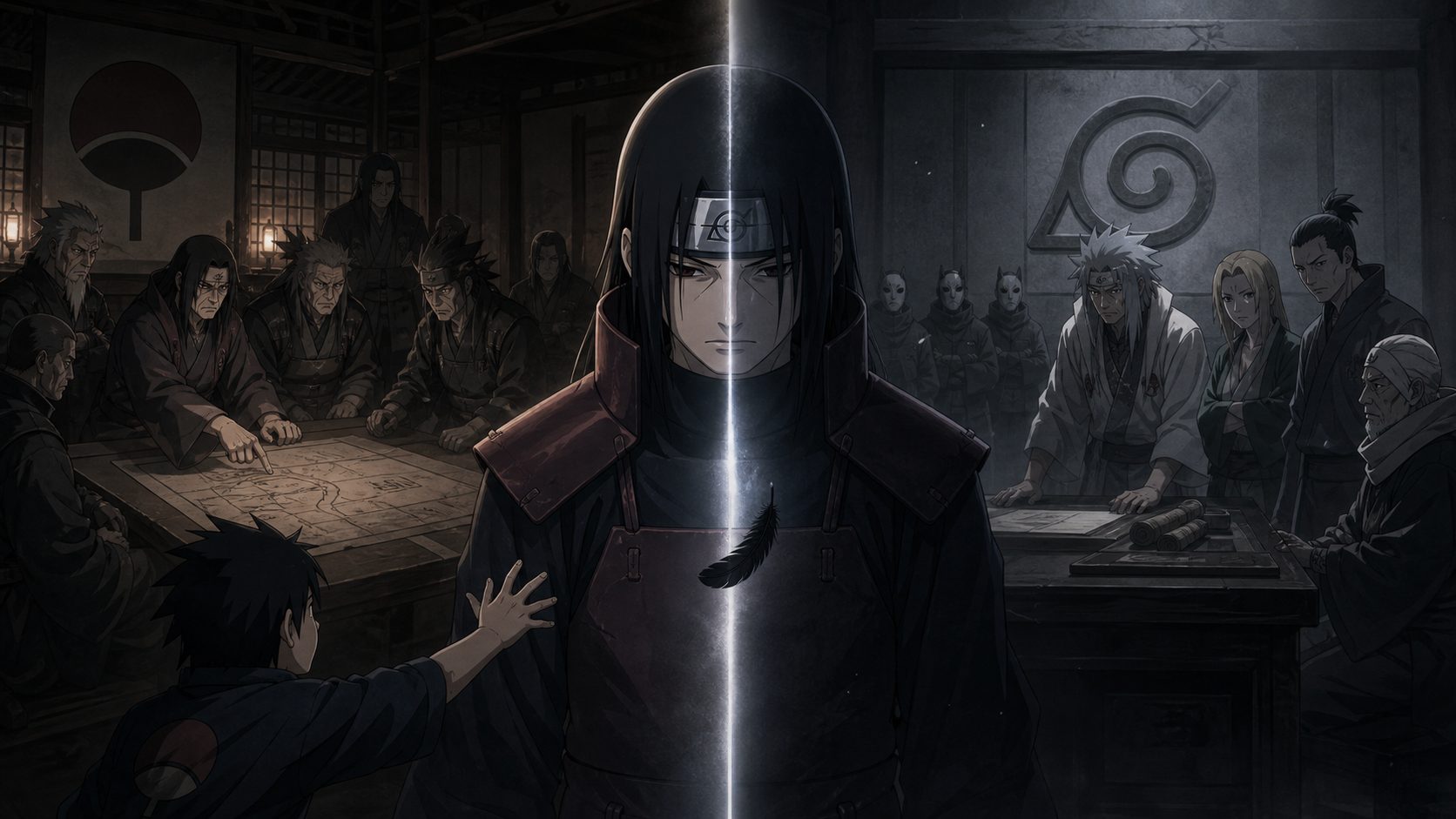
The massacre becomes a political tragedy as Itachi is divided between clan, village, peace, and the one brother he refuses to sacrifice.
What happens
Tobi continues his account of the Uchiha massacre. He tells Sasuke that the clan's forced relocation and growing surveillance after the Nine-Tails attack deepened resentment until Fugaku and other leaders prepared a coup against the Leaf Village.
Itachi, gifted enough to enter the ANBU while still very young, became a channel between two sides that increasingly treated him as an instrument. The clan expected him to report on village leadership, while village officials used him to monitor the clan.
According to Tobi, Itachi's experience of war made him value peace more than loyalty to either institution. When negotiations failed and the coup threatened civil conflict, Danzo presented him with a choice built to destroy him: allow the uprising and risk a wider war, or eliminate the clan while preserving Sasuke.
Itachi accepted the mission, asked Tobi for help, and carried the hatred alone. He joined Akatsuki, kept watch over threats to the Leaf, and arranged his death so Sasuke would be seen as the brother who avenged the Uchiha.
Truth arrives through an interested narrator
The episode gives Sasuke information he urgently needs, but it never makes the conditions of the telling neutral. Tobi was involved in the massacre and wants Sasuke's future anger directed toward the Leaf.
That means two things can be true at once: the history may explain Itachi's contradictions, and the person explaining it may still be selecting details for strategic effect.
Sasuke's shock comes from how strongly the account fits evidence he already possesses. Itachi's final touch, his removal of Orochimaru, and the Amaterasu trap all look different when placed beside the claim that he protected Sasuke throughout the mission.
Tobi does not create those memories. He provides the frame that makes them point toward a new enemy.
The village and clan both use a child
Itachi's exceptional ability is treated as permission to burden him earlier. Because he can perform adult work, the adults around him decide he can carry adult political consequences.
The Uchiha need access to village intelligence. The village needs access to Uchiha planning. Itachi becomes valuable to both because he belongs to each side and can be trusted fully by neither.
Calling him a double agent sounds clinical, but the emotional reality is harsher. His family, command structure, neighbors, and younger brother are all located inside the conflict he is expected to observe.
Talent does not protect him from exploitation. It makes him easier for institutions to place where no humane choice remains.
The coup grows from exclusion
Tobi's account connects the planned uprising to the treatment of the Uchiha after the Nine-Tails attack. Suspicion leads to relocation, monitoring, and political distance from the center of the village.
Those choices do not excuse a coup, but they show how policy can turn fear into a self-reinforcing structure. The village treats the clan as dangerous, the clan recognizes that treatment as hostility, and leaders on both sides interpret each reaction as proof.
By the time Itachi is asked to intervene, the problem is no longer one conversation or one insult. Years of distrust have become organized plans.
The tragedy is political before it becomes personal, yet the cost is forced into the hands of one family member.
Danzo turns peace into coercion
Danzo frames the massacre as the option that prevents civil war and protects Sasuke. That framing gives Itachi a choice only in the narrowest sense.
One path risks the clan's coup expanding into conflict that enemies could exploit. The other requires Itachi to kill his family and accept permanent infamy.
The preservation of Sasuke becomes leverage. Itachi can save the person he loves most only by destroying everyone else and ensuring that brother will hate him.
This is not peace built through justice or reconciliation. It is stability purchased by concentrating institutional violence in a person young enough to obey and skilled enough to succeed.
Itachi designs Sasuke's heroic story
If Tobi is telling the truth, Itachi did more than spare Sasuke. He tried to construct a future in which Sasuke would never carry the clan's political stain.
By presenting himself as a criminal motivated by power, Itachi gave Sasuke a single target. By dying in battle against him, he allowed Sasuke to become the avenger who restored the Uchiha name.
The plan protected Sasuke's public identity while devastating his private life. It required years of fear, isolation, obsession, and manipulation.
That contradiction prevents a simple celebration of sacrifice. Itachi loved Sasuke deeply and still made choices that injured him. Protection and harm occupy the same plan.
The meaning of loyalty collapses
Itachi is described as loyal to the village, loyal to peace, loyal to Sasuke, and bound to a clan he ultimately kills. Those loyalties cannot be reconciled cleanly.
The episode asks whether loyalty belongs to people, institutions, ideals, or outcomes. Itachi prioritizes the prevention of war and Sasuke's survival, but the means violate the family and community that gave those values context.
Sasuke had organized morality around a much simpler division: the clan was innocent, and Itachi betrayed it. Tobi's history replaces that line with overlapping failures.
The resulting confusion is not weakness. It is the natural response to learning that the person you hated may have been both victim and perpetrator.
The massacre was never one man’s private evil
The village’s official silence allowed that explanation to stand because it protected leadership, policy, and reputation. Sasuke received a murderer instead of a political history.
Episode 141 restores institutions to the scene. Surveillance, forced relocation, coup planning, war anxiety, and coercive command existed before Itachi lifted a blade. Context does not erase his action. It identifies everyone who helped make the action possible.
Post-attack suspicion became policy without evidence
The Nine-Tails disaster gave Konoha leaders fear they could organize around the Uchiha. Relocation and monitoring turned suspicion into daily structure, teaching the clan that the village considered belonging conditional.
A government cannot isolate a community, deny political trust, and then act surprised when resentment hardens. The coup was dangerous. So were the policies that helped its planners argue peaceful participation had failed.
The Uchiha leadership also spends its children
Fugaku and the clan rely on Itachi’s ANBU access because his talent can penetrate spaces closed to them. Their legitimate grievance does not make that use humane.
Itachi becomes a channel for adult strategy before he has any safe authority to refuse. Sasuke remains outside the plan but will inherit its consequences. Both sons are assigned roles by people who call family loyalty an obligation.
The village praises Itachi’s maturity to avoid acting maturely itself
Adults admire that a child thinks like a Hokage. Then they hand him a crisis the actual Hokage and council failed to resolve.
Competence becomes an excuse for abandonment. Because Itachi can understand war, negotiate secrecy, and kill efficiently, leaders pretend he can ethically contain a decision that should never belong to one operative.
Danzo does not offer a choice, he weaponizes Sasuke
Spare the brother by destroying the clan or risk losing everyone in civil war. Sasuke’s life becomes leverage used to secure Itachi’s obedience.
Danzo recognizes love and converts it into a control mechanism. The offer preserves one child physically while guaranteeing that child’s emotional devastation. Calling the result peace hides who was forced to purchase it.
Hiruzen’s preference for negotiation is not enough
Wanting a peaceful solution matters only if leadership acts with urgency, transparency, and power against officials sabotaging that solution. Good intentions cannot substitute for intervention.
The massacre exposes the cost of delay at the top. Hiruzen’s reluctance to confront Danzo and the council leaves Itachi facing the deadline created by more aggressive actors.
Itachi’s fear of war is grounded in childhood trauma
He saw battlefields too young and learned to treat widespread conflict as the worst possible outcome. Danzo exploits that moral hierarchy by presenting massacre as the smaller catastrophe.
Trauma does not make Itachi foolish. It makes one type of threat emotionally absolute. A coercive leader gains power by framing every alternative as a return to the survivor’s oldest terror.
Preventing war and creating justice are not the same project
The massacre may prevent immediate civil conflict. It does not resolve discrimination, distribute accountability, or create legitimate trust. It removes the people whose grievance exposed the crisis.
Stability achieved by erasing one side is not reconciliation. It is silence enforced through overwhelming violence.
Itachi protects Sasuke’s reputation by destroying his reality
The plan allows Sasuke to become the heroic avenger instead of the surviving child of alleged traitors. Publicly, that future may look generous.
Privately, it requires torture, isolation, hatred, bodily danger, and a life organized around killing the one relative left. Protection of status cannot compensate for theft of informed choice.
The hero story keeps Konoha innocent
If Sasuke kills a rogue criminal and restores clan honor, the village can celebrate without admitting its own role in producing both brothers. Itachi carries the blame into death.
The arrangement protects Sasuke from stigma and protects the state from accountability at the same time. Those benefits should not be confused.
RaeRae reaction
What hits hardest is how often Itachi's talent becomes the excuse for adults to ask more of him. Everyone sees what he can do; almost no one protects the child who has to do it.
I do not think the revelation erases the damage Itachi caused Sasuke. The psychological torture and years of engineered hatred remain real. Love explains his intention, but it does not make every method loving.
The political context matters because it prevents the massacre from remaining one man's inexplicable evil. Clan leaders, village officials, surveillance, exclusion, and Danzo's coercion all narrow the field before Itachi acts.
Tobi knows exactly what this truth can do. He gives Sasuke a history that restores love for his brother and immediately makes that love available as hatred toward the Leaf. The episode is called “Truth,” but truth here is not an ending. It is the most powerful redirection Sasuke has ever received.
Love explains Itachi’s line without making the line harmless
He chooses Sasuke’s survival when every offered path contains atrocity. That choice reveals the relationship he values most.
He then dictates how Sasuke will understand the massacre, pursue strength, and participate in Itachi’s death. Love motivates the plan while control defines its daily experience.
Sasuke’s entire adolescence becomes evidence of institutional harm
His desertion, fixation, dangerous training, and willingness to enter Orochimaru’s orbit did not emerge from a naturally corrupt personality. They grew from false history maintained by the village and reinforced by Itachi.
Personal choices remain choices, but accountability must include the conditions powerful adults deliberately created.
Tobi restores Itachi’s humanity while recruiting Sasuke’s rage
The account gives Sasuke access to love he thought was fraudulent. That gift is emotionally enormous. Tobi immediately connects the recovered love to village betrayal.
He does not need to invent anger. He reveals a reason for anger and positions himself as the person who knows where it should go.
Truth does not belong to the narrator who reveals it
Tobi has evidence and proximity, but those advantages do not grant ownership over Sasuke’s conclusion. Facts remain available for interpretation beyond the recruiter’s preferred verdict.
Sasuke deserves corroboration from records, surviving officials, clan evidence, and people who do not need him to join their project.
The clan’s planned coup cannot justify collective punishment
Some leaders prepared an uprising. Children, elders, civilians, and people with no operational role died with them. Treating lineage as guilt is the same logic that made suspicion politically useful after the Nine-Tails attack.
Security language does not transform collective killing into individual accountability.
Itachi is both coerced instrument and accountable actor
Danzo narrows the options brutally. The clan places competing demands on him. War trauma shapes his fear. Itachi still makes choices within that structure and directly harms Sasuke.
Holding both truths is harder than canonizing or demonizing him. It is also the only reading large enough for the episode.
Sasuke’s grief has to change direction before it can find language
He killed the person he believed caused everything and now learns that person may have loved him most. Rage is easier to inhabit than the collapse of that moral world.
Tobi offers a new target before Sasuke can mourn. Movement protects him from stillness while making him available for another agenda.
The episode title promises neutrality the scene cannot provide
Truth sounds singular and clean. What Sasuke receives is testimony from a masked participant, supported by real memories and delivered under controlled conditions.
The information matters. So do source, timing, omission, motive, and the survivor’s lack of alternatives. Truth without those questions can still be weaponized.
A village cannot claim the Will of Fire while treating one clan as disposable
Konoha’s ideal says each generation protects the next and the village functions as family. The massacre exposes how quickly that language narrows when leaders decide some families threaten institutional stability.
Itachi is ordered to protect the larger home by destroying his actual home. Sasuke survives as proof of private love, not proof that the village honored its own principle.
Fugaku’s position deserves context without romantic rescue
He leads a community facing surveillance and political exclusion, and those grievances are real. Preparing a coup risks civilians inside and outside the clan, including children who never chose the confrontation.
Understanding pressure does not require declaring every response just. The same standard applied to Itachi and Konoha must apply to clan leadership too.
Danzo benefits from every side believing time has expired
Urgency makes extreme action appear practical. If the coup is imminent and war inevitable, consultation becomes weakness and extermination becomes the only decisive answer.
Authoritarian strategy loves a deadline nobody else can verify. It prevents alternatives from receiving the time, resources, and political protection needed to become real.
Itachi’s silence turns Sasuke into the final storage place for the secret
The official record blames Itachi. The clan cannot testify. Village leaders remain quiet. Sasuke carries memories shaped by genjutsu and a last gesture he cannot decode.
Tobi activates those memories as evidence. A child who was denied the archive becomes the terrain on which competing versions of history fight.
Justice would require more than changing the villain’s name
Replacing Itachi with Konoha as the single evil may satisfy the structure of revenge, but it still compresses many decisions into one target. Danzo, the elders, Hiruzen, clan leadership, Tobi, and Itachi hold different forms of responsibility.
Sasuke deserves an account precise enough to distinguish them. Collective vengeance repeats the logic that killed his clan.
The revelation restores love and creates a second bereavement
Sasuke has already lost the brother he thought existed before the massacre. Now he loses the certainty that the hated criminal was all Itachi became.
He must grieve the possibility that love survived every cruel performance, and that recognition arrives after the person involved can no longer answer, apologize, or be confronted.
I keep coming back to the fact that Sasuke was the only person in this political crisis who was never allowed to know he was part of it. Clan leaders planned around his future. Village leaders used his life to pressure Itachi. Itachi built an entire cover story around what Sasuke would believe and eventually do. Tobi waited to inherit the anger that cover story produced. Everybody treated the child as important while denying him participation in the decisions that destroyed his world.
That is not protection in any complete sense. Protection should preserve more than breathing. It should preserve dignity, truthful relationship, and some ability to shape the life being protected. Itachi saved Sasuke from the massacre and then trapped him inside a revenge identity designed to clean the clan’s public name. The village permitted that identity because it concealed state responsibility. Tobi now breaks it because the wreckage can serve him.
Sasuke’s next choices may be frightening, but they do not emerge from nowhere. They come after a calculated collapse of every trusted category: brother, village, clan, hero, criminal, sacrifice, and peace. Before judging the direction of his anger, I want the adults who created this maze named clearly. Danzo chose coercion. Hiruzen failed to stop it. Clan leaders escalated. Tobi participated. Itachi killed and concealed. Sasuke inherited the bill.
Truth matters because secrecy protected power, not Sasuke. If leaders had trusted him with honesty, care, and evidence, Tobi would not possess the leverage. The village calls silence necessary while the survivor absorbs consequences. That pattern deserves anger. What Sasuke needs is not another command disguised as revelation. He needs room to investigate, mourn, contradict, and choose without becoming anybody’s weapon again.
RaeRae’s final word on truth
This episode makes the village look worse because the tragedy was not unavoidable. Leaders created separation, tolerated escalating distrust, failed to restrain Danzo, and handed a child the violence they did not want publicly attached to themselves.
I grieve Itachi without turning him into a spotless saint. His love for Sasuke is real. So are the torture, deception, and engineered revenge Sasuke experienced as a result of that love being expressed through absolute control.
I believe the Uchiha coup posed danger. I also refuse the dishonest leap from dangerous leadership to the extermination of an entire community. Collective punishment is not peace.
Tobi gives Sasuke facts the village owed him years earlier. He also times those facts to claim the anger they create. The truth begins liberation only when Sasuke can examine it without another person deciding what he must become next.
RaeRae’s call
Itachi was a gifted child coerced by institutions and an older brother who harmed Sasuke through the plan he called protection. Both truths belong in the record, along with the village leaders who tried to bury their share.