
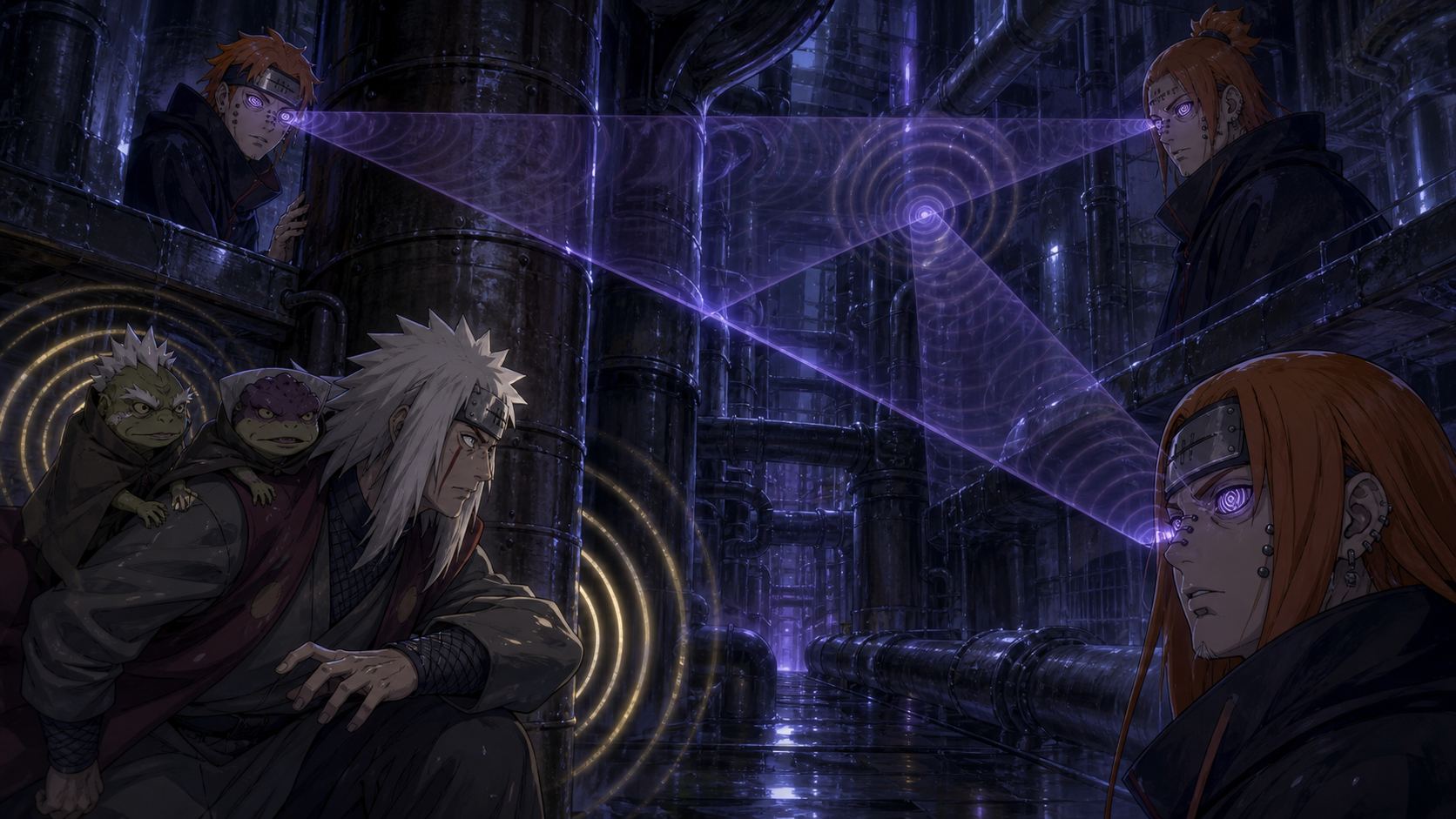
In Attendance, the Six Paths of Pain
Shared vision closes every ordinary blind spot, so Jiraiya and the toad sages change the battlefield from sight to sound.
What happens
Jiraiya, Fukasaku, and Shima face three Pain bodies whose coordination makes ordinary attack patterns fail. Ninjutsu disappears, close-range attacks are intercepted, and every angle seems visible before Jiraiya can exploit it.
Fukasaku identifies the likely rule: the bodies share vision. What one Pain sees becomes information available to the others, removing the blind spots a team of separate fighters would normally possess.
The sage trio retreats into the Rain's pipe corridors to create distance and test the theory. Jiraiya separates the bodies and uses the architecture to interrupt their shared sight lines.
Fukasaku and Shima prepare a powerful sound genjutsu. Because the attack travels through hearing rather than the visual network, it offers a route around Pain's greatest defensive advantage.
Shared vision is power without privacy
The Pain bodies function like a surveillance system. Each individual angle feeds a collective map, making surprise almost impossible while the formation remains intact.
That ability explains why Jiraiya's speed and experience are not enough. He can outmaneuver one observer, but not an observer whose blind side belongs to someone else.
The design also expresses Pain's politics. Individual bodies appear separate, yet perception is centralized. Difference exists at the level of function, not independent judgment.
I find that more unsettling than simple telepathy. The bodies do not communicate after seeing. They seem to inhabit one visual authority.
That shared authority changes the meaning of presence. Three bodies can occupy three locations without producing three perspectives. Pain multiplies coverage while eliminating disagreement. It is an efficient combat design and a bleak model of governance: many eyes, one permitted interpretation.
Retreat becomes disciplined thinking
Fukasaku recommends withdrawal because remaining in open combat only feeds the enemy more information. Jiraiya agrees long enough to build a better question.
Stories sometimes treat retreat as a failure of courage. Here it is the action that makes intelligence possible. Distance gives the team time to compare observations, isolate variables, and choose terrain that favors them.
Jiraiya's willingness to retreat also shows the value of collaboration. He does not protect his legend by ignoring an elder's advice. He lets better analysis change the plan.
The move is temporary, not passive. Every corner becomes a tool for breaking sight lines and turning the Rain's infrastructure against its ruler.
Sound reaches where eyes cannot
The toad sages' genjutsu is an elegant answer because it changes the sensory channel of the battle. Pain has built extraordinary visual coverage; the counter does not attempt to see faster.
Fukasaku and Shima use harmony as a trap. Their voices must coordinate precisely, and Jiraiya must keep the Pain bodies occupied long enough for the technique to form.
This is another example of Sage Mode working through relationship. The decisive weapon belongs to the two elders, while Jiraiya creates the conditions for them to use it.
The sound technique also fits the industrial environment. Metal corridors carry and amplify vibration, making the village's architecture part of the counterattack.
The bodies are clues, not the answer
Jiraiya recognizes faces among the Pain bodies, including people he encountered during earlier travels. That realization makes the mystery more disturbing.
If these are known individuals, then Pain may not be a single transformed student. The Rinnegan appears across bodies with different histories, suggesting control, reconstruction, or a remote source.
Jiraiya cannot solve the entire mechanism yet, but recognition changes the mission. Information about who the bodies were may reveal who is actually using them.
The teacher's personal memory becomes intelligence data. His years of wandering, often treated as eccentricity, give him a database no official archive could reproduce.
This is where Jiraiya's two lives finally converge. The spy needs facts, while the teacher needs to know what happened to Nagato, Yahiko, and Konan. Recognizing the bodies gives both missions the same next question: if none of these faces is the source, where is the person directing them?
RaeRae reaction
I love battles where one discovered rule changes everything. Shared vision explains the earlier frustration without making Jiraiya foolish. He was fighting a system whose coordination had been invisible.
The answer is equally satisfying because it is not a bigger explosion. The team changes terrain, separates targets, and attacks through sound.
Fukasaku and Shima continue to feel like partners rather than power-up accessories. They identify the problem, argue for retreat, and supply the technique that may decide the fight.
The episode also deepens the horror beneath Pain's divine image. A god who sees everywhere is revealed as a network of borrowed faces. Jiraiya is close to victory over the visible bodies, but the real question has moved somewhere beyond the room.
That makes the apparent tactical success feel temporary. The sage song may stop the bodies in front of him, but information is now more valuable than a clean escape. Jiraiya has found the edge of the secret and must decide how much of himself he will risk to reach its center.
Shared vision creates coverage by erasing private perspective
My bottom line is that Pain’s greatest tactical advantage is also the clearest political metaphor in the fight. Several bodies occupy different positions, but what they see becomes one central field. Multiplicity expands surveillance without producing disagreement.
That is not ordinary teamwork. Teammates communicate interpretations after seeing. The Paths appear to deliver perception directly into one authority.
Many eyes do not guarantee many points of view
Pain can watch several angles and still permit only one conclusion. Coverage and pluralism are not the same thing. A system may collect enormous information while remaining unable to correct the person interpreting it.
The combat design echoes the Rain’s government: observation everywhere, accountability nowhere visible.
Jiraiya earns the hypothesis through failed attacks
His speed should create blind-side openings, yet other bodies respond before the target can see him. Rather than call the result impossible, he compares reactions and asks what information moved between them.
Failure becomes evidence when pride does not prevent revision.
Retreat is the first successful counter
Remaining in open space lets shared sight cover every angle. Fukasaku recommends withdrawal, and Jiraiya listens. Distance creates time to compare observations and choose a different sensory channel.
The decision protects intelligence over performance. A legend does not need to look fearless every second to act courageously.
The pipe maze interrupts a visual network
Corners, chambers, metal, and vertical routes let Jiraiya separate bodies and break sight lines. The Rain’s infrastructure stops being only Pain’s surveillance territory and becomes a tool for testing its limits.
Architecture matters because power always operates somewhere. Terrain can strengthen a system or expose its dependencies.
Sound answers sight without competing on sight’s terms
Ma and Pa do not try to make Jiraiya faster than a network with almost no blind spots. Their song enters through hearing. The counter works by changing the question.
That is intelligent collaboration. When an opponent dominates one channel, victory may require leaving that channel rather than escalating inside it.
The duet preserves two voices
Fukasaku and Shima must coordinate precisely, but harmony does not erase who contributes each voice. Their partnership achieves unity through relationship.
Pain’s network appears unified through control. The contrast gives the techniques an ethical texture beyond spectacle.
Shared information is not the same as shared authority
Teams become stronger when members exchange what they see. Pain’s system removes the delay but also appears to remove the conversation. The bodies do not compare interpretations or challenge a conclusion. Perception moves toward one will.
That efficiency matters in combat and politics. A ruler can collect information from everywhere while remaining the only person allowed to decide what the information means.
Coverage can make a wrong conclusion more dangerous
More eyes improve detection. They do not guarantee ethical judgment. If one authority controls every body, an error at the center can use perfect surveillance to enforce itself.
Pain’s visual network is therefore not wisdom multiplied. It is reach multiplied. Jiraiya has to discover the difference before the title of god makes reach look infallible.
The bodies had names before they became Paths
Jiraiya recognizes faces from people encountered during his travels. That memory restores biographies the system has hidden. These are not shapes created solely to house abilities.
Whatever their histories and choices were, death did not make their bodies ownerless. The mystery of Pain is also a question about who claims physical remains and converts them into instruments.
Body autonomy remains central even after death
The shinobi world frequently treats corpses as information, weapons, disguises, and inherited property. Pain’s Paths make that practice central to divine authority. A dead person’s face becomes a mask for somebody else’s will.
The tactical effectiveness should not erase the violation. Power is being produced through bodies that cannot visibly consent or speak.
Jiraiya’s wandering becomes an archive no village file could replace
Official records might list missing ninja, battles, or rumors. Jiraiya remembers gestures, faces, locations, and personal encounters. His apparently undisciplined travel created human knowledge outside bureaucratic categories.
That archive lets him notice that the bodies belong to different histories. Recognition is the clue that breaks the god image into a constructed system.
Memory gives intelligence an ethical dimension
If Jiraiya saw only enemies, the Paths would be targets with unusual powers. Recognizing former people forces him to ask what happened to them and who is absent from the room.
Information becomes more useful because it becomes more human. Biography reveals mechanism where spectacle encouraged awe.
The toad song requires vulnerability before it creates control
Ma and Pa need time to coordinate breath and harmony. Jiraiya must protect them while they prepare, and the sound announces itself before the trap completes. Their strongest answer contains exposure.
That risk distinguishes partnership from an automatic weapon. Each participant depends on the others keeping a role under pressure.
Harmony is cooperation, not sameness
The duet works because two voices meet in a precise relationship. Fukasaku and Shima remain recognizable individuals throughout the technique. Unity is produced without flattening difference.
Pain’s shared sight creates unity by making separate perspectives unreadable. The episode places two collective systems beside each other and asks what each one preserves.
Sound changes the sensory politics of the room
Pain dominates sight. The sage trio refuses to keep treating vision as the only authoritative channel. Hearing reaches bodies even when their eyes cover every angle.
This is why the counter feels smarter than simple escalation. The team recognizes that an opponent’s strength also reveals where attention is concentrated.
The pipe corridors turn retreat into composition
Jiraiya does not flee randomly. He chooses corners, distance, and enclosed metal spaces that help separate targets and carry sound. Movement arranges the conditions for the song.
Retreat becomes active authorship of the next encounter. The battlefield changes because the team stops accepting Pain’s preferred geometry.
Isolation tests whether the network can remain whole
Pulling one Path away interrupts sight lines and asks how much information survives separation. Jiraiya is not merely reducing enemy numbers. He is probing the dependency that makes several bodies function as one.
A strong hypothesis predicts what should change. Every isolated reaction gives him evidence about the unseen controller.
Apparent victory can create the most dangerous confidence
The song catches the visible Paths, and the result looks decisive. Jiraiya has enough experience to know that stopping three bodies does not explain why six are named or where authority originates.
A battle can be won at the level of immediate threat while the system remains intact outside the room.
Jiraiya must choose between carrying evidence and finding the center
Once he understands that the bodies are not the true answer, escape becomes morally complicated. Leaving preserves what he knows. Continuing may discover the clue that makes the knowledge actionable.
No calculation removes the people who will grieve if he stays. Responsibility to the future and responsibility to loved ones pull in different directions.
The title announces six before Jiraiya sees the entire design
The phrase “Six Paths” gives the enemy a complete sacred structure while Jiraiya encounters fragments. Naming can create an illusion that the system has always existed in finished form.
His investigation reverses that effect. Bodies, eyes, summons, and memories become components with histories rather than proof of divine inevitability.
Godhood depends on nobody asking where the bodies came from
A god may inhabit many forms without owing explanation. A shinobi using corpses has methods, locations, preparation, and vulnerabilities. Biography turns worship back into forensic questions.
Jiraiya’s greatest threat to Pain is not only Sage Mode. It is the refusal to stop at the sacred name.
The sage song is powerful, but preparation gives Pain time to act. Ma and Pa cannot produce the genjutsu instantly, and Jiraiya cannot treat their voices as a button. He has to defend the relationship long enough for breath, rhythm, and sound to align. The decisive technique begins as shared vulnerability.
That matters because the Paths appear designed to remove vulnerable transition. One body covers another. One line of sight fills another’s blind spot. Summons create pressure while information moves across the network. Pain’s system tries to eliminate the pauses where separate fighters normally need trust.
Jiraiya creates a pause through terrain. He turns corners into broken sight lines, distance into time, and metal corridors into an acoustic advantage. The Rain’s industrial body becomes something its ruler cannot completely monopolize. Infrastructure can serve power and still contain routes of resistance.
The song also changes who carries the climax. Jiraiya is the famous Sannin, but Ma and Pa possess the technique that can bypass Pain’s eyes. His role is not diminished when partners deliver the answer. Leadership can mean making another person’s expertise possible under pressure.
I want that distinction preserved because fandom often assigns every collective achievement to the most famous man in the frame. Jiraiya’s skill, courage, and analysis are essential. So are Fukasaku’s hypothesis and the elders’ duet. The victory belongs to a system of consent and communication.
Pain’s system invites the opposite reading. The bodies contribute abilities, positioning, and sight, yet all identity collapses into Pain. Their former names disappear. Their faces remain useful only as surfaces for piercings and Rinnegan eyes. One title consumes several lives.
Jiraiya’s recognition interrupts that consumption. He remembers meeting at least some of these men before they became Paths. Memory cannot return their bodies, but it can expose the lie that they began as divine components. They were people before somebody reorganized their remains.
This is why his wandering matters beyond gathering rumors. Jiraiya spoke with strangers across countries and retained human details. An official archive might classify the same men by village, danger level, or death. Personal memory lets him see that unrelated biographies now occupy one formation.
The clue points away from every visible face. If the bodies belonged to people Jiraiya met and none is Nagato, then the Rinnegan does not identify the body as its original owner. The person he seeks may be absent while controlling presence everywhere.
That hypothesis is frightening because it changes the scale of the fight. Defeating one Path does not defeat the source. Defeating three may only remove replaceable instruments. The real target exists beyond the room, protected by the audience’s assumption that visible power must reveal the person using it.
Jiraiya now has enough information to know that escape would matter and not enough to make the report complete. That gap is where his final choice forms. He can protect partial truth or risk everything for the mechanism that might let Naruto survive later.
I cannot celebrate that risk without remembering Tsunade, Naruto, Ma, Pa, and everyone who will absorb his absence. Sacrifice is never paid only by the person who chooses it. The episode understands this by keeping partnership visible even as Jiraiya moves toward a solitary conclusion.
For me, Episode 132 is not the chapter where Jiraiya learns shared vision. It is where he learns that Pain’s multiplicity may hide absent authority and several stolen histories. Sight gives the system coverage. Biography gives Jiraiya a way to question its construction.
The toad song wins because the sage trio refuses Pain’s preferred channel. The investigation advances because Jiraiya refuses Pain’s preferred story. He will not accept many eyes as proof of godhood or unfamiliar faces as proof that memory failed.
That stubborn human recognition is the counter. Bodies came from lives. Techniques came from choices. Political divinity came from a child and a country the great villages exploited. Once those connections return, Pain may remain powerful, but he is no longer beyond explanation.
The danger is that explanation now lies deeper than safety. Jiraiya has found the outer edge of the mechanism, and the person who knows may be the person least able to leave it alone.
RaeRae’s final word on the Six Paths
I love a fight where one discovered rule reorganizes everything. Shared vision explains Pain’s impossible reactions without making Jiraiya incompetent. He was testing a system whose connections had been hidden.
Retreat, architecture, separation, and sound become parts of one answer. Ma and Pa supply the decisive technique while Jiraiya creates the time and terrain for it.
The borrowed faces remain the deeper horror. Jiraiya recognizes people from his travels where independent bodies should be. Memory tells him the Paths had lives before this formation.
A god who sees everywhere begins looking like a system built from stolen histories. Stopping the visible bodies may win the room. Understanding who controls them is the information that can protect everybody outside it.
RaeRae’s call
Pain’s shared vision creates perfect coverage without plural perspective. Jiraiya, Ma, and Pa answer through retreat, relationship, and a sound attack the visual network cannot intercept.