
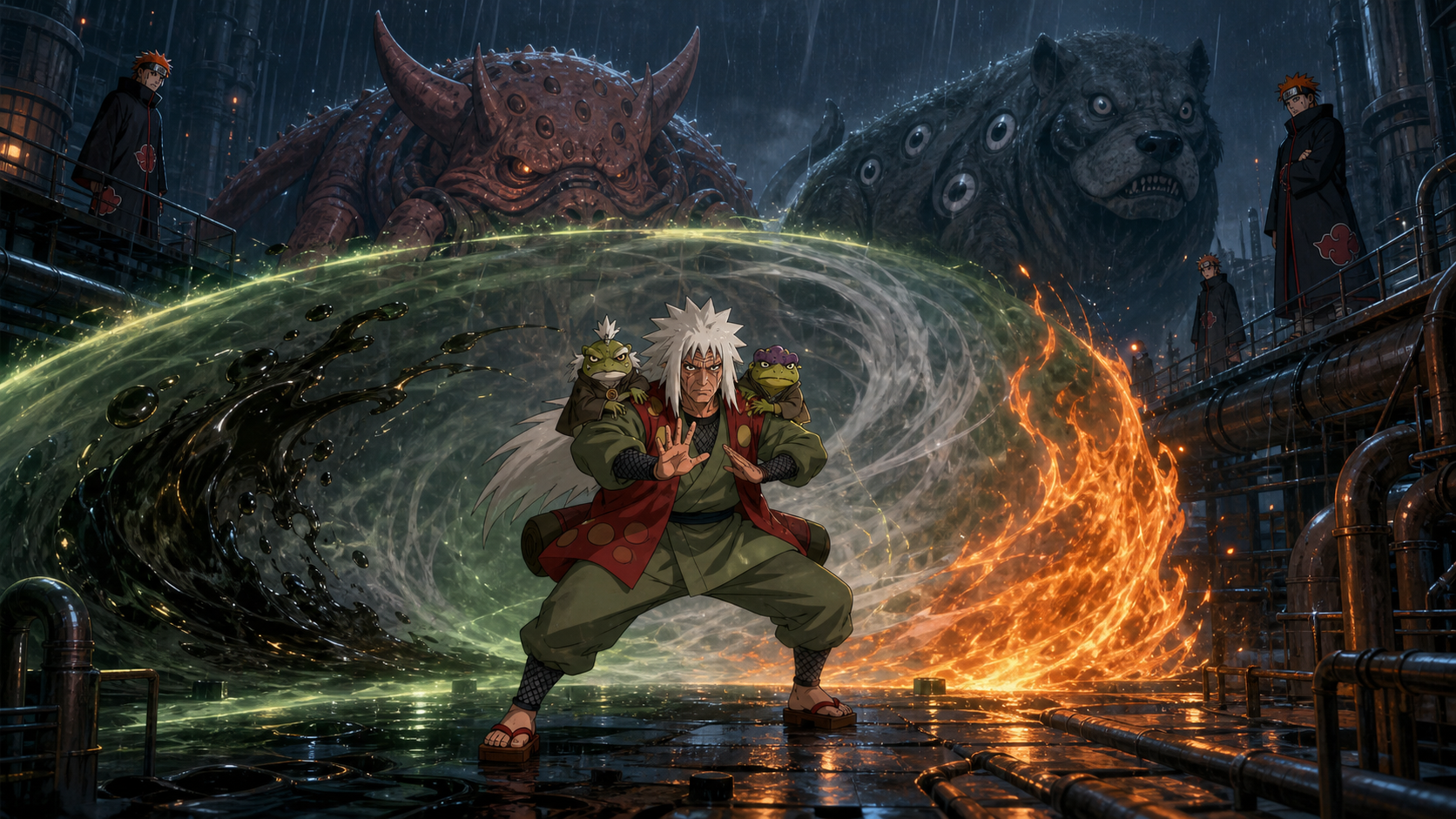
Honored Sage Mode!
Jiraiya’s strongest form makes collaboration visible while every successful counter exposes another mystery inside Pain’s design.
What happens
Jiraiya's confrontation with Konan draws Pain directly into battle. He realizes that ordinary techniques will not be enough against the leader who controls the Rain and begins the difficult preparation for Sage Mode.
Because Jiraiya cannot gather natural energy while moving, he summons Fukasaku and Shima to his shoulders. The two elder toads stabilize the transformation and bring their own sensory, vocal, and elemental abilities into the fight.
Pain answers with multiple bodies and enormous summons. A multiplying dog, a crustacean, and other creatures fill the industrial corridors, forcing Jiraiya to manage space rather than pursue a single opponent.
The three-person sage team combines oil, wind, and fire while studying how the Pain bodies coordinate. Every exchange makes it clearer that Jiraiya is not fighting one conventional ninja.
Sage Mode is collaboration made visible
Jiraiya's transformation is called Sage Mode, but it is not solitary mastery. He needs Fukasaku and Shima because gathering natural energy requires stillness he cannot maintain in active combat.
Their presence exposes the support hidden inside the legend. Jiraiya may be famous as an individual, yet one of his greatest forms depends on elders balancing chakra on his shoulders.
I love that the technique looks imperfect. His features become more toadlike than Naruto's later transformation, showing that mastery has degrees and personal shapes.
The roughness does not make it lesser. Jiraiya compensates with experience, teamwork, and a willingness to let other experts share control of the battle.
There is also generosity in how the episode frames age. Fukasaku and Shima are not retired symbols brought out for a ceremonial blessing. Their knowledge is active, embodied, and immediately useful. Jiraiya's strength includes knowing when the oldest people in the room understand a problem better than he does. That humility separates apprenticeship from mere power collection.
Three elements become one answer
The combined oil, wind, and fire attack demonstrates why the toad sages matter beyond maintaining natural energy. Each participant contributes a different substance, and the interaction produces something none could create alone.
That is a fitting counter to Pain's structure. Pain also distributes ability across bodies, but his coordination is centralized and mysterious. Jiraiya's coordination is conversational. Fukasaku and Shima argue, advise, and adapt beside him.
Both sides challenge the fantasy of the self-contained warrior. Power emerges from systems of linked perception and specialized roles.
The difference lies in relationship. The toad sages retain voice and personality. The Pain bodies move as instruments of a will Jiraiya has not yet located.
Summons turn architecture into a problem
Pain's creatures overwhelm the narrow Rain corridors with scale. A multiplying dog is especially dangerous because attacking it appears to increase the problem.
Jiraiya cannot solve that kind of enemy through force alone. He must identify the summoner, separate bodies, control movement, and avoid being trapped by the village's vertical pipes and flooded platforms.
The environment that helped Pain detect him now also shapes every tactical choice. Water carries movement. Gantries create sight lines. Enclosed chambers amplify sound and limit escape.
This is why the battle feels like investigation under pressure. Jiraiya is collecting rules while the rules are trying to kill him.
A teacher confronts the consequence of absence
Jiraiya knows Nagato possessed the Rinnegan, yet the orange-haired Pain body does not match the child he remembers. Konan's presence confirms continuity while Pain's identity resists it.
The uncertainty forces Jiraiya to question the story he told himself after leaving the orphans. He believed they had grown strong enough to pursue peace. He did not know what happened between that hope and the regime now facing him.
This is not an argument that teachers are responsible for every adult choice their students make. It is an argument that leaving creates gaps no amount of affection can fill later.
Jiraiya enters those gaps without demanding that memory make him safe.
His decision to continue is therefore more than professional duty. If Pain emerged from the children he taught, identifying the mechanism matters to the future of the Rain and to Naruto's safety. Retreat would preserve Jiraiya's life while leaving everyone else with a divine enemy and almost no usable explanation.
RaeRae reaction
I appreciate that Jiraiya's Sage Mode debut is powerful without becoming effortless. The preparation takes time, his transformation is visibly incomplete, and success depends on two elders who refuse to behave like silent accessories.
Fukasaku and Shima bring domestic texture into a lethal situation. Their familiarity with each other makes the battle feel grounded even when giant summons fill the frame.
Pain remains frightening because every answer creates another question. Defeating a summon does not explain the bodies. Recognizing the Rinnegan does not identify who is speaking. Knowing Konan does not reveal how her childhood hope became this allegiance.
“Honored Sage Mode!” celebrates Jiraiya's accumulated skill while stripping away the myth that experience guarantees understanding. He is at his strongest and still gathering the most important information in real time.
Imperfect Sage Mode tells the truth about mastery
My bottom line is that Jiraiya’s transformation is powerful because it refuses the fantasy of effortless completion. His face changes, his hands become more toadlike, and two elders must remain physically connected to maintain the natural-energy balance.
The form displays history rather than hiding it. Jiraiya learned enormously, reached extraordinary strength, and still has limits another student may eventually surpass.
Fukasaku and Shima are partners, not equipment
They speak, disagree, advise, sense, sing, and contribute their own techniques. Jiraiya cannot activate his best battle system by treating them as silent extensions of himself.
That distinction becomes important beside Pain. Both combat systems distribute power across several bodies. The toad partnership preserves individual voice. Pain’s bodies appear organized around one controlling will.
Stillness is the resource Pain refuses to give him
Natural energy requires balance and time without disruptive movement. The multiplying summons make stillness almost impossible, forcing Jiraiya to defend while preparing rather than separating preparation from combat.
Needing time is not weakness. It is a tactical condition that determines what support, terrain, and choices become necessary.
Age remains active on Jiraiya’s shoulders
Ma and Pa are not ceremonial elders who bless a younger fighter and leave. Their accumulated knowledge changes the battle immediately. Naruto rarely gives old age this much practical authority without removing personality.
Their domestic friction also keeps wisdom human. Expertise can arrive with impatience, affection, argument, and habits formed over a long partnership.
The combined elemental attack is collective authorship
Oil, wind, and fire become one answer because three people contribute different abilities in sequence. No participant owns the result alone.
That makes the technique thematically appropriate. Jiraiya faces a supposed god by accepting dependence. Collaboration answers divinity without pretending collaboration is tidy.
Pain’s summons turn force into a problem of rules
The multiplying dog punishes ordinary attack logic. More damage creates more bodies. Jiraiya has to identify relationships, control space, and search for the summoner rather than celebrate each successful hit.
Every enemy teaches him something about a system that remains hidden. Combat is reconnaissance performed with a body at risk.
The Rain’s architecture belongs to Pain’s battle plan
Narrow passages, water, pipes, height, and enclosed rooms shape movement. Pain does not fight in an empty arena. He uses the city whose weather already serves his surveillance.
Jiraiya must read architecture and opponent together while protecting the stillness his transformation requires.
Natural energy requires Jiraiya to negotiate with the world
Sage Mode does not create power from private will alone. Jiraiya has to draw from an environment that exists beyond him and keep that energy in proportion with what his own body produces. Too little changes nothing. Too much changes the body beyond safe return.
Balance is therefore practical rather than decorative language. The technique rewards attention to limits, surroundings, and relationship. It punishes the fantasy that more power is automatically better.
Ma and Pa make motion compatible with stillness
Jiraiya cannot remain still while Pain’s summons attack. Fukasaku and Shima solve the contradiction by gathering and managing energy while he moves. Their bodies create the continuity his solo body cannot maintain.
That is not a loophole that diminishes mastery. It is mastery expressed through a partnership designed around an honest limitation.
The shoulders make support impossible to hide
Stories often place helpers outside the frame once the hero receives power. Here the elders remain physically visible on Jiraiya’s body. Every enhanced strike and sensory judgment carries the image of who made the form sustainable.
Credit cannot be edited into one legendary man because the collaboration is built into his silhouette.
Domestic argument survives inside mortal danger
Fukasaku and Shima bring a marriage’s accumulated rhythm onto the battlefield. They complain, correct, and coordinate without becoming solemn symbols. Familiar irritation exists beside complete trust.
I love that texture. Partnership is not proven by constant agreement. It is proven by the ability to keep listening when the stakes rise.
Pain’s bodies coordinate without visible negotiation
The summons and Paths appear to share information and obey one strategy with almost no conversational delay. That efficiency frightens Jiraiya because normal assumptions about blind spots and divided attention stop working.
Perfect coordination raises a moral question before he knows the mechanism. Where are the separate wills inside the system?
Shared vision changes the geometry of combat
One body can observe an angle another body cannot. Attacking from behind loses value if sight is distributed across the formation. Jiraiya has to test whether coordinated reactions come from training, technique, linked senses, or something stranger.
The battlefield becomes an experiment whose failed hypotheses cause injury.
The multiplying dog punishes the obvious solution
Most shinobi survive summoned creatures by hitting harder. Pain’s dog turns damage into replication, making successful attacks increase the threat. Force without understanding becomes assistance to the enemy.
Jiraiya must revise quickly enough to contain rather than feed the technique. Experience shows itself in the willingness to abandon a familiar answer.
Giant summons also spend the city’s civilian space
Crustaceans, dogs, and other creatures fill corridors built around ordinary Rain life. Pain controls the battle, but residents inherit whatever damage escapes the hidden chambers.
A ruler who uses the village as a weapon also makes the village absorb the weapon’s footprint. Divine protection and civilian exposure can occupy the same policy.
Jiraiya keeps investigating when escape would be rational
He already knows Pain is extraordinarily dangerous and connected to his former students. Retreat could preserve his report. It would leave the central mechanism unknown, which means Konoha would meet the same system without tested assumptions.
His decision is brave and costly. Courage does not make the risk mandatory, but it explains why intelligence becomes worth more than personal safety.
Every answer changes the report he hopes to send
Multiple bodies, shared eyes, strange summons, the Rinnegan, Konan, and rain surveillance are not separate curiosities. Jiraiya is trying to identify the relationship that makes them one enemy.
A list of powers might warn Konoha. A model of the system could give future fighters a chance to break it.
The teacher recognizes technique before identity
Jiraiya sees familiar eyes and an unfamiliar body. That mismatch refuses the emotional shortcut of declaring Nagato returned. Memory helps him ask better questions while making every possibility more painful.
If Nagato controls the body, what happened to his own? If someone else holds the Rinnegan, what happened to the child? Recognition becomes investigation rather than reunion.
Sage Mode amplifies perception without supplying interpretation
Natural energy expands Jiraiya’s senses and physical ability. It does not tell him why Pain exists or how the bodies connect. More information still requires judgment.
This is a useful limit on power. Seeing further does not guarantee understanding better, especially when grief shapes the observer.
Jiraiya’s imperfect form carries the history of his training
The toadlike features show where the power comes from and how his body adapted. Naruto’s later cleaner form should not retroactively make Jiraiya’s version embarrassing.
Different students embody the same discipline differently. Progress is not meaningful only when it resembles the final generation.
The elders accept danger because the question reaches beyond Jiraiya
Fukasaku and Shima are not obligated accessories to his mission. They choose to help investigate an enemy threatening jinchuriki, villages, and the possibility attached to Naruto.
Their consent distinguishes this partnership from the coercive use of Manda. Summoning can create relationship or exploitation depending on whether another being retains a voice.
Power exposes character through how dependence is handled
Jiraiya names what he needs and lets partners contribute. Pain appears to distribute tasks across bodies whose agency is hidden. Both systems increase one fighter’s reach. Their ethics may be located in the relationship between center and parts.
The mystery is not only how Pain works. It is what kind of relationship makes that work possible.
The episode also asks what a legendary ninja owes the people supporting his legend. Jiraiya receives public credit for strength while Ma and Pa supply balance, sensory range, elemental coordination, and accumulated knowledge. He does not deny their contribution. He argues with them, listens, and keeps their names inside the work.
That openness matters because Jiraiya has often performed himself as the singular wandering sage. The battle reveals a network behind the persona: Mount Myoboku trained him, elders stabilize him, summons create space, and students give purpose to the risk. Individual fame sits on collective history.
Pain constructs singularity from the opposite direction. Several bodies, summons, and fields of vision support the identity of one god. The network is visible, but its members appear without independent claims. All credit and fear move toward the name Pain.
Jiraiya does not yet know that corpses are involved, so he cannot complete the ethical comparison. He can still sense that ordinary teamwork does not explain what he sees. The bodies coordinate too completely, recover information too quickly, and present the same eyes where separate identities should remain.
This is why separating a Path becomes more than a tactical maneuver. Isolation tests whether the system loses sight, command, or access when one component leaves the network. Jiraiya is building knowledge through controlled disruption. Each result narrows the mechanism.
Ma and Pa contribute a different kind of shared perception. They tell Jiraiya what they notice and remain capable of disagreement. Their information becomes common through communication rather than automatic control. That process is slower, but it preserves the people producing the knowledge.
Efficiency is not the only value a combat system can express. Pain’s design may react almost perfectly because distinction has been removed. Jiraiya’s partnership contains friction because distinction remains. The episode lets the messier relationship become a source of resilience.
I also refuse to treat Jiraiya’s changing face as a cosmetic failure. His body shows the negotiation with natural energy instead of hiding the source behind a conventionally attractive transformation. Power leaves evidence. The evidence connects him to teachers and a place beyond Konoha.
That visibility makes his Sage Mode feel earned. He does not become a cleaner version of himself. He becomes more entangled with the world that taught him. Toad features, elder voices, and combined techniques all contradict the idea that transcendence means leaving relationship behind.
Pain claims transcendence by making relationship unreadable. The bodies share eyes, but viewers cannot yet see consent, history, or personhood inside the arrangement. Jiraiya’s task is to restore those missing connections before power turns mystery into divinity.
For me, the best part of the episode is that strength never ends the need to think. Sage Mode raises Jiraiya’s ceiling and immediately confronts him with a system brute force cannot explain. Experience gives him more tools, not permission to stop asking questions.
Jiraiya’s willingness to remain curious under attack is part of what makes him dangerous. He does not interpret the successful counter as proof he understands the enemy. He keeps watching for contradictions, repeated eyes, impossible timing, and the gap between the student he remembers and the body in front of him.
That discipline is emotional as well as tactical. A frightened teacher could seize the familiar detail and declare an answer. Jiraiya allows recognition to unsettle him without letting it close the investigation. Love creates urgency, but evidence still has to shape the conclusion.
The cost is that gathering evidence requires staying inside Pain’s range. Every additional observation may help Naruto and Konoha while reducing Jiraiya’s chance of leaving. Intelligence work becomes a decision about how much future safety one present body can responsibly purchase.
I do not call that sacrifice automatically noble. People who love Jiraiya will carry consequences he cannot choose for them. I call it a serious decision made by someone who has already protected the information that must survive him. Sage Mode gives him power to continue. Ma and Pa give him partners who can question, witness, and possibly carry what he learns.
RaeRae’s final word on Sage Mode
I love that Jiraiya reaches his strongest form by admitting what he cannot do alone. Ma and Pa balance energy, contribute techniques, challenge conclusions, and keep their own voices.
The physical imperfection makes the form more meaningful. Mastery is not one polished endpoint. It is knowing enough to work responsibly with the limits that remain.
Pain’s distributed system looks divine because one will appears everywhere. Jiraiya’s system looks messy because three people negotiate. I trust the mess more.
The episode celebrates power while keeping investigation central. Jiraiya is stronger, not omniscient. Every counter buys another question, and every question may be the intelligence Konoha needs if he cannot carry himself home.
RaeRae’s call
Jiraiya’s imperfect Sage Mode is collective strength made visible. Ma and Pa preserve their voices while helping him investigate an enemy system built from bodies without apparent agency.