
The Man Who Became God
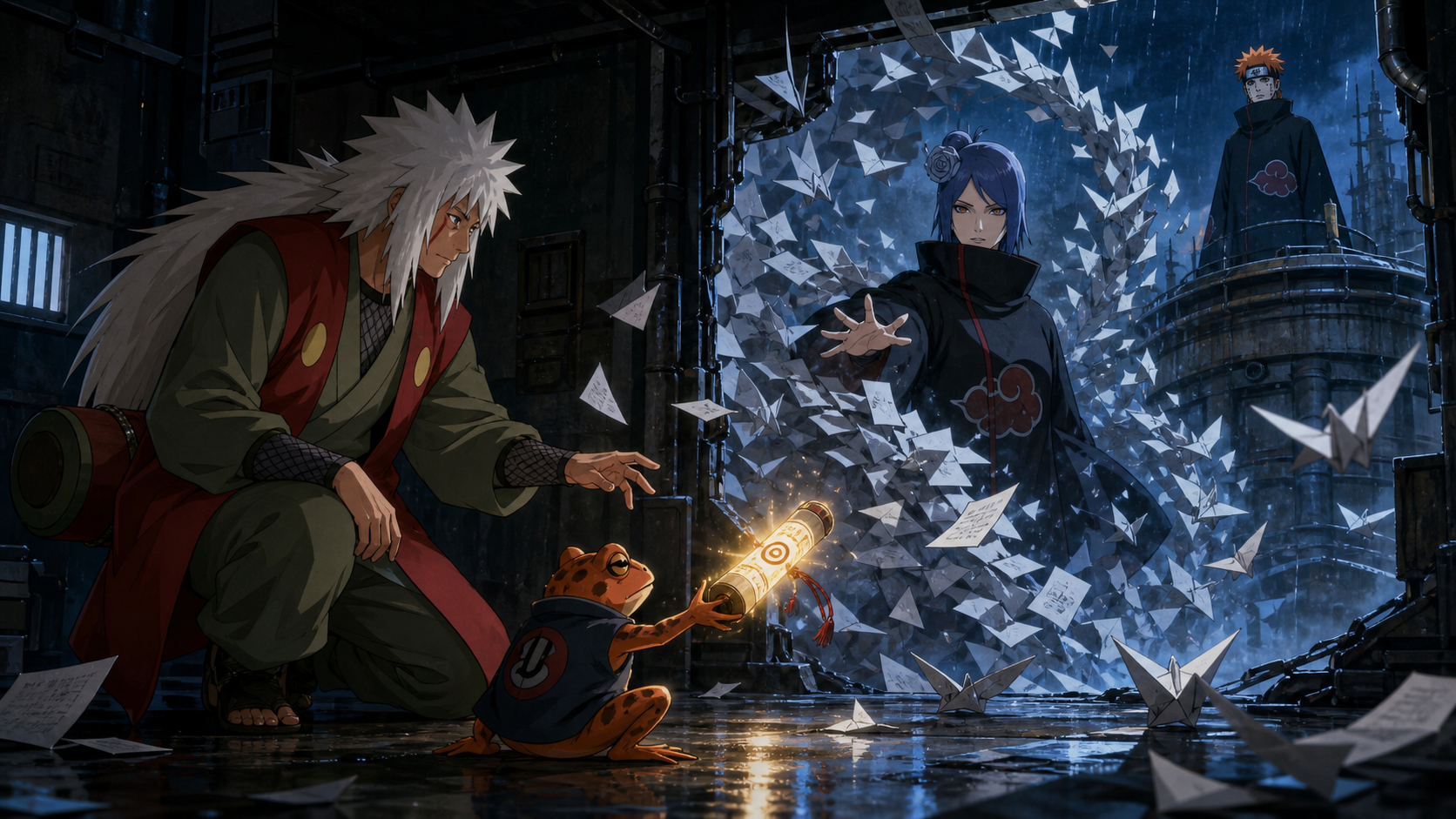
Jiraiya secures Naruto’s future before a paper storm turns divine myth back into the faces of students he once loved.
What happens
Jiraiya understands that the infiltration may become a battle he cannot leave. Before moving deeper into the village, he releases Gerotora, the scroll toad who carries the key to Naruto's Eight Trigrams Seal.
The precaution separates two responsibilities. Jiraiya must investigate Pain now, but knowledge connected to Naruto's future cannot be allowed to disappear with him. Gerotora leaves carrying both a technical key and evidence of the trust Jiraiya places in his student.
Jiraiya disguises himself as a captured Rain ninja and resumes reconnaissance. Pain has already detected the intrusion, and Konan attacks with a storm of paper.
Teacher and former student recognize each other across the battlefield. Jiraiya counters her technique with oil, restraining the paper, but the reunion offers no relief. Konan's loyalty is now aligned with Pain and the godlike order governing the Rain.
Preparing for death is not surrender
Jiraiya's decision to send Gerotora away is one of the episode's quietest and most important actions. He is not declaring that he will lose. He is ensuring that a loss will not erase everything entrusted to him.
That is mature risk management rather than fatalism. Shinobi stories often celebrate entering danger with total confidence. Jiraiya shows a different kind of courage: he plans for the possibility that courage will not be enough.
The seal key also connects his mission to Naruto even while they are physically separated. Jiraiya's research, Minato's design, and Naruto's body form a chain of knowledge that no single person should own completely.
Passing the key onward means accepting that the next generation may need to make decisions he will not be present to guide.
It also reframes inheritance as access rather than command. Jiraiya cannot decide in advance how Naruto will use the seal or relate to the Nine-Tails. He can preserve the knowledge, explain the danger, and leave room for Naruto to become more than the container adults designed around him.
Konan returns as an answer Jiraiya did not expect
Jiraiya once knew Konan as a child folding paper flowers in a shelter. Her adult technique transforms paper into flight, weapons, concealment, and multiplication.
The continuity is beautiful and painful. She did not abandon the thing that made her distinctive. She developed it until tenderness and threat occupied the same material.
Jiraiya responds with oil because he understands paper's physical weakness. The counter is tactically efficient, but the scene carries the discomfort of a teacher using old knowledge against a student.
Konan is not presented as confused about her allegiance. She believes in Pain and the order they created from the Rain's suffering. Jiraiya's affection cannot substitute for engaging with the political history that shaped that belief.
The man called god was once a student
Pain's title creates distance. A god appears self-created, beyond ordinary history, and answerable to no teacher.
Jiraiya's presence threatens that story because he remembers Nagato, Yahiko, and Konan before the sacred imagery. He knows their hunger, training, arguments, and hopes. Memory makes divinity human again.
That does not make Pain less dangerous. It makes the danger more tragic and more legible. The leader controlling the rain did not descend from nowhere. He emerged from a child whose country became a battlefield for stronger villages.
The episode asks what kind of power can grow when suffering is given enormous ability but no durable justice.
Jiraiya is both mentor and operative
Jiraiya enters the encounter carrying genuine care, but he is also conducting an intelligence mission for the Leaf. Konan has reason to see both identities.
From his perspective, he is trying to understand how his former students became central to an organization hunting tailed beasts. From hers, a representative of a Great Nation has infiltrated the village they fought to control.
Neither frame cancels the other. Their past gives the conflict emotional weight, while their current institutions give it political stakes.
I appreciate that the reunion does not pause the mission for easy sentiment. Recognition matters, but it cannot undo years Jiraiya did not witness.
RaeRae reaction
The seal-key scene is the part that stays with me. Jiraiya sends away something essential before the first major exchange because responsibility means thinking beyond his own survival.
Konan's entrance is visually striking without losing character meaning. The paper storm is not decoration. It is the grown form of a child's creative language and a declaration that she has chosen where she stands.
Jiraiya's oil counter demonstrates experience, yet it also exposes the imbalance of memory. He knows the foundation of her technique. He does not yet know the full story of the person using it.
“The Man Who Became God” begins stripping divinity back into biography. Before Jiraiya can confront Pain's power, he must face the possibility that his students built this world from lessons, wounds, and absences he helped leave behind.
Gerotora carries a future Jiraiya may not reach
My bottom line is that Jiraiya’s most responsible act happens before the reunion. He sends the seal key away because information tied to Naruto’s body cannot depend on one man’s survival. Planning for death is not the same as choosing it.
The decision turns inheritance into access. Jiraiya preserves knowledge without dictating the exact future use. Naruto and the people protecting him will have to judge risks Jiraiya cannot settle in advance.
The seal key belongs inside a history of adults managing Naruto’s body
Minato designed the seal, Jiraiya studied it, and Gerotora carries the means to alter it. Naruto lives inside the consequences. Technical expertise is necessary, but expertise should not erase the person whose body contains the system.
Jiraiya’s trust matters most when it leaves room for Naruto to become more than a vessel managed by older men.
Konan enters as a political actor, not a memory restored
Jiraiya recognizes the child he taught. Konan meets an infiltrator from the Leaf. Their shared past is real, but it does not dissolve the current conflict or grant the former teacher authority over her conclusions.
Recognition opens history. It does not replace the work of hearing what happened after Jiraiya left.
Paper carries childhood forward without preserving innocence
The same material once became flowers inside a temporary home. Adult Konan turns it into surveillance, flight, multiplication, and blades. The continuity is tender and frightening because the creative language survived by adapting to violence.
Growth does not require abandoning softness. It can mean building protection around the thing war tried to make impossible.
Jiraiya’s oil counter contains the intimacy of old knowledge
He recognizes paper’s physical weakness and responds efficiently. The tactic shows experience, but it also places teacher knowledge inside a fight against the student. What once helped him guide her now helps him restrain her.
That reversal is part of the grief. Knowledge shared in care remains usable after allegiance changes.
Pain’s divinity depends on biography disappearing
A god appears self-created, beyond family, teachers, hunger, and political cause. Jiraiya remembers Nagato before the title. His presence threatens the myth by carrying evidence that Pain had a childhood and once imagined a different route to peace.
Human origin does not reduce the power. It makes power answerable to choices rather than destiny.
The god story has material proof behind it
Pain controls rain surveillance, defeated Hanzo, and reorganized the village. Citizens are not believing an empty slogan. Extraordinary ability gives sacred language repeated evidence.
That makes the political mythology harder to challenge. Propaganda attached to visible power can feel like ordinary description.
Jiraiya and Konan stand inside different accounts of the Leaf
He may see a village worth protecting despite its failures. She knows a great power whose wars used the Rain and whose operative has entered again without permission. Neither history becomes false because the other exists.
The reunion requires political accountability, not only affection.
Gerotora’s reluctance deserves attention because the seal key is not a neutral inheritance. Altering Naruto’s seal can increase access to the Nine-Tails and increase danger to Naruto and everyone around him. Jiraiya believes the future may require that risk. Gerotora remembers enough of the design to question whether confidence has outrun evidence.
That disagreement is healthy. Knowledge should not move through a chain of obedience without friction, especially when the object of discussion is another person’s body. Gerotora can carry the key and still challenge the assumptions attached to it. Loyalty is stronger when it permits warning.
Jiraiya’s choice is responsible because he sends the information away before combat and troubling because Naruto is not present for the conversation about his own seal. The shinobi world repeatedly makes urgent decisions around jinchuriki bodies while claiming necessity. Preserving knowledge is essential. So is eventually returning agency to the person who bears the consequences.
The episode places that question beside Pain’s rule for a reason. Pain also believes extraordinary danger justifies concentrated control. He has seen villages ignore suffering until force reaches them. His answer is to make himself the authority who decides what pain the world must experience. A legitimate diagnosis does not make unilateral punishment just.
Nagato’s childhood gives the diagnosis moral weight. His parents died because Leaf ninja entered a home during war and mistook civilians for enemies. Yahiko died inside a betrayal involving Hanzo and Danzo. The Rain became a route and battlefield for stronger nations. None of that is invented grievance.
Calling Pain human is therefore not a way to dismiss him as merely wounded. It is a demand that political analysis hold cause and choice together. He was harmed by systems with real power. He later builds a system that makes other people absorb suffering under his command. Victimhood explains the road without sanctifying its destination.
Konan stands inside that history with her own memories. She watched Jiraiya stay when Orochimaru proposed death. She helped build Yahiko’s organization. She survived the ambush and remained beside Nagato when grief reorganized their movement. Her loyalty has political content, even when the series gives her too little dialogue to articulate it.
I want to know how she understands the angel title. Does she use sacred imagery because it stabilizes the Rain, because Nagato’s authority feels necessary, because shared grief made separation unthinkable, or because all three became inseparable? Treating her as a decorative believer wastes the character standing closest to the transformation.
Her attack shows judgment rather than frenzy. She identifies the infiltrator, uses paper to control space, and responds to someone whose abilities she knows. Jiraiya counters efficiently because teacher and student share technical history. Every move carries recognition even when neither person can pause for reunion.
Oil against paper is a simple elemental relationship with emotional cruelty inside it. Jiraiya remembers the foundation of Konan’s craft and can exploit its physical limit. A teacher’s attention once made growth possible. The same attention now creates vulnerability. Knowledge remains intimate after trust changes.
Konan also knows Jiraiya’s habits. His theatrical disguise and humor do not make him a stranger. She has reason to anticipate toads, barriers, oil, and the stubbornness beneath performance. Students study teachers too. The exchange should not be framed as experience acting on a passive former pupil.
Jiraiya’s infiltration forces both sides to confront the version of history they would rather control. He may want to believe the children carried his hope toward peace. Pain’s regime presents a violent answer. Konan and Nagato may want the great villages reduced to sources of hypocrisy. Jiraiya’s decision to stay with them remains evidence that individuals can interrupt institutional logic.
One compassionate adult never repaired the Rain, but his presence mattered. One abandoned country did not inevitably produce Akatsuki’s later crimes, but its exploitation mattered. Editorial honesty refuses the comfort of one cause because responsibility is distributed across people, governments, wars, and choices.
The god title tries to simplify that distribution. If Pain is divine, his judgments require no institutional account and his history becomes proof of revelation. If Pain is only a monster, the great villages do not have to face the world that shaped his argument. Jiraiya’s memory breaks both convenient stories.
He remembers Nagato as gentle enough to be frightened by his own power. That memory cannot absolve the adult, but it prevents power from erasing transformation. Something happened between the child who wanted to protect friends and the ruler who uses omnipresent fear. The investigation needs that sequence.
Jiraiya’s role in the sequence is limited and real. He gave food, shelter, training, and belief. He left when the children could defend themselves. He did not remain to help them confront political manipulation or return soon enough to understand how the movement changed. Care and absence both shaped what followed.
Sending Gerotora away shows he has learned at least one lesson about absence. If he fails to return, vital knowledge should still reach Naruto. He cannot prevent grief, but he can reduce how much the future loses with him. Preparation becomes a final form of teaching before the battle begins.
I resist romanticizing that preparation as proof he expects or welcomes death. Jiraiya wants to survive and report. He also knows courage is not armor. Mature responsibility includes the possibility that skill, conviction, and narrative importance will not guarantee return.
That realism makes the coming fight hurt more. Jiraiya is not wandering blindly into obvious doom. He assesses, preserves intelligence, separates what must survive, and continues because Akatsuki’s leadership threatens people beyond him. The decision is deliberate without being clean or inevitable.
The episode’s title points at Nagato, but Jiraiya performs the opposite of godhood. He accepts limitation. He cannot carry every responsibility, control every outcome, or remain the sole keeper of knowledge. Gerotora leaves because a human being plans around mortality.
Pain responds to limitation by trying to rise above it. If he becomes the source of punishment and peace, uncertainty narrows. Other nations will understand because he will force the lesson. The method protects him from depending on consent, persuasion, or institutions he has learned to distrust.
That protection is emotionally understandable and politically catastrophic. Peace imposed by one person’s capacity to destroy lasts only while fear and monopoly remain intact. It teaches obedience to overwhelming pain, not the mutual recognition Pain claims to want.
Jiraiya has not yet heard the full argument, but the city and Konan’s attack announce its structure. The children he taught to survive now govern a place through powers that make refusal dangerous. His lesson succeeded at the level of endurance and failed to guarantee the ethics of what endurance became.
No teacher can guarantee a student’s ethics forever. That truth should protect students from being treated as extensions and protect teachers from being credited or blamed for every later choice. It should not erase the responsibility to ask how teaching, departure, and institutional silence shaped the choices available.
I also appreciate that Naruto remains present through the absent seal. Jiraiya is confronting one prophetic student while protecting another. Nagato and Naruto are not interchangeable candidates in a destiny contest. They are two people whose losses, teachers, power, and political environments produced different answers to pain.
The seal key suggests Jiraiya still believes Naruto may build a relationship with the Nine-Tails that previous generations could not imagine. Pain suggests Nagato believes relationships between nations require an engineered catastrophe. Both futures involve dangerous power. One leaves possibility with a student. The other concentrates judgment in the self.
Konan complicates that neat contrast because she represents collective loyalty inside Pain’s supposedly singular godhood. The regime depends on her labor, intelligence, symbolism, and history. No god rules alone. Divinity hides the network of people who maintain power and the choices those people still possess.
That is why I want her recognition of Jiraiya to land as more than surprise. The teacher’s return reopens a time before angel and god, when three children shared food and argued about peace. Memory can threaten authoritarian identity because it proves the present arrangement was not the only imaginable future.
The paper storm tries to contain that threat before conversation can change its meaning. Jiraiya’s oil answers with another shared memory encoded in technique. They are fighting in the present with knowledge created during care. Every counter says, I remember who you were, while neither yet knows whether remembrance can reach who the other became.
For me, that tension makes the episode ache before the battle begins. Jiraiya did not come to reclaim students. Konan does not appear to request rescue. They meet as adults carrying love, violence, institutions, and incompatible duties. The tragedy is not that time changed them. Change was inevitable. The tragedy is that the world gave their reunion a battlefield before it gave them a room.
RaeRae’s final word on the man called god
I keep returning to the seal-key scene because Jiraiya protects tomorrow before confronting yesterday. He makes sure Naruto’s future does not vanish if the mission kills him.
Konan’s paper storm is beautiful because it carries her whole visual history. The flower did not disappear. It learned to become armor, movement, and threat.
I will not treat her as a lost student waiting for the correct teacherly sentence. She survived years Jiraiya did not witness and helped build a government from the Rain’s legitimate wounds.
The title starts to fail as soon as biography returns. Pain may possess godlike force, but Jiraiya remembers the hungry child beneath the system. The coming fight will test power. This episode first asks who benefited when the human story was erased.
RaeRae’s call
Jiraiya protects Naruto’s future before facing his own past. Konan’s paper turns memory into resistance, while Pain’s divine identity begins cracking under the return of biography.