
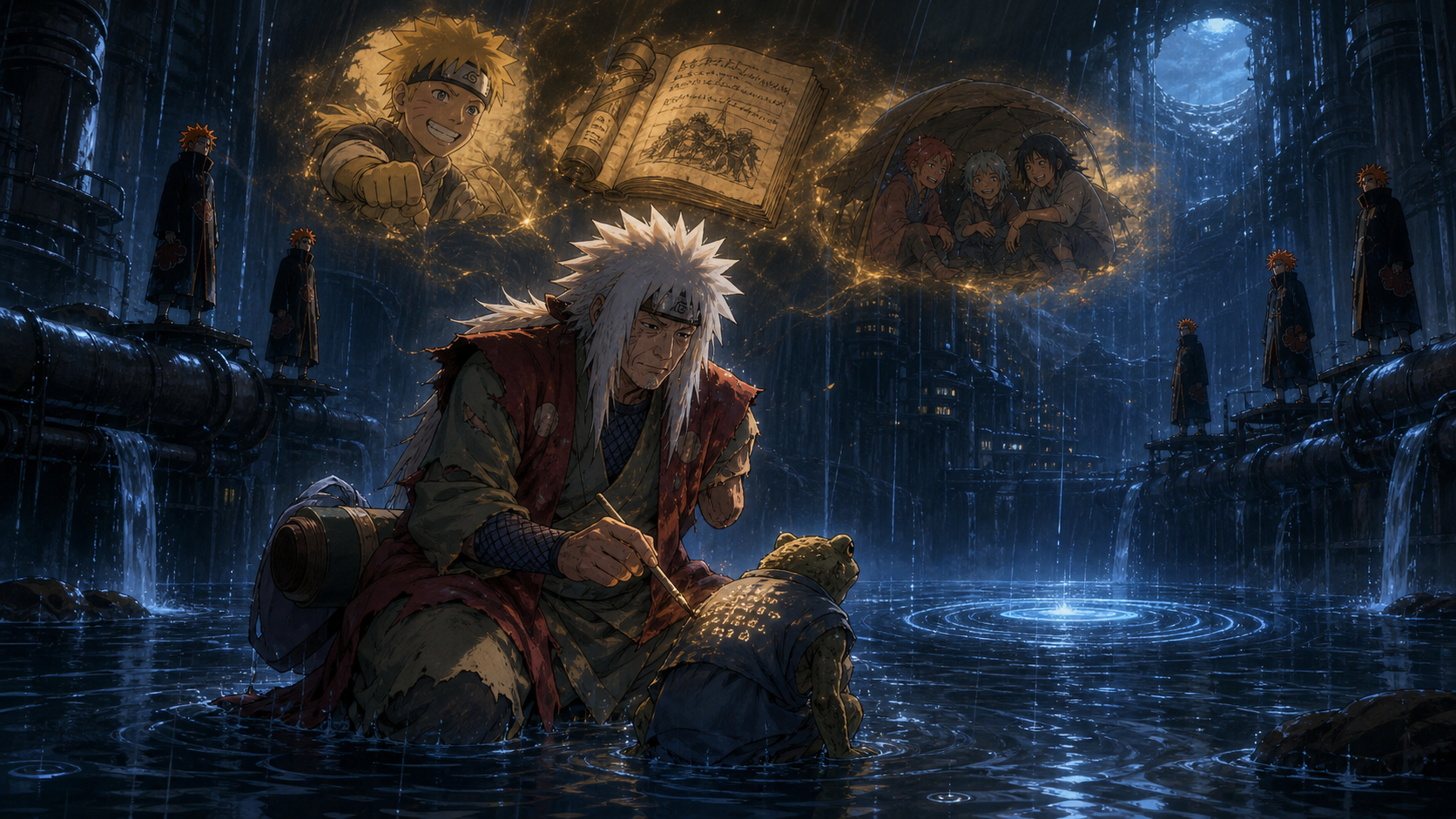
The Tale of Jiraiya the Gallant
Jiraiya cannot finish every dream, but he can turn one last discovery into the next chapter of Naruto’s life.
What happens
Jiraiya's sound-genjutsu plan defeats the three Pain bodies in front of him, but the victory is incomplete. Additional bodies arrive, revealing the full Six Paths formation and striking before he can escape.
Among them, Jiraiya recognizes Yahiko's face. Other bodies also resemble ninja he encountered during his travels, while Nagato, the student who actually possessed the Rinnegan, is absent.
The pattern gives Jiraiya the answer he came for: the visible Pains are not the real source. Someone elsewhere is controlling corpses or reconstructed bodies through the shared Rinnegan network.
Jiraiya could withdraw with partial information, but he returns to confirm the secret. Gravely outmatched, he sends Fukasaku away carrying a coded message for the Leaf and Naruto.
His final thoughts return to his first novel, his failures, and the student named after its hero. He decides that the ending of Jiraiya's own story can still give Naruto a beginning.
A victory that reveals a larger defeat
The sage song works. Jiraiya and the toad elders execute their plan correctly, trap three bodies, and create what should be a decisive opening.
Then the remaining Paths appear, turning success into new evidence. Pain's system contains redundancy. Defeating the visible formation does not defeat the controller or even exhaust all available bodies.
That reversal does not invalidate the strategy. It proves how much larger the mechanism is than anyone outside the Rain understands.
Jiraiya's mission changes in that moment. Surviving with a report would be valuable. Identifying the actual source could be the difference between future victory and an entire village being destroyed by an enemy nobody can locate.
Yahiko's face and Nagato's absence
Seeing Yahiko among the Six Paths collapses Jiraiya's past into the battlefield. The child who dreamed of peace has become the public face of a regime built around pain.
Yet the Rinnegan belonged to Nagato. That contradiction is the key. If Yahiko's body carries Nagato's eyes, identity and appearance have been deliberately separated.
The other recognizable faces strengthen the theory. Jiraiya met these people in different places and periods; they could not all naturally share the same eyes and will.
His years of wandering become essential intelligence. A less traveled observer might see six unknown enemies. Jiraiya sees a collection of dead histories arranged around one missing person.
Returning is a terrible and rational choice
Jiraiya has an opportunity to leave after the first exchange. Fukasaku urges survival because the information already gathered matters.
Jiraiya returns because the central secret remains unconfirmed. The choice is painful precisely because it is not simple recklessness. He understands the cost and can articulate why the additional fact matters.
That does not mean sacrifice should always be romanticized. Institutions often depend on individuals accepting impossible risks. The Leaf sent Jiraiya alone because his skill made the mission plausible, not safe.
What makes his decision his own is the purpose: he is not trying to protect a reputation. He is trying to leave others a usable weakness.
The code turns a body into a message
With speech and movement failing, Jiraiya writes the clue on Fukasaku's back. The message must survive even if he does not.
This is intelligence stripped to its core. Information needs a carrier, a recipient, and enough context to be decoded later. Fukasaku becomes the living bridge between the Rain and the Leaf.
The code also reflects Jiraiya's life as a writer. He has spent years turning experience into stories, sometimes badly, sometimes beautifully. His final contribution is another compressed text whose meaning depends on the readers he trusts.
He cannot explain everything. He gives them the sentence that will let them continue asking the right question.
Naruto becomes the next chapter
Jiraiya looks back on a life full of unfinished work. He did not bring Orochimaru home, win Tsunade's love, prevent his students' tragedy, or complete the peace he imagined.
If success is measured only by resolved goals, he can call himself a failure. The episode rejects that accounting.
His first novel did not transform the world, but Minato read it and named Naruto after its hero. Naruto then embodied the refusal to give up that Jiraiya had placed on the page before he fully lived it himself.
Influence travels through people in forms the author cannot control. Jiraiya's story matters because Naruto receives it, revises it, and carries it farther.
RaeRae reaction
This episode earns its grief by keeping Jiraiya active until the end. He is not reduced to a memory montage while events happen around him. He observes, theorizes, chooses, encodes, and sends information forward.
The title calls him gallant, but the quality that moves me is not swagger. It is his willingness to let another person become the meaning of his unfinished life.
Naruto does not erase Jiraiya's failures. He proves those failures did not prevent Jiraiya from becoming a teacher whose belief changed what was possible.
The final image of descent feels like an ending, but the message is already moving toward the surface. Pain wins the room. Jiraiya wins the continuation.
The full Six Paths turn victory into evidence
My bottom line is that Jiraiya does not fail because the sage song was weak or the plan foolish. The genjutsu defeats the three bodies he can see. Their replacements prove that Pain’s system contains redundancy and that the visible formation was never the whole answer.
A correct tactic can succeed locally while exposing a larger strategic problem. That distinction protects intelligence from hindsight.
Yahiko’s face makes public identity part of the weapon
The leader presented to the Rain wears the body of the child who first articulated its dream of autonomy. Yahiko’s charisma and sacrifice remain politically useful after death, but the body cannot speak about how his vision changed.
Pain’s authority therefore depends on memory and erasure at once. Citizens recognize a symbol while the person behind it is absent.
Nagato’s absence is more important than another visible body
The Rinnegan belonged to Nagato, yet none of the faces is his. Jiraiya’s breakthrough comes from treating absence as positive evidence rather than an empty gap.
If the original owner is missing while the eyes appear everywhere, the source must exist somewhere beyond the formation.
Jiraiya’s travels become a forensic archive
He recognizes other Paths as people met in different places and years. Their unrelated histories make a natural shared identity impossible. Wandering supplied the comparison no official file could give him in time.
Memory restores personhood and reveals construction through the same act.
Returning is rational without becoming morally simple
Jiraiya can leave with valuable partial intelligence. He returns because confirming the absent controller may give future fighters an actionable weakness. The choice is deliberate, not an automatic requirement of heroism.
Tsunade, Naruto, Ma, Pa, and the village will pay emotional costs he cannot choose only for himself. Sacrifice always has more than one account.
The code preserves the answer when the body cannot
Jiraiya uses Fukasaku’s back as the surface for a compressed message. Speech, strength, and time are failing, so writing becomes the remaining route between discovery and community.
The final intelligence act belongs to relationship. A message survives because a trusted partner can carry it and readers at home can interpret it.
His life as a writer reaches its clearest purpose
Jiraiya wrote entertainment, research, fantasy, and one hopeful novel that seemed unsuccessful. At the end, he again trusts a limited text to reach somebody who can give it more meaning than the author controls.
Writing does not finish the struggle. It lets another person begin from more truth.
A complete answer could save lives, but Jiraiya cannot buy it alone
Returning to the chamber gives Jiraiya the confirmation that none of the visible bodies is the original source. That knowledge will matter when Konoha faces Pain. The price includes his life and the grief of people who never consented to lose him for the mission.
Both truths belong in the evaluation. The choice is strategically defensible without becoming a template institutions should demand from every operative.
Heroism should not make unsafe systems look acceptable
The Leaf benefits because one exceptional shinobi enters hostile territory without backup and continues after escape becomes possible. His courage reduces the consequences of an intelligence failure larger than him.
Admiring Jiraiya should increase scrutiny of the system that required one body to carry reconnaissance, emotional history, combat, analysis, encryption, and delivery.
Fukasaku is a partner, witness, and living archive
The code reaches Konoha because Fukasaku survives. He carries marks on his body, his own memory of the fight, knowledge of Sage Mode, and grief for the man who sent him away.
Calling him a messenger would be too small. He is part of the intelligence and one of the people who must translate Jiraiya’s final choices.
The message depends on readers Jiraiya trusts
A code does not communicate by existing. Someone must recognize the key, reconstruct the context, and test what the sentence means against other evidence. Jiraiya cannot finish that process from the Rain.
His last act is therefore an admission of dependence. Meaning will be collective or it will be lost.
The writer leaves an unfinished sentence on purpose
Jiraiya spent much of his life writing stories whose endings he could control. The final code is different. It contains only enough information for other people to continue the investigation.
That incompleteness is not failure. A responsible text can tell the truth it knows and leave room for readers to discover what the author could not.
Yahiko’s body carries a politics he can no longer revise
Pain uses the face of the original Akatsuki’s public dream. Residents see continuity between Yahiko’s charisma and divine rule, but Yahiko cannot consent to the policies performed through his remains.
The body becomes political legitimacy stripped of political voice. That is one of the deepest violations inside the Six Paths system.
Nagato remains hidden behind the friend he lost
Using Yahiko’s body may preserve grief, punish the world, and keep the dead companion at the center of the movement. It also prevents Nagato from appearing publicly as the person making decisions.
Trauma and authority fuse. The world confronts Yahiko’s face while Nagato avoids the vulnerability of governing in his own.
Jiraiya recognizes the mechanism because he recognizes people
Technical analysis alone identifies shared vision and coordinated abilities. Personal memory identifies that the bodies belonged to unrelated men encountered across his travels.
Human attention produces the decisive intelligence. Remembering faces is not sentimental distraction from the mission. It solves the mission.
His wandering was not wasted even when it looked undirected
Jiraiya often judged himself against cleaner accomplishments: becoming Hokage, saving Orochimaru, winning Tsunade, identifying the prophetic student, or writing a celebrated book. Travel seemed like searching without arrival.
At the end, those scattered encounters become the archive that lets him see Pain clearly. A life can gather meaning after the person stopped expecting that form.
Failure is the wrong unit for measuring a teacher
Jiraiya did not prevent every student’s suffering or control what they became. A teacher who judges success by ownership of outcomes will always either claim too much credit or carry impossible blame.
The better measure is whether teaching expanded another person’s capacity to choose, learn, and continue. Naruto provides that answer without making Jiraiya flawless.
Naruto inherits a principle rather than a finished solution
The gutsy ninja in Jiraiya’s novel refuses to abandon peace. Naruto receives the name and the promise, but he must create methods the book did not supply.
Inheritance is alive because the student can revise it. Jiraiya gives direction without demanding imitation.
Minato and Kushina helped make the book a family object
They read the character as a hope worth giving their child. That choice connected Jiraiya’s uncertain fiction to Naruto before teacher and student built their own bond.
The novel’s influence traveled through readers, parenting, naming, and later training. Art works through relationships the author cannot schedule.
Jiraiya’s memories do not absolve his absences
He loved Naruto, Tsunade, his students, and Konoha. He also stayed away during years when Naruto needed protection, left the Rain children before their political danger was resolved, and often used wandering to manage intimacy.
A loving farewell can hold accountability. Grief does not require turning a complicated man into a perfect guardian.
His last thought gives Naruto agency over the continuation
Jiraiya does not imagine Naruto as a monument to himself. He believes Naruto can finish what the teacher could not. The future matters more than preserving the author’s reputation.
That faith is powerful because it accepts being surpassed. A student’s different answer can honor the lesson more deeply than repetition.
Drowning closes the body while the message moves upward
The visual direction carries the episode’s argument. Jiraiya sinks into dark water. Fukasaku and the code move toward air, community, and interpretation.
Death ends his ability to act, not the consequences of what he already shared. The story continues because knowledge and love were never contained in one body.
Jiraiya’s final accounting is painful because he measures himself against goals that required other people’s choices. Orochimaru had to want return. Tsunade had to want romance. His students had to build peace through circumstances he could not control. A person can work, love, and fail to produce the ending imagined. That does not make the work unreal.
The episode gives him another standard through Naruto. A teacher can succeed by helping a student develop enough agency to answer differently. Naruto is not proof that every lesson was correct. He is proof that belief, knowledge, humor, discipline, and affection can become materials another person uses more wisely.
That is why the novel matters even though Jiraiya dismissed its reception. Minato and Kushina found a principle inside it worth attaching to their child’s name. Naruto later gave the fictional stubbornness a body, history, and political meaning the author could not manufacture. Readers completed what sales did not validate.
I love that reversal because creative work rarely controls where significance appears. Jiraiya wrote a character while still struggling to live the character’s promise. Naruto receives the promise and eventually teaches it back to him. Influence moves in both directions between teacher and student.
The code on Fukasaku’s back belongs to the same pattern. Jiraiya cannot know who will decode it, how quickly they will understand, or which fighter will use the conclusion. He writes because incomplete communication is still better than letting knowledge die inside one mind.
There is humility in sending a clue rather than a command. The message identifies that the real one is not among them. It does not prescribe every tactic or claim authority over the response. Konoha will have to combine autopsy, memory, sensory work, and new observation. Jiraiya contributes one essential piece to collective intelligence.
His death should therefore hurt without becoming proof that death was the only meaningful ending. He wanted connection, recognition, peace, and more time. The value of his final act comes from protecting life beyond him, not from treating his own life as disposable.
Naruto and Tsunade will grieve what the mission cost. Ma and Pa will carry the battle in their bodies and memory. Fukasaku must deliver the code while mourning. The continuation is not emotionally clean. Information reaches safety inside a community newly altered by absence.
I also keep Yahiko, Konan, and Nagato inside this farewell. Jiraiya dies investigating what became of the children he left. His discovery may help stop Pain, but it cannot restore Yahiko’s agency, undo Nagato’s losses, or answer Konan’s political history. Resolution for Konoha is not complete justice for the Rain.
That unfinished responsibility passes forward too. Naruto will need more than a weakness to defeat. He will need to hear the argument Pain built from real suffering and reject the authoritarian answer without dismissing the wound. Jiraiya’s code opens the tactical door. His teaching gives Naruto reason to seek a human one.
For me, gallantry is the willingness to make the future less dependent on your presence. Jiraiya sends Gerotora away, trusts Fukasaku with the clue, and believes Naruto can carry the principle farther. He does not become irrelevant. He becomes part of a network of people who can continue after one irreplaceable person is gone.
The water closes over Jiraiya, but the episode refuses to let descent become disappearance. A coded sentence travels upward. Memories reorganize failure. A novel finds its reader. The student remains alive with choices the teacher protected but did not control. That is not a consolation pasted over death. It is the structure of legacy: grief carrying information, love carrying expectation, and somebody deciding what happens next. Jiraiya’s tale ends in the Rain, while the guts he tried to write continues in somebody who will return and answer it.
RaeRae’s final word on Jiraiya the Gallant
I refuse to call Jiraiya gallant because he dies dramatically. He earns the word by continuing to observe, think, and protect other people’s chances when his own future closes.
His life remains full of failures and unfinished love. Naruto does not erase them. Naruto proves influence can matter without making the teacher perfect.
Pain wins the physical room and still fails to contain the discovery. Fukasaku carries the code beyond the Rain. Information escapes the god who tried to make observation belong only to him.
Jiraiya sinks while the message moves upward. That contrast is the ending. One body reaches its limit. A student, a village, and an unfinished philosophy receive another beginning.
RaeRae’s call
Jiraiya cannot defeat the full system, but he identifies the absent controller and turns his last strength into a message. Pain wins the room; Jiraiya protects the continuation.