
Homecoming
Naruto comes home taller, louder, and supposedly wiser. Konoha has changed while he was gone, Sakura has grown into real power, and Sasuke is still the empty chair sitting in the middle of every reunion.
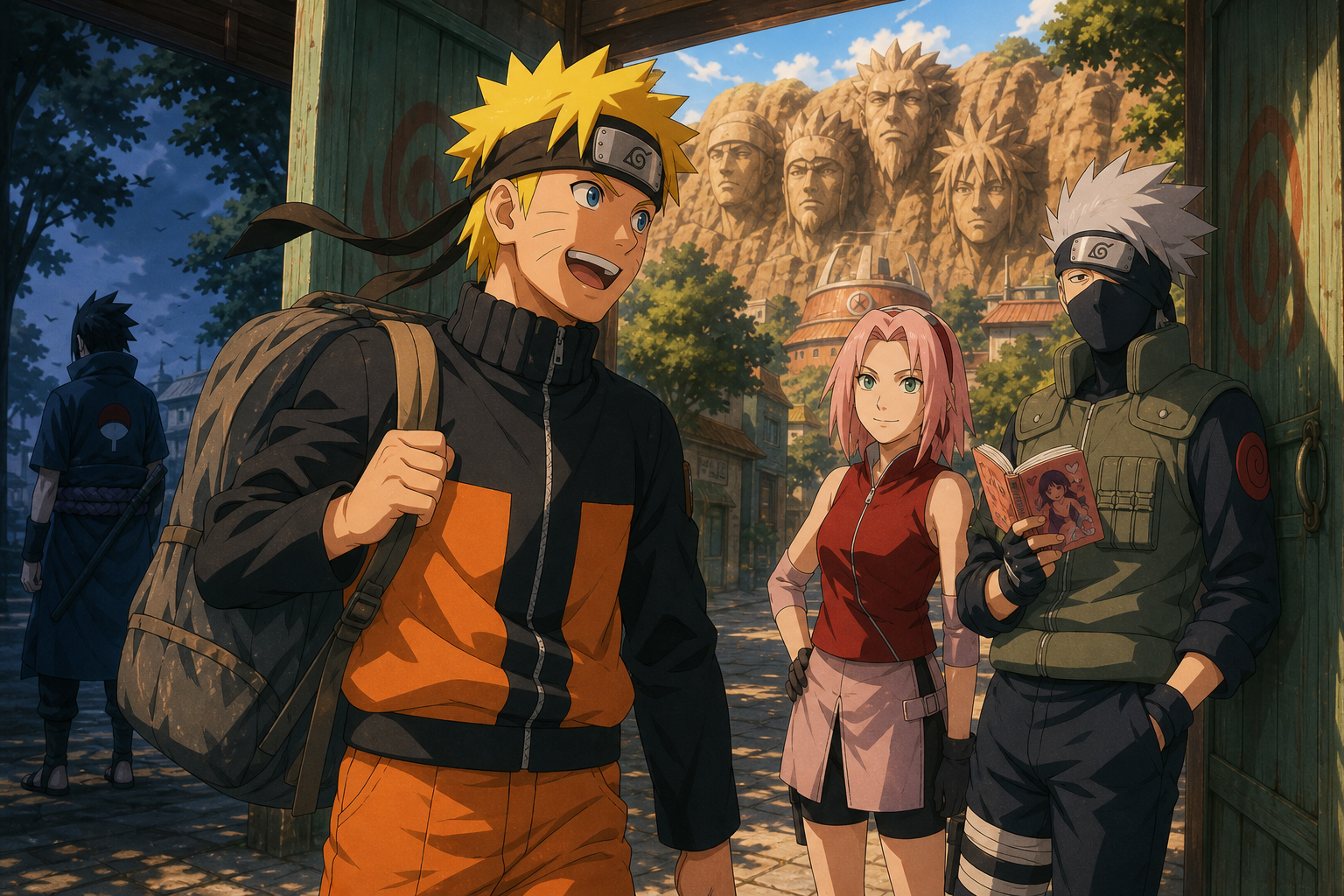
The road home is not the same as coming home
Naruto Shippuden opens by refusing to let the audience get comfortable. Before the proper homecoming, the anime flashes forward to Naruto and Sakura searching for Sasuke. The images are darker, the bodies older, and the emotional temperature immediately wrong. Sasuke is no longer merely the teammate who left. He is a person who has built a new space around himself, and Naruto is entering it as an intruder. Then the episode pulls us back to the beginning of the Shippuden timeline. That preview is not subtle foreshadowing. It is a warning label.
The choice changes how every cheerful reunion lands. Naruto can yell from the Konoha gate, Konohamaru can tackle him with enthusiasm, and Sakura can smile at the sight of him, but the opening has already told us that Team 7 is not whole. The premiere gives us pleasure and withholds completion at the same time. That is the emotional contract for early Shippuden.
Calling the episode “Homecoming” is almost rude, honestly. Naruto returns to the physical home. Sasuke does not. Jiraiya comes back with intelligence about Akatsuki rather than a recovered child. Sakura has spent the same years training under Tsunade because waiting without gaining power would be unbearable. Everybody has done something with the absence, but nobody has solved it.
Scene-by-scene recap and RaeRae reaction
The cold open makes reunion feel temporary
The future glimpse frames Naruto, Sakura, Sai, and Yamato moving through Orochimaru’s territory in search of Sasuke. The sequence is deliberately disorienting for a viewer arriving from the original series. New teammates appear before they are explained. Naruto and Sakura carry older faces. Sasuke’s silhouette is treated like an answer that may become another question.
As a structural choice, this is the series placing its largest unfinished relationship before its new status quo. We are not invited to believe that two and a half years of training erased the wound. Naruto may have learned new techniques with Jiraiya, but his promise to bring Sasuke home still organizes his future. That is loyalty, grief, and obsession sharing one coat.
The flash-forward also creates an adaptation wrinkle. The anime foregrounds a later confrontation before returning to the manga’s chronological restart. I like the emotional clarity more than the fake mystery. We know Sasuke will appear again. The real suspense is what Naruto and Sakura will become while chasing the version of Team 7 that no longer exists.
Konohamaru is the first receipt for elapsed time
Back in Konoha, Konohamaru, Moegi, and Udon are no longer tiny Academy accessories orbiting Naruto’s chaos. They are genin handling D-rank work under Ebisu. The mission itself is humble, but the visual point is immediate: time kept moving in the village. Children Naruto once treated as juniors now occupy the rank he held when he left.
Konohamaru complaining about low-level missions mirrors early Naruto so neatly that Iruka and the adults can see the inheritance in real time. Naruto’s influence is not only a future speech about never giving up. It has already entered another child’s posture, impatience, ambition, and need to be taken seriously. That is both sweet and mildly alarming because Konohamaru copied the attitude before copying the judgment.
When Naruto finally enters the village, Konohamaru’s excitement gives the return a human scale. The Hokage Monument has changed. Tsunade’s face has joined the line. Naruto notices the institutional update, then gets hit by a kid who missed him. One is history carved in stone. The other is proof that a relationship survived distance.
Naruto’s first impression is: taller, same fool
The episode lets Naruto announce his growth before testing it. He has a new outfit, a stronger body, and the swagger of somebody who expects the village to gasp on schedule. His fundamental Naruto-ness arrives right behind him. He is still competitive with Konohamaru, still easy to bait, and still capable of turning a normal greeting into a public performance.
This is the correct choice. A time skip that replaces personality with maturity is just a recast wearing the old name. Naruto should be more capable without becoming emotionally polished. He spent years traveling with Jiraiya, not attending finishing school. The comedy reassures us that the character survived the upgrade.
It also establishes a limit. Training can improve technique and endurance. It cannot automatically heal abandonment, regulate every impulse, or teach a teenager how to discuss the friend he failed to save. Shippuden will repeatedly ask whether power growth and emotional growth are keeping pace. The answer is going to be “sometimes,” followed by several hundred episodes of evidence.
Sakura’s reunion contains affection, evaluation, and one clean threat
Sakura’s entrance carries its own time-skip promise. She is not waiting at the gate as a symbol of who Naruto left behind. She has trained under Tsunade, developed medical skill, and learned to convert chakra control into frightening physical force. The premiere does not unload the entire résumé yet. It changes how she occupies the frame.
Naruto’s reaction to seeing her again is openly happy. Sakura’s response is warm until Naruto proves that travel did not cure him of every bad joke. Then the reunion snaps back into familiar comedy. The punch works as a franchise callback, but it also risks shrinking Sakura’s growth into “she hits harder now.” That is one of the early Shippuden adaptation traps. Her strength is not interesting only because Naruto becomes airborne. Her discipline, clinical knowledge, and decision-making are the actual transformation.
Still, the scene establishes that Naruto and Sakura can resume intimacy without pretending the years never happened. They know each other well enough to fall into an old rhythm and differently enough to require a new one. Their shared grief over Sasuke will make that relationship heavier than the jokes suggest.
Jiraiya brings a student home and a threat report to work
Jiraiya’s return cannot stay sentimental because he has not only been training Naruto. He has been gathering intelligence. Akatsuki’s movement turns Naruto’s homecoming into a security event. The organization is not hunting an abstract power. It is hunting people whose bodies contain tailed beasts, which means Naruto’s private burden now has an international timetable.
This matters because Konoha benefits from Naruto as a shinobi while also needing to protect him as a target. Hidden villages love calling a child an asset when “child” would require more moral responsibility. Shippuden expands the scale of that contradiction. Naruto’s body is personal, military, spiritual, and geopolitical property depending on who is talking.
Jiraiya’s mentorship therefore carries two jobs that do not always sit comfortably together. He cares for Naruto, and he prepares Naruto to survive a system already moving toward him. Training is affection translated into risk management. It is also evidence that adults still expect the teenager to meet organized killers on their terms.
Kakashi reads the new Team 7 before the bells come out
Kakashi’s reunion is quieter because Kakashi is always reading more than he says. Naruto brings him the new Icha Icha book from Jiraiya, a gift that is funny, strategic, and deeply tailored to the man receiving it. Naruto may be emotionally clumsy, but he notices what people love. Unfortunately, what Kakashi loves in public is making everyone question the village’s workplace standards.
The gift also creates continuity through comedy. Kakashi’s habits have survived. Naruto’s ability to use those habits against him has improved. When Tsunade eventually orders the bell test again, the exercise is not a nostalgic game. It is a professional reassessment. Kakashi needs to know whether Naruto and Sakura can operate as peers in danger rather than students under protection.
That shift matters more than rank labels. Sakura has trained with the Hokage. Naruto has traveled with a Sannin. Kakashi remains their teacher, but the old teacher-student triangle is changing into a field team. Respect in the shinobi world is often proved through labor before anyone says it aloud. The renewed bell test makes them put receipts on the table.
What changed during the time skip
Naruto
He returns with stronger fundamentals, better field experience, and the confidence of sustained mentorship. He also retains the impatience, dirty jokes, loud self-advertising, and Sasuke-shaped urgency that training could not neatly remove.
Sakura
She has chosen a discipline with direct consequence. Medical ninjutsu makes her responsible for keeping bodies alive, while Tsunade’s strength training gives her a new relationship to force. She is no longer asking to be protected from the mission.
Konoha
Tsunade is carved into the monument, younger shinobi have advanced, and the village has continued functioning. The home Naruto idealized did not freeze for his return, which is healthy and slightly painful.
The threat
Akatsuki is moving from shadowed promise to active operation. The danger connects Naruto to Gaara and the other jinchūriki as people targeted by the same extraction economy.
The culture inside the reunion
Japanese homecoming language carries more weight than a casual “hey, I’m back.” The familiar exchange of tadaima and okaeri links return to acknowledgment: somebody announces that they have come home, and somebody answers that the return is recognized. Naruto’s arrival is noisy enough to cover the whole village, but the emotional question remains whether Konoha has earned the right to call itself his home.
The village trained him, stigmatized him, used his power, and gave him real bonds. All four statements remain true. Shippuden should not flatten that history into either “Konoha saved him” or “Konoha only abused him.” RaeRae’s bottom line is harsher: institutions can contain sincere people while still causing structured harm. Iruka, Sakura, Kakashi, Jiraiya, and Tsunade make home possible through relationship. Their care does not erase what the village did.
A Confucian lens helps with the episode’s attention to roles and obligations. Student, teacher, Hokage, teammate, and junior are not decorative titles. Each relationship carries a duty. Konohamaru’s imitation of Naruto creates a senior-junior responsibility. Kakashi’s reassessment recognizes that students can grow beyond dependency. Tsunade’s leadership turns intelligence about Akatsuki into institutional action. The problem arrives when hierarchy demands loyalty without providing reciprocal care.
A Buddhist reading sits inside the episode’s refusal to preserve the past unchanged. Naruto wants Team 7 back. Sakura wants Sasuke back. The village feels familiar, but impermanence has already done its work. Growth requires accepting that reunion cannot mean restoration to an earlier form. Their attachment to the old Team 7 is emotionally understandable. It will become dangerous whenever the image of what was matters more than the people who exist now.
Japanese performance and production
TV Tokyo’s official staff listing credits Masashi Kishimoto’s manga as the source, Studio Pierrot and TV Tokyo as producers, Hayato Date as director, Tetsuya Nishio and Hirofumi Suzuki for character design, Yasuharu Takanashi and YAIBA for music, and Yasunori Ebina for sound direction. The shift in musical identity is one of the clearest ways Shippuden announces a larger, darker field without changing the emotional core of Naruto’s voice.
Junko Takeuchi returns as Naruto, Chie Nakamura as Sakura, Kazuhiko Inoue as Kakashi, Noriaki Sugiyama as Sasuke, Masako Katsuki as Tsunade, and Hōchū Ōtsuka as Jiraiya. Those original Japanese credits are verified. I am not inventing pitch, breath, or timing analysis without the heard Japanese scenes. A cast list with honest limits is better than fake criticism wearing a headset.
The Japanese broadcast history creates a numbering wrinkle worth stating clearly. TV Tokyo catalogs “Homecoming” as overall Naruto episode 221 and aired it on February 15, 2007, alongside the next chapter of the premiere event. International services label it Naruto Shippuden Season 1, Episode 1. Both conventions describe the same restart from different shelf systems.
What the episode does well
It makes the time skip legible through people instead of exposition. Konohamaru is older. Tsunade has joined the monument. Sakura stands differently. Naruto’s new clothes cannot hide his old habits. Kakashi’s unchanged book obsession becomes a measuring stick for everybody else’s change. The audience learns by comparing bodies, jokes, roles, and reactions.
It also refuses a clean victory lap. Naruto’s return could have been pure applause. Instead, Akatsuki is already moving, Gaara is already tied to the threat, and Sasuke’s absence has been placed before the title card can soothe us. The premiere says welcome home and check the locks.
Finally, the episode gives Sakura a meaningful entrance into the new era. She is not merely impressed by Naruto’s growth. She has work of her own to reveal. Shippuden will not always serve her as well as it should, but the premiere understands the assignment.
Where the episode gets on my nerves
The opening flash-forward manufactures mystery by showing unexplained teammates and a future confrontation. It works as a hook, but the emotional truth is stronger than the puzzle-box framing. Sasuke’s absence already matters. We do not need the anime waving a dark hallway at us like it discovered suspense yesterday.
The Sakura-hits-Naruto gag is recognizable, yet it can reduce her development to comic violence if the viewer or adaptation stops looking there. Her growth is medical, intellectual, physical, and professional. “She punches harder” is a trailer line, not a character analysis.
The episode also inherits the franchise habit of treating dangerous teenage labor as normal because everybody wears a forehead protector. Akatsuki is hunting human containers. The village’s answer is to evaluate whether two returning teenagers are field-ready. Efficient? Yes. Morally comfortable? Absolutely not.
Fandom arguments this premiere keeps starting
“Naruto did not mature.” False if maturity means increased skill, endurance, awareness, and responsibility. Fair criticism if someone means that his social behavior remains loud and impulsive. Growth is uneven because humans are annoying like that.
“Sakura’s only upgrade is strength.” No. The punch is the obvious visual receipt. Medical training, diagnostic responsibility, chakra control, and her willingness to enter danger as a contributor are the more important changes.
“Nothing happens.” Plot machinery moves quietly. Naruto returns, Akatsuki intelligence reaches Konoha, relationships are reset, the new threat is framed, and the bell test is prepared. A premiere does not need three corpses and a meteor to accomplish work.
“The village finally accepts Naruto.” Some people welcome him. That is not the same as an institution accounting for its past. Applause is not an apology, babes.
RaeRae verdict
“Homecoming” is a strong restart because it understands the pleasure of recognition. We see Naruto, Sakura, Kakashi, Jiraiya, Tsunade, Konohamaru, Iruka, and the village, and every familiar element has shifted just enough to make us inspect it. The premiere does not spend its best energy proving that Naruto is cooler. It proves that his relationships now carry more history.
My favorite choice is the emotional contradiction: Naruto genuinely comes home, but the team he wants to return to does not exist. That absence gives the jokes weight and the next mission urgency. My biggest complaint is the anime’s temptation to dress an already compelling relationship problem in extra mystery. Sasuke is not interesting because he stands in darkness. He is interesting because Naruto and Sakura cannot decide where love, duty, guilt, and possession stop touching.
Overall: 8.8/10. A patient, funny, uneasy premiere that lets the audience enjoy the reunion while making sure we notice the empty chair.
The premiere lets growth remain uneven
A premiere can announce maturity without pretending growth moves in a straight line. Naruto has survived harder training, learned from Jiraiya, and returned with a larger sense of the world. He can still behave like the loud boy who left. Sakura has become a disciplined medical ninja while retaining the temper and defensive reflexes viewers already know. Kakashi can recognize their progress while keeping the old bell exercise because trust must be demonstrated under pressure.
That unevenness gives the reunion credibility. People do not replace every old habit when a calendar turns. They carry earlier selves into new responsibilities, sometimes with grace and sometimes with all the subtlety of Naruto announcing himself at the village gate. The episode asks us to track what changed, what survived, and which traits will become liabilities now that the opposition has grown more organized.
Sasuke’s absence reorganizes every cheerful scene
Nobody needs to speak his name in every exchange for Sasuke to remain present. Naruto and Sakura meet as the two available members of a trio that broke apart. Kakashi evaluates a team whose original formation cannot be restored by repeating an exercise. Jiraiya’s intelligence about Akatsuki reminds everyone that individual grief now sits inside threats moving across villages.
The premiere’s restraint works because the audience already knows the promise Naruto made. Homecoming cannot mean returning to the day before Sasuke left. The people who remain must build a relationship capable of surviving that truth, even while they continue pursuing him. RaeRae’s issue is not their refusal to give up. The danger begins when saving Sasuke becomes permission to ignore the choices and needs of everyone standing beside them.
Watch and verify
Episode title and current licensed viewing were checked against Crunchyroll’s Naruto Shippuden listing. Japanese broadcast date, synopsis, and the overall-episode numbering convention were checked against TV Tokyo’s official episode archive. Series staff and original Japanese cast credits were checked against TV Tokyo’s official staff and cast page.