
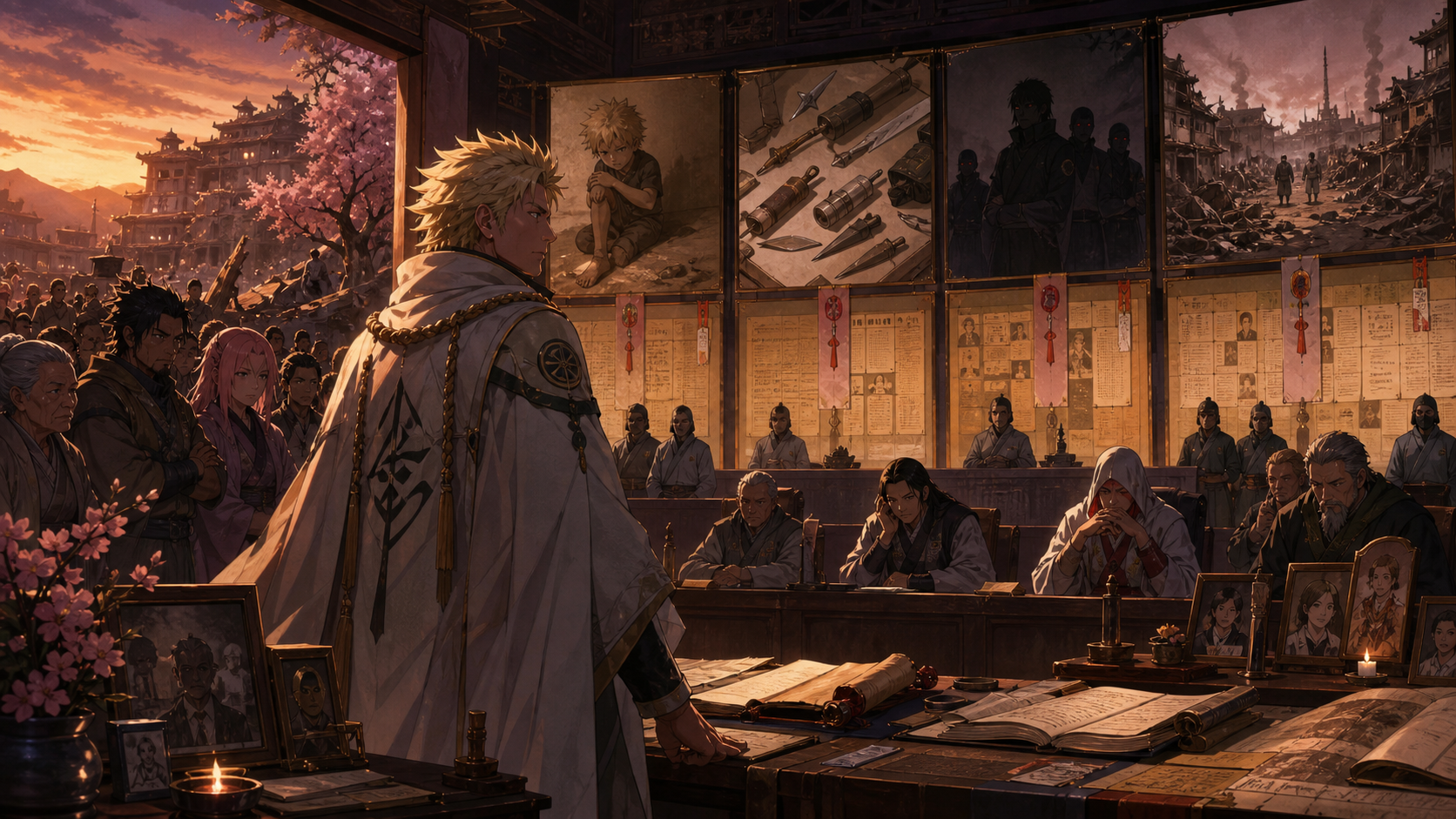
Naruto Forgave a Government That Never Apologized
Personal forgiveness helped Naruto survive. Konoha used his forgiveness as an ending to crimes the village never fully named, repaired, or promised not to repeat.
Naruto Uzumaki forgives people because refusing inherited hatred becomes his moral project. That choice saves lives. His compassion reaches Gaara, Nagato, Obito, Sasuke, and a shinobi world trained to treat revenge as public policy. Konoha receives the benefit of Naruto’s compassion without completing the harder work. The village celebrates him, elects him, and folds his survival into the Will of Fire. The government never gives him a full public accounting of why he grew up alone, why adults lied about his parents, why a child carried a military asset inside his body, or why officials allowed neighbors to treat him as contamination.
The same village keeps darker files. Konoha leadership isolates the Uchiha, uses a teenager as a double agent, and permits the annihilation of a clan to become a secret carried by survivors. Root recruits children, erases identity, and operates through coercion under Danzo Shimura. Jinchuriki policy turns children into strategic containers. Wartime decisions scatter grief across generations. Individual villains die. The administrative habits that made those villains useful receive far less scrutiny. My rant is not that Naruto should have become bitter. My rant is that a harmed person’s forgiveness cannot perform the legal, political, historical, and material work owed by the institution that harmed him.
Contents
- My actual rant
- Forgiveness is not a government program
- What Konoha did to Naruto
- The Uchiha massacre was state policy
- Itachi cannot carry the government’s guilt alone
- Root proves secrecy became infrastructure
- Jinchuriki policy made children strategic property
- Pain exposes the village’s selective memory
- The war produces heroes faster than accountability
- What Naruto inherits as Hokage
- What transitional justice clarifies
- What a real Konoha apology would require
- Material repair beyond speeches
- Archives, memorials, and public truth
- Guarantees of non-recurrence
- Final take
My actual rant: the village got a redemption arc without doing the paperwork
Konoha’s emotional redemption arrives through Naruto’s changing relationship with ordinary residents. The boy once avoided in shops becomes the hero welcomed home after defeating Pain. The crowd finally sees him. The scene works because recognition answers a need the story has carried from the first chapter. Recognition is not an investigation. Applause does not identify who made decisions, what records exist, which policies remain active, who benefited, who lost family or property, and what survivors need now. The crowd can love Naruto sincerely while the village government still owes him an account.
Stories prefer a face. Institutions are harder to dramatize because responsibility spreads through councils, departments, classified orders, professional norms, and people who insist they only performed one role. Naruto gives us Danzo as a face for government abuse. Removing Danzo does not explain why Hiruzen tolerated Root, why elders retained influence, why files stayed sealed, or why the next leader should be trusted. The village receives narrative absolution through Naruto’s character. He refuses to repeat hatred, so the audience can move forward with him. Forward movement feels satisfying. Forward movement without a record lets power decide what the future remembers.
Konoha keeps converting survivors into public relations. Naruto’s rise allows the village to tell a flattering story about itself. The system supposedly recognized hidden potential, gave an orphan opportunity, and produced a Hokage. Such a story mistakes success inside a system for proof that the system worked. Naruto succeeds through personal stubbornness, unusual power, exceptional teachers, friendships, luck, and repeated willingness to risk his life. Most neglected children will not receive a legendary mentor, inherit enormous chakra, or rescue their entire community from a catastrophic attack. Policy cannot use an exceptional survivor as the minimum standard for everyone else.
The village also benefits from Gaara’s transformation. Two jinchuriki become respected leaders, letting hidden villages imagine that weaponization ultimately produced admirable men. Their leadership indicts the treatment they overcame. Their leadership does not vindicate the adults who placed beasts inside children. Institutions love survivorship stories because praise costs less than repair. A scholarship ceremony photographs one graduate. The camera rarely visits every child pushed out before graduation. Konoha’s camera stays on the Hokage monument.
Forgiveness is not a government program. Forgiveness belongs to the harmed person. A survivor may forgive, refuse, reconsider, remain uncertain, or separate forgiveness from reconciliation. No institution earns discharge from responsibility because one survivor chooses peace. Accountability belongs to the public realm. Governments preserve evidence, disclose truth, investigate command responsibility, recognize victims, provide remedies, change personnel and policy, and create safeguards against repetition. Those duties remain after private anger changes. Naruto’s moral genius comes from refusing to let pain dictate the only available future. The village’s moral failure comes from allowing his genius to cover ordinary administrative cowardice.
Imagine a workplace where management harms an employee, the employee chooses not to pursue revenge, and executives announce that reconciliation has solved the matter. Nobody reviews policy. Nobody compensates lost wages. Nobody disciplines decision-makers. The survivor’s generosity becomes a subsidy for management. Konoha repeatedly receives that subsidy. Naruto repairs relationships the government damaged. He reaches fellow jinchuriki. He restores trust with other villages. He persuades enemies shaped by earlier wars. He carries emotional labor across an entire political order while leaders praise his exceptional heart.
Reconciliation requires two parties capable of meeting as equals. Naruto can reconcile with individuals who acknowledge him, change behavior, and accept vulnerability. Government reconciliation is harder because one side controls records, law, police, employment, and public ceremonies. A village cannot invite survivors into reconciliation while reserving the right to define every fact and remedy. Equality requires independent information, representation, legal rights, and the ability to refuse participation without penalty. Peace also differs from silence. Sasuke can stop attacking Konoha while remaining unconvinced by Konoha’s history. Former Root members can serve openly while still needing answers. Citizens can support Naruto while questioning the office he holds. A mature political community makes room for loyal criticism. Konoha too often treats secrecy as patriotism and dissent as vulnerability an enemy might exploit.
What Konoha did to Naruto was policy, not unfortunate loneliness
Naruto loses both parents during the Nine-Tails attack. Minato Namikaze seals part of Kurama inside his newborn son to protect the village and leave future power in Naruto’s hands. The decision saves lives and imposes a permanent burden on a baby who cannot consent. Afterward, Konoha controls information about Naruto’s identity and parentage. The Third Hokage prohibits public discussion of his jinchuriki status, but adults already know enough to direct fear toward him. Silence does not protect Naruto from stigma. Silence prevents him from understanding the stigma.
The village supplies housing and basic material survival. The story shows no stable guardian raising him. Residents avoid him. Children learn adult hostility without receiving the official explanation. Naruto develops disruptive behavior because negative attention remains easier to obtain than care. Calling that childhood neglect does not require inventing one official who ordered every lonely dinner. Institutional neglect often works through absence: no guardian assigned, no anti-discrimination enforcement, no truthful support plan, no adult responsible for checking whether the orphaned child is safe.
Hiruzen sometimes visits and cares about Naruto. Individual warmth does not answer the governance question. The Hokage knows the child’s identity, the danger of public hatred, and the political importance of the seal. Why does protection depend so heavily on occasional attention from the busiest official in the village? Iruka eventually gives Naruto the recognition he needs. Kakashi, Team 7, Jiraiya, Tsunade, and others build real relationships. Those people deserve credit. Their care also reveals how much the state had left to chance.
The secrecy surrounding his parents protected the village’s convenience. Officials can argue that identifying Naruto as the Fourth Hokage’s son would attract enemies. Security concerns have weight in a world built around assassination and inherited grudges. Secrecy still requires a care plan for the child bearing the consequence. Naruto grows up without access to family history, photographs, trusted explanations, or the knowledge that his parents chose his name and hoped for his future. Adults retain information central to his identity because officials decide risk outweighs his right to know.
Age-appropriate disclosure could have changed over time. A designated guardian could have preserved records and prepared him. Independent review could have reconsidered restrictions annually. Instead, plot revelation arrives when crisis and powerful mentors finally make truth unavoidable. Secrecy becomes paternalism when government says protection requires keeping a person ignorant indefinitely. Naruto is expected to serve Konoha before Konoha trusts him with his own life story.
The Uchiha massacre was state policy carried through a teenager
The Uchiha relationship with Konoha deteriorates through surveillance, political exclusion, inherited suspicion, and plans for a coup. Clan leaders pursue dangerous action. Government leaders fear civil conflict. None of those facts turns annihilation into an unavoidable weather event. Official Naruto material describes Itachi as a double agent reporting to Danzo while observing a clan preparing revolt. Konoha leadership recruits him for intelligence work and ultimately gives him a secret mission to annihilate the Uchiha. The story places a massive state crime inside the hands of a young operative.
Discussion often becomes a trial of Itachi’s soul. Did he choose the lesser evil? Did love for Sasuke redeem him? Did fear of war justify the decision? Those questions matter for character. Their popularity can hide command responsibility. A government identifies a minority community as a security threat, confines the political options, uses a member of that community as an informant, and authorizes collective killing. The government then preserves public legitimacy by assigning the visible guilt to the operative and the visible hatred to the surviving child.
Sasuke grows up believing his brother acted alone. The false history shapes his identity, choices, crimes, and relationships. Secrecy therefore creates new harm after the massacre. The cover-up is not separate from the original violence. The cover-up continues the violence through memory. Konoha later treats Sasuke’s anger as a security problem. His actions do create danger, and survivors remain responsible for harms they cause. Accountability loses credibility when the state judging him refuses public judgment of its own conduct.
Collective punishment survives through euphemism. Leaders describe the decision through national security, coup prevention, and avoidance of civil war. Those phrases identify genuine dangers while obscuring the people included in the punishment. A clan contains political leaders, dissidents, children, elders, uninvolved families, and people with no control over strategy. Once the government treats group identity as evidence, individual innocence becomes irrelevant. The same logic produces later suspicion toward Sasuke. His name carries danger before his conduct receives separate evaluation.
Collective punishment also destroys internal alternatives. Uchiha members who might have resisted a coup, documented abuse, negotiated reform, or protected neighbors disappear with everyone else. The massacre removes the community most capable of contradicting the official record. A truth process would reconstruct individual lives rather than discussing “the Uchiha” as one political body. Names, occupations, ages, relationships, views, and last known circumstances would restore the human detail security language erased.
Itachi cannot carry the government’s guilt alone. Itachi makes choices. He kills. He manipulates Sasuke through terror. His suffering does not erase the people he harmed. The government’s role does not erase his agency. Shared responsibility does not mean diluted responsibility. Commanders, advisers, operatives, and institutions can each hold distinct obligations. A serious inquiry would examine who proposed alternatives, who rejected negotiation, who controlled information, who issued orders, who obstructed oversight, and who preserved secrecy afterward. The story gives Itachi a private reckoning. He acknowledges mistakes, particularly his effort to control Sasuke and bear every burden alone. Private honesty between brothers carries enormous emotional weight. The dead Uchiha community receives no public forum.
Turning Itachi into either saint or monster repeats Konoha’s simplification. A saint absorbs guilt heroically. A monster isolates guilt conveniently. A young operative recruited into impossible choices can be responsible and exploited at the same time. Government accountability would refuse the comfort of one tragic genius. The question becomes not only why Itachi complied, but why political leaders designed a situation where a teenager’s compliance could erase an entire clan.
Root proves secrecy became infrastructure. Root is not one bad man’s hobby conducted beyond every institution. Danzo recruits children, marks tongues, suppresses emotion, controls information, and directs covert operations in the name of village security. Such activity requires training sites, personnel, budgets, records, and protection from scrutiny. Sai enters Team 7 after growing inside that system. His difficulty with emotion is treated comically at times, but his social disconnection reflects deliberate conditioning. Root does not merely order violence. Root produces people suited to deniable violence.
Yamato’s history connects experimentation, Orochimaru, and government intelligence. Children become research material because exceptional abilities promise strategic value. Survivors later serve the same village that benefited from the experiments. Danzo eventually dies. Root’s formal dissolution does not automatically repair former members, disclose operations, compensate victims, or prevent another leader from recreating similar capacity under a new name. Security institutions often defend secrecy as operational necessity. Some information genuinely requires temporary protection. Permanent secrecy about abuse protects perpetrators rather than missions. Oversight must include people outside the chain of command, access to records, power to compel testimony, and consequences for obstruction.
Konoha offers almost none of that on the page. Trusted protagonists learn pieces because plot brings them near the truth. Citizens receive a cleaner history. The tongue seal is a constitution written on a subordinate’s body. Danzo’s curse mark prevents Root members from speaking about him. The seal literalizes a workplace where nondisclosure is enforced through bodily punishment. A subordinate cannot testify, seek help, warn others, or create an independent record. Modern institutions use less magical tools: classification rules, loyalty norms, career retaliation, inaccessible complaint systems, and threats of prosecution. Some secrecy protects legitimate operations. Secrecy designed to prevent evidence of wrongdoing protects power.
Whistleblower protection would require a channel outside Root and outside the Hokage’s ordinary security hierarchy. Reporters would need immunity for disclosure of abuse, access to counsel, physical protection, and a written process that prevents files from disappearing. Sai’s recovery begins through friendship because formal support barely exists. Team 7 teaches names, humor, conflict, and affection. A government that deliberately damaged social development would owe professional care rather than hoping new teammates can improvise rehabilitation.
Jinchuriki policy made children strategic property
Hidden villages seal tailed beasts inside human hosts to control power and deter enemies. Hosts receive different treatment across villages, but childhood autonomy remains secondary to strategy. Naruto, Gaara, Killer B, and other jinchuriki show varied outcomes. Friendship and mentorship help some hosts build agency. Those relationships do not make the policy ethical. A humane guard cannot create consent retroactively. The language of sacrifice hides ownership. Leaders speak about protecting the village. The host’s body becomes territory where public security claims override private life. Villagers may fear the host while depending on the power inside him.
Naruto later befriends Kurama, changing the internal relationship from containment toward partnership. That achievement belongs to Naruto and Kurama. Konoha cannot claim their reconciliation as validation of the original decision. A real review would identify every living host, provide independent medical and psychological care, disclose known risks, recognize family losses, and establish a prohibition against nonconsensual sealing in children. Strategic anxiety cannot remain the final answer.
Pain exposes the village’s selective memory. Nagato’s violence against Konoha is indefensible. Civilians die. The village is destroyed. His history still matters because Konoha’s wars and Jiraiya’s generation helped create the conditions surrounding Amegakure’s suffering. Large powers remember war through their own losses. Smaller communities remember armies crossing homes, economies collapsing, and children surviving between strategic decisions made elsewhere. Nagato forces Naruto to confront pain that Konoha’s heroic story leaves outside the frame. Naruto refuses revenge and persuades Nagato to choose another path. The scene proves his extraordinary capacity to hear an enemy without accepting the enemy’s violence.
Konoha celebrates Naruto afterward. Celebration focuses on the boy who saved the village, not the history that made Nagato’s grievance legible. The village rebuilds structures faster than public memory. A fuller response would mourn Konoha’s dead while investigating Konoha’s regional impact. Competing victimhood does not require choosing one innocent population. Governments can protect residents and acknowledge harms committed beyond their borders.
The Fourth Shinobi World War produces unity faster than accountability. The allied shinobi forces create cooperation across villages facing a common threat. Former enemies share intelligence, command structures, medical support, and sacrifice. The alliance demonstrates that institutions can change rapidly when survival requires change. War also creates a convenient reset. Present unity can make earlier crimes feel settled. Leaders stand together. Young heroes carry the battlefield. Shared danger replaces a detailed accounting of who created previous conflicts and who paid the cost.
Obito and Madara channel personal loss into catastrophic projects. Kabuto builds power through bodies and stolen identities. The war makes individual antagonists visible while older village systems remain background conditions. Naruto becomes the emotional center of the alliance. He shares chakra, recognizes comrades, and refuses despair. Once again, a young survivor provides the social repair institutions failed to organize. Victory matters. Ending immediate violence is necessary. Postwar justice begins after victory rather than disappearing inside victory. Peace treaties need a ledger, not only a handshake. The Five Kage alliance can stop immediate conflict while leaving disputed histories unresolved. Durable cooperation requires shared records of missing people, battlefield deaths, covert operations, displaced families, and seized property.
A joint commission would not demand that every village agree on one emotional narrative. Investigators could establish verifiable facts, identify contested claims, preserve testimony, and recommend remedies across borders. Military alliances naturally prioritize future threats. Victims prioritize unanswered pasts because those pasts shape present poverty, grief, stigma, and distrust. Peacebuilding fails when leaders treat memory as a distraction from security. Naruto’s friendships with other leaders create political opportunity. Friendship cannot substitute for institutions capable of surviving less friendly successors.
What Naruto inherits as Hokage
Naruto’s election fulfills the dream that organized his childhood. The ignored orphan becomes the leader whose face joins the mountain. Emotional completion does not guarantee institutional transformation. As Hokage, Naruto inherits archives, security departments, clan relationships, mission economies, diplomatic obligations, and myths about previous leaders. He also inherits personal ties to nearly every major survivor. Those ties can deepen empathy and complicate impartial decisions. A reforming leader needs more than goodness. He needs transparent procedures, independent oversight, protected archives, survivor participation, professional staff, budgets, timelines, and successors who cannot casually reverse progress.
Naruto’s tendency to carry too much creates another risk. The child who survived by becoming indispensable can become an adult leader who believes personal endurance will cover institutional weakness. Overwork looks generous and leaves systems dependent on one exhausted person. The strongest version of Hokage Naruto would distribute authority. He would let investigators reach beloved predecessors, let survivors criticize the village, and accept that national pride can survive honest history. His personal involvement creates conflicts of interest. Naruto is a victim of village policy, a beneficiary of later public admiration, a friend of Sasuke, a former student of Kakashi, a surrogate son to several leaders, and the official responsible for government records. Those roles give him insight and create conflicts.
He should not personally decide which Uchiha files become public, whether prior Hokage conduct receives condemnation, or what compensation counts as sufficient. Independent commissioners, survivor representatives, historians, legal experts, and other villages need authority. Recusal would not signal weakness. Recusal would protect legitimacy. A trustworthy process should reach findings that the Hokage cannot control, including findings painful to him. Naruto also deserves the right to participate as a survivor without performing leadership during every hearing. Public office should not erase his private claim to truth.
Good leadership cannot depend on one good man. Naruto’s supporters trust him because they know his character. Citizens born later will know the office more than the man. Safeguards must constrain a future Hokage who lacks his empathy. Written rules, divided powers, public budgets, regular audits, and enforceable rights feel less inspiring than a hero’s promise. Their plainness makes them durable. A procedure does not need personal affection before offering protection. Succession planning matters too. Reform should create leaders and civil servants who understand why changes exist. Otherwise a later crisis can revive old practices under the claim that extraordinary danger requires extraordinary secrecy. Naruto spent childhood asking people to believe in him. As Hokage, his responsibility would include building institutions where vulnerable residents do not need personal belief from the leader before receiving justice.
What transitional justice clarifies
United Nations work on transitional justice commonly joins truth, justice, reparations, institutional reform, and guarantees of non-recurrence. No single measure completes the work. Truth without action can become an archive nobody must obey. Compensation without truth can look like payment for silence. Prosecution without institutional reform can remove a few perpetrators while preserving the machinery. Reform without victim participation can reproduce the paternalism that caused harm. Konoha mostly offers private revelation and changed relationships. Sasuke learns the massacre’s hidden history. Naruto learns about his parents. Sai develops bonds beyond Root. Those discoveries help individuals. Public institutions remain protected from a shared record.
Command responsibility matters because direct perpetrators rarely create every condition alone. Danzo’s guilt cannot end inquiry into elders, Hokage decisions, ANBU structures, clan governance, and the professional culture surrounding secrecy. Victim categories also need breadth. The Uchiha dead and survivors are obvious. Root recruits, experimental subjects, jinchuriki, war-displaced families, marginalized clans, and civilians harmed by covert missions may hold distinct claims. Justice must distinguish criminal responsibility from political responsibility. Some conduct would call for prosecution. Other failures involve negligence, tolerated discrimination, deficient oversight, or policy choices that may not fit a criminal charge. An honest process needs vocabulary for both.
If accountability means prison or nothing, institutions can avoid the entire conversation whenever evidence falls short of a criminal standard. Administrative findings, removal from office, professional sanctions, reparations, disclosure, and public condemnation can address responsibilities that prosecution cannot. The opposite danger appears when commissions replace courts for grave crimes. Truth-telling should not provide immunity automatically. Different mechanisms answer different questions and should coordinate without collapsing into one ceremonial report. Konoha’s narrative leans heavily on death as accountability. Danzo dies. Hiruzen dies. Itachi dies. Death ends a character arc while leaving no testimony, cross-examination, restitution order, or institutional record. A funeral is not a finding.
What a real Konoha apology would require
A public apology would name conduct plainly. Leaders would acknowledge state involvement in the Uchiha massacre, the use of children in covert operations, nonconsensual jinchuriki policy, tolerated discrimination, unlawful experimentation, and concealment. The apology would identify speakers and authority. A vague statement from “the village” lets every office remain innocent. The Hokage, council, relevant clan bodies, and security leadership would explain their responsibilities. Survivors would help shape language and ceremony. Government cannot decide alone which harms count or which memorial feels respectful. Sasuke would not become the sole representative of every Uchiha victim. Sai would not speak for every Root survivor. Naruto would not speak for every jinchuriki.
An apology would avoid praising victims for resilience. Gratitude for survival can quietly shift attention from perpetrator choice toward survivor character. The statement should center what authorities did and what authorities will change. Apology would accompany records, remedies, and reform. OHCHR guidance stresses that public apologies should not substitute for criminal justice or broader transitional measures. Konoha’s favorite mistake is treating emotion as completion. The audience matters as much as the speaker. A private apology to Naruto would recognize one relationship. A state apology must reach residents taught to fear him, children taught simplified village history, families harmed beyond Konoha, and officials expected to follow new rules.
Timing matters. Leaders should not announce an apology before consulting survivors and then ask survivors to applaud language already fixed. Consultation cannot become a photo opportunity held after every decision has been made. The statement should identify uncertainty honestly. Missing records and dead decision-makers limit knowledge. Government can acknowledge those limits without using uncertainty to deny every well-supported conclusion. An apology should also explain follow-through: which archive opens, which office accepts claims, which deadline governs investigation, which budget funds care, and which independent body reports progress. Specific commitments let citizens measure sincerity later.
Material repair beyond speeches. Reparations can include restitution, compensation, rehabilitation, recognition, and measures preventing repetition. Fictional Konoha would need forms tailored to each harm. Uchiha property and archives would require transparent review. Surviving family members would receive access to records, memorial authority, and remedies for wrongful seizure or concealment. Clan history would enter public education without reducing every member to the coup or massacre. Former Root members would receive identity restoration, health care, education, housing support, and protection from retaliation. Seals and conditioning would be treated as injuries requiring long-term care.
Jinchuriki and families would receive medical support, truthful records, decision-making authority, and compensation for state control. Villages would fund communities harmed during captures, transfers, and attacks connected to tailed-beast policy. Naruto’s repair cannot be a nicer apartment after he becomes famous. Repair would acknowledge the developmental cost of isolation and the labor he performed to win basic belonging. Rehabilitation is not another mission assignment. Shinobi culture often responds to trauma by returning survivors to useful work. Purpose can support recovery, and employment can restore routine. Service should not become the only socially acceptable form of healing.
Former child operatives need confidential care independent of fitness evaluations. A therapist employed by the same command structure may face pressure to prioritize readiness. Survivors may hide symptoms when disclosure threatens rank, income, or clearance. Families also need support. Sasuke’s harm affects teammates and later the family he builds. Sai’s conditioning shapes intimacy. Naruto’s childhood isolation influences his tendency to overwork and his availability at home. Institutional harm travels through relationships after the original order ends. Rehabilitation would therefore include long-term health care, family services, education, community reintegration, and freedom to refuse public storytelling. A survivor does not owe inspirational testimony in exchange for help.
Compensation cannot calculate a childhood and should still exist. No payment restores dead relatives, lost years, or bodily autonomy. That truth sometimes becomes an excuse to pay nothing. Compensation acknowledges measurable losses while other forms of repair address dignity, truth, and reform. A claims process should not demand documents the government concealed or destroyed. The state carries a duty to investigate its own archives. Evidentiary rules should recognize testimony, patterns, and records held across agencies. Collective reparations could rebuild communities, preserve cultural sites, fund clinics, restore land, and support education. Individual reparations would respond to personal injury. One form should not cancel the other.
Archives, memorials, and public truth. Archives matter because governments change stories through access. Sealed files let leaders claim that disclosure would endanger peace. Selective leaks let factions weaponize fragments. Destruction lets perpetrators convert absence into doubt. A truth commission would preserve testimony from survivors, officials, witnesses, and affected communities. Independent archivists would protect originals and publish records with narrow redactions for genuine present danger. Memorials would name victims rather than only heroic defenders. Konoha’s monuments favor sacrifice in service to the village. A fuller memorial landscape would include people harmed by the village.
Education would teach contradiction. Hiruzen could be remembered for leadership during crisis and criticized for failures of oversight. Itachi could be remembered as loving, exploited, and responsible. Complexity protects history better than changing one saint for another. Public truth would also reach other villages. Regional harms cannot be reconciled through five separate patriotic textbooks. A memorial should make the village uncomfortable on purpose. Konoha’s monument culture celebrates Hokage and shinobi who died in service. Those memorials help people grieve. A memorial to state victims would ask a different question: what did the village do in the name of protection?
The site should stand in a public location rather than behind an archive desk. Names should be included where families consent. Blank spaces could acknowledge people whose identities remain unknown. Exhibits could explain policy, resistance, and continuing disputes. Officials would attend commemorations without controlling every speech. Survivors could criticize current leadership. Students would visit as part of civic education rather than patriotic ritual. Discomfort serves a democratic purpose. A monument that produces only pride cannot warn future officials about the ease with which pride excuses violence.
Guarantees of non-recurrence are the part redemption stories skip. A promise that leaders have learned means little without structural limits. Konoha would need laws prohibiting collective punishment, child recruitment into covert units, nonconsensual experimentation, and unreviewed sealing practices. Security agencies would face civilian oversight, external audits, term limits, protected reporting, and judicial review. Secret operations would receive expiration dates and later disclosure requirements. Clan members would gain individual rights enforceable beyond clan leadership. Hereditary seals, coerced service, and family punishment would face legal prohibition.
Children would receive guardianship, mental health care, independent advocates, and real alternatives to shinobi careers. Schools would teach history and civic rights alongside combat skills. International treaties would create inspections and shared standards for jinchuriki, prisoners, experiments, and child combatants. Trust would rest on verification rather than friendship among current leaders. Personnel reform must reach respected names. Institutional reform becomes decorative when only obvious villains lose authority. Advisers who approved, ignored, or concealed abuse should face review even if they later supported peace. Longevity cannot become immunity.
Vetting requires evidence, due process, transparent criteria, and appeal. A purge based on rumor would reproduce collective punishment. A review based only on criminal convictions would miss officials protected by secrecy. Training also has to change. ANBU and Academy instruction should include lawful orders, civilian protection, reporting duties, trauma awareness, and refusal of commands targeting families or children. Budgets reveal sincerity. Oversight without staff, survivor services without clinicians, archives without preservation funding, and anti-discrimination rules without enforcement become speeches wearing office clothes.
Progress needs public measurement. Konoha would publish regular reports: files reviewed, claims received, remedies delivered, missing persons identified, former Root members supported, discriminatory incidents investigated, and recommendations completed. Numbers cannot contain every experience. Numbers can reveal delay, unequal access, and promises quietly abandoned. Survivor testimony would accompany statistics so administrative success does not erase lived quality. Independent monitors would verify reports and explain failures. Deadlines could change when reasons are public. Secrecy exceptions would receive periodic review rather than permanent approval. Celebration should follow evidence. A government does not earn praise for announcing the office meant to fix the problem. Results begin when survivors can use that office safely.
The tunnel has to lead beyond Naruto being unusually kind. A serious reform arc would begin with a public record of what Konoha did, who authorized each policy, which leaders benefited, and which families still carry the damage. The village would release archives with narrow protections for living victims, hold hearings that allow survivors to speak without becoming entertainment, and distinguish personal criminal guilt from institutional responsibility. Naruto could support that process without serving as investigator, judge, witness, victim, and symbol at the same time. Independent officials would review Root, jinchuriki policy, orphan care, clan surveillance, mission assignments, and the use of children in intelligence work. That structure would not weaken Naruto’s leadership. The structure would protect the village from needing another perfect Hokage.
Repair would also require ordinary budgets. Konoha could fund counseling, housing, education, medical care, family tracing, legal support, and long-term services for people harmed by village policy. Compensation would not purchase forgiveness or turn grief into a price list. Compensation would admit that the state transferred costs onto children and families while collecting the benefits of military power. Memorials would name the dead and describe the decisions that produced the loss. Academy students would learn the history before receiving a headband, because loyalty built on edited memory produces the next secret program. None of those changes would erase the village’s genuine sacrifices or the danger shinobi faced. A mature society can honor courage without hiding abuse.
The best version would show disagreement inside the reform. Some veterans would fear that disclosure dishonors the dead or exposes security methods. Survivors would disagree about names, punishment, privacy, and reconciliation. Younger shinobi might want faster change than institutions can deliver, while administrators might use complexity as an excuse to delay. Naruto would sometimes choose poorly, apologize, revise policy, and accept limits on his office. Those conflicts would create better drama than another speech about breaking the cycle because the audience would watch a government attempt the boring work that speeches usually replace.
The endpoint should not be a village where nobody suffers or every survivor forgives. The endpoint should be a village where harm cannot disappear behind one hero’s smile. Citizens would know how to report abuse, challenge records, protect children, review emergency powers, and measure whether reforms last. Sasuke could remain distant. Families affected by Root could reject ceremonies. Former jinchuriki could demand different forms of repair. Naruto’s grace would remain meaningful because Konoha would finally stop treating grace as payment in full.
Final take: Naruto’s grace was a gift, not a receipt
Naruto refuses inherited hatred because he wants a future larger than revenge. His forgiveness represents strength, imagination, and care. Nobody should diminish that choice. Konoha owes truth whether Naruto demands truth or not. Konoha owes repair whether Sasuke returns or not. Konoha owes reform whether Danzo is alive or not. Public responsibility does not expire when the most visible survivor chooses mercy. The series often resolves politics through relationships because relationships carry emotional power. Naruto reaches people institutions abandoned. That gift saves the world and reveals the scandal: a child had to become morally extraordinary before adults reconsidered ordinary cruelty.
The better ending is not Naruto holding anger forever. The better ending is Naruto setting anger down while Konoha finally picks up the files. That ending would not destroy the Will of Fire. Honest repair could rescue the best meaning from the slogan. Care across generations should mean adults accepting responsibility so children inherit fewer secrets, fewer enemies, and fewer duties disguised as destiny. Naruto’s compassion should remain the beginning of political imagination rather than the last item on Konoha’s agenda. He proves that people shaped by violence can choose another relationship. Government must prove that systems shaped by violence can choose another structure.
The distinction sounds less romantic because institutions rarely deliver one grand emotional scene. Reform arrives through testimony, budgets, archives, hearings, clinics, laws, training, and years of follow-through. Such work lacks a finishing move. Such work changes what the next child survives. Konoha taught Naruto to pursue acknowledgment. The village eventually gave him acknowledgment because he became impossible to ignore. Justice would mean recognizing people before heroism forces recognition, protecting people before catastrophe displays their value, and telling truth before an enemy uses the secret.
Forgiveness can free a survivor from organizing life around the perpetrator. Accountability prevents the perpetrator from organizing public life around forgetting. Naruto deserves both freedoms: the freedom to release hatred and the freedom to live inside a government that has earned trust through truth. Anything less asks his grace to do the government’s job again. Konoha has asked enough.
Sources and further reading
- Naruto Official: Itachi retrospective and the secret Uchiha mission
- Naruto Official: Itachi as Danzo’s double agent
- United Nations: Dignity Requires Truth
- OHCHR: Public apologies, reparations, and non-regression
- OHCHR: Transitional justice and institutional reform
- OHCHR: Rule-of-law tools for reparations programmes