
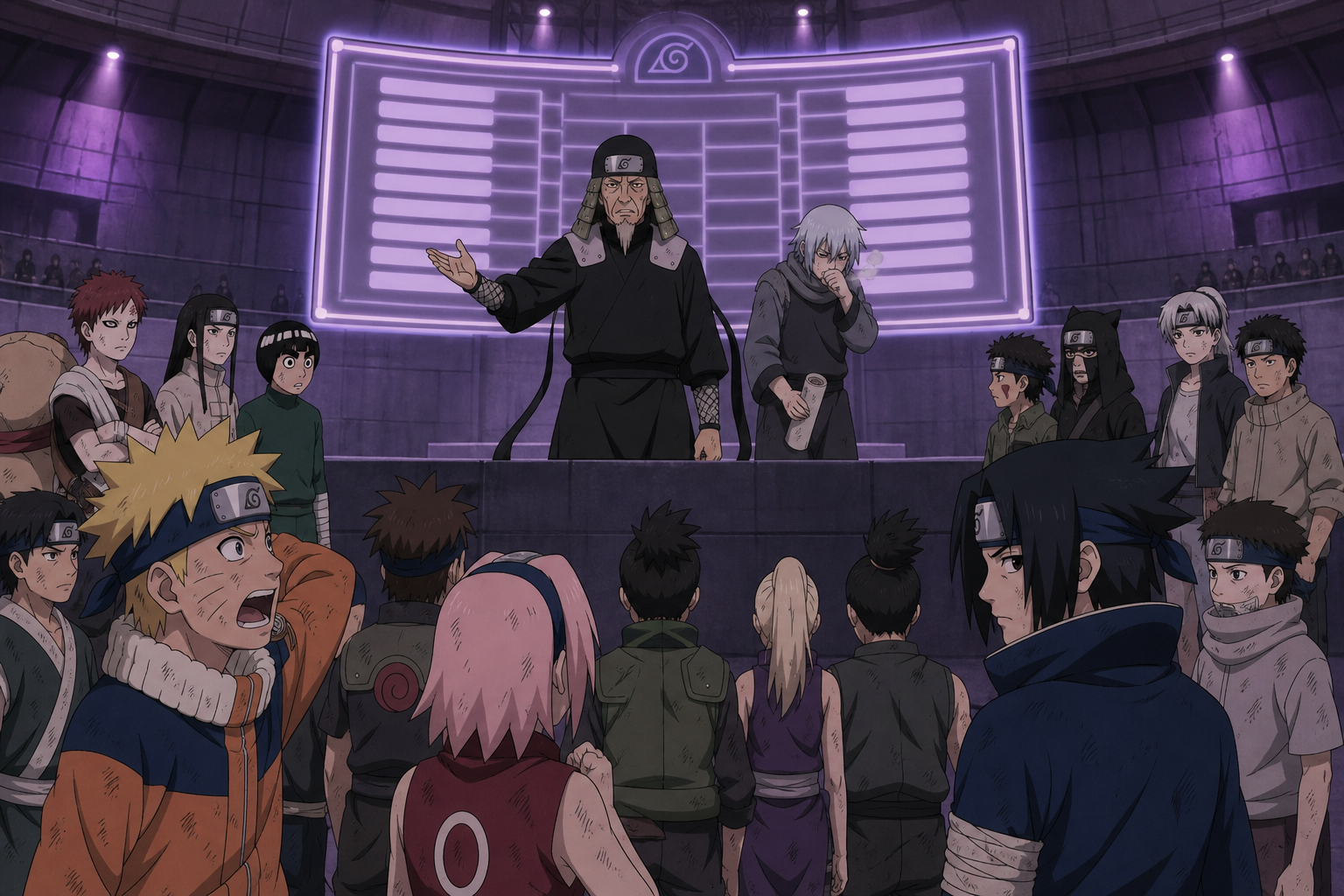
Narrowing the Field: Sudden Death Elimination!
Twenty-one children survive the Forest of Death. The adults call that too many, explain that the exam is military theater, and send the exhausted survivors straight into one-on-one elimination matches.
Episode 38 finally says the quiet part out loud: the Chūnin Exams are a miniature war and a sales floor for village military power. These children are not only students hoping for promotion. They are demonstrations for clients, rivals and political partners. Their skill protects village prestige, and their injuries become part of the show.
Then the administration looks at twenty-one survivors and decides the problem is not that they just endured five days of hunger, combat and an S-rank intruder. The problem is the bracket. So the children get no meaningful recovery period before sudden-death preliminaries. Baby, that is not neutral assessment. That is an institution turning exhaustion into another test because the schedule matters more than the bodies.
Twenty-one survivors walk into a military showroom
Naruto, Sasuke and Sakura join the other teams that cleared the Forest of Death. The room holds the Rookie Nine, Team Guy, the Sand siblings, Kabuto’s team and the remaining Sound genin. Everybody carries a different combination of fatigue, injury, fear and ambition.
The staging invites us to scan faces before anyone explains policy. Naruto sees rivals. Sakura sees people who hurt her friends and people who protected them. Sasuke carries Orochimaru’s curse mark under his clothing. Kiba has witnessed Gaara kill. Lee is injured. Dosu’s team knows their employer’s plan is larger than the exam. The roster looks orderly only if you ignore what each body brought into the room.
That is the episode’s first receipt. Institutions love a clean line of names because a roster makes unequal damage look equal. Everyone is called a qualifier, but they did not arrive with the same safety, information, support or physical condition.
Hiruzen explains what the exam actually sells
Hiruzen Sarutobi tells the candidates that the Chūnin Exams are a small-scale version of war among allied nations. The villages maintain an official friendship while using the examination to display the strength of their shinobi. That performance helps preserve the balance of power.
This is bigger than choosing squad leaders. A village with impressive candidates can attract missions, reassure allies and warn rivals. A weak showing can damage confidence in the village’s military labor. The children are therefore taking a promotion test and participating in state advertising at the same time.
Hiruzen does not pretend the institution is gentler than it is. I appreciate the honesty. I do not confuse honesty with innocence. Explaining that children risk their lives to stabilize an adult political order does not make the arrangement morally clean.
Peace in the shinobi world still depends on a threat
The allied villages are not at open war, yet their friendship is maintained partly through competitive displays of force. Peace here is not the absence of military pressure. It is military pressure organized into a ritual that lets states measure one another without immediately sending armies across borders.
That logic resembles deterrence. Each village wants others to believe it can produce dangerous, disciplined shinobi. The exam turns bodies, bloodlines and techniques into evidence. Neji’s Byakugan, Gaara’s sand, Sasuke’s Sharingan and Shino’s insects are personal abilities, clan inheritances and national inventory all at once.
Naruto wants acknowledgment as a person. The village can use his performance as proof of institutional strength. Those motives overlap without becoming identical. This is one of the show’s sharpest political tensions: a child’s honest dream can still feed a system that sees value in him for reasons he did not choose.
Too many children survived, apparently
Twenty-one candidates pass the second exam, and leadership decides that number is too large for the final stage. Immediate preliminaries will reduce the field. The wording matters. Nobody failed to meet the announced second-stage requirement. The institution changes the path because the successful group does not fit the desired event.
That means the exam does not measure a fixed threshold alone. It controls scarcity. Promotion must remain limited enough to protect rank value, client perception and the spectacle of the final tournament. When more candidates succeed than the structure wants, success itself creates another elimination round.
The children are told rank follows merit. Episode 38 shows that merit is filtered through capacity, politics and presentation. You can meet the standard and still be cut because the institution only wants so many winners. Welcome to the labor market with kunai.
No rest is part of the test, whether they admit it or not
The preliminaries begin immediately. That decision advantages candidates whose forest experience left them healthier and candidates whose abilities require less recovery. It punishes teams that protected injured members, endured longer battles or were targeted by threats outside normal exam design.
Sasuke is the clearest example. Orochimaru marked him during an illegal infiltration, and the mark reacts to chakra use. The village knows a hostile adult targeted him. Instead of removing that external contamination from the evaluation, the system allows its consequences to shape his next match.
There is a shinobi argument that leaders must perform while tired because missions do not schedule naps around danger. Fine. A realistic stress test still needs controlled variables if it claims to evaluate candidates fairly. Orochimaru is not a standard weather condition. He is a security breach with a personal agenda.
Hayate arrives looking like the job already ate him
Hayate Gekkō steps forward as the preliminary proctor. He is pale, visibly unwell and punctuates authority with a cough. Naruto notices because subtlety has never paid rent in that boy’s house.
Hayate’s body adds another layer to the scene. The adult enforcing the system also looks consumed by it. He remains precise, professional and capable, but the visual refuses the fantasy that military labor leaves its administrators untouched.
That does not make Hayate secretly weak. Illness and competence can occupy the same body. The joke lands through Naruto’s blunt reaction, yet the character design also normalizes a working professional whose authority is not erased by visible physical limitation.
Individual combat breaks the team into merchandise
The second exam required teams to survive together and possess both scrolls. The preliminaries switch to one-on-one matches. Cooperation got the candidates into the room. Individual spectacle now decides who reaches the public final.
This shift serves the event’s political purpose. A single fighter is easier to compare, remember and market. Clan techniques become identifiable products. Village training systems get faces. The bracket converts complicated team survival into simple winners and losers.
It also changes the emotional problem. Sakura cannot compensate for Sasuke’s curse mark inside his match. Shikamaru cannot place Chōji where his strength works best. Hinata cannot hide inside Team 8’s collective competence. Every relationship remains psychologically present while the rules remove direct support.
Kabuto understands when information is more valuable than promotion
Kabuto Yakushi withdraws before the matches, citing his condition. On the surface, the repeated exam participant decides his body cannot continue. Underneath, his larger role makes promotion less important than observation and access.
His exit shows a kind of intelligence the exam cannot neatly grade. He knows when the official prize is not his real objective. He has already gathered information, entered the tower and maintained his cover. Staying would create exposure without enough benefit.
Naruto reads withdrawal through his own value system, where giving up feels unbearable. Kabuto operates through mission logic. The difference matters because apparent courage and actual strategy are not always the same thing.
Sasuke refuses to step aside from the danger
Sakura knows Sasuke is not well. Kakashi knows the curse mark is dangerous. Sasuke still insists on remaining. Part of that choice is pride. Part is fear that removal will confirm weakness. Part is his obsession with measuring himself against strong opponents.
The exam environment rewards that refusal. Continuing while injured reads as resolve, and withdrawal carries stigma. Shinobi culture treats the body as a tool that should obey mission needs. Sasuke’s body is also being claimed by Orochimaru, which makes his insistence on control emotionally understandable even when the choice is unsafe.
Agency under coercion is still agency, but it is not freedom from pressure. Sasuke chooses to fight inside conditions shaped by trauma, rivalry, institutional expectation and a predator’s mark. Calling the decision purely brave would flatten the whole mess.
Sakura sees the danger before the rules acknowledge it
Sakura’s concern is not decorative worry. She watched the curse mark transform Sasuke’s behavior in the forest. She knows his chakra use can trigger something he cannot fully control. Her knowledge comes from proximity and care, not official rank.
The system listens more easily to formal declarations than relational evidence. Sakura cannot simply order Sasuke out. Kakashi has more authority, but even he works within an event leadership chose to continue.
This is care work inside a military structure. Sakura notices, remembers and tries to protect while the institution keeps moving. Her fear is treated as emotion, yet it carries accurate operational information.
The bracket pretends history starts at the matchup
An electronic board can reduce two people to names. The audience sees everything attached to those names: clan histories, injuries, rivalries, village politics and secret assignments. A matchup looks clean because the screen cannot display the baggage.
The first selection sets Sasuke against Yoroi Akadō, a member of Kabuto’s registered team and an operative connected to Orochimaru. That is not neutral to us, even if the exam presents it as random. Sasuke enters with Orochimaru’s mark and faces a person inside Orochimaru’s network.
The story uses the bracket as dramatic machinery while making us distrust its promise of fairness. Random selection can be procedurally equal and materially unequal. Rules do not erase context merely because the board refuses to print it.
Direction turns explanation into pressure
Episode 38 carries a large amount of institutional exposition. The direction keeps it from feeling like a committee meeting by cutting between Hiruzen’s explanation and the qualifiers absorbing what it means. Their faces make policy personal.
The arena’s scale matters. The candidates stand below officials and the towering matchup display. Vertical space makes authority visible. The children are centered as the content of the event while adults control the platform, speech and rules.
The episode also delays combat long enough to reframe every fight that follows. We are not only watching cool techniques. We are watching villages advertise power through children who have already been pushed beyond a reasonable school exam.
Japanese performance makes authority sound ordinary
Hidekatsu Shibata performs Hiruzen in the original Japanese anime. The scene works because the explanation does not need villain laughter. Hiruzen presents the miniature-war purpose as established institutional reality. Calm delivery makes the system feel older and more normalized than one cruel official.
Junko Takeuchi gives Naruto the immediate, loud resistance of a child who thought passing meant he had passed. Chie Nakamura keeps Sakura alert to Sasuke’s condition, while Noriaki Sugiyama holds Sasuke in guarded determination.
Nozomu Sasaki introduces Hayate with tired restraint rather than theatrical frailty. Nobutoshi Canna’s Kabuto remains controlled during withdrawal. The ensemble lets one room contain ambition, fear, calculation and exhaustion without making every candidate announce a thesis.
A Confucian reading asks whether hierarchy earns obedience
Confucian role ethics does not only demand obedience from juniors. It demands responsibility, moral example and care from seniors. Hiruzen has the authority to define the exam’s meaning, and that authority creates an obligation toward the young people placed beneath him.
The candidates are expected to accept sudden rules, endure hardship and represent their villages with discipline. Leadership owes them an examination worthy of that trust. Orochimaru’s infiltration and the lack of recovery expose a failure in reciprocal duty.
Hierarchy becomes morally thin when sacrifice travels downward and prestige travels upward. Episode 38 does not resolve that contradiction. It puts a microphone in its hand.
A Buddhist lens sees attachment dressed as national balance
The villages cling to reputation, military strength and control of mission markets. The exam channels that attachment into comparison. Rather than releasing competition, the allied system ritualizes it.
Individual candidates carry their own attachments: Naruto to acknowledgment, Sasuke to strength and revenge, Neji to fatalism, Lee to proving a ninja can succeed through taijutsu. Those desires are not identical, but the institution can use all of them as fuel.
Nonattachment would not mean abandoning effort. It would mean seeing rank and prestige clearly instead of mistaking them for the whole self. The episode shows how difficult that is when survival, identity and village approval are tied to the same board.
Fandom loves the fights and sometimes skips the invoice
The preliminaries deliver some of the Chūnin Exams’ most memorable matchups. That pleasure is real. The structure is efficient, character-specific and full of consequences. We can enjoy it without pretending the adults created a healthy educational environment.
“They are ninja” is not a moral eraser. The series repeatedly asks what kind of system trains children for violence, what loyalty costs and whether the next generation can inherit something better. Taking that question seriously is not imposing modern softness on the text. Hiruzen literally explains the war economy.
The best fandom reading holds both levels: the match can be thrilling, and the institution can be using the fighter. If our analysis stops at who wins, we understand the bracket and miss the story.
What Episode 38 changes
The Chūnin Exams’ political purpose becomes explicit. Twenty-one qualifiers are ordered into immediate one-on-one preliminaries because the final event cannot accommodate them all.
Hayate Gekkō takes control as proctor. Kabuto withdraws. Team-based survival gives way to individual elimination, and the matchup system selects Sasuke and Yoroi for the opening fight.
Sasuke enters that fight with the curse mark still active and chakra use dangerous. The institution knows enough to understand the risk and proceeds anyway. Everything that follows now belongs partly to personal choice and partly to that decision.
RaeRae’s verdict
This episode gives me the receipt I needed. The Chūnin Exams are not a cute ninja SAT with occasional murder. They are military marketing wrapped around a promotion process, and Hiruzen says so in front of the children.
Then twenty-one survivors become “too many,” because apparently surviving the Forest of Death was only impressive until it inconvenienced the tournament schedule. The fights ahead are excellent television. The policy is still nasty work.
Fandom misreadings I am rejecting
“The exams are only about finding leaders.” Promotion is one purpose. Village power, deterrence and client perception are also explicit.
“Immediate preliminaries are fair because everyone is tired.” Everyone is tired differently, and some injuries came from an outside security breach.
“Kabuto quits because he is weak.” Withdrawal protects his cover and serves objectives that matter more to him than promotion.
“Sasuke’s choice proves the adults are not responsible.” His agency matters. So do the coercive conditions and institutional decision that frame it.
“Hayate’s cough means he is incompetent.” Visible illness does not cancel authority, skill or professional control.
“Political realism makes the system morally neutral.” A system can be understandable, functional and harmful at the same time.
Receipts and official routes
Episode number, English title and official synopsis: Naruto Official Site. Japanese broadcast title, airdate and synopsis: TV Tokyo. Streaming availability varies by region; use the official options linked from the episode directory.