
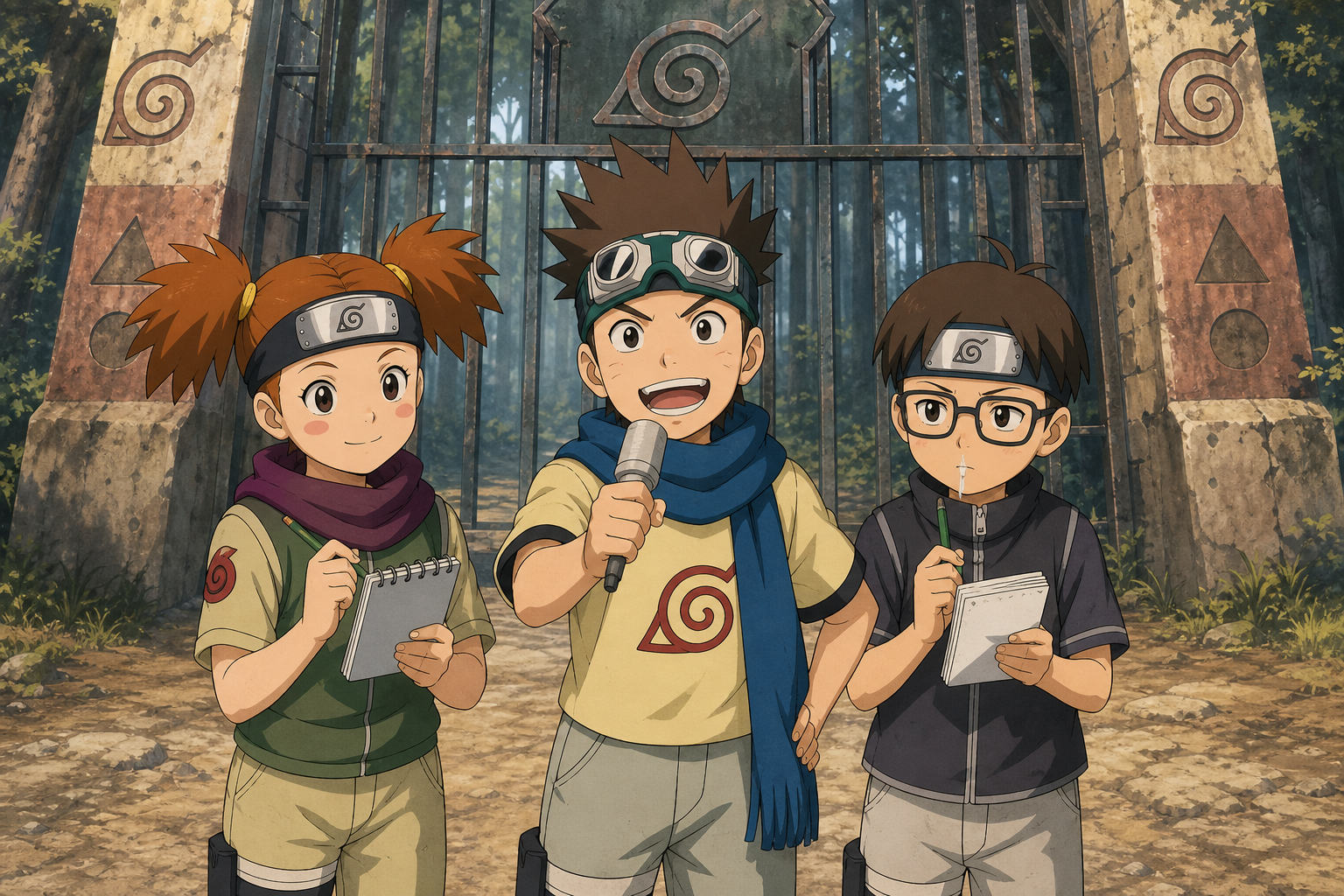
Special Report: Live from the Forest of Death!
The Chūnin Exams pause so three Academy children can ask a deceptively serious question: who gets to tell Naruto’s story once his private pain becomes public legend?
A recap episode becomes a lesson in who controls the record
The school newspaper frame is easy to dismiss because viewers are ready for the Forest of Death. Yet the device asks a useful question: what happens when Team 7’s story is retold for an audience that was not present?
Interviews select moments, memory rearranges emphasis, and presentation turns danger into a narrative other people can consume. The mission record is never the same thing as living through the mission.
Konohamaru’s team approaches shinobi life through fandom
Konohamaru, Moegi, and Udon know Naruto as a person and as a developing legend. Their curiosity contains affection, but it also demonstrates how quickly traumatic experience becomes exciting material for younger children imagining their own futures.
They can ask about battles because they did not feel Zabuza’s killing intent, see Haku die, or sit under Ibiki’s threat. Distance makes adventure look cleaner. Naruto’s answers help decide which version of shinobi life they inherit.
Naruto edits himself while pretending not to
Naruto loves an audience and naturally places himself near the center. His retelling turns confusion into confidence and fear into a story with a punchline. That performance is not simply dishonesty. It is one of the ways he converts experiences he cannot fully process into an identity he can carry.
The danger is that performance can hide need. If every terrifying moment becomes proof that Naruto is amazing, no listener has to ask what the child required afterward.
Sakura remembers details Naruto turns into spectacle
Sakura’s perspective corrects Naruto’s exaggeration and restores sequence, context, and consequence. She is often the person who notices the part of an event that does not fit his preferred legend. Her memory keeps Team 7’s story from becoming a solo performance.
That role is editorial labor inside the narrative. She does not merely react to Naruto. She protects the shared record from being swallowed by the loudest voice.
Sasuke’s reserve is also control over access
Sasuke does not offer himself easily to the newspaper project. Silence lets him decide which parts of his growth remain private, especially after the Land of Waves exposed how much Naruto matters to him.
Refusing an interview can look aloof, but it is also a boundary. A team’s story does not automatically belong to every person who asks for it, even when the request is affectionate.
The episode pauses before a phase designed to remove safety
Anko has announced the Forest of Death with theatrical enthusiasm. The candidates are about to enter an environment where injury and death are explicit possibilities. Placing a recap here creates tonal frustration, but the pause also gives the audience one last look at who Team 7 believes they are.
That self-image will be tested immediately. Naruto sees determination, Sakura sees the team’s uneven history, and Sasuke sees strength still insufficient for revenge. The forest will not respect any of those preferred narratives.
Filler is not automatically empty
Episode 26 reuses material and delays the next stage, which is a real production function. Calling it filler can describe placement without settling value. The question is whether the frame changes how familiar scenes are understood.
The newspaper device adds something when it reveals selection, performance, and the gap between public story and private experience. It becomes empty only when repetition is treated as a substitute for perspective.
Younger children are watching what the village celebrates
Konohamaru’s group learns which traits earn laughter, attention, and admiration. If adults and older genin present danger only as glory, the next cohort may understand injury as an admission price for relevance.
Naruto wants to inspire them because he needed someone to believe effort could alter a label. Inspiration becomes responsible when it includes the parts of survival that do not look heroic.
The archive can preserve people or flatten them
A newspaper can record names, events, and victories that might otherwise disappear. It can also compress Haku into an enemy, Sakura into a witness, Sasuke into a prodigy, and Naruto into a loud hero. Categories make stories portable while removing complexity.
That problem echoes the ninja cards from Episode 23. Information helps people understand a larger world. The format still decides which truths fit.
RaeRae’s final take
Yes, I wanted the forest too. Anko opened the gate to snakes and psychological damage, and the episode handed us a school newspaper. The frustration is honest.
On revisit, the pause earns more patience because it is about narration. Naruto performs his legend. Sakura protects context. Sasuke limits access. Konohamaru’s team turns lived danger into the kind of story younger children use to imagine becoming shinobi.
The episode matters when we treat the recap as an editorial act. Who tells the story, whose memory corrects it, and what gets left outside the frame are not side questions. They determine which Team 7 the village believes it knows.
Episode file
Official episode
Naruto Episode 26, “Special Report: Live from the Forest of Death!”
Story position
Between the written examination and the Forest of Death’s second phase.
Primary frame
The Konohamaru Corps reports on the exams for the Ninja Academy newspaper.
CVM Sekai lens
Memory, spectatorship, institutional storytelling and children learning how heroism is manufactured.
Verdict: structurally disposable, thematically revealing.
The short version
Episode 26 is a recap wearing a press badge, but its childish newspaper frame accidentally exposes one of Naruto’s deepest concerns: a person is never only what happened to them; they are also what a community chooses to remember.
Konohamaru Sarutobi, Moegi Kazamatsuri and Udon Ise arrive as Academy reporters while the Chūnin Exam candidates prepare for the Forest of Death. Their interviews create an excuse to replay Team 7’s beginning, the Land of Waves mission and Naruto’s path to this gate.
The reused footage is obvious. So is the scheduling purpose. Yet the choice of witnesses matters. Children too young to enter the forest are already being taught how to look at those who do.
The gate after the tenth question
Episode 25 ends with Naruto refusing to retreat from Ibiki’s final threat. He does not solve the written test through academic mastery; he survives it by declaring that fear will not author his future.
Then Episode 26 interrupts forward motion. Instead of immediately entering the Forest of Death, the story turns around and looks backward.
That placement can feel brutal during a binge. The previous episode builds momentum toward danger, Anko tears open the next phase and the audience is ready to cross the gate. A retrospective appears exactly where anticipation is hottest.
But psychologically, the pause has logic. Thresholds make people inventory themselves. Before Team 7 enters a place designed to strip away safety, the series reviews who they were when their team formed and what they have already survived.
The recap is not new experience. Memory functions as provisions.
Our reporters are children
Konohamaru approaches the assignment with the self-importance of someone who thinks a title can make him professional. Moegi and Udon bring notebooks, questions and the practical work required to turn his enthusiasm into something resembling a report.
The comedy depends on their youth, but their position is unsettling if we stop laughing for a moment.
They are Academy students reporting on an examination that authorizes children to become more useful military operatives. The dangerous forest behind them is not an alien institution. The dangerous forest is their probable future.
The trio is not merely visiting older heroes. They are observing the next rung of the ladder they have already been placed upon.
Naruto often normalizes this structure through adventure. Episode 26 makes the normalization visible: younger children consume exam stories as news, aspiration and entertainment.
Konohamaru is not an objective reporter
Konohamaru admires Naruto because Naruto was the first person to oppose him honestly. Adults saw “the Honorable Grandson,” an extension of Hiruzen Sarutobi’s authority. Naruto saw an irritating kid blocking the road and treated him accordingly.
That recognition becomes discipleship. Konohamaru wants Naruto’s techniques, confidence and future, but what he truly inherits is permission to become a person separate from his surname.
So when he covers Naruto’s history, neutrality is impossible. He is documenting someone who changed the terms of his own childhood.
This bias does not make the report worthless. The bias makes the report human. Every archive has a point of view, including the official histories that pretend not to.
Konohamaru’s admiration selects a Naruto worth remembering: troublesome, resilient, embarrassing, brave and impossible to reduce to the Nine-Tailed Fox.
Moegi and the beginning of institutional memory
Moegi’s notebook looks like a prop until we consider the work Konoha requires. Shinobi return from missions and file reports. Intelligence becomes assignments; assignments become casualties or survival. Records teach people who were not present.
A school newspaper is a harmless miniature of that information system. Moegi is practicing how to gather testimony, identify a meaningful sequence and present events to an absent audience.
Her later life makes the exercise resonate. She becomes a jōnin leading a new Team 10. The child who once interviews exam candidates eventually evaluates whether her own students are ready to enter that examination culture.
Episode 26 therefore contains an unnoticed circle. Reporter becomes authority. The person collecting stories from outside the gate becomes one of the adults who may send children through it.
Udon and the dignity of attention
Udon is visually built to be underestimated. Glasses and a persistent runny nose supply a joke before he gets the chance to supply an idea.
Reporting gives that quietness a function. He listens, records and remains part of the group without competing with Konohamaru’s volume. The skills are unspectacular, but they are not empty.
As an adult, Udon leads Metal Lee, Denki Kaminarimon and Iwabee Yuino, three students whose abilities can be obscured by anxiety, unconventional technology or poor academic performance.
The boy reduced to one visible trait becomes the teacher responsible for seeing beyond other people’s visible traits.
Episode 26 is not consciously announcing that future, but completed-series knowledge changes the image. The pencil is an early version of his authority.
What the recap chooses to remember
The retrospective returns to Naruto’s early isolation, Team 7’s formation and the Land of Waves. The episode revisits pranks, tests, fear, rivalry, Zabuza and Haku before the Chūnin Exams expands the cast.
This selection creates an argument. Naruto has not reached the exam by becoming polished. He has reached it through repeated collisions with people who force him to redefine strength.
Iruka teaches him that acknowledgment can interrupt hatred. Kakashi teaches that rules without comrades become moral cowardice. Haku teaches that tenderness can coexist with violence when a child has built identity around being useful. Zabuza demonstrates how grief can break through a language of tools.
The recap turns these encounters into a curriculum. The test Naruto is taking did not begin when Ibiki distributed paper. The test began when the village taught him he was unwanted and he decided to demand a future anyway.
Memory smooths the wounds
Recaps compress. Compression creates clarity, but it also creates danger.
The Land of Waves becomes a set of turning points. The waiting, hunger, economic desperation and moral confusion shrink so the plot can move quickly. Trauma becomes evidence in a success story.
This is how communities manufacture heroes. They preserve the moment of courage and gradually lose the terror that made courage necessary.
Naruto’s past is becoming inspirational material for younger students even while the systems that harmed him remain largely intact. The village can celebrate his persistence without fully confessing why a child needed so much persistence to survive childhood.
Konohamaru’s affection resists total sanitization because he loves the troublemaker too. Still, the episode reminds us that admiration can domesticate pain.
The Hidden Village as narrator
A hidden village controls information by design. Secrets protect techniques, bloodlines, missions and political leverage. What civilians know, what Academy students learn and what rival villages infer are all matters of security.
Against that background, a newspaper is never entirely innocent. Even a school paper teaches children which stories are safe to circulate and which truths remain classified.
The Chūnin Exams themselves are public theater layered over military assessment. Villages display young talent to clients and rivals. Combat becomes diplomacy; children become proof of institutional strength.
Episode 26 adds another audience inside that theater. Academy students report on older students who perform for adults. Every generation learns to watch the next stage before being placed upon it.
The village does not only train bodies. The village trains desire.
Why Naruto’s story attracts Konohamaru
Konohamaru could admire an elite clan heir or decorated jōnin. He chooses Naruto, the boy the village publicly dismisses.
Naruto proves that official judgment is not metaphysical truth. The dead-last can contain a future no current ranking can measure. For a Hokage’s grandson trapped by an opposite label, considered too important before earning anything, that lesson is liberation.
Their problems are not identical. Naruto is denied belonging; Konohamaru is denied anonymity. One is unseen as a child because everyone sees a monster. The other is unseen because everyone sees a grandfather.
Both want a gaze that reaches the person beneath the inherited story.
Konohamaru’s report is therefore also autobiography. By explaining why Naruto matters, he explains the kind of recognition he wants for himself.
The episode’s existential question
If nobody remembers an experience accurately, does the person who survived it lose part of their life to the story told afterward?
Naruto begins as a child whose identity has been authored by people who refuse to tell him the truth. The village knows the fox is sealed inside him but lets social disgust communicate a distorted version of that fact.
His journey is partly a struggle for narrative agency: to say who he is loudly enough that inherited fear no longer gets the final word.
Episode 26 dramatizes the next problem. Once people begin to admire him, they will tell his story too. Love can misread a person just as hatred can.
Konohamaru’s affectionate account is kinder than the village’s stigma, but Naruto remains more complicated than either legend. Existing is not the same as being correctly narrated.
Easter eggs and details worth noticing
A future mentor at the exam
Moegi will later lead the children of the Ino–Shika–Chō families, making her early position outside the exam gate quietly circular.
Three future jōnin
The comic Konohamaru Corps eventually produces adult team leaders. Their notebook assignment is not the endpoint fandom often remembers.
Naruto as oral history
The retrospective reminds us that much of reputation travels through witnesses before official archives stabilize it.
The Forest as threshold
The barred gate visually divides children who observe danger from children currently authorized to enter it.
Recap as audience mirror
The trio consumes Naruto’s past much as viewers do by selecting favorite moments and turning lived pain into a coherent character arc.
Exam publicity
The assignment foreshadows how the exams operate not only as assessment but as a story Konoha tells about its own strength.
What works
- The Konohamaru Corps is a thematically appropriate frame for Naruto’s history.
- The episode provides breathing room between two very different exam phases.
- Completed-series hindsight gives Moegi and Udon’s reporter roles unexpected resonance.
- The retrospective restores early emotional stakes just before the ensemble expands dramatically.
- Konohamaru’s bias keeps the recap anchored in relationship rather than turning it into a clinical summary.
What does not work
- The timing interrupts one of the original series’ strongest cliffhangers.
- The volume of reused footage overwhelms the new framing material.
- Moegi and Udon receive too little individual voice despite doing much of the reporting labor.
- The episode rarely interrogates the disturbing reality of Academy children covering a militarized examination.
- During a modern binge, the practical broadcast function is far more visible than it was in weekly television.
Calling those weaknesses does not require pretending the episode has no meaning. Honest criticism requires separating meaning we can read from momentum the episode undeniably sacrifices.
RaeRae reaction: yes, I wanted the forest too
Let us be honest: Anko had just arrived with theatre-kid menace, the Forest of Death was waiting, and the show handed us a school newspaper.
My first emotional response is not philosophical generosity. My response is, “Baby, move. There are snakes and psychological damage behind that gate.”
But Naruto earns revisiting because its awkward choices often expose ideas the polished momentum would hide. The recap asks us to experience anticipation as inheritance. Konohamaru, Moegi and Udon want the story because the story is how they imagine their own future.
That is adorable until it is horrifying.
They are children playing journalist beside an institution that will eventually assess whether they are prepared to risk their lives for rank. The cheerful framing and lethal backdrop belong to the same village. Naruto’s world is always doing this: serving childhood and militarization in the same bowl, then hoping enthusiasm keeps us from tasting the contradiction.
Final reading
Episode 26 will never become essential viewing because of new plot. Almost everything a first-time viewer needs can be inferred without it.
Yet “nonessential” is not the same as meaningless. Its framing makes Naruto’s emerging reputation visible. The boy once defined by whispered disgust is becoming a story younger children actively seek.
That transformation is victory, but not uncomplicated victory. Reputation is another container. Reputation can hold acknowledgment, expectation, distortion and the pressure to keep performing the version of yourself other people need.
Konohamaru’s report lovingly preserves Naruto as proof that imposed identities can be defeated. Moegi and Udon help convert that proof into a record. The Forest gate waits behind them, reminding us what the record is preparing them to desire.
The episode looks backward because the children are looking forward.