
Kiba’s Long Day
Kiba’s infected partner becomes a public threat, forcing medicine, village safety and Akamaru’s own resistance into the same painful rescue.
Kiba loves Akamaru enough to risk everything for him.
That does not mean every choice he makes is right.
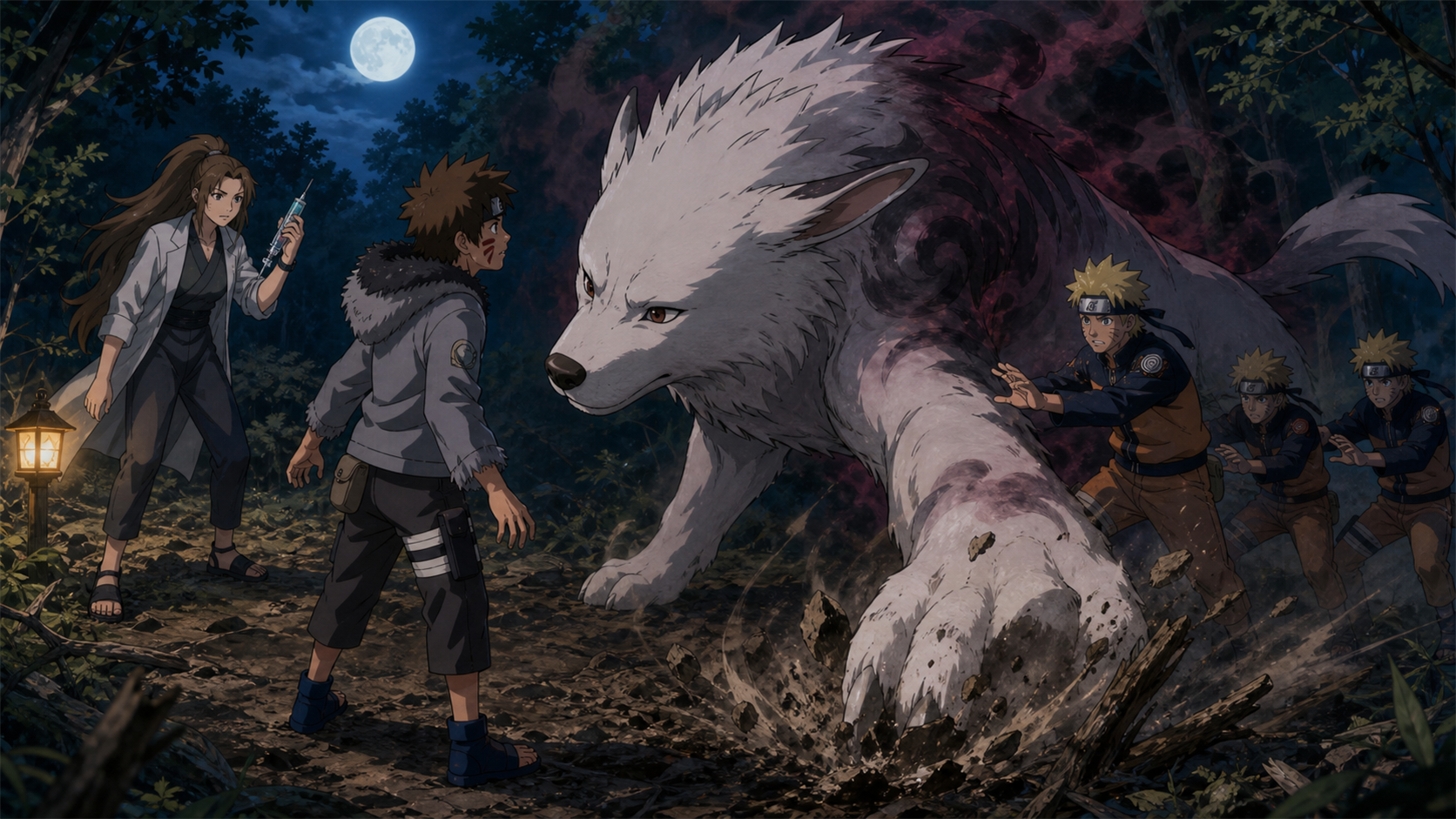
Episode 184 traps Kiba between the partner he refuses to abandon and a village that cannot ignore an infected ninja hound attacking people in the dark. Tsunade has to protect the public. Hana has to attempt a treatment that might make the patient worse. Naruto has to help a friend who keeps treating help like a threat.
Akamaru has the hardest fight of all.
He has to find himself inside a body that no longer obeys him.
Episode 184 Facts
- English title: Kiba's Long Day
- Japanese title: 犬塚キバのなが~い一日
- Original Japanese broadcast: May 10, 2006
- Story position: A standalone anime-original episode
- Medical lead: Hana Inuzuka, Kiba's older sister and a veterinarian
- Threat: A biological weapon that progressively overrides an infected host's mind
- Treatment odds: A serum with a fifty-percent survival chance and dangerous side effects
- Outcome: Akamaru redirects his final attack, and the Medical Corps saves both partners
The episode works because nobody receives a morally painless role. Tsunade must define the public-safety limit. Hana must recommend treatment without certainty. Kiba must decide whether trust means accepting risk. Naruto must keep helping after Kiba rejects him. Akamaru must resist an enemy operating from inside his own body.
An Enemy Leaves a Weapon Behind
The crisis begins after Kiba's team captures a shinobi who infiltrated the Leaf.
The prisoner swallows a pellet and kills himself before interrogation. The investigation reveals why he may have preferred death to questioning. His village uses a biological weapon that spreads a special pathogen through an opponent's body.
The infection does not merely cause fever or weakness. It gradually erases mental control until the victim's body belongs to the bacteria.
Akamaru fought the intruder.
Now he may be carrying the weapon home.
The infiltrator's suicide also blocks ordinary accountability. The Leaf cannot question him about transmission, timing, treatment, or whether other carriers exist. One attack leaves behind a patient, a security threat, and almost no clinical information. The weapon keeps working after its user is gone.
Naruto receives an assignment to monitor him, although spying quietly has never been one of Naruto's natural gifts. Kiba thinks Akamaru is only tired and skips training to let him recover. Hana Inuzuka, Kiba's older sister and a veterinarian, has examined his blood but can offer only a fifty-fifty assessment.
The uncertainty makes every strange reaction harder to judge. Is Akamaru sick, irritable, or already losing himself?
The first warning comes from creatures that understand danger before the humans do.
Shino's Insects Know Something Is Wrong
During Team 8 training, Shino's insects attack Akamaru.
Shino cannot control them, and he has never seen them turn on a comrade. Their reaction suggests that whatever they sense no longer registers as the familiar partner beside Kiba.
Akamaru later catches Naruto hiding near the Inuzuka home and bites him. Naruto is annoying on a normal day, yes, but Akamaru knows his scent. An attack serious enough to tear Naruto's clothes is not ordinary guard-dog behavior.
Kiba tries to treat the bite as a training problem. Hana patches Naruto's clothing while the siblings avoid saying what both suspect.
Then multiple shinobi are mauled during night training.
Witnesses assume a group launched the attack because one attacker should not be capable of that much damage. The evidence points to one animal.
Kiba smells Akamaru's blood at the scene.
The possibility becomes a public emergency.
Shino's insects and Kiba's nose provide independent biological warnings before laboratory certainty arrives. Neither proves the full mechanism alone, but together with the bite and night attacks they justify containment. Waiting for perfect confidence would give the pathogen more time to take control.
Tsunade Cannot Pretend Akamaru Is Harmless
Tsunade orders Anbu to place Akamaru under supervision while the Medical Corps searches for a cure.
Kiba hates it. Naruto demands to know what happens if the doctors fail.
Tsunade gives the answer neither boy wants. If Akamaru remains infected and dangerous, the village may have to put him down.
That sounds brutal because it is brutal. It is not casual.
Akamaru has already attacked comrades and overwhelmed multiple trained ninja. If the pathogen fully takes his mind, civilians will face an animal bred, trained, and empowered for combat. Tsunade cannot value one beloved partner by pretending every other life is expendable.
She also does not jump straight to execution. She orders containment and gives the medical teams time to find treatment.
Leadership sometimes means holding hope and worst-case responsibility at the same time.
Tsunade's order also protects Akamaru from immediate panic. Formal supervision keeps frightened shinobi from treating every movement as grounds to kill him. Containment creates time for Hana and the Medical Corps to investigate while acknowledging that time may run out.
Kiba hears only the worst case.
Kiba Confuses Escape With Protection
Kiba removes Akamaru from the veterinary hospital and flees.
He promises that nobody will take his partner. In his mind, he is keeping the vow that defines their bond.
In practice, he takes a rapidly deteriorating patient away from the people developing the only possible cure.
The choice is emotionally believable. Kiba remembers other moments when Akamaru suffered beside him, especially the injuries they endured during the Sasuke recovery mission. He swore he would never let his partner go through that again.
Fear turns the promise into a wall.
Kiba hides their tracks and rejects everyone before they can explain themselves. He decides that Anbu, Tsunade, Naruto, and eventually Hana all want the same thing. Anyone approaching Akamaru must be an executioner.
Meanwhile, Akamaru grows larger, more violent, and less recognizable.
Protection without treatment is only delay.
Kiba also increases the danger to Akamaru by removing monitoring. Outside the hospital, nobody can track changes in his blood, adjust restraint, or intervene when his body expands. Love tells Kiba not to abandon his partner. Fear translates that duty into isolation, which is the worst possible environment for a rapidly changing infection.
The Cure Is a Risk, Not a Guarantee
The Medical Corps produces a serum.
It gives Akamaru a fifty-percent chance of survival. It may also produce side effects that drive him further out of control.
That is a miserable choice, but it is still a choice. Without treatment, the infection continues taking over. With treatment, Akamaru has a chance to return.
Naruto finds Kiba and tries to help. Kiba assumes Naruto came to dispose of Akamaru and attacks the one person reckless enough to defy an entire pursuit unit for a friend.
Naruto finally gets through one fact: the Special Pursuit Corps is closing in, and arguing wastes the treatment window.
When the unit arrives, its leader is Hana.
She carries a syringe, not an execution blade.
Hana tells Kiba the truth about the serum. She does not promise it will work or hide what failure could mean. She asks him to accept the risk because medicine has no safer answer left.
Kiba freezes.
He can run from a certain order. He cannot run from being asked to choose uncertain hope.
The fifty-percent figure does not mean doing nothing is equally safe. Untreated deterioration is already visible and accelerating. The serum's uncertainty sits against a worsening baseline, not against a healthy alternative. Kiba hears treatment as an active risk and escape as neutrality, but escape is a decision with its own likely outcome.
Naruto and Hana Fight for the Patient
Naruto uses shadow clones while Hana directs him to immobilize Akamaru's legs.
Their goal is not to defeat him. They need one clean chance to administer the serum without allowing a giant, infected ninja hound to tear through the team.
Kiba stands aside, paralyzed by the possibility that treatment could make everything worse. Hana pushes him away from the fight because indecision has become another danger.
The serum attempt fails to reach Akamaru as he throws off Naruto's clones.
Hana reaches the boundary Tsunade warned about. If they cannot restrain him and the infection keeps escalating, she may have to terminate him.
That is when Kiba finally acts.
Hana's willingness to consider termination does not cancel her role as caregiver. Veterinary duty includes preventing an uncontrollable combat animal from killing others when treatment and restraint fail. She exhausts care first, carries the serum herself, and faces the last resort rather than hiding it behind somebody else's order.
He does not produce a secret cure. He does not prove the medical danger was exaggerated. He steps between Akamaru and the people preparing to stop him, then calls to the part of his partner the pathogen has buried.
Kiba Uses the Language They Share
Kiba asks whether Akamaru has forgotten his scent.
The question reaches deeper than a command. The Inuzuka partnership is built through bodies, instincts, and years of moving together. They coordinate transformations and attacks because neither one functions as the other's accessory.
Kiba apologizes.
He says he put Akamaru through painful experiences and failed to protect him. He calls himself a terrible master, then promises he will always remain beside him.
The word “master” does not fit what the scene shows.
Kiba is not standing over an animal and demanding obedience. He is standing in the path of a lethal attack, trusting that his partner still exists inside the infection.
Scent is the right language because the pathogen can distort behavior without erasing their shared history all at once. Kiba does not ask Akamaru to perform a trick. He offers the most basic proof of who stands in front of him and ties it to memories formed before the infection.
Akamaru strikes.
Both collapse.
The Medical Corps arrives barely in time to save them.
Akamaru Was Fighting Too
At the hospital, Kiba corrects the assumption that he survived by luck.
Akamaru's final attack missed his vital organs by the smallest possible margin. He used his remaining strength to control the movement of a body the pathogen was trying to own.
That detail changes the whole episode.
Akamaru was never a passive patient waiting for Kiba to rescue him. His attacks grew worse, but some part of him kept resisting. Kiba's scent, voice, and promise gave that resistance something familiar to reach toward.
Redirecting the strike costs Akamaru nearly everything. He cannot stop the body from attacking, so he changes the angle enough to spare Kiba's vital organs. That small piece of control is the episode's clearest evidence that infection has not erased the partner inside.
Love did not replace medicine. The Medical Corps still had to save both of them, and the serum mattered because memory alone could not remove a biological weapon.
Medicine did not replace the bond either. Kiba gave Akamaru the moment of recognition that allowed him to redirect his attack.
Episode 184 lands because it does not force a cheap choice between the village and the dog.
Tsunade protects the village by pursuing treatment until no safe option remains. Hana accepts the ugly uncertainty of care. Naruto refuses to let Kiba isolate himself. Kiba stops running long enough to trust them. Akamaru proves he never stopped fighting his way back.
Kiba thanks his partner when they wake beside each other.
After one very long day, both are still there to hear it.
Their survival does not prove Kiba was right to run. It proves that medicine, family, friendship, and Akamaru's own resistance finally worked together after Kiba stopped treating them as competing loyalties.
That is the line the episode gets right. Public safety does not require pretending Akamaru is disposable, and loving Akamaru does not require denying the danger. Care becomes real when everyone faces both truths at once.
Neither truth gets to erase the other, even when fear makes that tempting.
The enemy turns Akamaru into a weapon after the fight ends
The infiltrator does not need to survive interrogation for his attack to continue. The bacteria enter through Akamaru’s wound, spread through his body, and begin stripping away his control. That makes the infection more than an illness. It is a delayed weapon designed to send a trusted combat partner back among allies before anybody understands the threat. The Leaf must investigate the original encounter, everyone exposed afterward, and whether the captured shinobi carried more than one transmission method.
Shino’s insects provide an early warning that deserves respect
The insects recognize a biological change before the medical team has a complete explanation. Their reaction is not proof of every later conclusion, but it is meaningful field evidence from a system Shino understands intimately. Dismissing it because the warning looks strange would waste time. The responsible response is to combine it with Akamaru’s bite, Kiba’s scent findings, the mauled shinobi, and laboratory work until the pattern becomes clear.
Tsunade’s containment order protects Akamaru too
Supervision is not the same as a death sentence. Anbu containment limits the chance that frightened residents or injured ninja will attack Akamaru on sight. It also keeps him close to the people working on a cure. Tsunade names the worst outcome because the village needs a boundary if the infection fully takes a trained ninja hound’s mind. Honest leadership cannot promise that care will always succeed, but it can make sure lethal force remains the final option.
Kiba hears the worst case and stops hearing the plan
Once Kiba learns that Akamaru might be put down, every uniform looks like an executioner. Fear narrows the situation until escape feels like the only loyal choice. Yet Tsunade has not abandoned treatment, Hana has not abandoned her patient, and Naruto has not abandoned his friend. Kiba’s love is real. His conclusion that love requires isolation is the part that fails Akamaru.
Running removes the patient from the only available care
Outside the hospital, nobody can monitor the infection, adjust restraints, or respond safely when Akamaru’s body changes. Kiba protects him from an outcome that has not yet been ordered while exposing him to deterioration already underway. This is the ugly lesson: refusing a frightening medical decision is still a decision. Doing nothing does not return Akamaru to health. It gives the bacteria more uninterrupted time.
The fifty-percent serum is not a coin toss against safety
Hana’s odds sound unbearable because active treatment makes risk visible. The comparison, however, is not between the serum and a healthy Akamaru. It is between the serum and an infection that is already erasing control and escalating violence. Consent requires that Kiba understand both paths. A fifty-percent chance may be terrible, but untreated decline is not neutral simply because nobody has to push a syringe.
Hana carries two duties without pretending they are easy
She is Akamaru’s veterinarian and Kiba’s sister, but she is also responsible for the people an uncontrollable combat animal could kill. The episode does not make her choose compassion or public safety as though only one can be humane. She develops treatment, brings it herself, directs restraint, and faces the last resort when restraint fails. Her care has boundaries because other lives also matter.
Naruto helps even after Kiba attacks him
Kiba mistakes Naruto’s pursuit for betrayal and lashes out. Naruto does not turn that rejection into an excuse to leave. He keeps telling Kiba what is happening and returns to the rescue once Hana arrives. Friendship here is not automatic agreement. It is refusing to flatter a terrified person while also refusing to abandon him to the consequences of his panic.
The team restrains a patient instead of defeating an enemy
Naruto’s shadow clones target Akamaru’s movement so Hana can administer treatment. The objective shapes the ethics of the fight. They need enough force to prevent injury, but not the kind of force used to crush an opponent. Calling Akamaru dangerous is accurate. Calling him disposable would be wrong. The team must hold both facts while every second makes the distinction harder to preserve.
Kiba finally speaks in the language their partnership built
He asks whether Akamaru remembers his scent because their bond was never based on commands alone. They trained, tracked, fought, rested, and grew through shared physical memory. Kiba’s appeal does not magically cure the infection. It gives Akamaru a familiar point to resist toward when his own body has become hostile territory.
Akamaru redirects the attack rather than disappearing inside it
He cannot fully stop the strike, but he shifts it away from Kiba’s vital organs. That small movement proves Akamaru remained an active participant in his rescue. The story does not reduce him to a beloved object passed between Kiba, Hana, and Tsunade. He fights from inside the infection and uses the control he has left to protect his partner.
Love and medicine succeed together
Kiba’s appeal creates recognition. Hana’s serum and the Medical Corps keep both partners alive. Naruto helps hold the crisis open long enough for either to matter. None of those contributions cancels the others. The episode rejects the cheap fantasy that devotion alone cures disease and the equally cold idea that clinical care has no room for the relationship motivating survival.
The village needs a biological-response review after the rescue
Saving Akamaru closes the immediate emergency, not the security problem. The Leaf should document the pathogen, monitor everyone exposed, review the captured shinobi’s route, establish quarantine triggers, and prepare treatment guidance for future attacks. Kiba and Akamaru also deserve follow-up that considers trauma as well as physical recovery. Being saved does not make the fear, loss of control, or forced choices vanish.
RaeRae’s full take
Kiba’s love for Akamaru is never the question. The question is whether fear gets to define what that love demands. Kiba decides that protection means running from every person who might help because one possible outcome terrifies him. That choice feels loyal and makes Akamaru less safe.
Tsunade and Hana get the thankless roles. They have to say the thing nobody wants spoken: a powerful, infected ninja hound cannot be allowed to kill people indefinitely because his family loves him. They also keep working for a cure. That is the difference between treating Akamaru as disposable and accepting responsibility for a genuine threat.
The ending belongs to Akamaru. He is not saved because Kiba’s feelings overpower biology. He uses the piece of control he still has, Kiba gives him something familiar to reach for, and the medical team does the work that keeps both of them alive. Care wins because everybody finally stops treating love, medicine, and public safety as enemies.
RaeRae checkpoint: Kiba proves his loyalty when he stops running long enough to let other people help Akamaru. Love is not denial. Love faces the danger and still fights for the patient inside it.
Receipts and official routes
- Episode number, licensed title, infection mechanism, and official synopsis: Naruto Official Site.
- Japanese title, Akamaru’s worsening condition, Kiba’s forced choice, and May 10, 2006 broadcast record: TV Tokyo.