
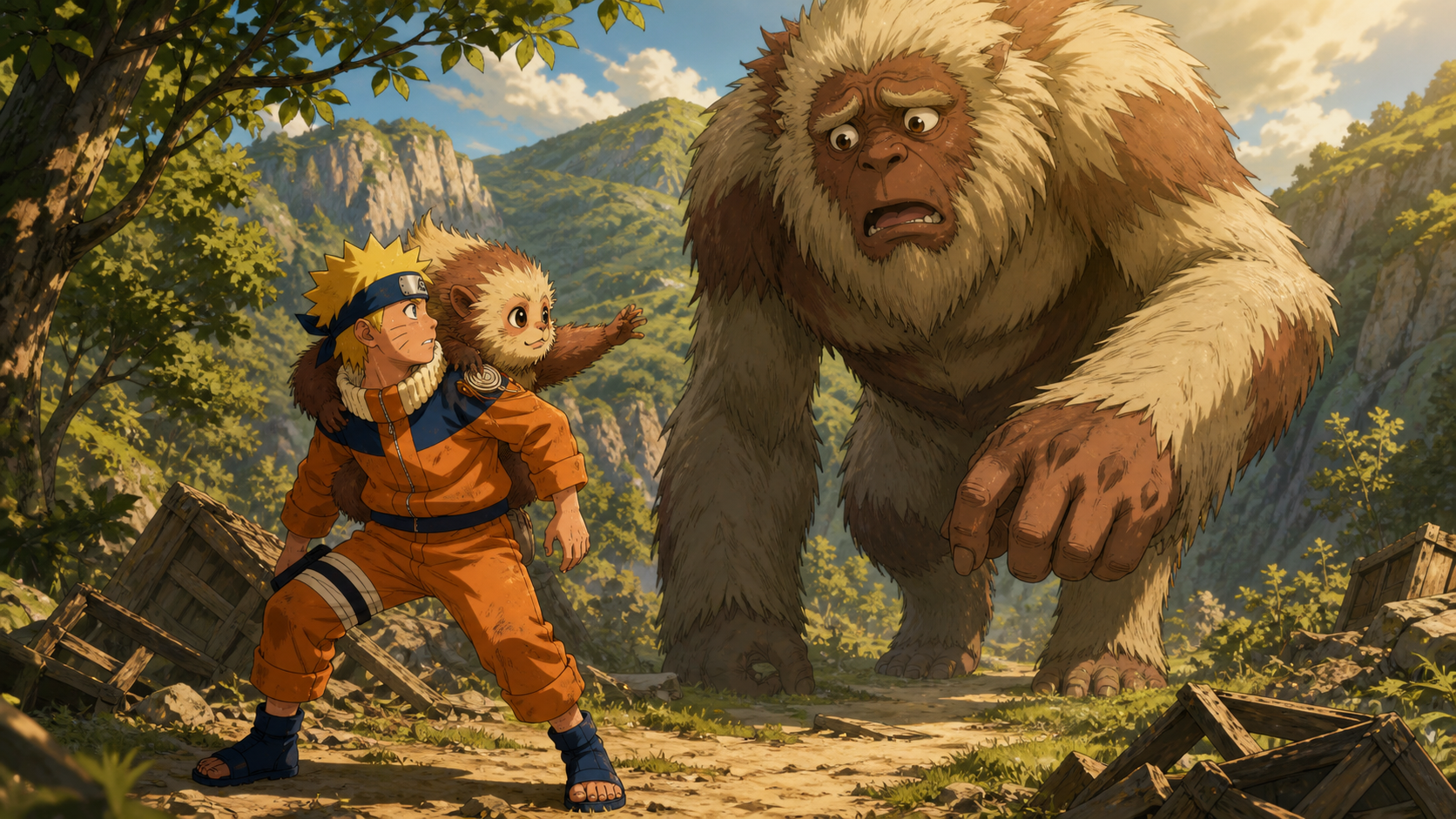
A Legend from the Hidden Leaf: The Onbaa!
A baby onbaa imprints on Naruto, turning involuntary care into a strange partnership before its enormous mother arrives to reclaim it.
Naruto becomes a parent because a bird drops a furball on him.
Nobody asks whether he is ready.
The baby does not care.
Episode 185 is a full comedy detour after two much heavier stories. A legendary animal attaches itself to Naruto's back, eats everything in reach, grows at an alarming rate, and turns every basic task into public humiliation.
Naruto calls it a burden until it saves his life.
Then he introduces it as his kid.
That emotional turn gives the ridiculous premise just enough heart to work.
Episode 185 Facts
- English title: A Legend from the Hidden Leaf: The Onbaa!
- Japanese title: 木ノ葉隠れの伝説 オンバアは実在した!!
- Original Japanese broadcast: May 17, 2006
- Story position: A standalone anime-original comedy episode
- Infant's name: Onbu
- Species: Onbaa
- Imprinting rule: An infant clings to the first being it sees as a parent until adulthood
- Mission: Naruto and Onbu remove bandits from Yamabuki Pass
The premise is pure nonsense, but it follows a recognizable emotional progression. Naruto begins with involuntary responsibility, develops routine care, receives protection from the dependent he underestimated, and then lets the child return to the family he lost. The final village-wide infestation turns that growth back into a joke before the episode gets too pleased with itself.
Something Lands on Naruto's Back
Naruto trains alone in the forest when a hawk drops something small and furry onto him.
He does not notice.
That is the first and best clue about the episode's priorities. Naruto can sense hostile ninja, fight clones, and survive impossible missions, but apparently cannot identify a creature hanging directly behind his head.
Other people notice the smell. Akamaru reacts. Naruto tries to bathe. The thing remains attached through every attempt to pull, scrape, and shake it loose.
When the mystery finally reaches Tsunade, she remembers an old story about a mountain creature called the onbaa.
The supposed legend sounds like something Jiraiya would invent to avoid admitting he spent summer vacation lost in the woods.
Unfortunately for Naruto, Jiraiya wrote a report.
The hawk deserves blame too. Naruto did not raid a nest, lure the infant, or volunteer for exotic-animal parenting. Onbu's imprint begins through an accident created by a predator. That matters once the adult appears and assumes the human carrying her child must be the thief.
Jiraiya May Have Told the Truth for Once
Tsunade remembers Jiraiya announcing that he would investigate the onbaa as a child.
Young Tsunade mocks him. He boasts that he will wrestle the creature and prove her wrong. Orochimaru unexpectedly says he is betting on Jiraiya, then looks embarrassed that such reckless confidence escaped his mouth.
Jiraiya returns three days later with findings written at exactly the scholarly level everyone expects from him.
The onbaa is big. It is scary. It stands about nine feet tall. Nobody can match it when angry. Jiraiya claims he beat one by wrestling it out of the ring.
There is also one useful observation.
Baby onbaa grow while riding on a parent's back.
According to the legend, an infant treats the first being it sees after birth as its parent and refuses to leave until adulthood.
The animal on Naruto has imprinted on him.
Jiraiya's report may be badly written, but the evidence is currently chewing on Naruto's hair.
Orochimaru's brief vote of confidence is the strangest part of the memory. Before everything between the Sannin hardened, he could still blurt out belief in Jiraiya and feel embarrassed afterward. The joke lasts seconds, but it preserves a version of their relationship that later history almost erased.
Naruto Names the Problem
The infant repeats a sound that becomes its name: Onbu.
Naming him changes nothing practical. Onbu still will not get down. He needs food, makes a mess, disrupts Naruto's work, and grows with horrifying speed.
Naruto's assignments shrink to odd jobs because sending a genin into serious danger with a mystery animal attached is not great mission planning. He complains that Onbu has ruined his life while continuing to feed and carry him.
That contradiction is the early shape of their relationship.
Naruto says he wants the burden gone, but he already responds when Onbu calls. He makes room for the creature at Ichiraku and buys enough fish cake to keep him fed. His frustration sounds less like rejection and more like a very tired parent discovering that a small dependent controls the schedule now.
Naming does not create ownership, but it creates attention. “The thing on my back” becomes Onbu, a particular creature whose hunger and calls Naruto learns to interpret. Naruto has not agreed to parenthood. He has started behaving as though Onbu's needs belong inside his decisions.
Onbu grows larger by the hour.
Tsunade decides the village has enjoyed enough of this experiment.
Being Needed Changes the Joke
The premise could have stayed at the level of Naruto carrying an inconvenient animal while everybody laughs at him.
The episode gives it one sharper edge.
Naruto knows what it means to grow up without a parent waiting at home. He has spent the series building family out of teachers, teammates, rivals, and the ramen-shop owner who remembers his order. Onbu skips every slow stage of that process. He looks at Naruto once and decides this is the person who will carry him.
That unconditional dependence annoys Naruto because it is exhausting. It also gives him something he rarely receives so directly. Onbu does not know the Nine-Tails story. He does not avoid Naruto, whisper about him, or ask whether he deserves a place in the village. He simply expects Naruto to be there.
Naruto meets that expectation before admitting he cares.
That trust differs from the recognition Naruto usually chases. Onbu does not admire a victory or revise an old prejudice. He needs Naruto before Naruto proves anything. For a boy who spent years demanding that the village see him, being seen first as home lands differently.
He feeds Onbu, adjusts his movements around the extra weight, and keeps showing up for whatever small task Tsunade will allow them to take. The comedy is still broad, especially as Onbu expands behind him, but the routine establishes why their later separation matters.
Naruto is not sentimental because the plot tells him to be.
He has already spent the day acting like a parent while loudly insisting he is only stuck.
Tsunade Solves the Problem With a Mission
Tsunade assigns Naruto to remove mountain bandits from Yamabuki Pass.
Solo.
She claims his recent growth makes him ready for independent infiltration. Naruto immediately sees the real motive. Onbu is getting too large, and Tsunade hopes danger outside the village will separate them or at least relocate the trouble.
It is not her finest personnel decision.
Tsunade's assignment is funny because her operational logic is shameless. A rapidly growing unknown species creates a village-management problem, so she sends the problem and one genin toward armed bandits. The mission happens to reveal Onbu's loyalty. That does not make the staffing process responsible.
Naruto accepts anyway. By this point, he no longer talks about going alone. He promises that he and Onbu will finish the mission and return with pride.
When the bandits appear, Naruto announces himself as Naruto Uzumaki with his child Onbu.
The wording slips out naturally.
Onbu is not “this thing” anymore.
He is Naruto's kid.
The introduction occurs before Onbu saves him, which matters. Naruto has already accepted the relationship through daily care. The rescue confirms partnership; it does not purchase the right to be treated as family.
Onbu Earns His Place on the Team
Naruto handles the bandits with shadow clones despite carrying a rapidly growing creature on his back.
A surviving attacker catches him by surprise.
Onbu intervenes and saves Naruto's life.
The rescue destroys Naruto's last complaint that Onbu contributes nothing. He apologizes through action, promises to return to the Leaf together, and imagines their partnership succeeding Kiba and Akamaru.
That comparison is ambitious. Kiba and Akamaru train techniques built around years of trust. Naruto and Onbu met because a hawk had poor grip.
Still, Naruto has accepted the central fact. A partner is not defined by convenience. Onbu created trouble, demanded care, and then protected Naruto when it mattered.
Naruto refuses to believe the species is dangerous just because an old legend says so.
That confidence is partly earned and partly very Naruto. One friendly infant does not prove every adult is harmless. His refusal still pushes against the easy assumption that unfamiliar strength equals hostility, an assumption people used against him for years.
Then Onbu's mother arrives.
The Real Parent Is Nine Feet of Furious
The adult onbaa is enormous, aggressive, and not interested in Naruto's explanation.
From her perspective, the situation looks terrible. A human has her missing infant strapped to his back and is wandering around announcing himself as the parent.
Naruto insists he did not steal Onbu.
The adult attacks anyway.
The fight turns Naruto's new protectiveness back on him. He has spent the mission defending Onbu from bandits and from the idea that the creature is a nuisance. Now he faces a mother acting from the same instinct. Both believe the child needs protection from the other.
Onbu finally separates from Naruto's back.
Instead of immediately running to the adult, he shields Naruto. The gesture repeats the bandit fight and confirms that their bond was never only an imprinting reflex.
Recognition follows. Onbu and his mother reunite, and the conflict ends once each side understands the other was trying to keep him safe.
Onbu's choice to shield Naruto does not reject his mother. It communicates that the human is also safe. The infant becomes the only participant with enough trust in both sides to stop the fight, which is impressive work for a creature whose earlier résumé consisted mainly of eating and smelling terrible.
Naruto Lets Onbu Go
Naruto says goodbye.
The separation is gentle because he no longer wants it. At the beginning, he would have celebrated anything capable of peeling Onbu off his back. After carrying him, feeding him, fighting beside him, and being protected by him, Naruto has to accept that reunion with his actual mother is the right ending.
The onbaa carry an exhausted Naruto back near the Leaf before returning to the forest.
Naruto tells Tsunade that he wrestled Onbu, echoing Jiraiya's old claim. She laughs at the absurd report even though a living onbaa has just proved the legend true.
Jiraiya, somewhere, deserves one smug point.
Then the eagles return.
They drop infant onbaa throughout the village, and suddenly everyone has a furry child locked onto their back. Tsunade and Naruto's friends beg him to explain how he removed his.
Naruto tells them to wrestle.
He walks away laughing while the village receives the parenting lesson he never requested.
Episode 185 does not pretend Naruto has become mature overnight. He is still loud, impatient, and delighted when a joke lands on somebody else.
He also cared for a helpless creature until care became attachment.
For one strange mission, Naruto got to be the first face someone trusted without question.
He made himself worthy of it.
The mass arrival lets Naruto enjoy one rare advantage: experience. Everyone who laughed at his burden now wants instructions, and he possesses the only field-tested answer. Naturally, he gives them Jiraiya-grade advice and leaves.
The ending also completes Jiraiya's vindication in the messiest possible way. One onbaa could be dismissed as an accident. A village full of attached infants confirms the legend, the imprinting rule, and the urgent need for somebody to improve that old research report.
Jiraiya was right, and somehow everyone else still pays for it.
The hawk creates a custody crisis and leaves Naruto holding it
Naruto does not take an egg, enter a nest, or invite a strange animal home. A hawk drops the infant onto him, and the imprinting bond begins before he even understands something is attached to his back. That origin matters when the adult onbaa arrives. What looks like theft is an accident followed by care. The episode’s conflict depends on everyone acting from incomplete information instead of somebody secretly being cruel.
Imprinting makes Naruto responsible before it makes him ready
Onbu decides Naruto is a parent through instinct, not consent. Naruto still becomes responsible for the vulnerable creature who now depends on him. He feeds Onbu, adjusts his daily life, and protects him while complaining at full volume. Responsibility does not always begin with a noble vow. Sometimes it arrives smelling terrible, chewing your hair, and refusing to get down.
Naming Onbu turns an inconvenience into somebody specific
The name does not give Naruto ownership. It gives him a way to recognize one creature’s needs and communicate their growing relationship. Onbu stops being a mysterious weight and becomes the infant Naruto watches, feeds, scolds, and carries. That shift is why the later goodbye has emotional weight. Attachment grows through repeated ordinary care long before Naruto admits what the routine means.
Jiraiya’s terrible report still contains useful field knowledge
The childhood account sounds like bragging because Jiraiya wrote it exactly that way. Yet the size estimate, defensive strength, growth pattern, and imprinting behavior all become relevant. The problem is not that informal field observation has no value. The problem is that the report buries its useful facts beneath ego and leaves later readers with no safe handling guidance. Hidden Leaf should update the record after this encounter.
Young Orochimaru’s confidence preserves a relationship the future destroys
His embarrassed support for Jiraiya lasts only a moment, but it shows that their childhood was not always the cold history viewers know. Orochimaru could once believe in his teammate impulsively enough to say it aloud. The joke does not excuse anything he later becomes. It makes the loss of that earlier bond more visible without turning the episode into a lecture.
Naruto recognizes unconditional trust because he rarely received it
Onbu sees Naruto first and treats him as home before Naruto proves his usefulness, wins a fight, or forces the village to acknowledge him. For someone who spent childhood chasing recognition, that immediate dependence hits a tender place. Naruto resists because the care is exhausting. He keeps providing it because being needed without a trial also means something to him.
Tsunade’s mission solves an inconvenience with questionable staffing
Sending one genin carrying a rapidly growing unknown animal to confront bandits is funny because the operational logic is shameless. Tsunade wants the trouble outside the village, and the assignment gives Naruto something more substantial than errands. The result works out. That does not make the decision a model risk assessment. A proper plan would include support, evacuation contingencies, and somebody who understands the species.
Naruto calls Onbu his child before receiving anything back
The introduction at Yamabuki Pass matters because Naruto uses the family word before Onbu saves his life. Daily care has already changed the relationship. Onbu’s later rescue confirms the partnership, but it does not purchase the right to be treated as family. Naruto has quietly accepted the role while still pretending the whole thing is happening against his will.
Onbu becomes a partner without becoming a replacement Akamaru
Naruto immediately imagines an impressive combat team, because of course he does. The comparison to Kiba and Akamaru skips years of training and communication. Still, Onbu’s intervention proves that care is not moving in only one direction. The infant watches Naruto, recognizes danger, and acts. Their partnership is young and ridiculous, but it is real enough to change the mission’s outcome.
The adult onbaa’s attack begins from a reasonable fear
She finds her missing infant strapped to a human’s back in the mountains. Naruto knows he did not steal Onbu. She does not know that. Her aggression is dangerous, but the motive mirrors Naruto’s new protectiveness. Both see a child beside a powerful stranger and decide immediate defense matters more than patient explanation.
Onbu protects Naruto without rejecting his mother
Stepping between them communicates something neither adult can establish through words. Naruto is safe. The adult onbaa is still Onbu’s family. The infant does not have to erase one bond to return to the other. That is the emotional intelligence beneath the slapstick. Care received during separation remains meaningful even when reunification is the right outcome.
Letting go proves Naruto is caring for Onbu, not collecting him
At the beginning, Naruto would have celebrated any method that removed the creature. By the end, separation hurts, and he still allows it. Wanting Onbu close does not outweigh Onbu’s place with his species and mother. Naruto’s care becomes mature at the exact moment he refuses to convert attachment into possession.
The village-wide drop needs more than wrestling advice
Naruto’s final joke is deserved. Everybody who laughed now has an infant onbaa attached and wants his expertise. Hidden Leaf should also respond like a village responsible for residents and wildlife. The new report needs feeding guidance, growth timelines, safe reunification procedures, habitat notes, and a plan to prevent panicked removal attempts from injuring infants or temporary caregivers.
RaeRae’s full take
Episode 185 is proudly silly, but it understands why the joke stops being disposable. Naruto does not fall in love with Onbu during one dramatic rescue. He gets there through food, smell, inconvenience, small jobs, and the exhausting reality of arranging his whole body around somebody else’s needs.
The adult onbaa is not a monster invading Naruto’s new family. She is a parent who finds her missing baby with a stranger and panics. Onbu solves the fight because he trusts both of them. Protecting Naruto does not cancel his mother, and returning to her does not make Naruto’s care temporary or fake.
Then the episode refuses to polish Naruto into a tiny saint. When the rest of the village gets buried under furry infants, he repeats Jiraiya’s useless wrestling advice and walks away laughing. Growth achieved. Petty revenge retained. That sounds exactly like Naruto.
RaeRae checkpoint: Naruto proves he became Onbu’s parent for one strange day when he lets the infant return to his real mother. Care created the bond. Possession was never the point.
Receipts and official routes
- Episode number, licensed title, forest encounter, and Onbaa identification: Naruto Official Site.
- Japanese title, imprinting behavior, growth and strength details, mountain mission, and May 17, 2006 broadcast record: TV Tokyo.