
The Star’s Radiance
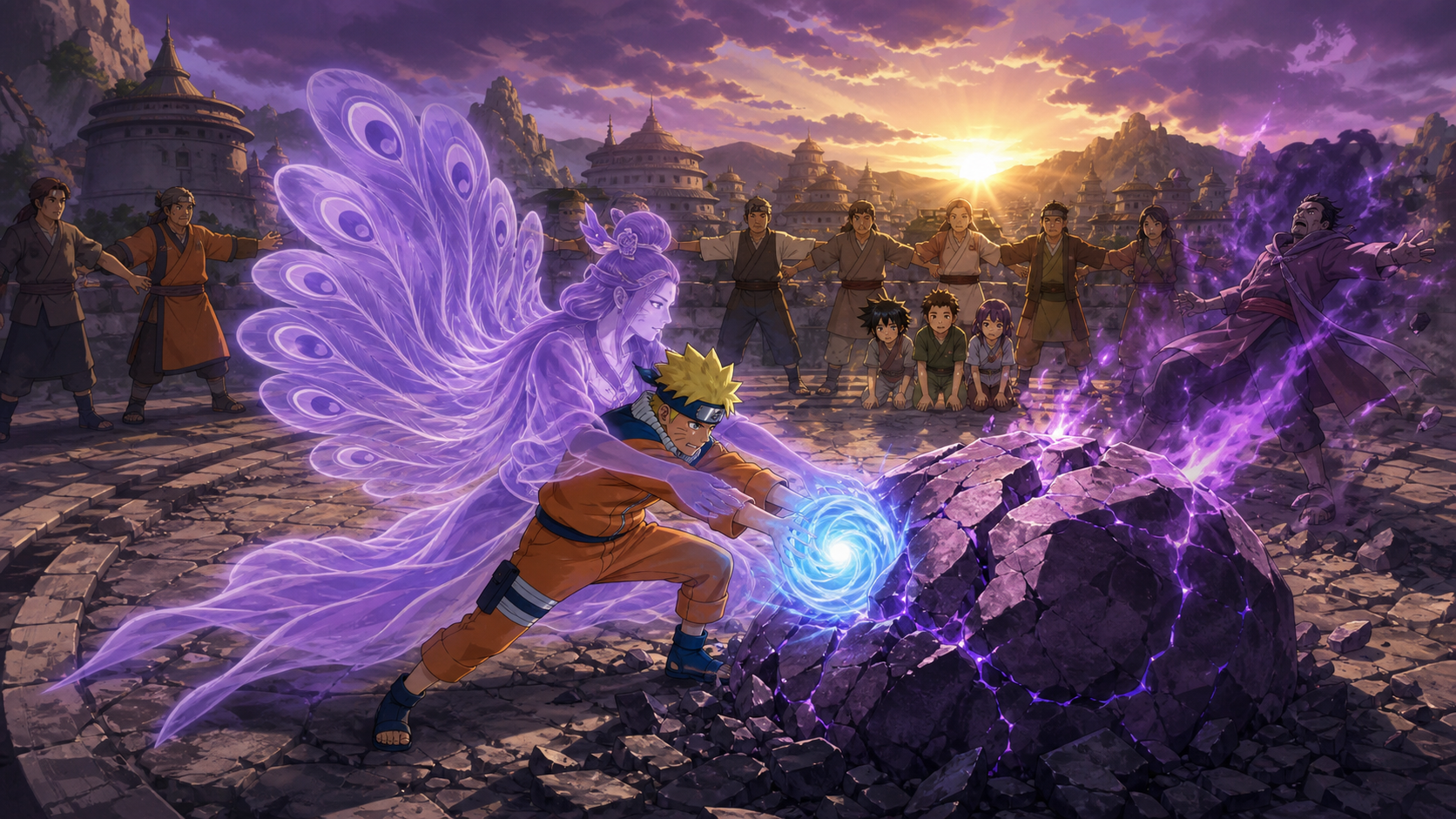
Hidden Star rejects Akahoshi before Naruto, backed by Natsuhi’s remaining chakra, destroys the meteorite and ends the training cycle.
Hidden Star does not need Naruto to save it from Akahoshi.
It needs its own people to stop obeying him.
Episode 183 closes the Star Guard Mission by separating a village from the object it mistook for its future. Hokuto tells the truth. Mizura makes the cost visible. The adults decide that protecting their children matters more than protecting a leader's pride.
Only then can Naruto fight without becoming the foreign ninja who overthrew another village's ruler.
The final victory is not taking the star back.
It is learning to live without it.
Episode 183 Facts
- English title: The Star's Radiance
- Japanese title: 星は輝きを増して
- Original Japanese broadcast: May 3, 2006
- Story position: Sixth and final episode of the Star Guard Mission
- Public witnesses: Hokuto and Mizura expose the training's lethal cost
- Political turning point: Hidden Star withdraws recognition from Akahoshi
- Final attack: Naruto uses Natsuhi's remaining chakra support to destroy the meteorite with Rasengan
- Medical outcome: Shizune expects the trainees, including Mizura, to recover with treatment
The resolution happens in the correct order. Testimony comes first. The injured body confirms it. The adults reject Akahoshi. Only then does Naruto enter the battle. Physical victory follows political legitimacy instead of replacing it.
Sumaru's Revenge Could Cost Him His Home
Sumaru kneels beside Natsuhi after sensing her death.
He finally found the mother he had spent years missing, learned why she left, and heard their lullaby from her own voice. Akahoshi takes that reunion away almost as soon as it begins.
Sumaru wants revenge.
Naruto understands the impulse immediately. Neji understands the consequence.
Akahoshi is still treated as Hidden Star's leader. If Sumaru attacks him, the village can brand its own child a rogue ninja. Sumaru may avenge Natsuhi and lose every home he could return to.
The Leaf team faces the same boundary. They know Akahoshi arranged murder, controlled Sumaru's chakra, threatened Natsuhi, and lied about the mission. None of that automatically gives four visiting genin the authority to remove another village's government.
Naruto sees a murderer who needs to be stopped.
Neji sees the war that can begin when an outside force decides it alone has the right to choose another village's leader.
Both are looking at something real.
Neji's warning also protects Sumaru from letting Akahoshi define the rest of his life. Revenge would make the boy's first act after reuniting with his mother another sacrifice to the man who killed her. Justice requires removing Akahoshi's power without turning Sumaru into the exile Akahoshi already declared him to be.
Akahoshi Calls Children Materials
Akahoshi mobilizes Hidden Star's ninja and prepares to execute Sumaru.
One of his followers hesitates because Sumaru is still a child and the village's strongest genin. Akahoshi answers that Sumaru is now a dangerous element and that they have enough material to train replacements.
The word exposes the entire program.
Akahoshi does not see children with names, families, illnesses, or futures. He sees bodies that can be placed beside the meteorite until one survives long enough to make Hidden Star look powerful.
Sumaru attacks through a volley of arrows. Naruto and Team Guy watch from concealment, furious but restrained by the limits of their commission.
The episode refuses an easy rescue. Naruto cannot charge in, punch the villain, and leave Hidden Star to accept a government chosen by outsiders.
Change has to begin inside the village.
Hokuto begins it.
Her intervention is dangerous precisely because she no longer carries recognized status. Akahoshi has already called her rogue, so she cannot rely on rank or official access. She has only firsthand knowledge, the trust of fellow trainees, and the willingness to say publicly what injured children were trained to keep private.
Hokuto Tells the Truth in Public
Hokuto enters the training room and addresses the trainees directly.
If they continue star training, they will die. Natsuhi stole the meteorite to protect them.
Akahoshi answers with the belief that kept the program alive. Anyone who cannot withstand the pain must not love Hidden Star enough. True devotion will transform suffering into strength and allow their small village to surpass the Five Great Nations.
It is a perfect defense because every injury becomes proof against the injured person.
If a child survives, Akahoshi claims the star works. If a child collapses, he calls the child's heart weak. The leader and his weapon can never be wrong because the victim carries every failure.
Hokuto's testimony breaks the silence, but Akahoshi can still label her a traitor.
Mizura brings evidence that a label cannot hide.
Akahoshi's argument is designed to survive testimony. Anyone who objects proves insufficient loyalty. Mizura defeats that structure by accepting its premise and showing the contradiction. He loved Hidden Star, trained through pain, and is dying anyway. If devotion cannot protect the most devoted trainee, the test measures biology, not patriotism.
Mizura Makes the Cost Impossible to Deny
Mizura can barely stand when he reaches the crowd.
He exposes the damage the meteorite has done to his body and asks Akahoshi a devastating question. Mizura took pride in Hidden Star. He endured the pain and continued training. Were his feelings for the village still not enough?
The adults see what their ambition demanded from a child.
One villager remembers why the Third Hoshikage prohibited the training. Another says there can be no lie in Mizura's words or body.
The political balance changes before any outside ninja throws a punch.
Hidden Star's adults move to protect Hokuto and Mizura. They tell Akahoshi that these are not traitors. They are the village's children.
That distinction defeats his ideology. Akahoshi requires people to prove love for the village by accepting the destruction of its youngest members. The adults finally recognize that a village without its children has no future to protect.
Their mistake was not caring too much about Hidden Star.
It was allowing Akahoshi to define what that care required.
The adults reclaim responsibility when they stand between authority and children. They do not wait for Naruto to demonstrate which side will win. Their choice carries risk while Akahoshi still commands armed followers and the meteorite. That is what makes it a political decision rather than crowd approval after a victory.
Akahoshi Confesses When Obedience Ends
Akahoshi orders every dissenter executed.
Even Yotaka and Shisou tell him he has gone too far. In anger, he reveals what the three of them did to seize control.
They assassinated the Third Hoshikage because he would not permit use of the meteorite.
Akahoshi describes murder as the fastest way to save the village. His defense sounds exactly like his training policy. Immediate power justifies any body spent to obtain it, whether the victim is a leader who says no or a child whose chakra network fails.
The villagers reject him.
They say they will no longer recognize Akahoshi as leader and that justice is not with him. The children, not the man claiming the highest title, possess the hearts that truly care about Hidden Star.
This is the finale's essential victory.
Naruto does not take Akahoshi's authority away.
Hidden Star does.
Akahoshi's confession matters because the village has already begun rejecting him. The truth confirms their judgment, but it does not create moral courage from nothing. Hokuto, Mizura, and the adults shift the ground before the villain conveniently explains every crime in public.
The Star Gives Akahoshi Power Without Control
Akahoshi refuses to accept the village's decision.
He attacks Mizura, then joins the meteorite to his own body and declares that he will become the Fourth Hoshikage. He believes he has discovered the final shortcut. There is no need for training if he can take the star's power all at once.
The chakra floods his network and runs out of control.
Akahoshi wanted strength without discipline, rank without recognition, and loyalty without responsibility. His transformed body makes those contradictions visible. The power is enormous, but it does not make him a leader. It makes him a danger to the people he claims to represent.
When Akahoshi attacks the children after the village rejects him, Neji's restraint reaches its limit. Naruto insists on intervening. Neji tells him to take responsibility for acting on his own.
That exchange matters. The Leaf team has not quietly decided diplomacy was foolish. The facts have changed. Akahoshi no longer speaks for a village asking outsiders to leave its internal affairs alone. The village has withdrawn its consent, and he is using a poisoned weapon against its children.
Naruto can finally enter the fight on the side Hidden Star has chosen for itself.
Neji does not issue a formal Leaf intervention order. He allows Naruto to accept personal responsibility after Akahoshi loses local authority and attacks civilians. The distinction is narrow, but it preserves the arc's concern with who has the right to act and why.
Natsuhi Keeps Protecting Sumaru
Naruto's shadow clones struggle against Akahoshi's distorted peacock chakra.
Then Natsuhi's lullaby returns.
Her remaining Mysterious Peacock Method chakra manifests after death. Akahoshi recognizes what it means before Naruto does. Natsuhi is still protecting Sumaru.
The episode does not turn her death into a reason Sumaru should be grateful for losing her. Her absence remains painful, and nothing can restore the years they missed. This final act completes the purpose she chose when she removed the meteorite.
She is not lending power so Hidden Star can keep its dangerous advantage.
She is helping Naruto destroy it.
Natsuhi's remaining chakra does not validate the weapon that killed her. Her technique came through the star, but her final use opposes the institution built around it. She turns the product of harmful training against the object that would repeat the harm.
Naruto accepts her support, breaks through Akahoshi's defense, and drives a Rasengan into the star. The meteorite shatters. Akahoshi falls with the object he believed would crown him.
Natsuhi's last protection saves her son from both the man who killed her and the cycle that would have poisoned him.
Hidden Star Chooses a Future Without the Meteorite
Back in the Leaf, Tsunade begins with the obvious problem.
Team Guy was commissioned to protect the star. Naruto smashed it.
The mission's client, however, was Akahoshi. He was also the culprit who deceived the Leaf and attacked his own village. Hidden Star has filed no complaint, so Tsunade dismisses the failed commission.
Akahoshi, Yotaka, and Shisou remain alive to face severe punishment by Hidden Star. That consequence belongs to the community they betrayed.
Keeping them alive matters. Akahoshi does not become a martyr destroyed by foreign force, and Hidden Star does not lose the opportunity to document the assassination, kidnapping, medical abuse, and conspiracy. Accountability continues after the Rasengan.
The children receive medical examinations in the Leaf. Shizune reports that proper treatment should restore their health, including Mizura's.
The final scene gives Sumaru his dream back without returning the star.
He still intends to become Hoshikage. He still wants Hidden Star to become a powerful ninja village. Now he promises to build that future without the meteorite.
Naruto answers with his own vow to become Hokage first.
Their friendly argument reveals what Akahoshi never understood. A title is not proof that someone stands above others. It is a promise to help a village grow without treating its people as fuel.
Hidden Star loses the object that made it feel exceptional.
It gains the chance to become worthy of the future its children already believe in.
Sumaru's promise rejects the false choice between abandoning ambition and accepting abuse. Hidden Star can still seek strength, recognition, and capable leadership. It must build them through people who remain alive enough to inherit the result.
The star's brightest legacy is therefore not chakra. It is the generation that finally refuses to confuse suffering with worthiness.
Hokuto refuses to let Akahoshi write the ending
Akahoshi expects fear, hierarchy, and exhaustion to keep Hidden Star quiet. Hokuto ruins that plan by speaking publicly. She does not offer a vague accusation. She names what happened, who was harmed, and why the meteorite training must stop. That specificity matters because abusive leaders survive on confusion. If every injury can be called devotion and every objection can be called betrayal, nobody can challenge the person in charge.
Mizura turns private suffering into public evidence
Mizura’s body shows what the village’s doctrine has cost its children. He should never have needed to display his injuries to deserve protection, yet the regime has made visible damage the only testimony it cannot easily dismiss. His appearance breaks the fantasy that the Mysterious Peacock Method is simply difficult training. The adults can see the difference between discipline and a system that consumes young bodies for prestige.
The villagers withdraw their recognition before the Leaf wins the fight
This is the episode’s most important political turn. Hidden Star’s residents do not wait for Naruto to defeat Akahoshi and then cheer for the winner. They hear the evidence and stop granting him moral authority. Force may remove him from the battlefield, but the village has already rejected the story that made his power seem legitimate. That distinction keeps the resolution from becoming nothing more than a stronger outsider choosing their leader.
Akahoshi’s confession destroys his last excuse
He admits that he murdered the Third Hoshikage because the older leader stood between him and the meteorite. The confession reveals that every speech about sacrifice and village strength served a private ambition. He did not inherit a crisis and make one cruel decision. He created the crisis, buried the safeguard, and trained children under the very danger the Third Hoshikage tried to end.
Fusing the meteorite to his body completes the logic he taught everyone else
Akahoshi has spent the arc treating people as containers for the star’s power. When public support collapses, he makes himself the final container. The act looks like desperation, but it also exposes his belief that possession creates authority. He thinks becoming inseparable from the meteorite will make him untouchable. Instead, it leaves no space between the leader, the weapon, and the harm he imposed on the village.
Attacking the trainees proves they were never his future
The children were useful while they obeyed, endured the training, and made his promises look noble. The moment they stand near the truth, he attacks them. That reversal should end any debate about whether his methods were harsh but sincere. A leader building a future protects the young people asked to carry it. Akahoshi protects only his claim to command.
Sumaru’s grief does not become permission for revenge
Sumaru has every reason to want Akahoshi dead. His mother was taken from him twice, first through exile and then through murder. Naruto understands the rage because he knows what loneliness does when somebody gives it a target. Still, stopping Sumaru from throwing away his own life is not a defense of Akahoshi. It is a refusal to let Akahoshi take one more thing from Natsuhi.
Natsuhi’s remaining chakra reaches the fight without erasing her death
The episode lets her love and training remain present, but it does not pretend that chakra is a substitute for a living mother. What reaches Naruto is the last strength of a woman who spent years resisting the meteorite’s cycle. Her presence helps him finish the task she began. It does not cancel Sumaru’s loss or turn sacrifice into a neat reward.
Naruto destroys the object instead of claiming it
The meteorite could be framed as a prize after the battle. Naruto never treats it that way. He uses the Rasengan to destroy the source of the village’s lethal training and the symbol around which Akahoshi built his rule. That choice respects the Third Hoshikage’s original judgment and Natsuhi’s final mission. Power that requires a supply of sick children is not an inheritance worth preserving.
Destroying the star also closes the easiest route back to the same abuse
Removing Akahoshi alone would leave the meteorite available for another ambitious leader. Hidden Star has already shown how quickly collective pride can be used against medical evidence. Destroying it prevents a successor from promising a safer version without changing the incentives. The village will have to build strength through people, training, alliances, and honest limits instead of returning to a shortcut that keeps demanding bodies.
Akahoshi and his accomplices survive for local accountability
The story does not hand Naruto an execution and call that justice. Akahoshi, Yotaka, and Shisō remain alive for Hidden Star to judge. That outcome matters because the crimes were committed against the village’s residents, records, leadership, and children. The survivors deserve a process that names each act, separates responsibility, preserves testimony, and prevents the next authority from reducing everything to one defeated villain.
Survival creates obligations beyond punishment
Hokuto, Mizura, Sumaru, and the other trainees need medical follow-up that does not depend on the institution that injured them. Families deserve complete information about exposure, symptoms, and long-term uncertainty. The village also needs an honest record of the Third Hoshikage’s murder and Natsuhi’s resistance. If the files remain hidden, somebody can later recast Akahoshi as a misunderstood reformer and the children as willing volunteers.
Shizune’s expectation of recovery should begin care, not end the conversation
The possibility that the trainees can recover is welcome. It does not erase what happened or guarantee identical outcomes. Each child needs assessment, time, and the freedom to stop performing strength for adults. Recovery also includes rebuilding trust. The same village that praised dangerous training must now prove that saying “this hurts” will lead to care instead of shame.
Sumaru keeps the Hoshikage dream without keeping the meteorite
This is the cleanest answer to Akahoshi’s ideology. Sumaru does not abandon Hidden Star because its leader betrayed him, and he does not need the star to imagine serving it. His dream survives after the object is gone. That means the village’s identity was never truly stored in a rock. It lives in people willing to protect one another without demanding that children bleed for a title.
The village must decide what Hoshikage means now
Akahoshi treated the title as recognition he could seize. Sumaru imagines it as responsibility he must grow into. Hidden Star now has a chance to define leadership through consent, care, transparency, and service. That work will be slower than meteorite training and less dramatic than a glowing chakra cloak. It will also be real.
RaeRae’s full take
Episode 183 works because Naruto does not rescue a village that stays passive and grateful. Hokuto speaks. Mizura shows the cost. The residents listen and withdraw their support. Naruto wins the physical fight after Hidden Star has already started reclaiming its own judgment.
Akahoshi tells on himself at every stage. He murders the leader who set a safety boundary, calls injured children loyal, brands dissenters traitors, and attacks the same trainees he claimed to be strengthening. When nobody believes him anymore, he fuses himself with the meteorite. That is not devotion. That is a man making sure the village cannot separate his ambition from the thing he taught them to worship.
Sumaru’s final dream gives the arc its answer. He still wants to become Hoshikage, but the meteorite is gone. Good. Let the title mean protecting people instead of feeding them to a shortcut. Natsuhi deserved to see that future. Since she cannot, the survivors owe her the harder version of remembrance: tell the truth, care for the injured, judge the people responsible, and never rebuild the system in prettier language.
RaeRae checkpoint: Hidden Star does not lose its future when Naruto destroys the meteorite. It gets its future back when the children stop being fuel for somebody else’s title.
Receipts and official routes
- Episode number, licensed title, confrontation, and official synopsis: Naruto Official Site.
- Japanese title, public testimony, Akahoshi’s exposed ambition, and May 3, 2006 broadcast record: TV Tokyo.