
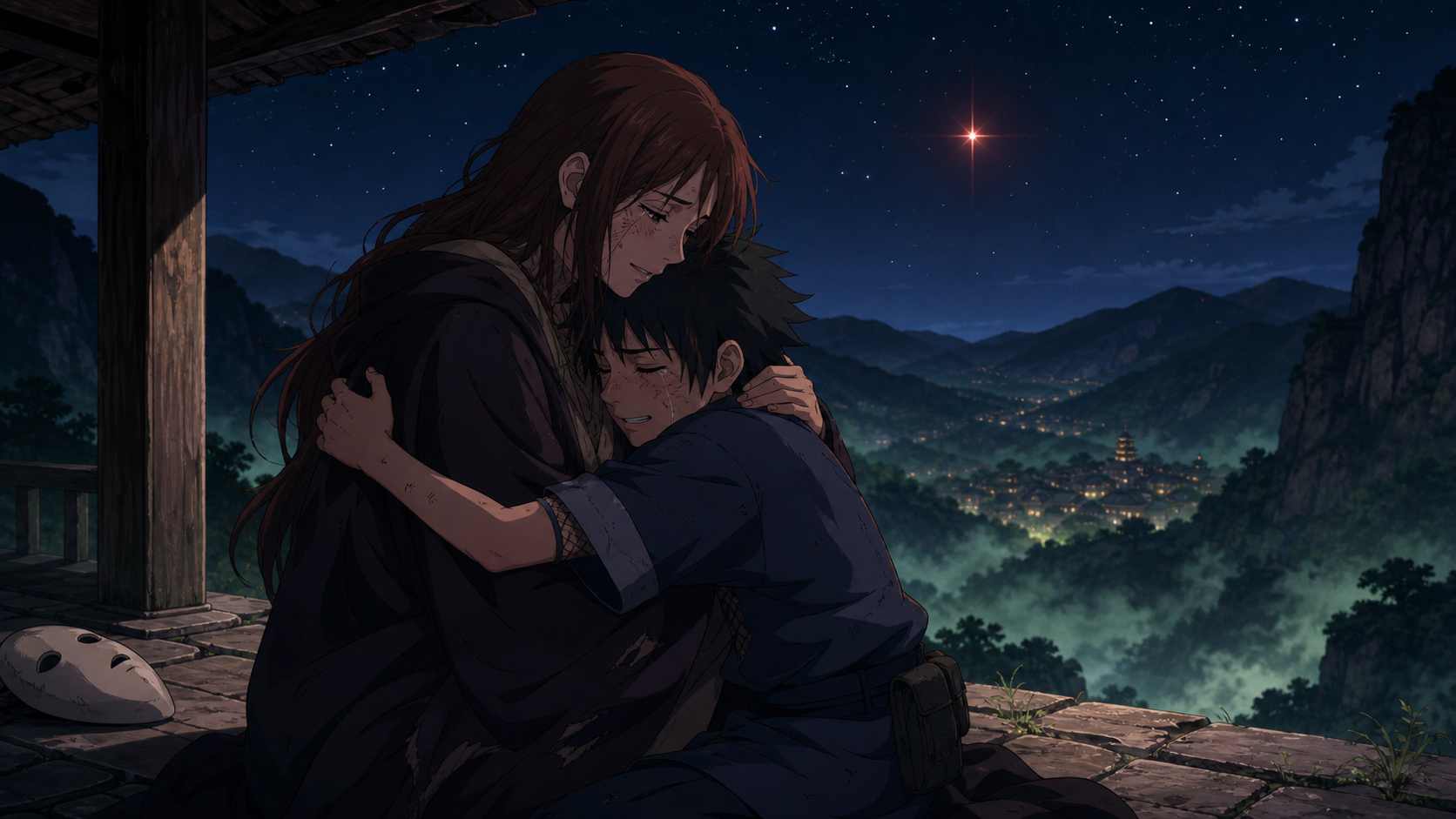
Reunion: The Remaining Time
Natsuhi and Sumaru reclaim one honest night together while Akahoshi uses coercion, diplomacy and her failing body to take the star back.
Sumaru gets his mother back for one night.
Akahoshi makes sure the reunion has an expiration time.
Episode 182 places love, duty, and diplomacy inside the same trap. Natsuhi can overpower Akahoshi, but her chakra network is failing. She can keep the star away from him, but he controls Sumaru's body. The Leaf team knows Akahoshi murdered, kidnapped, and lied, yet attacking the recognized client could turn a rescue into conflict between villages.
Nobody has a clean choice.
Akahoshi is the only person pretending his choices are clean.
Episode 182 Facts
- English title: Reunion: The Remaining Time
- Japanese title: 再会 残された時間
- Original Japanese broadcast: April 26, 2006
- Story position: Fifth episode of the six-part Star Guard Mission
- Coerced exchange: Natsuhi returns the meteorite to save Sumaru
- Medical warning: One more use of Mysterious Peacock Method will kill Natsuhi
- Political break: Hokuto stays with Sumaru and is labeled a rogue ninja
- Cliffhanger: Akahoshi claims the Fourth Hoshikage title after Natsuhi's death
The episode is built from authority gaps. Akahoshi possesses local command without legitimacy. Neji possesses evidence without authority to remove another village's ruler. Natsuhi possesses the power to resist without enough life left to sustain the fight. Sumaru finally possesses the truth without time to build the childhood it should have changed.
Akahoshi Makes Sumaru Repeat the Creed
Natsuhi's strength begins to fail during the fight.
Akahoshi mocks her condition. Proper star training once made her far stronger than his secret practice, but the same meteorite has damaged her body until that advantage cannot last.
Sumaru and the other trainees arrive in time to see the woman they believed dead.
Akahoshi immediately defines her for them. She stole the star and threatened the village, so motherhood does not matter. She is an enemy.
Naruto gives the missing half. Natsuhi removed the meteorite to save children from training that causes agony, collapse, and death.
Akahoshi does not answer the medical evidence. He appeals to identity. Sumaru wants to become Hoshikage and prove Hidden Star deserves respect. A true shinobi should dream of dying for the village.
Sumaru agrees that he can die for Hidden Star.
Neji sees the manipulation inside his chakra. Sumaru and Akahoshi are synchronized. The leader is controlling the boy while using his mouth to make coercion sound like loyalty.
Akahoshi has spent months teaching children the words.
Now his jutsu supplies the voice.
The synchronized chakra turns indoctrination into visible mechanics. Akahoshi does not invent unfamiliar words for Sumaru. He takes the village creed already planted inside the boy and forces it through his body at the exact moment Natsuhi must decide whether to believe him. Control works because the language sounds like something Sumaru might sincerely say.
The Choice Is the Star or Her Son
Akahoshi tells Natsuhi that Sumaru's life sits in his hand.
She can keep the meteorite or save her child.
Natsuhi returns the star.
Akahoshi releases Sumaru and later tells his followers that she surrendered it with good grace. He turns coercion into consent before the scene has even ended.
That lie matches everything else about his rule. Children “choose” deadly training after he hides its history. Sumaru “chooses” sacrifice while Akahoshi controls his chakra. Natsuhi “chooses” to return the weapon while her son's life is threatened.
Akahoshi wants obedience and the appearance of moral legitimacy.
That is why he immediately rewrites the exchange for his followers. A hostage bargain would prove Natsuhi still opposes him and that Sumaru was leverage. A voluntary return lets Akahoshi claim even the thief recognized his right to possess the star. He does not only seize the object. He seizes the meaning of her surrender.
That appearance matters because open force would expose him too quickly. He needs trainees to believe the choice came from Natsuhi, just as he needs villagers to believe his orders represent Hidden Star rather than his private hunger for status.
Naruto attacks in rage. He does not care that Akahoshi hired the Leaf because the client has already used that relationship to deceive and endanger them.
Neji stops him.
The restraint hurts because Akahoshi deserves the punch. It also reflects a real duty larger than personal anger.
Neji Refuses to Start a War
Neji says the star has been recovered and the commissioned objective is complete.
What follows is an internal Hidden Star matter. If Leaf shinobi attack the person recognized locally as leader, they risk betraying a client and turning intervention into an international incident.
Naruto and Lee hate the answer.
So does Neji.
His position is not that Akahoshi is innocent. The team exposed the kidnapping, found Sumaru in his residence, and learned the Third Hoshikage was murdered. Neji is asking whether four visiting genin possess authority to remove another village's ruler by force.
The answer cannot be invented in the middle of combat simply because the moral case is obvious.
Tenten proposes the proper route: take Natsuhi and Sumaru toward the Leaf for treatment, contact Tsunade, and request instructions.
It is slower than Naruto's fist.
It protects the Leaf from becoming the foreign invader Akahoshi can use to rally frightened villagers.
Neji's restraint also preserves the difference between rescue and regime change. The moral emergency is obvious, but outside force can still produce civilian resistance, retaliation against allies, and a precedent that larger villages may remove smaller leaders whenever they claim good cause. Akahoshi exploits that principle shamelessly. The principle remains real.
Akahoshi Defines Loyalty as Abandonment
With the meteorite back, Akahoshi invites everyone who wants to live for Hidden Star to follow him.
Then he orders them to forsake Sumaru as the son of a traitor.
The demand exposes his version of village loyalty. It does not mean protecting comrades. It means abandoning anybody the leader places outside the circle.
Hokuto refuses.
She stays with Sumaru and is immediately called a rogue ninja. One decision to care for an injured friend erases her official belonging.
The other trainees leave with Akahoshi, caught between fear, indoctrination, and the only authority structure they know. Their choice is painful without making them villains. Akahoshi controls the star, village institutions, and the story of what happened.
Leaving also means returning to the only homes, teachers, and daily structure most of them possess. Defiance costs more than agreement when leadership controls belonging itself.
Hokuto sees the person on the ground.
She decides a village that requires leaving him there is asking for the wrong loyalty.
Hokuto's choice creates the first open political cost among the trainees. She loses rank, home, and protection the moment she treats Sumaru as a friend before treating Akahoshi as authority. Calling her rogue does not describe betrayal. It enforces the idea that belonging exists only through obedience.
One More Jutsu Means Natsuhi Dies
Neji examines Natsuhi.
Her chakra network is shredded from years of star damage and Akahoshi's attack. The injury may already be fatal. If she uses Mysterious Peacock Method one more time, she will not survive.
Naruto immediately thinks of Tsunade.
Neji cannot promise even the greatest medical ninja can repair this.
The diagnosis creates the episode's remaining time. Natsuhi has found Sumaru again, but her body no longer offers a future they can plan together. Every hour matters, and every use of the power she mastered spends what remains.
The star gave her the strength to protect Hidden Star.
It also built a delayed death inside that strength.
Natsuhi can rest and seek treatment, or act before Akahoshi places more children beside the meteorite. Neither choice returns the years she lost.
The proposed trip to Tsunade is still worth making. Uncertain treatment is not false hope when the uncertainty is stated honestly. What makes the option tragic is that institutional delay has reduced a medical decision to hours. Hidden Star ignored the damage until even the best available healer may receive the patient too late.
Sumaru Does Not Pretend the Sacrifice Was Enough
Mother and son finally speak without Akahoshi between them.
Natsuhi expects anger. She admits that she often wanted to take Sumaru into exile but convinced herself a rogue ninja with a failing body could not give him happiness.
Sumaru describes recurring dreams of chasing his parents while crying.
He believed the Third Hoshikage's story that foreign ninja killed them and that his mother became Natsuhiboshi, the red star watching over him.
Then he says what heroic sacrifice stories usually avoid.
He wanted her to take him anyway.
He was lonely.
Natsuhi's reason was loving and serious. She tried to keep a child safe while honoring the agreement that stopped deadly training. Sumaru still experienced abandonment. Intent does not erase impact just because the parent suffered too.
Their reunion works because the episode lets both truths remain.
Sumaru does not reject Natsuhi's reason, and Natsuhi does not ask him to call the separation painless. Their honesty refuses the heroic story structure that harmed him. A sacrifice can protect somebody and still leave a wound that deserves to be named.
They embrace and sing the lullaby together. The song about a mother searching for a distant child is no longer a mysterious memory. It is their shared history.
Natsuhi Leaves to End the Cycle
Natsuhi leaves while Sumaru sleeps.
She knows another use of her jutsu will kill her. She also knows that allowing Akahoshi to keep the meteorite will create more dying trainees and more families separated by the same program.
At the star temple, she acknowledges that the meteorite once protected and empowered the village. She did not begin by hating it or denying what it gave Hidden Star.
The cost has become too high.
She asks forgiveness and prepares to destroy it.
Akahoshi attacks before she can finish. Natsuhi uses Mysterious Peacock Method despite the warning. Her body gives out, and Sumaru senses her death from afar.
The remaining time ends exactly where she feared it would.
Leaving while Sumaru sleeps repeats the pattern they just discussed, but the context has narrowed brutally. Natsuhi is not choosing another decade of secrecy. She believes she has one final opportunity to remove the object that will produce more children like him, and she knows asking permission would force her son to watch her choose death.
Akahoshi Crowns Himself Over Her Death
Akahoshi responds by declaring himself Fourth Hoshikage.
His first official order names Sumaru, Hokuto, and the Leaf shinobi enemies who demean Hidden Star. Anyone who sees them enter the village must kill them.
The title is self-awarded, built on the murder of the Third Hoshikage, and announced over the death of the woman who tried to enforce that leader's final policy.
Akahoshi finally has the image he wanted: the star in his possession, the village obeying, and himself called Kage.
He has achieved it by defining every witness as an enemy.
That first order reveals what the title means to him. It does not create responsibility for the whole village. It creates permission to purge the people who know how he obtained power. His claim to leadership begins with an execution list because testimony is more dangerous to him than any foreign army.
Sumaru vows to kill the man who murdered his mother. Naruto wants to move with him. Neji warns that direct action could begin a war with Hidden Star.
Episode 182 ends on that impossible threshold.
The finale must decide whether the village still belongs to Akahoshi simply because he controls its orders, or whether the people he used can reclaim its meaning.
That decision cannot come from Naruto alone. If Hidden Star's people continue accepting Akahoshi, an outside victory would only replace local consent with Leaf force. The decisive break must happen inside the village before Naruto's strength can defend it.
Akahoshi makes Sumaru recite the doctrine controlling him
The boy says a true shinobi should be willing to die for Hidden Star because that belief has organized his training, ambition, and grief. Akahoshi uses the statement as evidence of consent while controlling Sumaru’s chakra and holding him within a threat. Words repeated under coercion cannot authorize the danger being imposed.
Natsuhi returns the meteorite because the hostage matters more than the safeguard
Her choice does not prove Akahoshi deserves the star. It proves Sumaru’s immediate life outranks an object, even one she believes must eventually be destroyed. Hostage exchanges are designed to force a protector to violate longer-term judgment. Accountability belongs to the person creating that collision, not the parent who refuses to sacrifice her child for strategic purity.
Recovering the star strengthens Akahoshi’s control over the narrative
With the meteorite back, he can present Natsuhi as a defeated thief and himself as the leader who restored national power. The Leaf team must preserve its contrary evidence: Sumaru’s detention location, Neji’s chakra findings, Mizura’s medical condition, the Third Hoshikage’s prohibition, and Naruto’s account of the valley attack. Possession cannot become proof of legitimacy.
Neji refuses an impulsive strike because inter-village force has consequences
The team has strong evidence against Akahoshi, but openly attacking the recognized client without protecting civilians or documenting the basis could be framed as Leaf aggression. Neji’s restraint is not indifference to Sumaru. It is an attempt to keep a rescue from becoming the excuse Akahoshi needs to isolate witnesses and rally the village around him.
Restraint still needs an urgent rescue plan
Diplomatic caution cannot become paralysis while a child remains controlled and Natsuhi’s condition worsens. Neji should divide tasks: secure Sumaru and the sick trainees, establish independent communication with village residents, preserve evidence, and create a safe route out. Waiting for perfect authority would let the person abusing authority decide every next move.
Hokuto rejects the order to abandon Sumaru
Akahoshi labels her a rogue because she treats loyalty to a person as more important than obedience to the office harming him. That label reveals how the regime defines belonging. A good trainee is one who accepts injury and silence. A traitor is anyone who insists the village exists for its people. Hokuto chooses the better definition.
Calling dissenters rogue shinobi controls future testimony
Once Hokuto and others are formally branded enemies, any evidence they offer can be dismissed as revenge. Their homes, families, and access to care may become vulnerable. The Leaf team should document when the label was issued, what conduct preceded it, and whether any independent process reviewed the accusation. Akahoshi cannot be complainant, judge, and beneficiary without scrutiny.
Neji’s warning gives Natsuhi a concrete mortality boundary
One more use of the Mysterious Peacock Method may kill her. The warning respects her right to know while leaving the decision hers. Medical truth does not remove agency. It makes agency possible. Natsuhi should also hear alternatives, including containment help and coordinated action that does not require her body to absorb the entire cost alone.
Natsuhi and Sumaru finally exchange complete emotional truths
She explains that exile was meant to protect him and uphold the Third Hoshikage’s order. He tells her that safety did not erase the loneliness of growing up without her. Both statements can be true. Protective intent does not cancel a child’s grief, and grief does not prove the parent’s danger assessment was false.
Sumaru’s wish to have been taken along deserves room
He is not ungrateful for survival. He is naming the relationship the safety plan removed. Adults often describe separation through strategic necessity because necessity feels cleaner than loss. Sumaru deserves to say he wanted his mother without being asked to approve the choice retroactively before he has processed the truth.
The reunion cannot repair years in one night
They share memory, explanation, touch, and the lullaby, but no conversation can instantly rebuild ordinary family knowledge. Natsuhi does not know every version of the boy he became. Sumaru has known her mainly as a dead hero and masked threat. Their reunion begins a relationship at the same moment the story prepares to end it.
Natsuhi leaving while he sleeps repeats the wound for a protective reason
She intends to destroy the star before more families suffer and knows Sumaru may follow if told. The decision reduces immediate interference but denies him another goodbye and choice. Her urgency is understandable, especially with little time left. The emotional cost remains. Protection through disappearance has already shaped his childhood.
Destroying the star targets the source of repeated coercion
The meteorite is not morally evil, yet its presence enables a lethal training program and concentrates authority around whoever controls it. Secure containment might be possible under trustworthy leadership. Akahoshi has murdered, kidnapped, and manipulated allies to regain it. Natsuhi concludes no current institution can keep the object from becoming another demand placed on children.
Akahoshi kills the witness and claims the crown
Natsuhi’s death removes a survivor of the original training, Sumaru’s mother, a custodian of the Third Hoshikage’s agreement, and a direct witness to the regime’s breach. Declaring himself Fourth Hoshikage immediately afterward attempts to convert violence into succession. The title cannot cleanse the method used to obtain it.
Ordering every witness killed abandons the last appearance of public service
Akahoshi is no longer defending the star from an external thief. He is eliminating residents, trainees, and allied shinobi who know how he acted. That order gives the village a clear choice between loyalty to Hidden Star and loyalty to the man occupying its office. The two are no longer compatible.
Yotaka and Shisō become chakra resources
Akahoshi absorbs power from the accomplices who helped him reach this point. Their guilt does not make his act just, but the betrayal exposes the bargain they accepted. A hierarchy built on disposable trainees eventually treats loyal enforcers as disposable too. Nobody becomes safe by helping the leader define other bodies as fuel.
The Leaf team’s duty now includes protecting the record
If Akahoshi survives politically or the village fractures after his defeat, evidence will determine whether Natsuhi remains branded a thief or recognized as a guardian. Neji, Tenten, Lee, and Naruto should preserve testimony, the detention site, medical findings, old orders, and the sequence of attacks. Victory without a record leaves the buried truth vulnerable to another burial.
RaeRae’s full take
Episode 182 gives Sumaru one honest night with his mother and refuses to pretend honesty erases the years. Natsuhi protected him. He was still lonely. She upheld a safeguard. He still deserved the truth. Love can survive that contradiction without turning either person’s pain into ingratitude.
Akahoshi makes every relationship transactional. Sumaru becomes leverage. Natsuhi becomes an obstacle. Hokuto becomes a rogue. His accomplices become chakra. Then he calls himself Hoshikage as though a title can transform ownership into leadership.
Natsuhi’s final decision comes from believing no institution left in Hidden Star can safely hold the meteorite. She should not have been forced to carry that burden alone. The remaining team owes her more than revenge. They owe her evidence, survivor protection, and a village where Sumaru can remember his mother without repeating her sacrifice.
RaeRae checkpoint: Sumaru’s reunion is honest because love and hurt share the same night. Akahoshi answers that truth by killing the witness and crowning himself. A title cannot turn hostage-taking into leadership.
Receipts and official routes
- Episode number, licensed title, Natsuhi’s condition, hostage exchange, and official synopsis: Naruto Official Site.
- Japanese title, reunion and star-destruction premise, and April 26, 2006 broadcast record: TV Tokyo.