
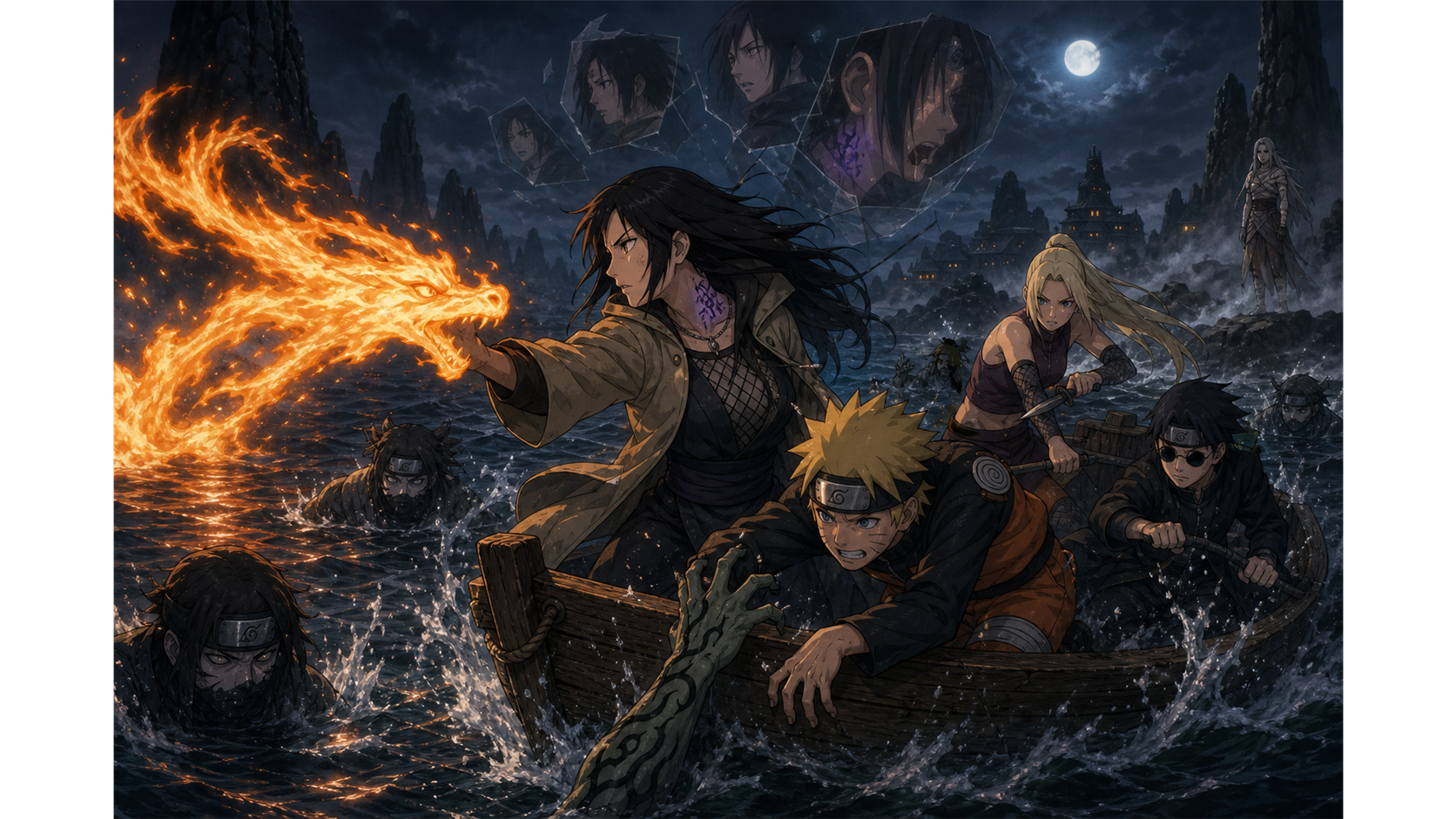
Remembrance: The Lost Page
Anko leads an information-heavy sea mission while a damaged memory, missing records, and her cursed seal point back toward Orochimaru.
Orochimaru did not merely leave Anko behind.
He tampered with her ability to tell anyone what he did.
Episode 169 opens the Kaima Capture Mission with two holes in the same history. Part of Anko's memory is gone. The Leaf's written record is incomplete too. Her mind cannot supply the missing page, and the institution that should document a shinobi's service cannot hand it back.
Her cursed seal remembers.
That is the nasty part. Orochimaru removed the story but left the pain.
Episode 169 Facts
Episode: 169 of the original Naruto anime
Licensed title: Remembrance: The Lost Page
Japanese title: 記憶 失われた頁 (Kioku Ushinawareta Pēji)
Japanese broadcast: January 25, 2006
Arc: Kaima Capture Mission, Episodes 169–173
Classification: Anime-original filler and arc opener
The title names memory as a page because this story gives personal recollection and institutional record the same job. Anko cannot read one. The Leaf cannot produce the other. Orochimaru survives in the gap between them.
Episode 169 does not yet reveal what happened on Demon Island or what Isaribi carries beneath the bandages. It establishes who gets believed when the evidence arrives through pain, rumor, and a body other people have already decided looks suspicious.
A Mission Buried Under the Mission
Naruto wants something flashy.
He has spent his recent days training and complains that the Leaf has no exciting assignment waiting for him. Sakura arrives with news that somebody finally found one.
Ships in the Land of the Sea are being attacked by a creature called the Demon of the Ocean. The Leaf team must investigate the threat and protect a vessel carrying government funds. Anko takes command, with Naruto, Ino, and Shino assigned under her.
The lineup tells us this is not a normal monster hunt.
Ino can gather intelligence through minds. Shino can track, scout, and observe with insects that most enemies never notice. Naruto brings force, clones, and the unshakable belief that a frightening name usually belongs to somebody who needs help. Anko brings direct history with Orochimaru, although she does not yet know how much of that history lives here.
It is also a welcome break from automatically rebuilding Team 7 around whoever happens to be available. Ino and Shino are not substitute Sakura and Sasuke. Their quieter specialties fit a case where the enemy hides under water, witnesses hide information, and the most important evidence may be too small or too frightened to announce itself.
The assignment makes sense as an information team before it makes sense as a combat team. Shino can spread surveillance across terrain without announcing where the search is concentrated. Ino can enter mental and communication problems that brute force cannot solve. Naruto draws people into conversation because he is constitutionally incapable of treating silence as the end of an argument.
Anko should supply experience, field judgment, and command. Instead, the location targets the part of her history she cannot consciously access. That does not make the lineup a mistake. It makes the mission a test of whether the genin can use their specialties when the leader's greatest expertise is also the wound under investigation.
Tsunade and Shizune do.
They review Anko's file and find gaps. Events that should have been recorded simply are not there, even though Anko herself was present. Orochimaru erased part of her memory when he abandoned the Leaf, then covered the trail well enough that official documents cannot reconstruct it.
The public mission is a sea-monster investigation.
The buried mission is finding out what Orochimaru made Anko forget.
The Victim Cannot Testify to Herself
Memory manipulation fits Orochimaru perfectly.
He treats other people's bodies as laboratories, containers, and spare parts. Taking control of the story those bodies can tell is the next step. If Anko cannot remember what happened, she cannot name the place, identify the work, or explain how she survived it.
She also has to doubt herself.
A missing report can be investigated. A missing memory makes the witness wonder whether the sensation, image, or fear belongs to something real. Orochimaru does not need to silence Anko every day if he can make her question the evidence inside her own head.
The Leaf archive offers no rescue. Its blank section proves that an institution can fail a victim without actively siding with the abuser. Nobody preserved enough independent evidence to restore what Orochimaru took.
Records are supposed to outlast damaged memory. Mission logs, medical notes, personnel assignments, witness statements, and travel records should let a village reconstruct where one of its children went with an adult mentor. If all of that can vanish because the mentor is powerful and secretive, the archive protects the institution's ignorance more effectively than it protects the child.
The missing page also changes the burden of proof. Anko has a cursed seal, physical reactions, broken images, and a known history with Orochimaru. Yet without the narrative sequence, every clue can be treated as incomplete. The person who caused the damage benefits from demanding a cleaner account than the damage permits.
Anko still built a career. She became a special jonin, ran the second stage of the Chunin Exams, confronted Orochimaru when he invaded the Forest of Death, and refused to become the obedient extension he wanted.
That strength does not cancel the damage.
Episode 169 lets her competence and trauma occupy the same body. She can lead a mission while a place she cannot remember makes her lose focus. She can recognize Orochimaru's presence through the cursed seal while hating that his mark remains the most reliable witness she has.
That is why “she should just explain it to the team” is too easy. Explain what? Her body recognizes the route. Her file does not. Her mind supplies fragments without context. A commander still owes subordinates enough information to stay safe, but trauma does not become neatly reportable because a mission clock has started.
The Curse Mark Knows the Route
Salt enters the air as the team approaches the Land of the Sea.
Mother Island, Taro Island, Jiro Island, and Demon Island come into view. The names sound like geography to the genin. To Anko, the landscape arrives as physical recognition before conscious memory.
Her cursed seal aches.
She sends Naruto, Ino, and Shino ahead to arrange a boat while she follows the sensation. Anko calls it business or information gathering, but the urgency is personal. Something nearby belongs to Orochimaru, and the mark he placed on her pulls toward it.
The choice is dangerous. A team leader should not disappear without a full explanation in unfamiliar territory. Anko is also trying to verify a history she cannot yet put into words. Telling three genin that her neck hurts because a missing piece of her childhood may be hidden on one of the islands would raise questions she cannot answer.
Naruto later jokes that Anko vanishes exactly the way he does.
He is right about the behavior, not the reason. Naruto runs toward people. Anko runs toward evidence that she was once the person somebody else controlled.
Naruto Meets the Girl Outside the Village
While arranging transportation, Naruto sees two men harassing a bandaged young woman.
They are Yoroi Akado and Misumi Tsurugi, former Chunin Exam opponents connected to Kabuto's disguised team. Naruto does not recognize them, which feels both ridiculous and perfectly Naruto. If somebody did not yell their life philosophy at him during a major fight, their odds of remaining in his memory are poor.
He still interferes.
The young woman's name is Isaribi. She comes from Mother Island, lives outside the village, and carries a reputation that makes residents uneasy. People discuss her appearance and repeat rumors as if loneliness confirms danger.
Naruto feels sorry for her before he knows the details.
That response is the most important thing he does in the episode. He does not need a dramatic reveal to recognize social exile. A village once looked at him, saw the Nine-Tails instead of a child, and used fear as permission to leave him alone. When people describe Isaribi as creepy, Naruto already understands the structure around her.
He offers help. She refuses and leaves.
Naruto cannot force trust from somebody whose experience taught her that attention usually becomes cruelty. He can only make his first move different from everybody else's.
That refusal is useful evidence too. Isaribi does not exist to reward Naruto instantly for basic decency. A stranger intervening once cannot cancel the village children, adult rumors, isolation, and whatever happened before she returned. Naruto recognizes the social pattern because he lived it, but shared exclusion does not give him automatic access to her story.
His strongest choice is stopping the harassment without demanding disclosure as payment. He helps before he knows whether Isaribi connects to the mission, the sea attacks, or the people threatening her. That keeps compassion from becoming an investigative tactic.
The Sea Is Not Blue Ground
The last ferry has already departed, and local boat operators avoid traveling near evening. The team borrows a small vessel and heads toward Mother Island as darkness arrives.
Yoroi and Misumi are waiting.
They know Leaf shinobi came to investigate the Demon of the Ocean. They attack from below, using water clones and the sea itself to control visibility, balance, and movement.
Naruto tries to answer an underwater enemy with a toad summon. He asks for Gamabunta and gets a much smaller lecture instead.
The Mount Myoboku toads are freshwater creatures. Saltwater is a terrible place to summon them.
It is a good joke with useful world logic. The sea cannot function like ordinary ground with a color filter. Familiar techniques behave differently here. Boats tip. Sightlines vanish. Fire meets open water. A summon perfectly suited to one environment becomes miserable in another.
The freshwater limit also punctures the idea that a powerful technique should work everywhere because it worked once. Summoning is a relationship with living creatures, not a menu button. Habitat matters. Consent and suitability matter. Gamabunta's strength cannot make saltwater healthy for a toad.
The attackers understand the environment better. They use fog, depth, current, and the boat's instability as force multipliers. Naruto's side enters with familiar village assumptions and learns that marine terrain changes what counts as footing, cover, escape, and even a viable ally.
Anko uses Dragon Flame Jutsu, while Yoroi's improved Chakra Absorption Technique drains Naruto. Misumi and the water clones keep the group divided. The attackers then release a violent current that turns the small boat into a trap.
Naruto goes into the water.
The loudest member of the team disappears beneath a surface where clones, chakra, and even breathing work against him.
Somebody in the Water Chooses Naruto
Episode 169 ends without solving either mystery.
Anko still lacks the memory that brought her here. The official record remains blank. Isaribi has not explained the bandages, the isolation, or her connection to the men Naruto confronted. The Demon of the Ocean is still a name attached to fear.
What the episode gives us is a pattern.
Orochimaru leaves people carrying evidence that communities misread. Anko's cursed seal marks her as his former student and makes some people suspect her loyalty. Isaribi's appearance makes the village treat her as something frightening. Both women live with bodies that speak before anyone lets them explain.
Naruto enters the story as the person most likely to hear them.
He is reckless, forgets enemies he should recognize, and summons a freshwater toad into the sea. He also sees an isolated girl being cornered and acts before deciding whether she looks safe enough to deserve help.
Now Naruto needs somebody in the water to make the same choice for him.
The lost page has not returned.
The people erased from it are already finding each other.
That final rescue choice matters even before the next episode tells us who made it. Somebody associated with the feared water threat sees Naruto drowning and intervenes. The action arrives before an explanation, just as Naruto defended Isaribi before she explained herself.
Episode 169 builds trust through sequence. First, act against abandonment. Then decide whether the frightened story everyone repeats was ever accurate.
Anko’s body carries evidence her conscious memory cannot access
Pain from the cursed seal and fragmented images connect her to the Land of the Sea before she can explain how. The reaction should not be treated as mystical intuition alone. Orochimaru altered her body and memory, leaving physiological evidence of a history he tried to control. Symptoms deserve medical support as well as investigative attention.
Missing memory changes what informed leadership requires
Anko is assigned command in a location linked to trauma she cannot fully recall. Tsunade should discuss the known gap, establish a deputy, and define when flashbacks or seal pain require withdrawal. Expertise and vulnerability can coexist. Concealing one from the team makes sudden disorientation more dangerous for everyone.
Orochimaru erased the institutional trail as well as personal recollection
Shizune and Tsunade cannot simply open a complete file and restore what happened. Missing records protect the abuser by isolating Anko’s bodily response from corroboration. Konoha should audit who had access, which dates are absent, and whether related mission logs or medical inventories survive elsewhere. Institutional memory needs redundancy when one powerful insider can rewrite it.
The team is not a random collection once roles are named
Anko brings experience with Orochimaru and aggressive field command. Shino supplies patient surveillance, Ino brings communication and mind techniques, and Naruto provides clones and rapid intervention. Calling the group “thrown together” overlooks how their differences can cover a sea mission if they establish signals and responsibilities before contact.
A government shipment creates two related duties
The team must investigate attacks attributed to the Demon of the Ocean and protect a vessel carrying public funds. Guarding money cannot outrank rescuing people, but losing the shipment may harm communities that depend on it. The route plan should identify civilian crew, lifeboats, cargo priorities, and what happens if the alleged creature attacks during escort.
“Demon” is a conclusion hiding inside a report
Residents may be describing a frightening shape, repeated attacks, or a person altered enough to be treated as nonhuman. The label can organize fear while discouraging questions about origin and motive. Anko’s team should document what witnesses actually saw before accepting extermination as the only response.
Isaribi’s bandages and isolation mark vulnerability, not guilt
Naruto encounters a young person being harassed by Yoroi and Misumi. Her distance from others and concealed body make her easy to frame as strange. Intervention should stop the immediate abuse without forcing her to expose injuries or explain herself publicly. Safety comes before satisfying curiosity.
Naruto recognizes harassment faster than hidden context
He knows what it feels like to be treated as a threat before being known. That recognition moves him toward Isaribi. The parallel can guide empathy without making her story identical to his. Naruto should ask what help she wants instead of deciding that shared isolation grants automatic access.
Yoroi and Misumi connect the present danger to an old network
Their presence near Isaribi and later role in the ambush suggest organized activity rather than a random sea monster. Anko’s team should communicate sightings immediately and compare techniques with Chunin Exam records. Known operatives create a material lead where the mission briefing offered folklore.
Losing the ferry should trigger a transport risk assessment
Borrowing a small boat keeps the pursuit moving but reduces stability, cover, carrying capacity, and rescue equipment. Saltwater, weather, submerged attackers, and limited visibility change what techniques are safe. Urgency cannot make any available vessel suitable without checking flotation, supplies, and who can navigate.
Saltwater limiting Gamabunta is mission-relevant knowledge
Naruto’s usual large summon is not available under these conditions. Discovering that during crisis wastes time and chakra. Briefing should include summon habitat limits before a maritime assignment. Adaptation begins with knowing which familiar tools the environment removes.
Water clones complicate target identification
Anko’s Dragon Flame can disperse visible attackers while the real operatives remain submerged or reposition. Shino’s insects may struggle over open water, but observation of wake and air movement can still help. Ino can maintain communication when sight lines break. The team needs confirmation before concentrating force on a copy.
Yoroi’s improved Chakra Absorption Technique changes contact rules
Close engagement may feed him the resource teammates need to survive in water. Naruto’s clones can test range, but every contact may still drain his reserves. Distance, restraints, and coordinated strikes become more important than proving physical dominance. Anko should communicate the technique’s known history before someone grabs the wrong opponent.
Naruto being pulled underwater creates an immediate rescue clock
Breath, orientation, and current matter before pursuit. The team needs a line, flotation, or diver assigned to recovery while another member tracks the attacker. Jumping in without coordination can turn one submerged teammate into several. Rescue planning is part of maritime combat, not an interruption from it.
Anko’s memory may sharpen during danger and still remain unreliable
Sensory triggers can return fragments without restoring sequence or context. The team should record what she recalls, distinguish image from inference, and avoid pressing for a complete narrative during active combat. Trauma memory can offer leads while requiring corroboration like any other evidence.
RaeRae’s full take
Episode 169 gives Anko a case where her body knows the route before her mind does. Orochimaru did not only harm her and leave. He damaged the memory and records that could help her explain the harm later. That missing page belongs to an institutional failure as much as a personal mystery.
Isaribi enters under bandages and harassment, which is exactly why the “Demon of the Ocean” label needs scrutiny. Naruto sees a person being targeted before he sees a monster. He needs to keep that recognition when the sea mission gets frightening.
The small boat ambush proves this team needed maritime rules before departure. No Gamabunta, chakra absorption at close range, copies in the water, and one teammate pulled below the surface is not a routine land formation with waves added.
RaeRae checkpoint: Anko’s cursed seal remembers what Orochimaru removed from her mind and Konoha’s archive. The mission must recover Naruto from the water without letting “demon” erase the human evidence gathering around Isaribi.
Watch Naruto Episode 169
- [Naruto Official episode guide](https://naruto-official.com/en/anime/naruto1/list/01_393)
- [Watch “Remembrance: The Lost Page” on Crunchyroll](https://www.crunchyroll.com/watch/G63VGP5XY/remembrance-the-lost-page)
- [Browse official Naruto viewing options from VIZ](https://www.viz.com/anime/tv-show/naruto-video/video-unit/1)
Receipts and official routes
- Episode number, licensed title, official synopsis, and listed team: Naruto Official Site.
- Japanese title, synopsis, and January 25, 2006 broadcast record: TV Tokyo.