
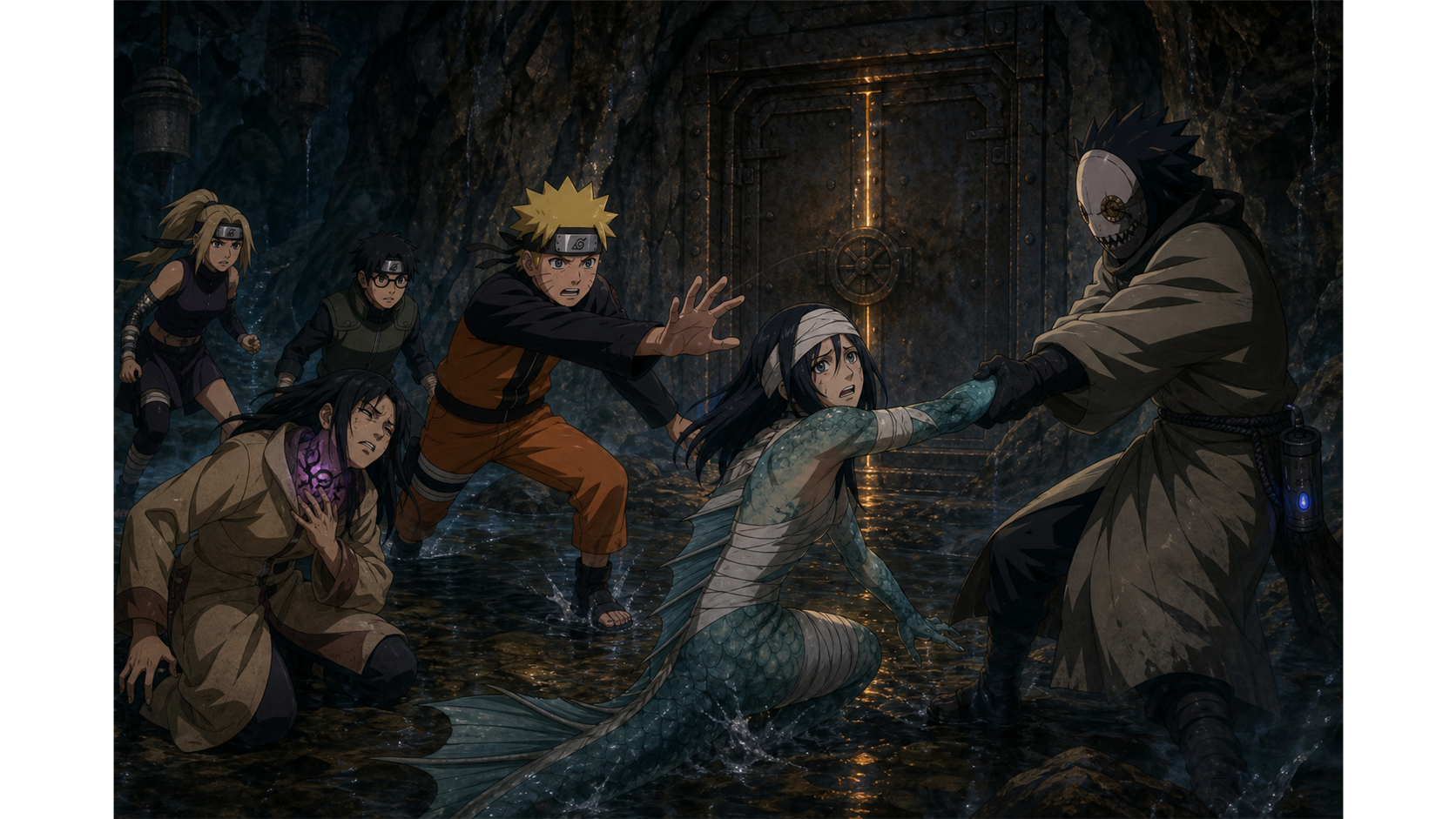
The Closed Door
Isaribi saves Naruto before her altered body is exposed, while Anko’s sealed memory and cursed mark point toward the same hidden laboratory.
Isaribi saves Naruto before he knows she is the monster he came to kill.
That fact should settle the moral question.
Episode 170 lets everybody else complicate it anyway. A village sees scales and calls a girl dangerous. Orochimaru sees a child and calls her research. The mission sees a Kaima and calls it a target.
Naruto wakes in Isaribi's home and calls her by her name.
The closed door in this story is not keeping a monster out. It is keeping abused people away from the truth, community, and help they deserve.
Episode 170 Facts
Episode: 170 of the original Naruto anime
Licensed title: The Closed Door
Japanese title: 衝撃 閉ざされた扉 (Shōgeki Tozasareta Doa)
Japanese broadcast: February 1, 2006
Arc: Kaima Capture Mission, Episodes 169–173
Classification: Anime-original filler
This episode opens three doors only far enough to show who has been trapped behind them. Isaribi is the feared Kaima. Anko was found in this same country after Orochimaru abandoned her. A medical researcher named Amachi still treats Orochimaru's approval like a career objective.
The full laboratory and shipping plot belong to the next episode. Episode 170 stays with recognition: Naruto has to see Isaribi inside the mission target, and Anko has to see her own missing history reflected in another altered child.
The Mission Cannot Wait for Naruto
Anko, Ino, and Shino search the fog after Naruto disappears into the sea. Shino's insects cannot locate him nearby. He either drifted beyond their range or escaped the water another way.
They have no proof that he is alive.
They also have a ship to protect.
Hitode, the official responsible for the collection vessels, tells Anko that departure has been moved to the next morning. The Land of the Sea is not wealthy, and its relationship with the Land of Water matters enough that the transfer cannot wait indefinitely. Fishermen already fear the Demon of the Ocean. Delaying the government funds would spread the damage into another part of civilian life.
Anko asks for time to search and investigate before guard duty begins. Hitode gives what little time the schedule allows.
That pressure helps the arc. A mission does not politely pause while its shinobi process trauma or recover a missing teammate. Anko has to lead Ino and Shino, investigate the Kaima, honor a new deadline, and confront a location that makes her cursed seal burn.
The deadline is not bureaucratic decoration. The Land of the Sea is poor and depends on its relationship with the Land of Water. Government funds moving by ship connect public administration to waters already made dangerous by disappearances and fear. Every delay costs a country that has less room than the Leaf to absorb disruption.
That does not make Naruto expendable. It explains why Anko cannot turn the whole assignment into an open-ended search without evidence. She negotiates for the hours available, keeps Ino and Shino working, and uses confidence in Naruto to hold the team together while uncertainty remains.
She tells Ino that Naruto is a Leaf shinobi and will not go down easily.
It is confidence, leadership, and the only answer she can afford until she has evidence.
Isaribi Already Answered the Monster Question
Naruto wakes in a bed with Isaribi watching over him.
She pulled him from the sea, carried him home, treated him, and fed him. The person residents describe as a bad omen saves a stranger who arrived to hunt the creature associated with her.
Naruto thanks her and introduces himself. Isaribi gives him her name.
Then Naruto cheerfully explains his mission to exterminate the Demon of the Ocean.
Isaribi warns him to leave the case alone. Getting involved will not end easily. Naruto hears concern but misses the confession hidden inside it. He promises that the team will catch the creature next time.
She sends him away as soon as he recovers.
Outside, Naruto finds the reason for her distance. Children have marked her home, throw things at her, call her a monster, and tell her to disappear. Isaribi accepts the abuse with the exhausted logic of somebody who has stopped expecting intervention.
She was spirited away. She came back different. Humans do not let different people into their group.
Naruto rejects every part of that conclusion except the evidence behind it.
He knows groups exclude people. He knows a village can take something done to a child and treat the child as responsible for it. He knows adults can teach their fear to children until cruelty feels like community service.
None of that makes the cruelty natural.
Naruto tells Isaribi it is not her fault.
He does not have the full story yet. He does not need it to understand that rocks, graffiti, and exile are choices made by the people hurting her.
The children matter because cruelty has already become communal knowledge. They did not invent the island disappearances or Isaribi's altered body. They learned which house can be marked and which person can be driven away without adult consequence. The village has converted fear into a lesson young people perform for one another.
Naruto breaks that performance. He does not argue that Isaribi looks ordinary. He argues that difference does not transfer blame to the person being targeted. That is the same distinction Konoha refused to make when adults treated the Nine-Tails seal as proof that a child deserved isolation.
Orochimaru Keeps His Research Running
Elsewhere, Amachi kneels before Orochimaru.
He continued the research after Orochimaru left and presents that persistence as loyalty. Orochimaru gives him permission to do whatever he likes with the interest of a man approving somebody else's hobby.
That imbalance says plenty about Amachi. He builds his identity around serving a master who barely values the work, much less the people used to perform it.
Sasuke stands beside Orochimaru.
Amachi identifies him as Itachi Uchiha's younger brother. Sasuke shuts down the conversation before Amachi can say more. His brief appearance connects Anko's past to Naruto's present. Orochimaru once selected Anko, marked her, used her, and discarded her. Now Sasuke occupies the place beside him.
Naruto does not see the meeting, but we do. His missing teammate and Isaribi's hidden condition belong to the same system of possession.
Sasuke's silence is not safety. He shuts down Amachi's curiosity and keeps control of the immediate conversation, but he is still standing in the room Orochimaru arranged. Anko's presence in the arc supplies the future cost of being selected by that man: a mark in the body, missing testimony, and years spent proving that survival did not equal loyalty.
The visual parallel does not erase the differences between them. Sasuke chose to leave the Leaf after pursuing power and revenge. Young Anko entered the relationship as a student under a trusted instructor. Isaribi's circumstances remain partly hidden here. Orochimaru's method adapts to each person, but it always treats their future as material he owns.
Orochimaru calls people promising when their bodies or abilities might serve him. What happens after they stop being useful is standing in the Land of the Sea with a cursed seal and a missing childhood.
Demon Island Ate the Witnesses
Ino and Shino question local residents while Anko continues the search.
The investigation gives both genin useful work without forcing either one into Naruto's volume. Ino asks direct questions and keeps the conversation moving. Shino listens for the detail that changes folklore into a route. They do not need to overpower a witness or produce a dramatic jutsu. They need people to trust them long enough to describe what the village stopped discussing with outsiders.
They learn that Demon Island carried a warning long before the recent Kaima attacks. Hidden reefs made the surrounding water dangerous, so fishermen respected the old story and stayed away.
Then a cold summer emptied the usual fishing grounds.
Hunger and necessity pushed people into the forbidden area. One woman returned to the surface and found her boat empty. Her husband had vanished. Others disappeared afterward, including people who tried to search for them.
The legend became a cover for a pattern.
Orochimaru's research benefits from that fear. Dangerous geography explains wrecks. A demon explains missing bodies. The poorer the community becomes, the more likely somebody is to risk the water, and the easier it becomes to turn a victim into another supernatural rumor.
Isaribi is the only known person who returned after being spirited away.
That makes her the witness everybody should have protected and questioned carefully. Instead, the village makes her live outside its boundaries. Fear turns the best surviving evidence into a person nobody wants near them.
Ino, Shino, and Anko head for her home.
Anko Was Found Here Too
Tsunade studies the Land of the Sea records back in the Leaf.
This is where Anko was found after Orochimaru abandoned her.
A memory shows the Third Hokage trying to help young Anko explain what happened. She recalls darkness, cold, pain, and the cursed seal. She knows she should remember more. The door will not open.
Orochimaru's suggestion sits too deep.
The flashback reveals how he trained Anko to cross moral boundaries. When she hesitates outside a laboratory and worries what the village would think, he tells her that refusing to pursue truth is the frightening choice.
That is manipulation wearing the language of courage.
Orochimaru does not need to order young Anko through the door. He makes hesitation sound cowardly and compliance sound like intellectual freedom. Once he defines conscience as fear, resisting him feels like failing the identity he praised her for having.
That is grooming through professional language. Curiosity is real. Research can require courage. Neither principle means a child owes a teacher access to forbidden experiments or must ignore the community whose rules make her uncomfortable. Orochimaru takes a value Anko respects and turns it against her ability to refuse.
Young Anko's fear was accurate. A trusted teacher taught her to distrust it because her conscience obstructed his work. He made obedience feel intellectually brave, then erased the memory that could expose him.
The Third Hokage treats the cursed seal first because it is eating away at her. Her memories never fully return.
Now the same mark reacts to Isaribi.
Naruto Recognizes Isaribi Inside the Kaima
Anko's team follows Isaribi into a cave.
They see her body change into an aquatic form and move to capture the Demon of the Ocean. From their position, the response makes operational sense. They have a mission, a suspected attacker, and a transformed figure trying to flee.
Naruto arrives late and sees the person inside the target.
He recognizes Isaribi.
The team tells him they caught the Kaima. Naruto does not pretend the transformation is invisible, but he refuses to let the label replace her name. He calls to her and demands an answer.
That naming choice separates observation from judgment. Isaribi has changed form. The team is not hallucinating the scales or inventing the danger of an unknown aquatic figure. Their mistake is treating a visible condition as a complete identity before they investigate who caused it and what choices remain available to her.
Naruto does not yet know enough to absolve every action linked to the Kaima attacks. He knows enough to reject the word “monster” as a substitute for evidence. Calling her Isaribi keeps the investigation attached to a person who can speak, remember, and be harmed.
Yoroi interrupts, takes Isaribi, and calls her an important guinea pig.
There it is. Not demon. Not volunteer. Not partner.
Guinea pig.
Naruto tries to pursue. Anko stops him from repeating the previous night's underwater mistake, then her cursed seal erupts in pain. She recognizes the connection before collapsing.
The door to Anko's memory remains closed, but Isaribi has become the handle.
Yoroi's “guinea pig” description confirms the power relationship without explaining the entire experiment. Isaribi is valuable to him as research material. Anko's cursed seal responds because her own body was also converted into evidence and property by Orochimaru's work.
The episode brings those histories together before either woman can tell the full story. One loses consciousness from the mark. The other is carried away under a laboratory label. Naruto is left with a direction and a moral fact: whatever waits on Demon Island was built by people, not demons.
That image makes the episode title hit harder. Opening the door will not reveal a clean answer waiting untouched behind it. It will expose what Orochimaru did, what Amachi continued, and how many people accepted a monster story because facing human cruelty demanded more from them.
Naruto knows where the trail points next.
Demon Island.
Isaribi saves Naruto before he knows anything about her condition
She pulls him from the sea and nurses him while the mission still speaks about a Demon of the Ocean. Her action establishes personhood and judgment before the transformed body enters view. That order matters. The audience meets care first, making the later monster label visibly inadequate.
Village children reproduce the fear adults have normalized
Defacing Isaribi’s home and calling her a monster are not isolated childish mistakes. Young people learn which neighbor can be targeted without consequence. Stopping the harassment should include repair of the home, adult accountability, and protection that does not force Isaribi to reveal medical details in exchange for basic dignity.
Naruto recognizes exclusion without claiming identical experience
He knows what it means to be treated as dangerous before anyone asks who he is. That history helps him reject the abuse. Isaribi’s altered body, forced experimentation, and island isolation remain her own. Empathy works when Naruto listens after recognizing the pattern instead of replacing her story with his.
Amachi calls ongoing experimentation routine work
Reporting results to Orochimaru converts human bodies into project status. The language of progress hides pain, consent, and failure. Every subject should be identified, medically stabilized, and offered a choice about future treatment. Research records may help reverse harm, but obtaining them cannot legitimize the methods that produced them.
Orochimaru’s indifference reveals how disposable the subjects are to him
He benefits from information while remaining emotionally and physically distant from the people altered. Amachi performs the direct labor, yet the hierarchy above him created incentives and supplied knowledge. Accountability should follow both hands-on action and command responsibility.
Sasuke’s presence connects two unfinished rescue stories
Anko’s former abuser stands near the teammate Naruto failed to retrieve. The image may intensify Naruto’s urgency, but Isaribi cannot become a route toward Sasuke rather than the person currently harmed. The mission must resist turning every victim of Orochimaru into evidence about someone else.
The Land of the Sea cannot simply cancel essential transfers
Government collection ships may carry funds communities depend on, and poverty limits the country’s ability to pause operations indefinitely. Escort planning should protect crew and passengers while investigating why attacks occur. Economic necessity explains departure without making workers disposable.
Ino and Shino trace disappearances as a pattern
Individual stories about vanishing near Demon Island can sound like folklore. Mapping dates, routes, survivors, and weather may reveal selection and transport. Shino’s patient observation and Ino’s communication skills can turn scattered fear into a usable record without demanding witnesses adopt Konoha’s interpretation.
Anko remembers resisting the laboratory
The recovered fragment matters because it restores moral agency inside a history Orochimaru erased. Young Anko recognized that the work crossed a line. Her later cursed seal and missing memory do not prove complicity. They show what happened after someone with greater power controlled the record.
Trauma memory should be documented without forced completion
A flash of a door, voice, or procedure can guide investigation while remaining incomplete. Shizune or another trusted clinician should record Anko’s words, physical symptoms, and uncertainty. Pressuring her to recover everything during the mission may produce confusion and place command stability at risk.
The cave turns the island myth into infrastructure
A passage, sealed door, and active operatives show that the alleged monster exists beside a maintained human system. Someone moves supplies, confines subjects, and controls access. Physical logistics make the laboratory traceable even when memories and official records are missing.
Seeing Isaribi’s Kaima form does not change the person Naruto met
Her body displays the consequences of experimentation. It does not erase the person who saved him, provided care, and endured harassment. Naruto’s recognition is ethically correct because identity continues through visible alteration. The team should use her name and ask about pain before assigning a creature label.
Capturing Isaribi as the mission target repeats part of the harm
The original order frames the Demon of the Ocean as something to eliminate. Once evidence shows a human subject, restraint should shift toward protection and medical care. Physical containment may be necessary during confusion, but the purpose must change from trophy or threat removal to safe recovery.
Yoroi calling her a guinea pig exposes ownership language
The phrase denies autonomy and reduces Isaribi to a test platform whose value lies in data. Naruto should reject that framing explicitly. Recovering her requires preventing further experimentation, securing records, and ensuring treatment choices are explained rather than imposed by another authority.
Anko’s collapse beside the door identifies a high-risk trigger
Cursed-seal pain links the sealed laboratory to her erased history, but she is also medically incapacitated at an operational threshold. Ino and Shino need to secure her airway, position, and extraction route while Naruto tracks Isaribi. Opening the door cannot outrank stabilizing the team leader.
The unopened door preserves an evidence boundary
The team knows something significant lies beyond it without yet knowing traps, subjects, contamination, or structural danger. Entry needs roles, protective equipment, and a method for preserving records. Curiosity should not send everyone through at once while Yoroi controls a hostage and Anko remains down.
Isaribi’s testimony should guide what happens next
She may know routines, treatments, exits, and who remains inside. Questioning must occur after immediate safety and without treating cooperation as the price of rescue. Her knowledge belongs to her experience; investigators can request it while respecting refusal and trauma limits.
RaeRae’s full take
Episode 170 makes the correct moral choice before the laboratory door opens. Isaribi saves Naruto. Naruto sees her altered body and still recognizes the person who saved him. The Kaima form is evidence of what was done to her, not evidence that the village’s monster label was right.
Anko’s cursed seal points toward the same door because Orochimaru’s harm connects both women across time. Her body remembers a place the archive cannot produce. That should make Konoha examine who allowed one man to erase a student’s memory and the records needed to restore it.
The team cannot rush through the door for answers while Anko lies collapsed and Yoroi pulls Isaribi away as property. Rescue comes first. Evidence comes next. Nobody inside that laboratory becomes a specimen again.
RaeRae checkpoint: Isaribi’s changed body records an experiment; it does not replace her identity. Naruto recognizes the person before the monster label, while Anko’s cursed seal identifies the history locked behind the door.
Watch Naruto Episode 170
- [Naruto Official episode guide](https://naruto-official.com/anime/naruto1/list/01_394)
- [Watch “The Closed Door” on Crunchyroll](https://www.crunchyroll.com/watch/GJWUQ1DQZ/the-closed-door)
- [Browse official Naruto viewing options from VIZ](https://www.viz.com/anime/tv-show/naruto-video/video-unit/1)
Receipts and official routes
- Episode number, licensed title, and official synopsis: Naruto Official Site.
- Japanese title, synopsis, and February 1, 2006 broadcast record: TV Tokyo.