
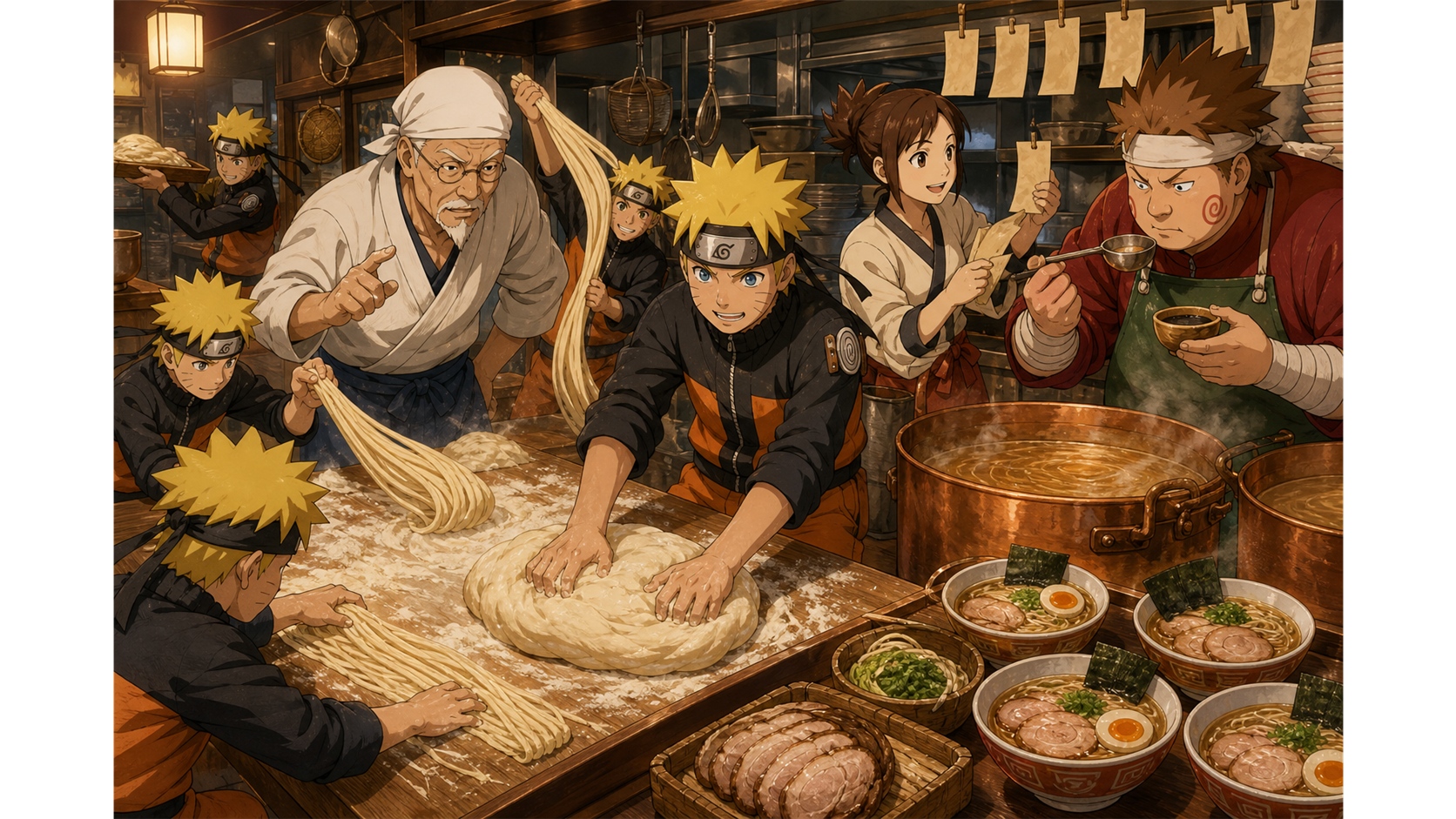
Mix It! Stretch It! Boil It! Burn Copper Pot! Burn!
Naruto, Sakura, and Chōji translate shinobi training into kitchen work when a cooking contest decides Ayame’s return to Ichiraku.
Naruto returns from missions with one reasonable request.
Give the boy his ramen.
Episode 168 closes Ichiraku, kidnaps Ayame over a misunderstood recipe, and makes Naruto, Sakura, and Choji cook for one hundred culinary shinobi before anybody gets lunch. This is the kind of standalone filler that knows exactly how ridiculous it is.
The episode also understands something Naruto never treats as a joke: Ichiraku is home.
Teuchi and Ayame fed Naruto before the village decided he was heroic. Saving their shop does not need an official mission rank. Naruto sees the closed sign and reacts like somebody locked the front door to one of the few places that always welcomed him.
That history gives the nonsense a real foundation. A hostage recipe contest sounds like disposable comedy until the people behind the counter are the same people who gave a lonely child a place to sit. Naruto is not defending a brand. He is returning care to a family that offered it without demanding proof that he deserved it.
Then he smells the broth.
Problem identified.
Episode 168 Facts
Episode: 168 of the original Naruto anime
Licensed title: Mix It! Stretch It! Boil It! Burn Copper Pot! Burn!
Japanese title: 燃えろ寸胴!混ぜて伸ばして茹で上げろ!! (Moero Zundō! Mazete Nobashite Yude Agero!!)
Japanese broadcast: January 18, 2006
Placement: Standalone anime-original story
Classification: Filler
This episode belongs to neither the Land of Birds mission that just ended nor the Kaima Capture Mission that begins next. It is a full reset at the ramen counter, complete with a recipe misunderstanding so avoidable that kidnapping becomes less believable than asking Teuchi what he meant.
That isolation helps the story. Naruto has spent six episodes fighting a government built on false identities. Episode 168 lets him solve a problem whose final villain is terrible communication and whose finishing move is competent food service.
Ichiraku Is More Than Naruto's Favorite Meal
Naruto and Choji arrive already chanting about ramen. They have been away on missions, and a bowl at Ichiraku represents the return to ordinary life. Hot broth, noodles, and a seat at the counter tell Naruto that he made it back to the Leaf.
The shop is temporarily closed.
Inside, Teuchi works over a new recipe with none of his usual ease. Ayame has been taken by the Ryonin, a group of Ninja Chefs who prepare meals for shinobi in the field. Their leader, Hakkaku, once trained in the same ramen shop as Teuchi. Now he wants the phantom recipe he believes his old colleague developed.
Teuchi does not know what he means.
Hakkaku responds to that confusion by taking Ayame and demanding a cooking match, because apparently reasonable follow-up questions are not part of the Ninja Chef curriculum.
The absurdity works because everyone commits to it. The episode does not pause to explain why a recipe dispute needs a hostage. Teuchi needs help, Ayame needs to come home, and Naruto accepts a bowl of ramen as sufficient cause for war.
Sakura and Choji join him. This is not Team 7 on assignment. It is three young shinobi protecting a civilian place that matters to them.
Teuchi Makes Them Learn the Work
Teuchi starts with the basics.
Mix the ingredients evenly. Knead the dough enough to give the noodles firmness. Stretch every strand to a uniform thickness so the batch cooks at the same rate.
Naruto, Sakura, and Choji are strong enough to fight armed enemies. None of that makes the first bowl easy.
Their failed practice matters. A weaker version of this story would let chakra flatten years of craft immediately. Instead, Teuchi explains why every physical step affects the final food. The shinobi still have to listen to the chef before their techniques become useful.
Teuchi says it takes about five years to become accomplished at noodle making. They have one night.
Naruto answers with confidence, but confidence does not fix bad dough. Sakura's strength can ruin the batch if she does not control it. Choji's hands can pull noodles apart as easily as they stretch them. Shadow Clones only multiply mistakes if Naruto has no consistent process to copy.
The episode gives civilian expertise its due. Teuchi is not the helpless shopkeeper waiting for ninja magic. He knows the broth, the dough, the heat, and the standards. The team succeeds only after it puts shinobi tools under his direction.
That is a far better use of “believe it” than pretending effort replaces knowledge.
The five-year warning also protects Teuchi from the usual fantasy shortcut. Naruto's team can compress production time because they already spent years learning chakra control, clone coordination, strength regulation, and body expansion. They are not absorbing five years of noodle knowledge overnight. They are translating existing training after a chef defines the actual problem.
That distinction matters outside the joke. Civilian work in Naruto often appears as scenery around shinobi action: meals arrive, uniforms get repaired, patients get treated, shops reopen, and missions receive supplies. Episode 168 briefly turns the camera toward the expertise that keeps those systems functioning. Being able to break a wall does not teach somebody how much pressure dough needs.
Cook Like Shinobi
After another ruined batch, Naruto realizes the obvious.
They are shinobi.
They do not need to copy the hand movements of chefs who spent years developing different physical skills. They need to understand what the cooking requires and decide which of their own skills can produce that result.
Naruto uses Shadow Clones and an Ichiraku version of Rasengan to mix the ingredients. The spinning chakra distributes the dough evenly at a scale ordinary hands could not manage.
Sakura takes over the kneading. Her strength, usually framed through shattered ground and terrified teammates, becomes controlled pressure. The goal is not to hit harder. It is to make the noodles firm without destroying them.
Choji expands both hands and stretches the dough into uniform strands. Partial Expansion Jutsu finally receives the culinary application it was clearly waiting for.
The sequence is funny because every attack gets treated with total seriousness. It is also smart. Each technique solves a specific production problem Teuchi already taught them to recognize.
Naruto does not replace the chef with a Rasengan. Teuchi's broth anchors the bowl, and his instructions determine what the team makes. The shinobi provide speed, consistency, and scale.
That is collaboration, not a magical shortcut.
The best gag is that every technique keeps its underlying rule. Shadow Clones distribute labor but still require Naruto to coordinate the workers. Sakura's strength becomes useful only through control. Choji's expanded hands solve uniform stretching because size changes the tool, not the recipe. The episode does not invent a “ramen jutsu” that ignores how food works.
It also gives Choji a rare food story where appetite is not his only personality. His body technique becomes precision equipment. He listens, adjusts, and performs one production step the others cannot reproduce as efficiently. The joke respects his skill before the ending remembers the series owns several tired weight jokes and apparently fears leaving one unused.
One Hundred Bowls at the Same Time
Hakkaku brings one hundred Ninja Chefs to judge the ramen.
Making enough food is only half the challenge. The chefs follow a strict service rule: the first guest to arrive must be the first served. All one hundred arrived at roughly the same time, so Teuchi's team has to put one hundred bowls down together.
Four people cannot do that.
One Naruto can become a crowd.
Shadow Clones carry the bowls and serve every judge at once. The solution turns one of Naruto's signature combat advantages into hospitality. His army does not overwhelm an enemy. It makes sure nobody watches the person beside them eat first.
The judges complain, posture, and prepare to find fault. Then they taste the ramen.
Ichiraku wins.
The victory belongs to the whole production line. Teuchi supplies the craft. Naruto mixes and serves. Sakura kneads. Choji stretches. Nobody's contribution can rescue a bowl if the others fail.
For an episode built around a cooking contest, that teamwork lands better than another fight would have.
The simultaneous-service rule sounds like nonsense until the episode treats it as a logistics problem. Hot noodles change while they sit. A hundred judges receiving bowls at different times would not be comparing the same product. Naruto's clones create consistency across service as well as speed.
That is hospitality as mission planning. The team has to interpret an oddly worded requirement, divide roles, protect quality, and deliver to every recipient on time. Nobody gets punched, but the operational thinking is recognizably shinobi work.
The Phantom Recipe Was Kitchen Scum
The Ninja Chefs finally explain their desperation.
Their original idea was good. Food pills keep shinobi alive on missions, but they taste miserable. Delicious field meals could improve morale and help teams work better.
Then the chefs became too successful.
Their food tasted so good that customers overate, gained weight, and struggled on missions. Demand collapsed. Hakkaku decided Teuchi's phantom recipe could save the profession.
There is no phantom recipe.
Teuchi developed a method for removing scum from stock. Somebody shortened the description, the words traveled, and a normal kitchen technique became legendary contraband.
Ayame was kidnapped because Hakkaku did not ask one more question.
That punch line fits the entire story. The Ninja Chefs overcomplicate everything. They turn field rations into irresistible feasts, turn a broth note into a secret formula, and turn an old colleague into an opponent when he would probably have explained the technique over a bowl.
They know how to make food. They have forgotten that feeding people means understanding what people actually need.
Their business failure makes the same point. Mission food has constraints beyond taste: portability, nutrition, portion control, digestion, preparation time, and the physical demands waiting after the meal. The Ninja Chefs optimize one variable until the product undermines its purpose.
Teuchi succeeds because he understands the eater as well as the bowl. Ichiraku is comforting partly because it sits inside ordinary village life. Field rations have a different job. Better flavor could improve morale, but “so delicious everybody overeats before combat” is not a successful military-food program. That is a buffet wearing a headband.
Ayame Deserved a Better Ending
The episode gets Ayame home, then reaches for the cheapest joke in the cupboard.
She gained weight while eating the Ninja Chefs' food. Teuchi and the others stare as if her body makes her unrecognizable. Later, diet ramen returns her to her earlier size while Teuchi eats so much of it that he becomes extremely thin.
Yes, the exaggeration is the gag.
It is still lazy.
Ayame spent the episode as a hostage motivating everybody else's work. When she finally returns, the story uses her appearance as the reveal instead of giving her much to say about being taken, living among the chefs, or watching her father fight to get her back.
Choji being present makes the choice look worse. Naruto has often used Choji to challenge the idea that body size measures courage or worth. Episode 168 briefly gives him a great role built around skill, then closes on the same body mockery the series sometimes asks us to reject.
Teuchi's final transformation spreads the joke around, but it does not repair it.
The problem is not that bodies can change or that diet and performance never matter. The Ninja Chefs' customers have an operational reason to care whether meals leave them ready for missions. The problem is staging Ayame's return as if her appearance has swallowed her identity. She is still Ayame. The people who love her should not need a punch line to locate her humanity.
The episode could have used the same exaggeration without making her body the entire homecoming. Let Ayame explain that she ate well, learned what the chefs misunderstood, and helped expose the recipe error. Then let Teuchi's diet ramen go comically wrong. Instead, the story gives the hostage less interior life than the stock scum.
The stronger ending was already sitting at the counter. Ichiraku reopens. Ayame is safe. Teuchi has a new menu. Naruto can eat the meal that tells him he is home.
That was enough.
Ayame’s abduction is labor coercion before it becomes a cooking joke
The cooking-nin take a worker and daughter to force Teuchi to surrender a recipe. Replacing combat with a contest does not make the original leverage harmless. Ayame’s safety and consent should remain visible throughout the challenge. Winning food praise is secondary to returning her without allowing kidnappers to normalize hostage-taking as professional rivalry.
Teuchi’s knowledge belongs to a practiced craft
The coveted “phantom recipe” sounds like one secret capable of producing mastery. His ramen actually depends on stock management, dough texture, timing, temperature, portioning, and years of correction. The shortened phrase about removing scum is funny because outsiders wanted a magical shortcut where the real answer was ordinary disciplined attention.
Naruto, Sakura, and Chōji fail when they treat cooking as instant transfer
Shinobi skills do not automatically make them cooks. Strength can damage dough, clones can multiply inconsistency, and appetite cannot replace palate. Their first attempts improve only after they listen to Teuchi and understand what the task requires. Respect begins when specialists stop assuming excellence in one field grants authority in another.
Teuchi should remain the instructor even when ninja techniques enter the kitchen
Shadow clones, chakra control, and expansion create new capacity, but the ramen maker defines texture and readiness. The scene works best when shinobi adapt their abilities to his standards rather than “upgrading” civilian craft. Teuchi knows the product, workflow, and customers. The others supply labor under that knowledge.
Sakura’s controlled strength is valuable because control comes first
Kneading needs repeated pressure without tearing structure or overheating the dough. Sakura can deliver force precisely after learning the desired response. The application shows why her training matters beyond combat. Power becomes useful when shaped by a craft’s limits rather than displayed for its own sake.
Chōji’s Partial Expansion creates uniformity at scale
Stretching noodles evenly requires steady tension and sensitivity to breakage. His technique increases reach, but the contribution also depends on attention. Chōji is not present only because he loves eating. He understands what a satisfying bowl should feel like and can connect physical technique to consistency across many servings.
Naruto’s clones turn production into coordination
More hands can create bottlenecks, crowd hot surfaces, or repeat the same mistake one hundred times. Naruto has to assign stations, maintain identical instructions, and move bowls without collisions. The kitchen becomes a leadership test where quantity succeeds only through workflow.
One hundred simultaneous orders make fairness part of service
If challengers all demand food at once, early bowls can cool while late customers wait. Naruto’s clones allow synchronized delivery, but Teuchi’s team still needs consistent portions and safe carrying paths. Serving everyone fairly becomes the victory condition alongside taste. Hospitality includes timing.
Hot broth and copper pots create real workplace hazards
A crowded kitchen full of clones and expanded limbs needs clear movement lanes, dry floors, protected handles, and communication before lifting. Excitement should not turn burns into acceptable collateral. Skilled food labor includes keeping workers and guests safe under rush conditions.
Ayame deserves to be more than the prize returned to Ichiraku
She knows the shop, customers, service rhythm, and likely parts of the recipe process. The episode should allow her observations about the cooking-nin, captivity, and contest rules to shape the response. Rescue restores her agency when it returns decision-making, not only her physical presence behind the counter.
The cooking-nin confuse possession of knowledge with mastery
Stealing a phrase or notebook cannot reproduce Teuchi’s judgment about when broth is ready or dough needs adjustment. Their plan treats expertise as an object that changes owners through force. The contest exposes the missing practice beneath that ambition.
Food competition can resolve conflict only if the terms are trustworthy
Kidnappers set the challenge, hold Ayame, and control whether they honor the result. Teuchi needs verification that she is safe and a contingency if the cooking-nin refuse defeat. Naruto’s team should protect the contest without assuming a fair meal automatically creates fair captors.
Chōji’s pleasure in food is knowledge, not a body joke
He notices taste, texture, aroma, and satisfaction because eating matters to him. That attention can become culinary judgment. The episode is stronger when appetite supports expertise rather than existing as evidence that his body is available for ridicule.
The final body-size gag weakens the respect built through the contest
Ayame and Teuchi’s changed appearances are treated as punch lines after an episode demonstrating labor, care, and appetite. The joke asks viewers to forget that bodies belong to people whose work just saved the shop. A visual change can exist without becoming a verdict on desirability or worth.
Naruto’s reaction should not define Ayame’s confidence
She has survived coercion, helped protect family knowledge, and returned to her community. Whether Naruto finds her appearance surprising is irrelevant to those achievements. The editorial should refuse to reproduce the gag as the final meaning of her return.
Ichiraku’s importance comes from repeated care
The shop feeds Naruto when he is lonely, gives Chōji joy, and provides a familiar place where village life feels ordinary. Saving it is not trivial because the conflict involves cooking rather than a battlefield. Community institutions can be small and still carry enormous emotional value.
RaeRae’s full take
Episode 168 is at its best when the ninja stop pretending they already know how to cook. Teuchi remains the expert. Sakura, Chōji, and Naruto learn what the dough needs, then translate their own training into his kitchen instead of replacing his craft.
The one hundred bowls work because fairness becomes part of the challenge. Every customer receives the same care at the same time. Naruto’s clones finally serve a workflow rather than creating noise around it.
I am leaving the final body joke where it belongs: outside the meaning of the victory. Ayame comes home. Teuchi’s knowledge stays his. Ichiraku remains a place built from labor and care. Their bodies do not need to become punishment for loving food.
RaeRae checkpoint: The secret recipe is skilled attention, not a magic phrase. Teuchi defines the craft while Naruto, Sakura, and Chōji adapt their abilities to serve it, and Ayame’s return matters more than the dated body joke.
Watch Naruto Episode 168
- [Naruto Official episode guide](https://naruto-official.com/en/anime/naruto1/list/01_392)
- [Watch “Mix It! Stretch It! Boil It! Burn Copper Pot! Burn!” on Crunchyroll](https://www.crunchyroll.com/watch/G6MG1QN26/mix-it-stretch-it-boil-it-up-burn-copper-pot-burn)
- [Browse official Naruto viewing options from VIZ](https://www.viz.com/anime/tv-show/naruto-video/video-unit/1)
Receipts and official routes
- Episode number, licensed title, and official synopsis: Naruto Official Site.
- Japanese title, synopsis, and January 18, 2006 broadcast record: TV Tokyo.