
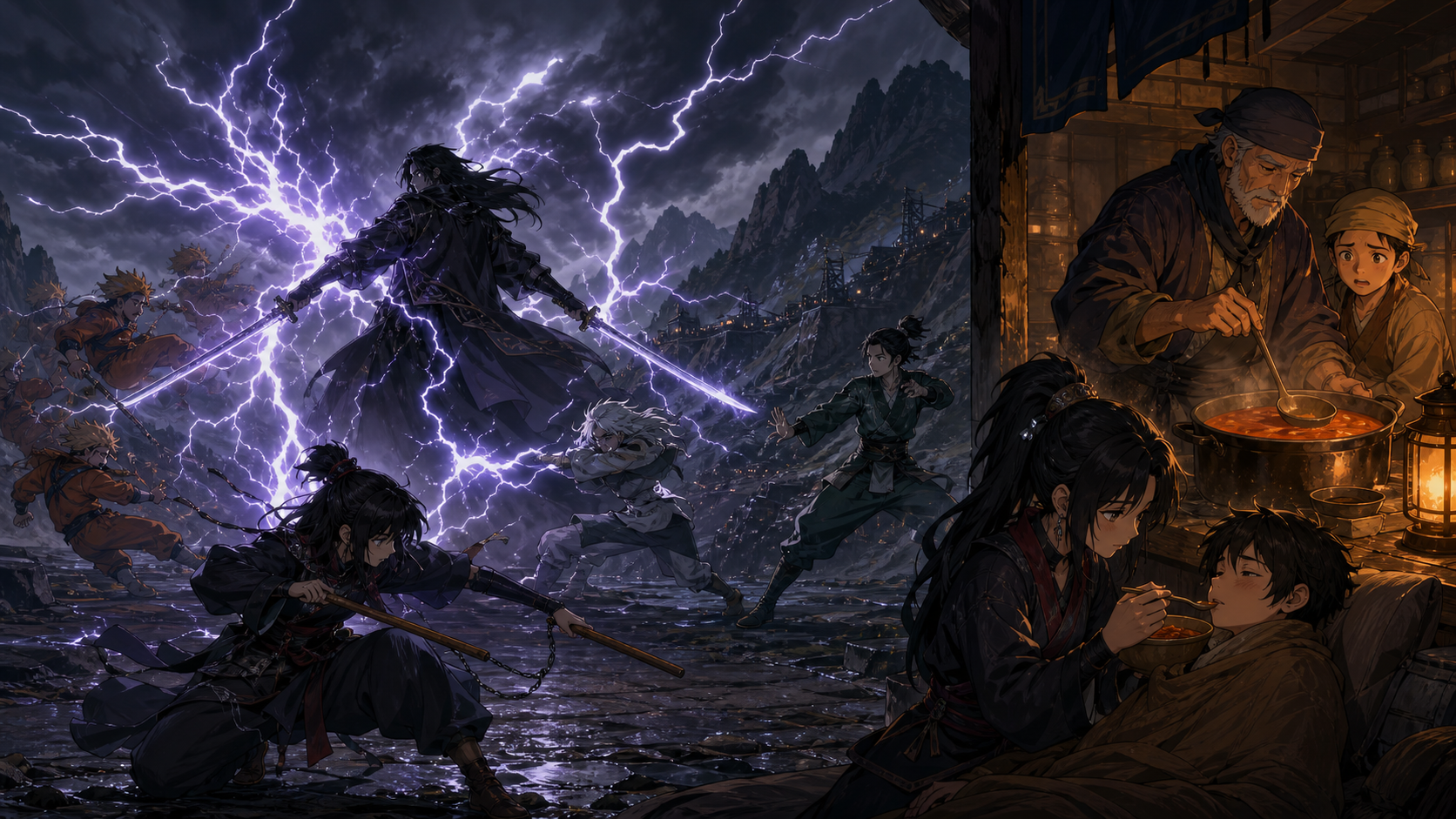
Raiga’s Counterattack
Raiga turns Ranmaru’s sacrifice into revenge, while Tenten demands responsibility and Sansho’s curry gives the boy another choice.
Ranmaru gives nearly everything in his body to bring Raiga back. Raiga wakes, sees the boy collapsed beside him, and receives the clearest possible proof that his life matters to someone.
He uses that new life to plan three funerals.
Episode 156 strips the romance from Raiga and Ranmaru's bond. Their care for each other is real. So is the damage they keep choosing in its name. Ranmaru nearly dies to save Raiga, and Raiga answers the sacrifice by blaming everyone else, attacking Tenten, threatening Karashi and Sansho, and calling more murder a memorial.
Tenten delivers the correction the arc needs. Ranmaru does not get to help take other people's choices away, then call his own death an act of love.
Raiga Turns Grief into a Weapon
A storm gathers over Katabami as Naruto, Lee, and Neji finish reinforcing Sansho's curry shop. At the ravine, Raiga wakes and finds Ranmaru motionless.
Karashi explains what happened. Ranmaru detected that Raiga was still alive and transferred his own chakra to revive him. The boy lying there is not evidence that the Konoha team murdered Raiga's partner. He is evidence that Ranmaru chose Raiga again, even at catastrophic cost to himself.
Raiga cannot face that cost. He demands someone to blame.
First, he turns on Karashi. Then Karashi points toward the Leaf shinobi, and Raiga grabs the explanation because it lets him convert grief into revenge. If Naruto and the others had never arrived, he says, he and Ranmaru could have remained together forever.
That sentence ignores Katabami completely. Their forever required an occupied mine, forced labor, and living burials. Raiga treats every person who resisted as an intruder in his relationship rather than a victim of what the relationship enabled.
Tenten arrives before he can return to the village. She sees him standing and attacks.
Tenten Fights with the Whole Toolbox
Tenten rarely receives this much uninterrupted work, and she earns every second of it. She begins with kunai, shifts to a summoned chain, fills the air with a wider weapon barrage, and then adapts when Raiga's lightning makes metal a liability.
Her wooden staff is a smart response rather than a magic answer. She uses it to keep distance, strike his legs and body, and even knock one sword away. Raiga splits the pole with his remaining blade, then drives electricity through the damaged weapon and into her.
Tenten loses, but the fight shows why she belongs on this mission. She does not repeat one attack and wait for the plot to rescue her. She changes range, material, and rhythm while facing a former Mist swordsman alone.
Raiga calls her an annoyance because dismissing her is easier than admitting she made him work.
Once she is down, he returns to Karashi. He orders the frightened cook to bring Naruto, Lee, and Neji to Lightning Pass. If Karashi fails, Raiga will kill him and Sansho. The three shinobi will become offerings at Ranmaru's funeral.
There is Raiga's love again: a pile of unrelated bodies used to decorate his feelings.
Karashi Follows Fear One More Time
Tenten regains consciousness after Raiga leaves and discovers that Ranmaru still breathes. His body burns with fever, and he has almost nothing left after reviving Raiga. She carries him toward shelter.
Karashi reaches the curry shop first and tells Naruto, Lee, and Neji that Tenten fell from a cliff near Lightning Pass. His story is shaky. Neji immediately questions whether Tenten would lose her footing because of thunder, and the group recognizes that Karashi may be lying or acting under threat.
They go anyway. A trap does not prove Tenten is safe.
Karashi stays behind, claiming he will follow with first aid. Instead, he tries to drag Sansho away before Raiga kills them. He is terrified, and for once his fear includes someone besides himself. He wants his mother alive.
Yet his solution remains the same: obey the strongest threat, mislead everyone else, and run.
Sansho refuses. She will not abandon her shop, the team fighting for Katabami, or the people who may need what she can make. Her courage is not loud. She simply declines to let Raiga decide where her life can exist.
Then Tenten arrives carrying Ranmaru.
Tenten Refuses the Easy Death
Ranmaru sees no point in treatment. Raiga has revived, and Ranmaru believes his own part is finished. If he dies after giving Raiga life, he can turn the exchange into the perfect ending to their bond.
Tenten will not let him.
She reminds Ranmaru that he and Raiga killed people who wanted to live. Their victims did not choose a dramatic sacrifice. They were worked, hunted, placed in coffins, and buried because Raiga wanted funerals and Ranmaru helped him find targets.
Ranmaru therefore does not get to treat death as an escape from consequence. He must live and take responsibility for the freedom he helped steal.
It is the sharpest moral statement in the arc because it refuses two easy stories. Ranmaru is not a helpless innocent whose suffering erases everything he did. He is also not disposable because he helped a murderer. Accountability requires a future. If he dies now, the people he harmed receive nothing, and Ranmaru never has to become someone capable of choosing differently.
Tenten does not promise that living will feel good. She says it is owed.
Real Lightning Changes the Fight
At Lightning Pass, Naruto, Lee, and Neji meet Raiga under the storm. The weather transforms his power. Earlier, he created lightning with chakra, which meant every attack consumed a limited internal supply. Now his swords draw on actual lightning in the sky.
Neji recognizes the problem. Natural energy gives Raiga an outside source with far greater force than the team faced in the mist. They cannot simply wait for him to exhaust himself.
Naruto throws wave after wave of shadow clones into the electrical field, trying to create a path for close combat. Neji drives in with the Gentle Fist when an opening appears. Raiga's lightning crushes the approach before either can shut him down.
When Raiga mocks them after they spend themselves fighting, Lee's anger takes over. He cannot stand hearing effort dismissed, especially when the insult targets his teammates. He steps forward even as Naruto and Neji struggle to move.
This is no longer the unconscious surprise that confused Ranmaru in Episode 154. Lee knows exactly why he is fighting. Raiga mistakes limited chakra for limited resolve, and Lee has built his whole life around proving those are not the same thing.
Still, resolve does not make a body immune to lightning. The team is in serious trouble.
Karashi Finally Uses What He Knows
Sansho decides to save Ranmaru with the Curry of Life. Karashi initially wants to flee, warning that Raiga will return, but the work pulls him back toward the person he used to be.
When Sansho's spice mixture goes wrong, Karashi recognizes the mistake. He has memorized her recipe. Together, they make the true curry.
This is Karashi's first credible step toward repair. He does not become brave through a speech or win forgiveness with another apology. He uses a skill learned from his mother to help a dying boy. The action is small, useful, and pointed in the opposite direction from the Kurosuki Family.
Ranmaru still refuses to eat. Tenten asks whether he cannot perform even that basic act without Raiga. Sansho and Karashi worked to save him without demanding his sight, obedience, or service. Their care gives him nothing to hide behind.
He takes one bite.
The heat, nourishment, and absurd force of Sansho's curry register as something his body wants. Tenten tells him that sensation is what being alive feels like.
Ranmaru's next thought is still Raiga. He wants Raiga to taste the curry too.
That response is not full independence, but it is different from sacrificing himself. Ranmaru no longer wants to die so Raiga can continue alone. He wants to carry something life-giving toward him and ask him to share it.
The Curry Heads Toward the Storm
Tenten, Sansho, Karashi, and Ranmaru prepare to bring the Curry of Life to Lightning Pass. The food cannot erase Raiga's crimes, restore his victims, or guarantee that he will accept Ranmaru's changing mind. It can keep injured people alive long enough to make another choice.
Episode 156 ends before the curry reaches Naruto, Neji, Lee, or Raiga. The battle remains open. Raiga is drawing power from the storm, the Leaf fighters are exhausted, and Lee is still standing mostly because anger refuses to let him fall quietly.
Raiga believes Ranmaru's sacrifice entitles him to revenge. Tenten insists it creates responsibility instead. Sansho and Karashi turn that responsibility into a bowl placed in front of the boy: eat, survive, and decide what you will do with the life other people worked to protect.
Ranmaru finally eats. Now he has to carry that lesson back to the man who taught him that love and violence were the same thing.
Raiga wakes because Ranmaru nearly empties himself
The revival is not a neutral return to battle. Ranmaru transfers so much chakra that he lies nearly lifeless beside the adult he saved. Raiga sees the child’s condition and interprets it as a reason for rage. He should interpret it as a reason to stop. If their bond means protection, the first obligation after waking is care for the person whose body paid for his recovery.
Grief becomes another excuse to center Raiga’s desires
Raiga believes Konoha took away the life he shared with Ranmaru. That story ignores the child’s own decision, the danger Raiga created, and the people killed under their partnership. His pain may be genuine. Genuine pain does not establish innocence. He channels loss into thunder because violence lets him avoid asking whether the relationship ever allowed Ranmaru a future beyond serving him.
Ranmaru’s sacrifice should trigger medical urgency
The child needs warmth, monitoring, hydration, and assessment for chakra exhaustion. Leaving him exposed while Raiga pursues revenge compounds the original harm. Any adult encountering the scene should treat Ranmaru as a critical patient before treating him as a witness or moral lesson. Survival is the condition that makes later accountability possible.
Tenten confronts Raiga before the rest of the squad can regroup
Her intervention buys time and prevents him from reaching more vulnerable people immediately. The episode gives her a rare sustained tactical role, and the details matter. She changes distance, attack pattern, and material as Raiga counters her weapons. Tenten does not fail because she lacks courage. She faces an elite opponent empowered by weather while protecting a battlefield that has already collapsed around her.
Metal weapons become liabilities against lightning
Tenten’s usual arsenal conducts the threat she is trying to stop. Adapting to a wooden staff shows fast material reasoning rather than simple escalation. When Raiga sends lightning through the split wood anyway, the defeat reveals the strength of his control, not the foolishness of her adjustment. The correct lesson is to keep testing while creating an exit, not to assume one insulating material solves every electrical hazard.
A solo defense still needs a retreat threshold
Buying time can save others, but Tenten should know when continued engagement no longer protects anyone. A signal, covered withdrawal, or prearranged rendezvous would preserve her ability to help with Ranmaru and the village afterward. Shinobi culture often praises standing until collapse. Mission care should praise survival that keeps a skilled teammate available for the next urgent need.
Karashi is coerced back into service through fear
Raiga orders him to bring Naruto, Lee, and Neji to Lightning Pass. Karashi’s earlier gang membership makes him vulnerable to the old chain of command, especially when the leader he believed dead suddenly returns. Coercion explains the choice while the ambush still creates danger. Repair requires him to disclose what happened and help undo the trap as soon as a safer opening appears.
Lightning Pass is selected because terrain extends Raiga’s power
The storm allows his blades to draw from natural lightning rather than relying only on personal chakra. This turns weather into an external battery and makes ordinary endurance calculations unreliable. Naruto cannot assume Raiga will weaken after a few large attacks. The squad needs shelter, grounding awareness, spacing, and a way to interrupt the connection between blades and storm.
Neji should read the environment as carefully as the opponent
Byakugan may show chakra flow, but natural lightning adds force outside Raiga’s body. Watching only his internal reserves will underestimate the threat. Neji can help identify blade angles, terrain channels, and moments when the electrical path changes. Episode 154 taught him that trusted evidence needs context; Episode 156 asks him to apply that lesson under pressure.
Naruto’s clones can distribute risk without becoming disposable
Shadow clones are useful for testing attack range, drawing lightning away from civilians, and identifying safe approaches. They are still extensions of Naruto’s attention and chakra. Flooding wet terrain with bodies may create more conductive paths and exhaust him before the real opening. Quantity should serve a specific information goal rather than substitute for one.
Lee enters another fight while still carrying damage
His determination makes retreat emotionally difficult, especially after Tenten falls and Raiga threatens the others. Injury changes balance, reaction time, and the cost of every impact. The team needs to treat Lee’s willingness as information about loyalty, not proof that his body is ready. Protecting his future includes setting limits he may not choose for himself in the moment.
Tenten’s rescue of Ranmaru connects combat and care
After facing Raiga, she becomes the person who physically supports the child whose power restored him. Those tasks are not opposites. Stopping an attacker and protecting a depleted participant both serve the same safety goal. Tenten also refuses to let Ranmaru disappear into the romantic story of sacrificing everything for someone he loves.
Her demand for responsibility begins with staying alive
Ranmaru helped Raiga locate targets and sustain violence. He cannot repair those harms if he dies to preserve the partnership. Tenten’s insistence that he survive is not absolution. It is a refusal to let death become an escape that leaves victims with no truth, no acknowledgment, and no chance to see him choose differently.
Responsibility must be scaled to Ranmaru’s age and coercive context
He is a child shaped by isolation, physical dependence, and attachment to the adult who gave him purpose. Those conditions reduce the freedom surrounding his choices without making every action consequence-free. A fair process distinguishes information he knowingly provided, threats he understood, and decisions made under fear of losing his only caregiver. Accountability should produce safer behavior, not reproduce abandonment.
Sansho refuses to flee because the curry shop is part of the community
Her decision can look reckless, but occupation has already asked residents to surrender places, routines, and relationships. The shop is where care continues despite fear. Remaining should still come with a safety plan, protected routes, and help from trained ninja. Courage does not require an older civilian to stand alone against lightning and gang retaliation.
Karashi corrects the Curry of Life recipe
His knowledge becomes useful without frightening anyone. That matters because the gang taught him to associate value with borrowed violence. Preparing the correct curry is a small but concrete act of repair: he listens, contributes, and supports someone in danger. One helpful action does not erase the ambush. It shows the direction repeated actions could take.
The curry offers nourishment without demanding service
Ranmaru is accustomed to receiving movement and belonging through what he provides Raiga. Sansho feeds him because he is sick and present. The meal carries no requirement that he use his eyes, transfer chakra, or prove loyalty. Accepting a bite becomes difficult precisely because care without exchange is unfamiliar.
Ranmaru’s decision to carry the curry toward Raiga is morally unsettled
He may want to stop the fight, feed the person he loves, or return to the relationship he cannot release. The action should not be labeled redemption before its purpose and consequence are known. What matters is that he now moves with people who have shown another model of care. The next choice will reveal whether he can bring that model into confrontation with Raiga.
The squad should not leave Katabami unguarded during the pass battle
Raiga’s challenge draws the strongest fighters toward terrain chosen for his advantage. Remaining gang members or panic could threaten residents while everyone watches the mountain. Clones, local watches, and communication routes can preserve village safety. Winning a duel at Lightning Pass means little if the town becomes vulnerable again.
RaeRae’s full take
Raiga wakes beside a child who nearly died restoring him and decides the correct response is revenge. That tells me more about the relationship than any speech about being two halves of one life. Ranmaru spends his body. Raiga spends the result on his own anger.
Tenten is the episode’s backbone. She adapts her weapons, faces a storm-powered swordsman, rescues Ranmaru, and tells him the truth compassion often avoids: surviving does not erase responsibility, but death cannot do the work of repair. She refuses both cruelty and easy absolution.
The Curry of Life matters because Sansho and Karashi offer Ranmaru something Raiga never did. Food reaches him without a demand for service. One bite cannot transform years of dependency. It can give him enough strength to make the next choice while knowing another kind of belonging exists.
RaeRae checkpoint: Raiga spends Ranmaru’s sacrifice on vengeance. Tenten answers with a harder form of care: survive, accept responsibility, and learn that being fed does not have to mean becoming useful to someone else’s violence.
Watch Naruto Episode 156
- [Naruto Official episode guide](https://naruto-official.com/en/anime/naruto1/list/01_380)
- [Watch “Raiga's Counterattack” on Crunchyroll](https://www.crunchyroll.com/watch/G65VE31Q6/raigas-counterattack)
- [Browse official Naruto viewing options from VIZ](https://www.viz.com/anime/tv-show/naruto-video/video-unit/1)
Receipts and official routes
- Episode number, licensed title, and official synopsis: Naruto Official Site.
- Japanese title, synopsis, and October 19, 2005 broadcast record: TV Tokyo.