
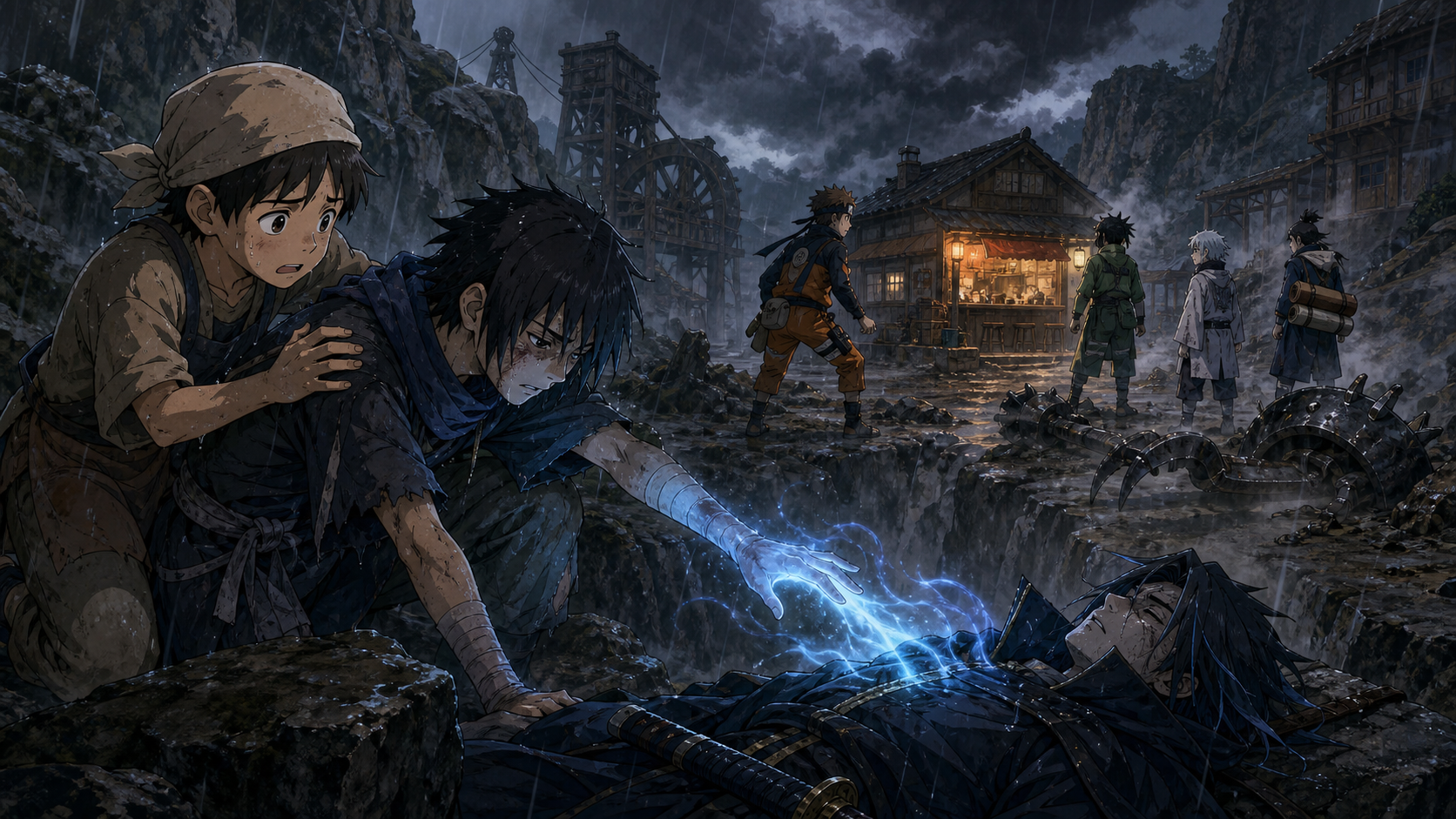
The Dark Creeping Clouds
Karashi and Ranmaru receive second chances, then misuse them: one enables another trap while the other secretly restores Raiga to life.
Raiga appears dead, the Kurosuki Family has scattered, and Katabami Gold Mine looks ready to breathe again. Then Karashi welcomes the Konoha team home by helping the surviving gang drop boulders on them.
So much for one punch fixing a person.
Episode 155 gives Karashi and Ranmaru second chances, then lets both boys misuse them before the credits. That does not make mercy foolish. It makes mercy honest. Rescue can remove someone from immediate danger, but it cannot erase fear, dependency, or years of bad choices on command.
Lee and Naruto offer each boy a way forward. Karashi gets work, accountability, and a home. Ranmaru gets help imagining a life outside Raiga. Neither is ready to choose that future cleanly.
Karashi Sets One More Trap
Naruto, Lee, Neji, and Tenten return to Katabami with the residents they rescued. The mine seems calm. Most of the Kurosuki Family fled after Raiga's defeat, and the villagers are still standing.
Karashi waits for them, claiming he cannot return to his mother's curry shop after everything he has done. The shame sounds plausible. It is also cover.
Surviving gang members hide above the approach and release boulders toward the group. They follow with iron claws and Black Tornado, insisting that the Kurosuki Family will continue even without Raiga.
Naruto has already prepared for the possibility that Karashi's apology was worth less than Lee hoped. The falling rocks crush transformed shadow clones instead of the real group. When the gang attacks the apparent survivors, those targets are clones too.
The trick works twice because the Kurosuki men are desperate to believe their own ambush succeeded. They see what confirms the plan in their heads, then stop checking.
Once the real team appears, the fight ends quickly. Lee's taijutsu, Neji's Sixty-Four Palms, Tenten's weapons, and Naruto's clones dismantle the remaining attackers. The occupation is finally broken at the level that matters to the residents: the armed men standing over their daily lives are gone.
That leaves Karashi.
Fear Explains Karashi, but It Does Not Clear Him
The villagers turn on him, and their anger is earned. Karashi says he cooperated because the Kurosuki Family would have killed him if he refused. That may be true. It is also the same threat every miner lived under while Karashi stood with the people enforcing it.
Fear explains why he chose the gang. It does not transform the choice into innocence.
Lee steps between Karashi and the crowd. He offers himself for punishment and says he bears some responsibility because his own example taught Karashi that power was everything.
Lee is being generous, but he is also taking too much. Karashi admired his strength, yet Lee never taught him to extort miners or lure rescuers into a rockslide. Karashi chose the shortcut from feeling weak to standing beside cruelty. Lee can help him repair the harm without pretending the decision belonged to anyone else.
His better argument is practical. Karashi once used his hands to make curry that helped save Lee's life. Let him return to Sansho. Let him work, feed people, and earn trust through repetition. If he strays again, Lee promises to handle him.
The residents agree because Karashi was a low-level underling and did not personally attack them. Their mercy is conditional. Nobody declares the past erased. Karashi receives an opportunity to make amends, not a certificate saying he already has.
That is a much sturdier second chance than instant forgiveness. It gives him something useful to do tomorrow.
Ranmaru Tells the Rest of His Story
The mission is not finished until the team retrieves Ranmaru. Without Raiga, the boy repeats that he cannot live alone.
His history explains why that belief runs so deep. Ranmaru does not remember his parents. Illness confined him to a small cabin, and villagers kept him alive by leaving limited food. His unusual sight let him perceive events outside his room, including private details no ordinary child could know from bed.
At first, that ability connected him to a world he could not physically enter. Then the villagers learned what he could see and became frightened. Care turned into suspicion. Visitors stopped coming. Ranmaru waited to die in the same room from which he had watched everyone else live.
Raiga carried him outside.
That act matters. Raiga did not invent Ranmaru's isolation, and calling their bond simple exploitation misses why the boy would sacrifice everything to preserve it. Raiga gave him movement, companionship, and direct contact with a world that had existed only at a distance.
In return, Ranmaru became Raiga's sight. He says good and evil did not matter because he considered himself only a sense organ.
There is the poison inside the rescue. Raiga helped Ranmaru leave his bed, then gave him a role so narrow that the boy stopped treating his own judgment as necessary. If he was only Raiga's eyes, then whatever Raiga chose to see, hunt, or kill could never be Ranmaru's responsibility.
Naruto refuses that definition. Existing as another person's body part is not the same as living.
Naruto Makes a Huge Promise
Naruto tells Ranmaru to live and promises to become his body until he can walk independently.
It is classic Naruto: wildly generous, emotionally correct, and not remotely worked out. He does not know how long Ranmaru's physical recovery might take, what medical care he needs, or who will support him after the mission ends. Naruto hears a boy say he has no body without Raiga and answers with the biggest promise available.
The promise still matters. Ranmaru has known help as a transaction that made him useful to one person. Naruto offers help aimed at making him less dependent. He wants Ranmaru to reach a day when he can choose where to go without serving as anyone's equipment.
Ranmaru asks for one favor before they leave. He wants to return to the ravine and see Raiga's body.
Neji checks the fallen man with the Byakugan and finds no sign of life. Ranmaru can perceive what Neji cannot. Raiga is barely alive.
Ranmaru says nothing.
That silence is his first major choice after Naruto tells him to live for himself, and he uses it to preserve the old bond. Change has been offered. He has not accepted its cost.
Curry, Consequences, and a Dead-End Lead
Back at Sansho's Curry of Life shop, Karashi apologizes to his mother and promises to train as her successor. Sansho does not waste time on a soft reunion. She serves him punishment curry at absurd strength and expects him to eat.
It is comedy, but the shop gives both boys an alternative to the Kurosuki Family. Karashi can become valuable by feeding people instead of frightening them. Ranmaru receives a mild bowl prepared for his body rather than a demand that he use his power.
Naruto also returns to the reason he joined the mission. He asks Ranmaru about Zabuza and describes Kisame by his massive wrapped sword and fishlike face. Ranmaru recognizes the men, but he knows only that Kisame left the Hidden Mist. He has no current location and no route to Itachi.
The Sasuke lead goes nowhere.
That failure quietly proves the mission mattered anyway. Katabami is free, Rokusuke survived, Karashi has a chance to repair what he helped damage, and Ranmaru has been offered a life beyond serving Raiga. None of it brings Sasuke one step closer.
Lee begins his promised supervision immediately, putting Karashi through brutal physical training. His plan is very Lee and not especially tailored to a curry cook, but it makes accountability visible. Karashi will not drift home and wait for everyone to forget.
The Storm Was Already Inside the Shop
Dark weather gathers over Katabami. Naruto, Neji, and Lee help Sansho reinforce the shop while Tenten is asked to check on Karashi and Ranmaru.
The boys are gone.
Ranmaru has persuaded Karashi to carry him back to the ravine. Karashi, fresh from receiving mercy for following dangerous people out of fear, follows another dangerous request. He still wants someone else to tell him where strength and safety live.
At Raiga's body, Ranmaru transfers nearly all his chakra into him. He does exactly what he said Raiga once did for him: he pulls the other person back from death and gives him access to life again.
The act is loving. It is also catastrophic.
Ranmaru does not revive a reformed man. He revives the leader who occupied Katabami, buried residents alive, and tried to kill the Konoha team. Saving someone from death does not answer what that person will do with another day.
Raiga wakes and sees Ranmaru collapsed. His first fear is that the boy died to restore him. Karashi remains nearby, caught between the second chance Lee built for him and the violence he keeps helping return.
Episode 155 ends before Raiga strikes back. The dark clouds in the title are literal, but the real storm has been forming through every untested promise. Lee believes Karashi can make amends. Naruto believes Ranmaru can live as his own person. Both beliefs may be right eventually.
Right now, Karashi has enabled another trap, and Ranmaru has spent his new freedom restoring the man who took everyone else's away.
Mercy did not fail them. They have barely begun learning what to do with it.
Peace is announced before Katabami is actually secure
The Kurosuki Family appears dispersed, but hidden members remain positioned above the village with a boulder ambush ready. Removing visible guards did not dismantle the whole network. A responsible liberation needs watches, safe routes, a count of known enforcers, and a way for residents to report intimidation without exposing themselves. Celebration is understandable. Declaring the danger finished too early gives the remaining gang the surprise it needs.
The boulder attack targets trust as much as bodies
Residents have begun to believe the occupation is over. An attack from concealed high ground tells them the gang can still reach into ordinary movement whenever it chooses. Naruto’s transformed clones expose the trap, but the village also needs reassurance grounded in visible security measures. People cannot rebuild daily life if every ridge remains a possible execution platform.
Karashi’s involvement tests whether mercy had any structure
The villagers spared him after Lee argued that he could make amends. Conditional mercy should include clear expectations, supervision, and consequences. If everyone simply returned him to the curry shop and hoped gratitude would produce reform, they left both Karashi and the community without support. A second chance is an opportunity to choose differently, not a magical reset that removes learned loyalty or fear.
Relapse does not prove mercy was foolish
Karashi helping another trap can make the villagers feel that compassion exposed them to danger. That reaction deserves acknowledgment. The answer is not permanent cruelty toward every recruit who seeks to leave. The answer is better reintegration: verify behavior, restrict access to sensitive information, pair welcome with accountability, and intervene when old contacts or pressures return.
Lee’s faith in Karashi needs boundaries to remain protective
Lee sees the caring person Karashi was and refuses to let gang membership become his only identity. That belief can support change. It becomes unsafe if Lee dismisses evidence because accepting betrayal would hurt. Care should make truthful confrontation possible. Protecting Karashi from consequences would also protect the habits pulling him back toward the Kurosuki Family.
Concrete amends belong in the curry shop and beyond it
Working beside Sansho can reconnect Karashi to food, service, and community rather than intimidation. Repair should also respond to the people he helped frighten. He may need to identify remaining gang routes, return stolen goods, assist injured workers, and listen without demanding immediate forgiveness. The goal is not public humiliation. It is rebuilding trust through repeated actions residents can observe.
Ranmaru receives care without being used for the first time
At Sansho’s shop, food and shelter are offered without requiring his vision to guide someone’s violence. That is a profound change in the terms of belonging. Naruto promises support until Ranmaru can walk independently, which gives the child a future not defined by serving as Raiga’s eyes. The episode also shows how unfamiliar that freedom feels when dependency has shaped every surviving relationship.
Learning to walk carries emotional meaning beyond rehabilitation
Physical independence could expand where Ranmaru goes, whom he trusts, and what he chooses to do with his abilities. It also threatens the bond he believes made life meaningful. Improvement can feel like abandonment when a child has learned that need is the glue holding love together. Caregivers must state clearly that becoming stronger will not cost him connection.
Ranmaru conceals Raiga’s survival from Neji
The omission is an active decision with consequences for everyone in Katabami. Grief, loyalty, and fear help explain why he protects Raiga. They do not make the danger disappear. The team should avoid framing the child as a mastermind while still recognizing that incomplete disclosure prevents the village from preparing for a living attacker.
Neji’s reassessment needs physical confirmation
After Ranmaru manipulated Byakugan in the previous fight, relying on the same sense to confirm Raiga’s death is especially risky. The ravine should be searched by multiple methods, with tracks, disturbed vegetation, blood, and terrain examined alongside chakra perception. A missing body is unresolved evidence. The team has already learned what happens when expectation fills the gaps.
Karashi carrying Ranmaru creates a dangerous alliance of unfinished recovery
One young person has just left a gang; the other has just been separated from the adult he believes completed him. Neither is ready to safeguard the other alone. Their disappearance during the storm is not proof that care failed. It is proof that early recovery required closer support than the adults provided.
The storm gives secrecy cover and raises physical risk
Rain obscures tracks, makes ravine paths unstable, and can hide the sound of movement. Ranmaru is physically frail, while Karashi may be acting under emotional pressure rather than a safe plan. When they vanish, the search should treat both as endangered even before the team understands their destination. Suspicion does not cancel the obligation to recover them alive.
Ranmaru gives nearly all his chakra to revive Raiga
The act is framed as devotion, but it places the child’s body at the edge of collapse so an adult fighter can return. Raiga’s revival is built from Ranmaru’s depletion. This is the central imbalance in their bond. The person with greater mobility and social power survives through a vulnerable child’s willingness to disappear inside service.
Consent formed inside dependency needs careful examination
Ranmaru chooses to revive Raiga, yet his choices have been shaped by isolation and the belief that life without Raiga has no value. That context does not make his agency meaningless. It does mean adults should not celebrate the sacrifice as uncomplicated love. Real care would protect his ability to choose a future where the relationship is not maintained through self-erasure.
Raiga’s responsibility begins the moment he wakes
If he loves Ranmaru, he should notice the child’s exhaustion, refuse another battle, and seek help. Accepting the transferred chakra and returning immediately to vengeance would demonstrate that affection remains subordinate to Raiga’s needs. A caring adult does not let a dependent child pay the bodily cost of restoring his power, then spend that restoration on more danger.
Naruto’s promise must include supervision, not only encouragement
Telling Ranmaru that the team will support his independence is emotionally generous. The child still needs a concrete caregiver, medical evaluation, mobility plan, and protection from contact with Raiga. Naruto cannot make a large promise and assume warmth at the curry shop fulfills it. Consistent structures are how a new life becomes believable.
The village’s mercy toward Karashi and care for Ranmaru are related
Both young people have been shaped by harmful attachments promising strength or purpose. Neither should be reduced to the worst decision made immediately after removal. Both must also be prevented from placing residents at risk. Compassion and safety are not competing policies. Thoughtful limits are one way compassion protects everyone involved.
The episode refuses the fantasy of instant redemption
A meal, a speech, and a promise do not erase the habits that kept Karashi and Ranmaru attached to violent people. Their choices are disappointing because the offered care was real. The story becomes useful when it treats change as repeated practice rather than one emotional revelation. Recovery can begin sincerely and still move backward under stress.
Katabami deserves a transition plan before the ninja leave
The remaining gang attack, Karashi’s instability, Raiga’s unconfirmed fate, and Ranmaru’s disappearance all show that the mission is not ready for closure. Konoha should coordinate local watches, medical aid, communications, and follow-up. A village emerging from occupation cannot be handed a single victory scene and expected to manage every surviving threat alone.
RaeRae’s full take
Episode 155 understands something fandom stories often skip: mercy is the beginning of work. Karashi gets another chance and still helps danger return. Ranmaru receives care and still chooses Raiga. Neither decision proves that kindness was wasted. Both prove that speeches without structure cannot compete immediately with relationships built through years of fear and dependency.
I am most concerned by how much Ranmaru gives away to revive Raiga. He transfers nearly everything into the adult whose power already depended on him. If Raiga wakes and chooses vengeance over the child lying depleted beside him, the relationship tells us exactly whose needs have always come first.
Katabami also cannot call itself safe yet. Hidden gang members remain, Raiga’s body was never confirmed, and two vulnerable boys disappear in a storm. Liberation needs follow-through. Otherwise the dark clouds are not only weather. They are every unexamined danger the first victory allowed the team to stop watching.
RaeRae checkpoint: A second chance offers room to change; it does not complete the change. Karashi and Ranmaru need care with boundaries, because old loyalties remain powerful enough to put their bodies and Katabami at risk.
Watch Naruto Episode 155
- [Naruto Official episode guide](https://naruto-official.com/en/anime/naruto1/list/01_379)
- [Browse official Naruto viewing options from VIZ](https://www.viz.com/anime/tv-show/naruto-video/video-unit/1)
Receipts and official routes
- Episode number, licensed title, and official synopsis: Naruto Official Site.
- Japanese title, synopsis, and October 12, 2005 broadcast record: TV Tokyo.