
The Enemy of the Byakugan
Ranmaru manufactures the exact chakra evidence Neji trusts, then separation reveals how much of Raiga’s battlefield power belongs to the child he carries.
Neji should own this battlefield. Mist can hide faces and movement from ordinary sight, but the Byakugan reads chakra networks. A body behind fog is still a body, and Neji has spent his life trusting that his eyes will expose what everyone else misses.
Episode 154 breaks that certainty in minutes.
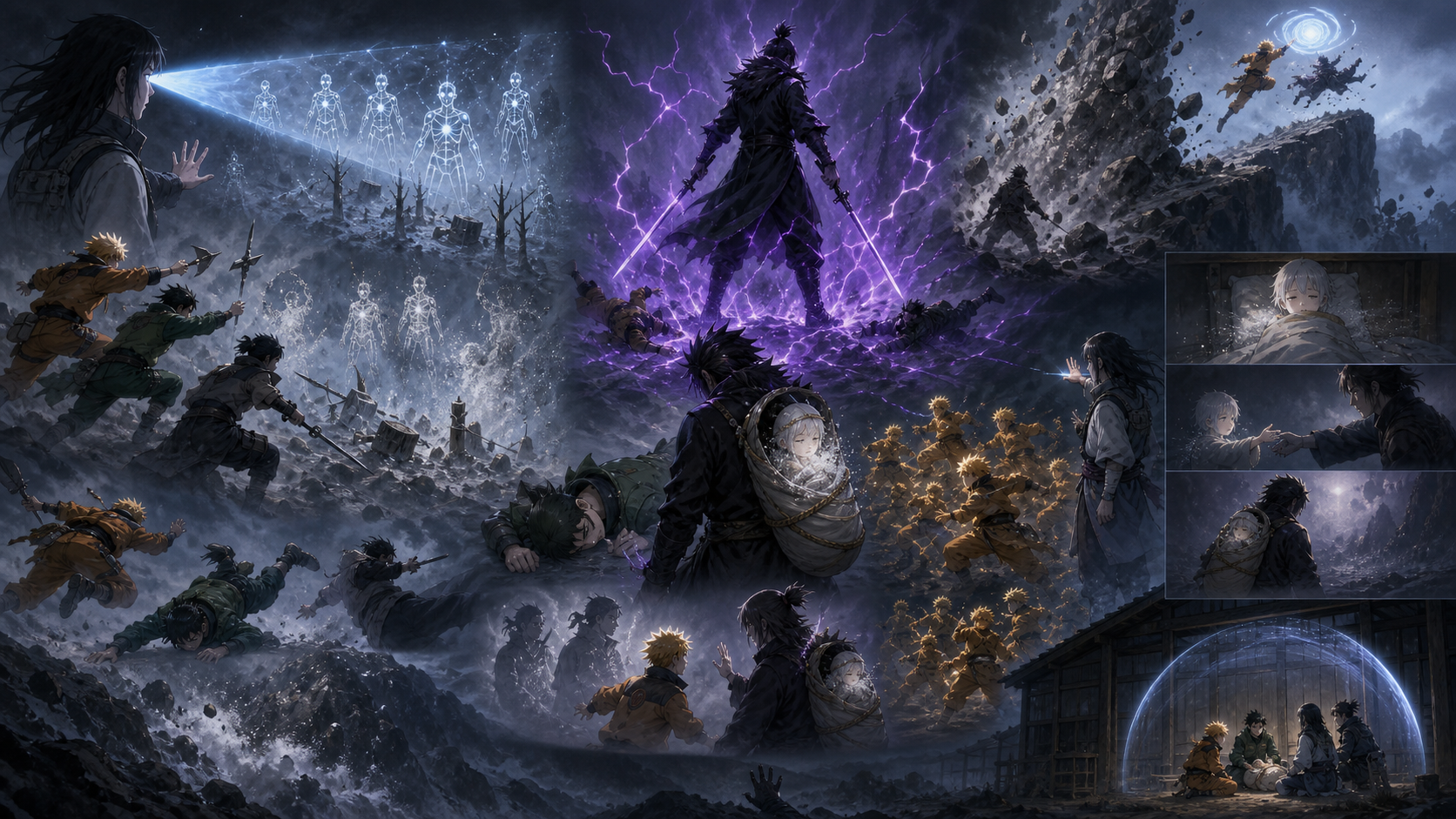
Ranmaru does not merely conceal Raiga. He gives dead trees the appearance of living chakra systems and feeds Neji evidence designed specifically for the Byakugan. Naruto, Lee, Neji, and Tenten attack the targets Neji identifies, only to hit wood and empty ground.
For once, better sight makes the trap more convincing.
When the Byakugan Lies to Its Owner
Neji activates the Byakugan inside the mist and finds several human shapes. He calls their positions, and the team moves. Naruto sends shadow clones into one target. Lee strikes another. Every attack misses because none of the apparent bodies is Raiga.
The false targets include chakra networks. That detail changes the problem from simple camouflage into a direct attack on Neji's method of knowing. An ordinary illusion might fool Naruto's eyes while leaving Neji untouched. Ranmaru manufactures the exact signal Neji has been trained to treat as proof.
Neji does not become careless. He follows the strongest information available to him, and it is wrong.
That is why Ranmaru earns the episode's title. He is not stronger than the Byakugan in every possible sense. He is its enemy because his perception can understand what Neji sees, hide Raiga from it, and place convincing lies inside its field.
Raiga takes full advantage. From concealment, he drives his paired swords into the ground and releases Thunder Funeral: Feast of Lightning. The attack tears across the area and drops all four Konoha shinobi.
Raiga approaches the bodies already thinking about another funeral. Ranmaru warns him that they are unconscious rather than dead. Raiga decides to finish the work personally.
Then Lee's body kicks him.
Lee Fights Before He Wakes Up
Lee is still unconscious. His eyes remain closed, and he has no deliberate plan. His muscles continue the fight because thousands of repetitions have taught his body what to do even when his conscious mind is absent.
It is ridiculous in the best possible Lee way, but it also creates a problem Ranmaru cannot easily solve. Ranmaru reads opponents and calls directions so Raiga can respond. An unconscious fighter is not forming normal intentions. Lee's movements come from drilled reactions instead of conscious choices, making them harder to predict.
Raiga has the battlefield's most extraordinary pair of eyes in his ear, and Lee becomes dangerous by fighting without thought.
The scene makes Lee's training physical in a way speeches cannot. Guy did not teach him a collection of flashy poses. He made Lee repeat movements until skill lived deeper than decision. Even knocked senseless by lightning, Lee's body remembers the promise to keep moving.
Naruto and Neji begin to recover while Lee holds Raiga's attention. In the confusion, the wrapped carrier attached to Raiga's back is cut loose. The bundle falls away from him, and the battle changes immediately.
Raiga is still dangerous, but he is no longer complete.
Raiga Without His Eyes
Naruto uses the opening to demand answers. Guy's rumor brought him to Katabami, and he wants to know whether Raiga truly belonged to the Seven Ninja Swordsmen of the Mist. More importantly, he asks about Zabuza and Kisame.
Zabuza is part of Naruto's own history. Kisame is the possible route to Itachi, and Itachi remains a possible route to Sasuke. This is the thread Naruto hoped Raiga would provide.
Raiga refuses. He says he hates the other swordsmen and wants no memories of them. Naruto threatens to force the information out of him, but there is little heroic romance in the exchange. One teenager is trying to extract a lead from a violent man who has no reason to cooperate.
Their fight shows just how much Raiga relied on the child he carried. He lashes out with Lightning Ball attacks and still has skill with his twin blades, but he can no longer read Naruto's feints with the same precision. Naruto gets behind him with a clone trick. Raiga reacts later and spends more chakra covering uncertainty with force.
Meanwhile, Neji and Tenten inspect the fallen carrier. The Byakugan finally detects a real person inside. Material packed around the bundle has hidden the child's actual chakra network while helping create the false ones scattered through the mist.
Neji gives Naruto the information that turns the fight: Raiga's eyes are with them now.
Naruto floods the slope with shadow clones. Earlier, Ranmaru could identify the real Naruto and guide Raiga past the decoys. Alone, Raiga cannot sort the crowd quickly enough. He starts burning through his remaining chakra and retreats uphill.
One Body Made from Two Lives
Raiga triggers a boulder avalanche to crush the pursuing clones. Naruto avoids the worst of it, attacks from above, and drives a Rasengan into him. Raiga falls away from the battlefield, apparently defeated.
The win belongs to the separation as much as the final strike. Together, Raiga and Ranmaru covered each other's limits. Ranmaru could perceive the battlefield but could barely move through the world. Raiga gave him movement while using his sight to fight beyond his own ability.
That partnership was real. It was also used to occupy a town, bury dissenters alive, and make resistance feel impossible.
When Neji and Tenten open the carrier, they find a sick boy rather than the weapon they expected. Ranmaru's body is frail, and his life before Raiga was brutally small. Illness kept him confined to bed. Other villagers shunned him. He watched the outside world from beneath blankets because observation was the only access he had to it.
Raiga entered his home while hunting for a spy and killing with little discrimination. Ranmaru sensed something inside him that other people missed: Raiga was suffering too, crying inwardly and searching for a reason to live.
Ranmaru offered himself. If killing him would give Raiga meaning, then Raiga could do it.
Instead, Raiga carried him away.
Ranmaru Is Not Haku, but Naruto Knows the Shape
Ranmaru became Raiga's eyes and ears. Raiga became his arms and legs. Each gave the other access to a part of life he believed he could not reach alone.
It sounds tender until the bodies begin piling up.
Their dependence did not stay private. They made other people pay for it. Ranmaru's sight helped Raiga terrorize Katabami, and Raiga's strength let Ranmaru experience the world through executions and control. Feeling needed gave them both a reason to continue, but neither asked what that reason cost everyone around them.
Believing Raiga dead, Ranmaru asks Naruto to kill him. Without Raiga, he says, there is no purpose left.
Naruto immediately remembers Haku. Haku tied his value to Zabuza's need and called himself a tool. Naruto watched that belief carry Haku toward death, then watched Zabuza understand the bond only when it was too late to choose another life.
The resemblance gives Naruto a reason to refuse Ranmaru's request, but it does not make the two boys identical. Haku protected Zabuza out of devotion while still showing mercy to strangers. Ranmaru actively helped Raiga manufacture false bodies, locate victims, and defeat anyone who resisted. His suffering explains how Raiga reached him. It does not clean his hands.
That distinction makes Naruto's refusal stronger. Ranmaru does not need to be innocent to remain alive. A person's right to a future cannot depend on whether the audience finds his past pure enough.
Surviving Is Only the First Answer
Neji points out that Ranmaru poses little immediate physical danger without Raiga. The team restrains him in a barn or storehouse, and Naruto places a chakra-sealing tag over the entrance before they return toward Katabami.
It is a practical solution, not a cure. Naruto has rejected the idea that Ranmaru should die, but he has not handed the boy a new purpose. No speech can replace the only relationship Ranmaru has known. The next step will require choices Ranmaru makes for himself.
The episode closes by revealing that Raiga survived the fall.
That final beat keeps every question open. Raiga has lost the child who made him stronger. Ranmaru has lost the man who made movement possible. Neji has learned that even perfect sight can authenticate a lie. Naruto has found no useful path to Sasuke, only another child who believes his life belongs to someone else.
Episode 154 strips away the supports each person trusted. What remains is not independence for its own sake. It is the harder possibility that needing someone can be honest and life-giving without turning that person into your eyes, your legs, your weapon, or your only excuse to exist.
Raiga and Ranmaru never learned where mutual care ended and mutual destruction began. Separating them wins the fight. Teaching either one how to live afterward will be much harder.
Ranmaru does not merely hide from the Byakugan
He creates chakra networks that look human enough for Neji to authenticate. That distinction makes him dangerous. Concealment produces uncertainty, but fabricated evidence produces confident error. Neji does not strike empty space because he sees nothing. He strikes dead trees because the information reaching his trusted sense has been deliberately shaped to resemble truth.
The strongest sensor can become the team’s largest single point of failure
Neji’s accuracy has taught the squad to treat his report as the battlefield map. Once Ranmaru compromises that map, every teammate inherits the mistake. The lesson is not that Byakugan suddenly lacks value. The lesson is that reliable tools still need independent checks when an opponent demonstrates a direct countermeasure.
Neji should be allowed to report uncertainty without losing status
A specialist may hesitate to say that conditions have defeated his usual method, especially when everyone expects certainty. Leadership should reward the warning. “I can see a chakra network, but physical evidence does not match” is more valuable than another confident command toward a decoy. Expertise includes recognizing when the instrument and the environment disagree.
Tenten can test the map without walking into every target
Thrown tools, wire, tagged markers, and controlled impact can reveal whether a shape has the mass, movement, and response expected from a person. Her distance work offers a physical check against Ranmaru’s visual forgery. The episode should use her preparation as a form of intelligence rather than reducing her to extra firepower after the deception is already exposed.
Kiba’s absence shows why redundant sensing matters
The previous arc carried scent, insect behavior, and Byakugan together. This team relies heavily on Neji’s eyes. A fabricated chakra network might not carry human scent, breath, heat, or displaced ground. No technique must solve every problem, but multiple imperfect systems can expose contradictions that one celebrated system misses.
The mist is part of the deception, not a neutral backdrop
Reduced ordinary visibility makes the squad depend even more heavily on Neji. Sound travels without clear direction, wet surfaces change footing, and lightning threatens a wide area. Raiga and Ranmaru designed the conditions around their combined strengths. Entering that space without forcing the fight into clearer terrain gives them control before the first blade moves.
Raiga’s lightning punishes tight formation
A broad electrical attack can drop several teammates at once, especially in a wet environment. Staying close helps prevent separation in mist, yet it also creates a shared target. The squad needs spacing tied to audible signals or marked lines, not an unplanned cluster. Team safety depends on adapting formation to both visibility and attack range.
Lee’s unconscious movement is trained memory, not comic invincibility
His body responds because repetition has made certain defensive patterns automatic. That moment honors years of practice, but unconscious fighting is not a safe strategy. Lee cannot assess civilians, coordinate with teammates, or recognize a changing threat while incapacitated. The kick buys survival time. It does not mean the squad can ignore the injury that left him unaware.
Ranmaru cannot predict what Lee is not consciously deciding
The hidden observer helps Raiga read deliberate action. Lee’s body memory creates movement outside the decision pattern Ranmaru expects. That is a clever tactical disruption, yet the child’s surprise also reveals how dependent Raiga has become on borrowed perception. When the prediction fails, Raiga’s confidence fractures faster than his physical ability.
Separating the carrier exposes the architecture of Raiga’s power
Cutting Ranmaru away does more than remove a passenger. It removes Raiga’s eyes, battlefield verification, and emotional anchor. The swordsman remains dangerous, but his apparent completeness was built from a child’s hidden labor. The fight should credit that labor rather than treating Ranmaru as equipment that happened to be strapped to an adult.
Dependency can contain love and still be unequal
Raiga gave Ranmaru movement and a connection beyond isolation. Ranmaru gave Raiga sight and tactical certainty. They describe themselves as completing one another, which may feel emotionally true. The exchange still places a physically vulnerable child inside lethal conflict and makes the adult’s violence dependent on the child’s abilities. Care should expand a dependent person’s choices, not fuse survival to service.
Naruto recognizes the structure because Haku remains with him
Ranmaru’s devotion to Raiga echoes a bond where a young person believed usefulness was the condition for belonging. Naruto cannot hear a child ask to die with the adult he served without remembering Haku. The comparison should deepen his response: preserving Ranmaru’s life is only the first step; helping him imagine an identity beyond being someone else’s missing function is the harder rescue.
Refusing Ranmaru’s death wish is necessary but not sufficient
Naruto is right not to treat despair as an informed final choice from an injured, isolated child. The team also needs medical care, warmth, food, truthful explanation, and time. Telling Ranmaru that life matters cannot instantly supply a reason to live. Safety creates the conditions where new reasons can form.
The squad must not interrogate a child during acute grief
Ranmaru has useful information about Raiga, the mist, and the Kurosuki network. He is also separated from the only attachment he believes he has. Questions necessary for immediate safety should remain narrow. A complete debrief can wait until his body is stable and another adult advocate is present. Intelligence needs do not erase his condition.
Raiga falling from the cliff is not verified resolution
The team sees an apparent defeat after Naruto’s Rasengan, but no body, capture, or independent confirmation closes the threat. Assuming death because the terrain looks fatal repeats the episode’s warning about trusting evidence shaped by expectation. The squad should secure Ranmaru, warn Katabami that Raiga may survive, and maintain watches until the mine is genuinely safe.
Naruto receives no useful Sasuke route because the rumor was thin
Raiga’s connection to the Seven Ninja Swordsmen never guaranteed knowledge about Kisame, Itachi, or Sasuke. Naruto risks the team for an information chain that produces nothing. The disappointment should teach proportionality. Secondary intelligence can be gathered when safe, but Katabami’s liberation cannot depend on whether an oppressor answers Naruto’s private question.
Ranmaru’s false networks raise an ethical question beyond combat
A power capable of manufacturing trusted bodily evidence could support escape, concealment, or nonviolent protection. Under Raiga, it becomes a tool for ambush and killing. Separating the child from the adult creates a chance to ask what Ranmaru wants his ability to do. Rehabilitation should offer uses not organized around making another person more effective at violence.
Neji’s response can model professional recovery from deception
Being fooled may strike directly at his identity as the person who sees what others cannot. Shame would tempt him to overcorrect or hide uncertainty. A healthier response documents how the false networks differed from living bodies, develops cross-checks, and shares the limitation. A specialist becomes more trustworthy by making the countermeasure known.
Katabami still needs protection while the squad studies the mystery
The mine’s residents remain exposed to gang members, collapsing discipline, and possible retaliation. Securing Ranmaru and pursuing Raiga cannot pull every ninja away from the community. Tenten or clones can help hold safe routes and communicate with residents while Neji reassesses the battlefield. The people who requested help must not disappear from the plan once the villain becomes interesting.
RaeRae’s full take
Episode 154 is not really about proving the Byakugan weak. It is about proving that confidence can be manufactured when an enemy understands exactly what evidence the expert trusts. Ranmaru feeds Neji a human-shaped chakra story, and the whole team moves inside the mistake. The answer is not to shame Neji. The answer is to build checks around even the best eyes.
Separating Ranmaru from Raiga reveals who has been carrying whom. Raiga provides movement, but Ranmaru provides sight, prediction, and certainty. The child’s labor is hidden on the adult’s back until it disappears. Their bond may contain love. It still asks a vulnerable child to become a weapon system.
Naruto’s memory of Haku is the right reason to refuse Ranmaru’s request to die. Now the team has to do more than keep him breathing. They need to show him a life where usefulness is not the price of being allowed to stay.
RaeRae checkpoint: Ranmaru defeats certainty by fabricating the evidence Neji trusts. Separating him from Raiga exposes both the hidden labor behind the swordsman’s power and the child who needs a life beyond serving as someone else’s eyes.
Watch Naruto Episode 154
- [Naruto Official episode guide](https://naruto-official.com/en/anime/naruto1/list/01_378)
- [Watch “The Enemy of the Byakugan” on Crunchyroll](https://www.crunchyroll.com/watch/GY8VJ5K1Y/the-enemy-of-the-byakugan)
- [Browse official Naruto viewing options from VIZ](https://www.viz.com/anime/tv-show/naruto-video/video-unit/1)
Receipts and official routes
- Episode number, licensed title, and official synopsis: Naruto Official Site.
- Japanese title, synopsis, and October 5, 2005 broadcast record: TV Tokyo.