
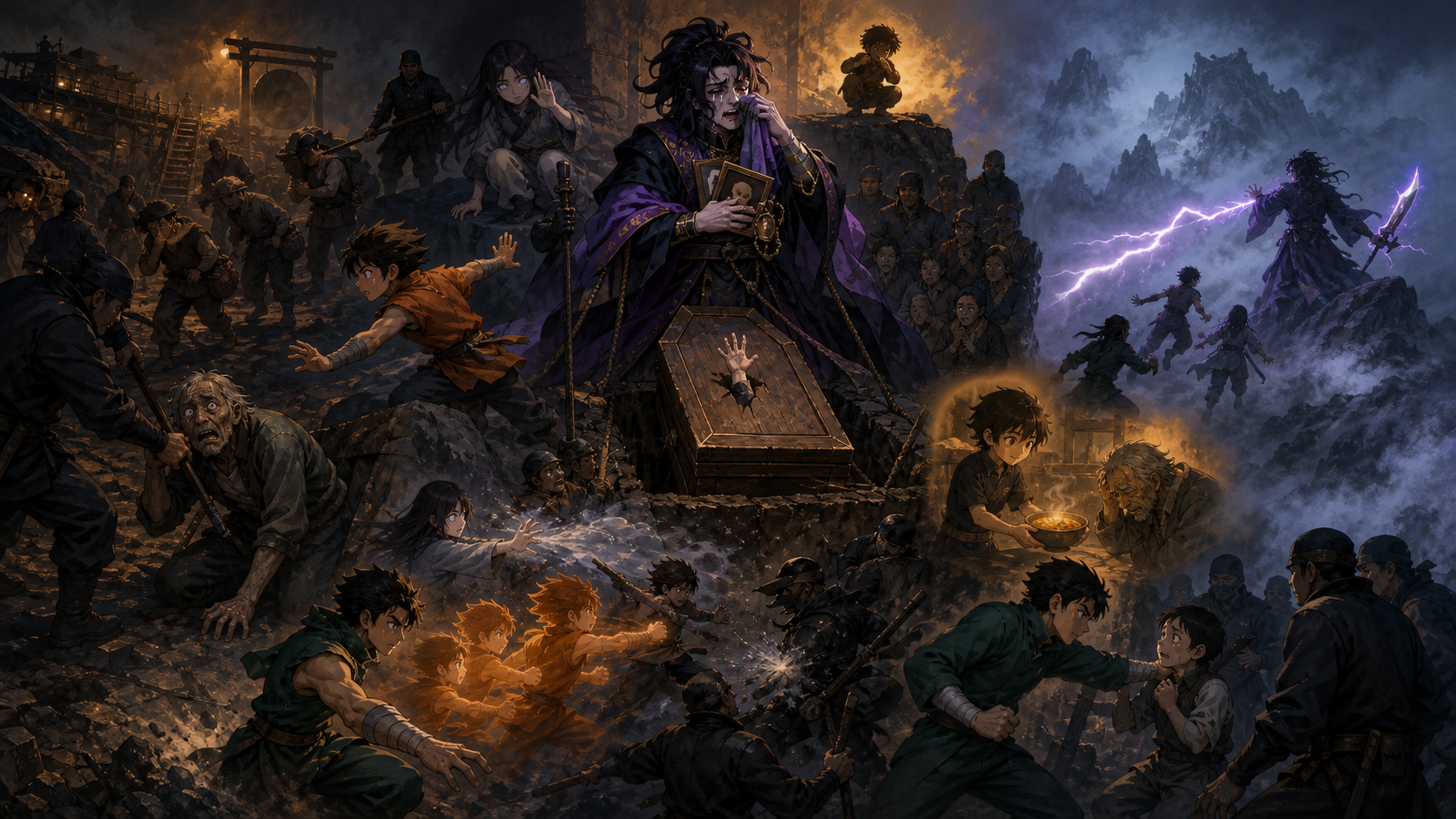
A Lesson Learned! The Iron Fist of Love!
Raiga buries living people while performing grief, and Lee answers Karashi’s borrowed fear with the memory of strength expressed through care.
Rokusuke reaches Katabami Gold Mine ahead of the Konoha team and runs straight to the cemetery. He is not there to mourn. One of his friends was buried alive, and Rokusuke digs with the desperate hope that he is not too late.
The Kurosuki Family finds him before he can finish. They surround him, drag him to Raiga, and turn his attempted rescue into the reason for another execution. Raiga announces that Rokusuke will receive a funeral of his own.
At Katabami, that does not mean waiting for death. Raiga likes to bury people while they are still breathing.
Episode 153 gives the Kurosuki Family's rule a face, and it is stranger than ordinary greed. The gang controls the mine through labor and fear, but Raiga wants more than obedience. He wants to cast himself as the loving mourner at every death he causes. His victims lose their lives, their voices, and even the right to name what happened to them.
Katabami Works Under Threat
Naruto, Lee, Neji, and Tenten approach the mine carefully. Neji wants information before the team commits to a fight, so they watch the settlement from cover. Below them, residents carry heavy loads while Kurosuki men supervise with the confidence of people who believe no one will challenge them.
The rocks do not look like gold to Naruto. Lee explains that the valuable metal has to be separated through processing. The detail makes the occupation feel brutally practical. Raiga's men are not terrorizing the settlement as a hobby on the side. They are forcing people to produce wealth for them, then using that stolen wealth and the threat of death to keep the system in place.
An elderly miner collapses under his load. The guards do not offer water, rest, or concern. They order him back to work.
Naruto is ready to jump down immediately. This is the outward attention Episode 152 was waiting for. At the mission briefing, three injured petitioners could not hold his interest until Raiga became a possible link to Kisame, Itachi, and Sasuke. Now Naruto can see the abuse happening in front of him, and the mine is no longer valuable only as a source of information.
Neji orders him to wait. The team still does not know how many gang members are nearby or where Raiga is positioned. Lee breaks cover first.
It is not the cautious choice, but it is completely Lee. He drops into the work area and puts the guards down before their cruelty can continue. The others join him, and the immediate threat disappears.
The old miner does not thank them. He asks them to knock him out too.
Rescue Does Not Erase Fear
His reaction is one of the episode's most honest details. The arrival of four capable shinobi does not instantly undo years of terror. The miner knows what Raiga does to people accused of resistance, and he does not yet know whether these strangers will still be standing when Raiga answers their attack.
If they leave or lose, he will remain. So will his family and neighbors. Being seen near the people who fought the Kurosuki Family could be enough to condemn him.
Then a gong sounds across the mine.
The miner explains that it is Raiga's funeral bell. Anyone Raiga calls a traitor may be placed in a coffin and buried alive. The cruelty is made public so everyone understands the price of disobedience.
The gang's language keeps trying to reverse reality. Forced labor is called protection. Execution is called a funeral. Fear is presented as respect. Even Raiga's tears become part of the machinery.
When the team learns that Rokusuke has been captured, the reconnaissance phase ends. They hurry toward the cemetery before the grave can be closed.
Raiga Mourns the People He Kills
Rokusuke's coffin is carried before Raiga, who cries as if the death were an unavoidable loss. He recalls memories, speaks with affection, and treats the gathering as proof that he understands the value of a life.
He is the person ending that life.
That contradiction is the center of Raiga's horror. He does not deny the victim's humanity. He borrows it for his own performance. His memories let him feel sentimental, and his tears let him imagine himself as compassionate, while Rokusuke struggles inside a box because he tried to save someone else.
Raiga's funerals are not only punishment. They are theft. He decides when a person will die, what their death will mean, and whose emotions will matter at the grave. The victim cannot object once the coffin closes. Everyone else must watch Raiga become the most visibly sorrowful person at a murder he ordered.
Someone hidden nearby helps him maintain that control. A child's voice warns Raiga that enemies are approaching. The watcher can sense the Konoha team without stepping into view, giving Raiga an advantage that Neji does not yet understand.
Neji activates the Byakugan and confirms what the funeral audience is meant to ignore: Rokusuke is alive inside the coffin. The team attacks.
The Funeral Breaks Apart
Smoke disrupts the ceremony, and the Konoha shinobi move through the Kurosuki guards. Tenten meets their weapons with her own practiced range. Neji closes down opponents with the Gentle Fist. Naruto fills the cemetery with shadow clones and drives through the gang with the kind of noisy force that makes concealment impossible. Lee handles his share at close range.
The staged solemnity disappears as soon as someone refuses to follow its rules. Raiga's mourners are armed guards. The funeral party is an execution crew. Once the team fights back, there is no dignity left for the gang to hide behind.
One frightened member remains near the graves. Lee moves to strike, then recognizes him.
It is Karashi, Sansho's son.
Karashi insists that joining the Kurosuki Family made him strong. He wanted protection from people who bullied him, and now he stands inside the group everyone else fears. To him, that is proof that his choice worked.
Lee sees the opposite.
Lee Remembers the Curry
Lee tries to reach Karashi through the memory they share. During Lee's training with Guy, Karashi helped make the Curry of Life that restored him when he had collapsed. His hands created something for an exhausted stranger. He took part in an act of care that helped Lee stand again.
That was strength.
Karashi's gang uniform has not made him braver. It has taught him to shelter behind Raiga's reputation and participate in frightening people who cannot fight back. He has traded the risk of being kind for the safety of belonging to the bullies.
Karashi refuses to hear the distinction. Naruto is ready to hit him, but Lee gets there first. The title's iron fist of love is not subtle, and it should not be mistaken for the whole lesson. The important part comes before the punch: Lee tells Karashi exactly when he saw real strength in him.
Lee does not praise Karashi for winning a fight or intimidating a miner. He remembers a bowl of curry. He remembers being helpless and receiving help.
That memory cuts through the gang's entire definition of power. Raiga needs an occupied town, armed followers, and a silenced victim to feel important. Karashi once needed a kitchen and the decision to care whether a stranger recovered.
After Lee knocks him down, Karashi appears to apologize. The team frees Rokusuke before the burial can be completed. For one moment, the mission has delivered exactly what it promised: the prisoner is alive, the local guards are defeated, and Karashi seems willing to come back.
Neji knows the real enemy has not gone far.
The Byakugan Meets a Blind Spot
Neji detects a watcher above the cemetery, and the team follows into the mountain. Mist closes around them. Lee remembers that shinobi from the Hidden Mist are especially skilled at disappearing inside it, but ordinary concealment should not defeat the Byakugan. Neji does not rely only on visible outlines. He can read chakra pathways and locate living bodies through barriers.
This time, he finds nothing reliable.
The hidden child explains the problem to Raiga. Neji can see a person's chakra or life energy, but the child's own perception is stronger. Working together, Raiga and this unseen partner can hide where the Byakugan normally exposes.
That is a serious shift for the team. Neji has been the mission's source of certainty, the person who checks what waits beyond cover and slows everyone else's impulses with better information. In the mist, his best tool can be deceived.
Raiga draws two swords. Lightning gathers around the blades and tears toward the Konoha shinobi before they can locate him.
Episode 153 ends there, with one rescue completed and the larger fight finally revealed. Naruto came to Katabami hoping a former Seven Swordsman might point him toward Sasuke. Instead, the first lesson belongs to Lee: strength is not measured by how much fear surrounds you. It is measured by what you do when another person is at your mercy.
Raiga has built a town around the wrong answer. Now the team has to find him in a mist designed to make sure he never has to face the right one.
Raiga turns mourning into permission to kill
He performs grief over people who are still alive, then treats the funeral as proof that their deaths have already been decided. The ritual steals the victim’s voice twice. Rokusuke is denied the right to live and denied the right to define what his life means. Raiga’s tears do not soften the violence. They center the killer’s feelings while the person inside the coffin struggles to breathe.
A living funeral is psychological control for the whole town
The ceremony targets more than one prisoner. Every worker watching learns that Raiga can declare a person socially dead before completing the murder. The gong, procession, coffin, and public grief turn terror into routine. Residents are forced to rehearse obedience through someone else’s burial. That is how occupation continues even when gang members cannot stand beside every miner at once.
Rokusuke’s return shows courage and the cost of desperation
He slips away from trained escorts because Kanpachi remains in danger. The decision exposes him to capture, yet it also proves he never left Katabami simply to save himself. He crossed the river and reached Konoha to bring help back. A responsible rescue should honor that commitment while giving civilians safer roles than walking alone into the gang’s cemetery.
Neji verifies life inside the coffin before the team attacks
Byakugan changes the intervention from an emotional guess into confirmed rescue. Neji can see that Rokusuke is alive and identify where immediate force can help rather than crush the prisoner beneath debris. This is why reconnaissance matters. Naruto’s anger is justified, but Neji’s information determines how that anger can move without causing the death everyone is trying to prevent.
Naruto’s outrage belongs beside a civilian-protection plan
Watching guards abuse miners should make him furious. A mine full of exhausted workers also leaves little margin for uncontrolled combat. Shadow clones can separate enforcers from civilians, open exit routes, and create shields before pursuing the loudest opponent. Anger becomes useful when it protects the people whose suffering produced it.
Forced labor continues the protection racket’s logic
The Kurosuki Family claimed it would guard a valuable mine, then turned workers into a captive source of wealth. Violence keeps production moving for someone else’s benefit. Removing Raiga is essential, but liberation also requires ending the gang’s control over food, movement, wages, and access to the outside. A village is not free merely because its most visible abuser leaves the gate.
Lee intervenes when an older worker collapses
He does not need a personal connection before abuse becomes his concern. Lee sees a body pushed beyond its limit and recognizes that strength should interrupt harm rather than enforce it. That response makes his later conversation with Karashi credible. He is not preaching kindness as an abstract virtue. He has already placed himself between power and a person being crushed by it.
Karashi borrowed safety from the people making everyone unsafe
Joining the gang gave him proximity to strength and temporary protection from being targeted. The cost was helping the organization target others. Recruitment through fear creates real pressure, especially for someone shaped by bullying. It still requires a path toward accountability. Karashi cannot recover by insisting he was weak, and the village cannot recover by deciding weakness makes him permanently disposable.
Lee remembers Karashi’s care as evidence of another kind of strength
Serving curry to an exhausted stranger required attention, effort, and the willingness to help without dominance. Lee names that memory because it predates the gang’s definition of power. He gives Karashi an identity to return to rather than only describing the person he should stop being. Recovery often needs a concrete memory of capability outside the harmful group.
The iron fist of love needs more than a blow
A punch can interrupt immediate violence or shock Karashi out of rehearsed loyalty. It cannot complete rehabilitation. Love needs boundaries, truthful acknowledgment of harm, protection from retaliation, and work to repair trust with residents. If the story reduces care to hitting someone until they remember goodness, it risks repeating the same equation between force and belonging that drew Karashi toward the gang.
Sansho’s welcome should not require silence from harmed neighbors
A mother can want her son home while other residents remain angry about what he helped enforce. Both realities deserve space. Reintegration should not make victims swallow their experiences to prove compassion. Karashi can receive shelter and a chance to change while listening to what people need before they feel safe sharing a town with him again.
Raiga’s grief is performance because it refuses consent
Genuine mourning listens to the person lost and supports the people who loved them. Raiga decides who will die, stages the meaning, and cries for his own experience of the event. The emotion may feel sincere inside him, but sincerity does not make the relationship mutual. Feeling deeply while controlling every other person remains domination.
Ranmaru’s hidden presence changes the battle’s information balance
Neji enters the mist expecting Byakugan to provide the superior field picture. Another unseen child can interfere with what he perceives and help Raiga target the squad. The danger is not simply a stronger sword. It is false confidence in a trusted sensing system. Teams need secondary confirmation whenever one technique becomes the sole foundation of their map.
The mist protects an unequal partnership
Raiga moves through the battlefield while Ranmaru remains concealed and physically dependent. Their connection may contain genuine care, yet the arrangement also places a child inside lethal conflict as the adult’s hidden advantage. Protection cannot be measured only by affection. It must include whether the more powerful person reduces the dependent partner’s exposure to harm rather than building strategy around it.
Neji’s failure to see clearly should not be treated as personal collapse
A countermeasure has altered the information available to him. The correct response is to report uncertainty, narrow formation, and combine Byakugan with Tenten’s tools, Lee’s hearing and movement, and Naruto’s distributed observation. Expertise includes recognizing when conditions have compromised the expert. Pretending certainty would place everyone at greater risk.
Tenten’s preparation matters most in terrain that denies sight
Tools can mark routes, test suspicious areas, carry lines across gaps, and force an unseen opponent to reveal movement. Her role should not shrink to standing behind two Byakugan users and Naruto. The mist creates a problem where controlled distance and prepared equipment can become the squad’s most reliable information source.
Raiga opens with lightning in a wet, obscured environment
The terrain magnifies uncertainty and may magnify danger to everyone nearby. Civilians, metal tools, soaked ground, and limited visibility turn an attack into a broad hazard rather than a clean duel. The team needs spacing and a retreat route before pursuing information about the Seven Ninja Swordsmen. Protecting Katabami remains the mission even when Raiga makes the confrontation personal.
Naruto cannot interrogate a connection if the squad dies chasing it
His interest in Raiga partly comes from the possible route through Kisame and Itachi toward Sasuke. Lightning, mist, and concealed support should force that secondary objective back into proportion. Capture and questioning may be useful if safely possible. Civilian rescue and team survival cannot be gambled for a rumor whose chain of information may end immediately.
The episode distinguishes strength that feeds fear from strength that restores choice
Raiga uses power to decide who lives, who mourns, and what the town must produce. Lee uses power to interrupt abuse and remind Karashi that another identity remains available. The physical techniques may both hurt, but purpose and accountability separate them. Protective force creates room for other people’s choices. Domination closes every choice except obedience.
RaeRae’s full take
Raiga crying over a living person’s funeral does not make him tender. It makes him the only person allowed to have feelings in a scene he created through terror. Rokusuke cannot consent, object, or tell his own story from inside the coffin. The performance is violence wearing mourning clothes.
Lee’s answer to Karashi works because he remembers something specific. Karashi once fed an exhausted stranger. That act required more courage than hiding behind a gang that bullies the whole town. I want the story to keep going after the punch, though. Coming home needs accountability, safety for the people he harmed, and a real way to live without borrowed fear.
The mist is the warning at the end. Neji’s sight can be challenged, and Raiga has help the team has not identified. Naruto must stop treating every possible Sasuke connection as permission to run ahead. Katabami asked for liberation. That promise comes first.
RaeRae checkpoint: Raiga’s tears center the killer while a living victim lies in the coffin. Lee offers Karashi a stronger memory: care once made him useful without making anyone afraid.
Watch Naruto Episode 153
- [Naruto Official episode guide](https://naruto-official.com/en/anime/naruto1/list/01_377)
- [Watch “A Lesson Learned: The Iron Fist of Love!” on Crunchyroll](https://www.crunchyroll.com/watch/G6P81GZ56/a-lesson-learned-the-iron-fist-of-love)
- [Browse official Naruto viewing options from VIZ](https://www.viz.com/anime/tv-show/naruto-video/video-unit/1)
Receipts and official routes
- Episode number, licensed title, and official synopsis: Naruto Official Site.
- Japanese title, synopsis, and September 28, 2005 broadcast record: TV Tokyo.