
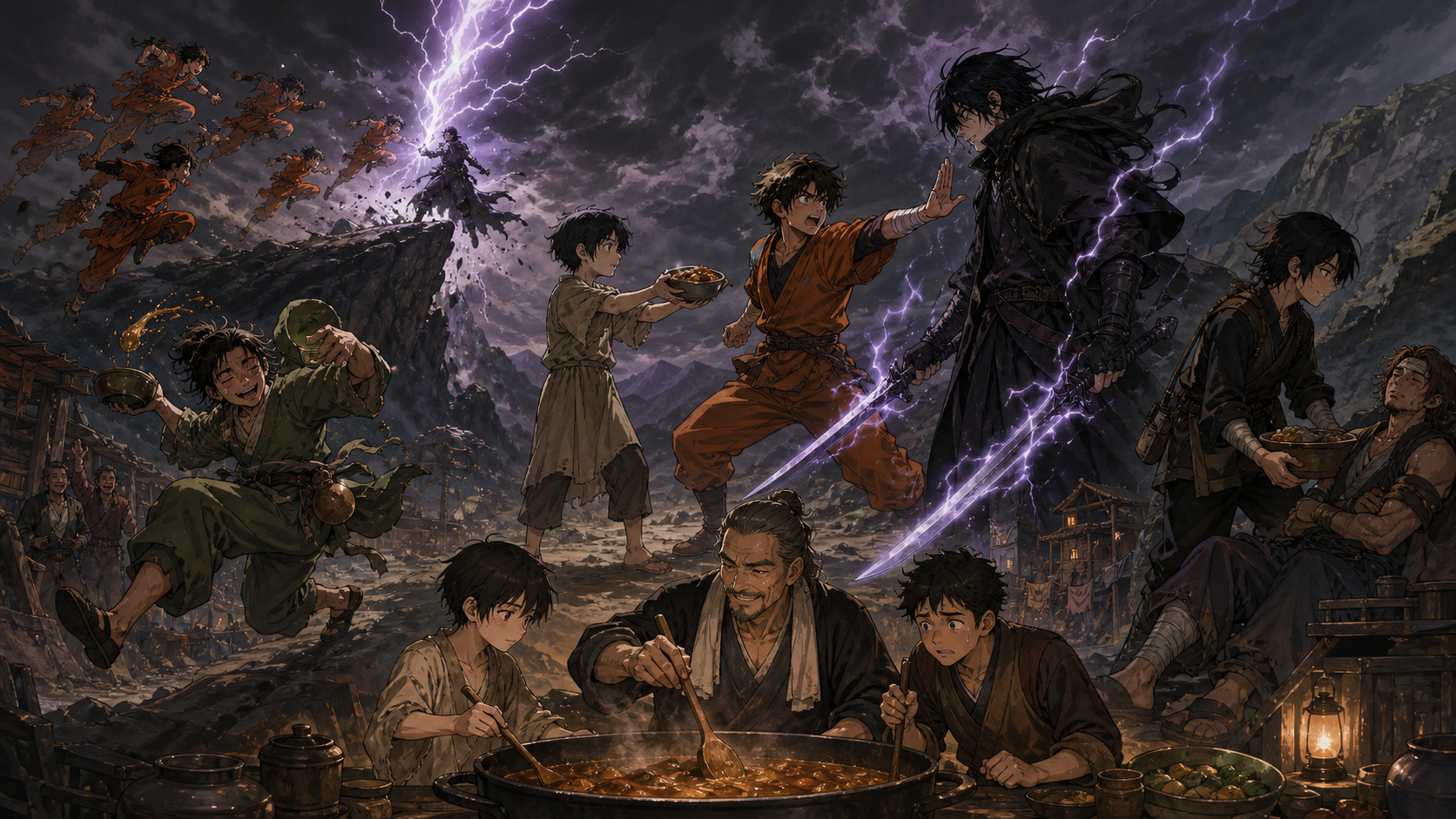
Run! The Curry of Life!
Ranmaru finally asks Raiga to stop, forcing their bond to face the difference between care and control as Katabami’s mission ends.
The Kurosuki Family Removal Mission ends with a pot of curry, an accidental bottle of wine, one terrible murder-suicide plan, and Raiga discovering that he only liked Ranmaru's devotion while it came without an independent opinion.
That is a lot for one bowl to carry.
Episode 157 reaches the right conclusion through a finale that cannot decide whether it wants tragedy or slapstick. Ranmaru finally asks Raiga to stop hurting people and accept care from someone besides him. Raiga calls that betrayal. The emotional point lands. Then drunken Lee flies through the fight, Neji reacts to curry like it killed him, and the episode asks the serious material to share space with a food gag stretched to its limit.
The mess does not erase what works. It just makes the good parts fight harder for air.
Lee Keeps Standing for Guy
Lee faces Raiga alone at Lightning Pass while Naruto and Neji are down. Raiga cannot understand why an injured kid keeps getting back up, so Lee gives him the answer he gives everyone: he wants to become strong enough that Guy can look at him with pride. That is his ninja way.
Raiga hears devotion and immediately imagines a funeral. He tells Lee that Guy can mourn all his hard work after he dies.
The exchange places two forms of attachment side by side. Lee's love for Guy pushes him to develop his own discipline, defend teammates, and become a fuller person. Raiga's bond with Ranmaru demands that the boy remain an extension of him. One teacher wants his student to surpass limits. One partner wants his companion to stay useful and dependent.
Raiga summons Thunder Dragon Tornado. The storm takes a massive dragon shape, engulfs Lee, and sends him off the pass.
Sansho, Karashi, Tenten, and Ranmaru are racing uphill with the Curry of Life when they find him below.
The Curry Works, Sort Of
Sansho gets curry into Lee while Tenten and Karashi carry portions toward Naruto and Neji. Naruto wakes with his strength restored and his mouth basically on fire. Neji does not recover. His body responds to the curry by dropping even deeper into unconsciousness.
Lee wakes too, but something is wrong. His movements loosen, his attention wanders, and his behavior becomes familiar to anyone who remembers his fight with Kimimaro.
A bottle of wine fell into the curry pot.
Lee is absurdly sensitive to alcohol, so the life-saving meal has brought back Drunken Fist Lee. He is fast, unpredictable, and almost impossible for an opponent to read. He is also a walking tonal problem in an episode trying to resolve a story about exploitation, guilt, and suicidal dependence.
The gag is funny in isolation. Neji appearing nearly dead because the curry is too spicy is funny in isolation. Together, they drain urgency from a battle where Ranmaru is deciding whether his life belongs to him.
The Curry of Life works better as an idea than as a medical system. Sansho, Karashi, and Tenten made and carried it together. It represents care that does not demand the recipient become anyone's weapon. Ranmaru tasted that care and chose to bring it to Raiga.
Unfortunately, he tries a much worse plan first.
Ranmaru Still Thinks Atonement Means Dying
Ranmaru returns to Raiga and claims the Leaf shinobi are dead. He offers to become Raiga's eyes again, creates fog, and guides him toward a cliff.
Raiga believes they are restoring the old arrangement. Ranmaru appears to intend a shared fall.
It is not freedom. It is the same dependency wearing the clothes of repentance. Ranmaru still imagines that every meaningful ending must include Raiga. If helping Raiga live was wrong, then perhaps dying with him will balance the scale.
Tenten already told him why that fails. The people buried by Raiga did not choose death. Ranmaru cannot repair their stolen futures by throwing away his own. Atonement requires him to remain alive long enough to act differently.
Before he reaches the cliff, drunken Lee attacks.
Raiga activates Thunder Armor and survives blows that would normally finish the fight. Lee's erratic movement creates openings, but Raiga eventually knocks him down and prepares to kill him.
Naruto arrives with shadow clones and protects Lee. Raiga's lightning tears through the crowd, but the interruption gives Ranmaru another chance to speak.
This time, he tries something better than dying.
Eat the Curry and Stop Hurting People
Ranmaru asks Raiga to stop. He wants him to eat the Curry of Life and understand that he is not alone. Sansho and Karashi put their effort into the food. Tenten carried Ranmaru to safety. Naruto promised to help him walk. A wider circle of people cared whether he survived without asking for his supernatural sight in return.
Ranmaru wants Raiga to feel that too.
It is a small demand with enormous consequences: eat, accept help, and stop killing.
Raiga refuses. He tells Ranmaru that he is supposed to be his eyes and ears. If Ranmaru brings his own judgment into the relationship, they can no longer be two people in one.
There it is. Raiga does not fear losing Ranmaru's affection. He fears Ranmaru becoming a separate person.
Ranmaru pushes further. If they truly are one person, then Raiga should strike him. Killing Ranmaru would destroy the strong Raiga who depends on him. The challenge exposes the contradiction, but it also places Ranmaru back in danger as proof.
Naruto refuses to let the lesson cost Ranmaru's life. He condemns Raiga for trying to kill the friend who sacrificed himself to revive him and tells Ranmaru to stop planning deaths, including his own.
Ranmaru has other friends now. He is free.
Raiga Only Wanted One Kind of Loyalty
Raiga hears that Ranmaru formed other attachments and treats it as abandonment. Their bond worked for him when Ranmaru had no one else, no movement without him, and no moral boundary Raiga had to respect.
The moment Ranmaru says they should stop hurting people, Raiga calls him selfish.
That reaction clarifies the entire arc. Raiga did rescue Ranmaru from a lonely room. He also built a relationship in which gratitude had to remain permanent obedience. He gave the boy access to the outside world while making sure that world stayed full of enemies, victims, and people who could never compete with their exclusive pair.
Ranmaru's new friends threaten him because they prove care can expand rather than close around two people like a locked door.
Naruto briefly tries one last time to salvage the mission's Sasuke lead. He asks Raiga about Kisame. Raiga says he hates Kisame and every other member of the Seven Ninja Swordsmen. He offers no location, no contact, and no useful path to Itachi.
The lead is dead. Naruto still fights.
That matters because Episode 152 began with him reluctant to help Katabami until Raiga appeared useful. By the finale, Raiga has nothing Naruto wants except the ability to stop hurting the people in front of him.
Raiga Chooses His Own Funeral
Naruto attacks with clone-assisted kicks and body slams, driving Raiga over the ledge. As he falls, Raiga tells Ranmaru he is free.
Then he calls lightning down on himself and asks the thunder for his funeral.
Raiga dies inside the ritual he forced on everyone else, but the symmetry should not be mistaken for justice delivered by the sky. This funeral is the one death in the arc he chooses for himself. His victims received no such control.
Ranmaru survives. That is the more important ending.
Katabami is free of the Kurosuki Family, and Ranmaru stays at Sansho's shop beside Karashi. Both boys begin training to make the Curry of Life. Sansho makes it clear that Karashi's return did not complete his redemption. He starts again from the beginning, and Ranmaru joins him.
Their future is ordinary on purpose. They will stir pots, learn recipes, feed travelers, and be corrected by a woman who does not confuse love with indulgence. Ranmaru can help people without becoming an organ attached to one man. Karashi can build strength through useful work instead of borrowed fear.
Naruto, Lee, Neji, and Tenten leave for Konoha. Sansho offers them one final curry so spicy that the team suddenly remembers how urgently Tsunade expects them home.
The comedy gets the last word, because of course it does.
Episode 157 does not make every part of the arc work. The wine gag barges through the climax, Karashi's consequences remain light, and Ranmaru's shift happens fast. Yet the finale gets one thing exactly right: Raiga calls independence betrayal because he never wanted two lives joined by care. He wanted one life controlling another.
Ranmaru walks away from that definition. For now, he walks with help. The point is that one day, he may choose the direction himself.
Lee keeps fighting because loyalty has become muscle memory
His injured body continues toward Raiga while his mind holds onto Guy’s example. That determination is moving, but the Thunder Dragon Tornado proves devotion does not cancel physical limits. Lee being swallowed by the attack should trigger rescue, not admiration for how long he remained upright. A team protects the person whose courage makes stopping difficult.
The Curry of Life functions as community medicine, not a miracle cure
Sansho brings food through dangerous terrain because nourishment is the form of care she knows how to provide. The curry can restore energy and warmth, but it cannot erase lightning injuries or replace medical evaluation. Its narrative power comes from people carrying help toward one another, not from pretending a recipe removes every consequence of combat.
Accidental wine changes Lee’s movement without making impairment safe
Drunken Fist gives him an unpredictable pattern Raiga struggles to read. The tactical benefit is real inside the scene. Lee still cannot consent to intoxication when the ingredient was accidental, and the team cannot plan around impaired combat as a routine weapon. Afterward he needs monitoring, hydration, and protection from being encouraged to repeat a dangerous state for entertainment.
Neji’s response to the spice is comic and still deserves care
The curry affects teammates differently. One recipe cannot be assumed safe because it revives Naruto or changes Lee’s fighting style. Sansho and Tenten should know who can tolerate it, how much was served, and what symptoms require attention. Community care becomes stronger when enthusiasm leaves room for individual bodies.
Tenten carries supplies after already carrying the arc’s heaviest care work
She fought Raiga alone, recovered Ranmaru, challenged his death wish, and now helps bring nourishment to injured teammates. Those actions make her operationally central. The episode should not treat delivery as a lesser assignment than landing the final blow. Moving medicine through a storm can decide who remains alive long enough to fight.
Karashi’s running becomes a visible act of repair
He previously used movement and local knowledge to lead the team into danger. Now he helps carry the correct curry toward the people harmed by Raiga’s return. One reversal does not erase his choices, but it gives the village evidence of change. Accountability becomes credible through repeated helpful actions performed when returning to the gang would be easier.
Ranmaru first imagines atonement as dying with Raiga
His plan for a shared fall repeats the belief that his life has no independent value. He wants to stop Raiga and accepts self-destruction as the price because the relationship still defines the limits of his imagination. Tenten and Sansho have shown him another form of responsibility: remain alive, interrupt harm, and do repair that continues beyond one dramatic sacrifice.
Asking Raiga to stop is harder than following him into death
Ranmaru finally states an independent judgment. He offers food, names the damage, and asks the adult he loves to choose a different life. That request risks rejection without guaranteeing the clean emotional ending of mutual sacrifice. Independence begins here, in the willingness to disappoint the person whose approval once determined whether Ranmaru believed he deserved to exist.
The curry invitation gives Raiga a concrete alternative
Ranmaru does not only say “stop.” He offers a meal and a community where neither of them has to continue ruling through fear. Sansho’s shop cannot erase murder or occupation, and Raiga would still face accountability. The invitation matters because it makes change imaginable as daily practice rather than a vague demand to become good immediately.
Raiga calls independent care betrayal
When Ranmaru no longer mirrors his desire, Raiga treats the child’s judgment as abandonment. That response reveals the condition beneath their bond. Ranmaru was cherished while functioning as Raiga’s eyes, certainty, and emotional confirmation. Love that cannot tolerate the other person saying no is control with affectionate language wrapped around it.
Naruto protects Ranmaru’s right to separate
Standing between the child and Raiga matters more than winning an argument about their past. Ranmaru has asked for the violence to end. Naruto’s job is to make that refusal physically survivable. This is one of the clearest ways his memory of Haku can shape better action: do not let another child remain useful to an adult at the cost of a future.
The fight should not make Ranmaru prove his innocence through danger
He has already transferred nearly all his chakra, traveled while feverish, and confronted Raiga. The team should not demand another sacrifice before accepting that his choice changed. Protection must arrive before perfect redemption. Otherwise the new community repeats the old rule that Ranmaru earns belonging only by spending his body for someone else.
Naruto’s lack of a Kisame lead closes the secondary objective honestly
Raiga does not provide the route Naruto hoped would connect him to Itachi and Sasuke. That disappointment should remain separate from whether Katabami was worth saving. The mission succeeded in freeing residents and helping two recruits find a path out. Human value cannot be calculated by how much intelligence a rescued village produces for Naruto’s private search.
Raiga’s final lightning funeral remains his own choice
After Naruto drives him toward defeat, Raiga calls the storm onto himself during the fall. Ranmaru does not cause that decision by asking him to stop. Naruto does not cause it by protecting the child. Raiga chooses a death that preserves control over the final scene rather than accepting accountability or a relationship no longer organized around obedience.
The story should not romanticize the suicide as reunion
Raiga’s attachment to funerals and his refusal of change can make the ending look tragically poetic. The people of Katabami experienced his power as terror. Ranmaru experiences the final rejection as loss. Naming the death clearly prevents the aesthetic of lightning and falling from erasing the harm that preceded it or placing responsibility on the child who survived.
Katabami’s freedom needs more than the villain’s absence
The mine must establish local governance, safe labor conditions, routes for communication, and support for residents affected by the living funerals. Remaining Kurosuki members need individual review rather than automatic execution or automatic pardon. Konoha should schedule follow-up instead of treating Raiga’s fall as proof that every structure of occupation vanished with him.
Ranmaru joining the curry shop changes the scale of belonging
His old world contained one person and one purpose. Sansho’s shop contains customers, work, recipes, disagreement, and care that does not depend on supernatural sight. Ordinary community may feel smaller than battlefield devotion, but it offers many relationships instead of one totalizing bond. That variety is part of safety.
Karashi and Ranmaru should not be made responsible for each other’s recovery
Training together can reduce isolation, yet both are early in leaving harmful loyalties. Sansho and the village must remain the adult structure around them. If either relapses, the other should not carry sole blame or rescue duty. Peer companionship helps most when dependable adults hold the boundaries neither young person can maintain alone yet.
The curry shop apprenticeship creates measurable accountability
Preparing food requires showing up, following sanitation and safety rules, serving people consistently, and receiving correction without violence. Those routines give Karashi and Ranmaru daily ways to build trust. Repair becomes observable over time instead of resting on one emotional promise made after a battle.
The mission succeeded even without helping Naruto find Sasuke
Katabami is no longer ruled by the Kurosuki Family. Rokusuke returns, workers can begin reclaiming the mine, Karashi has a supervised path toward amends, and Ranmaru survives outside Raiga’s control. Those outcomes matter independently. Naruto needs to learn that a mission can fail his private hope and still be worth every step.
RaeRae’s full take
Ranmaru asking Raiga to stop is the real climax. Dying beside him would have repeated the old bond. Living long enough to disagree creates something new. The curry is not absolution. It is an invitation to sit down, be fed, and face what comes next without making another child pay for your feelings.
Raiga’s answer confirms the problem. He accepts Ranmaru while Ranmaru completes him. The moment the child develops an independent moral judgment, Raiga calls it betrayal. That is control, no matter how sincere the grief sounds.
I want the ending at Sansho’s shop to stay ordinary. Karashi and Ranmaru learn recipes, serve people, make mistakes, and return the next day. After an arc full of living funerals and grand sacrifice, daily responsibility is the braver life.
RaeRae checkpoint: Ranmaru’s ninja way begins when he asks Raiga to stop and survives the refusal. Katabami gives him a wider community where care no longer depends on becoming one adult’s missing body part.
Watch Naruto Episode 157
- [Naruto Official episode guide](https://naruto-official.com/en/anime/naruto1/list/01_381)
- [Watch “Run! The Curry of Life!” on Crunchyroll](https://www.crunchyroll.com/watch/GR09Q3E2R/run-the-curry-of-life)
- [Browse official Naruto viewing options from VIZ](https://www.viz.com/anime/tv-show/naruto-video/video-unit/1)
Receipts and official routes
- Episode number, licensed title, and official synopsis: Naruto Official Site.
- Japanese title, synopsis, and October 26, 2005 broadcast record: TV Tokyo.