
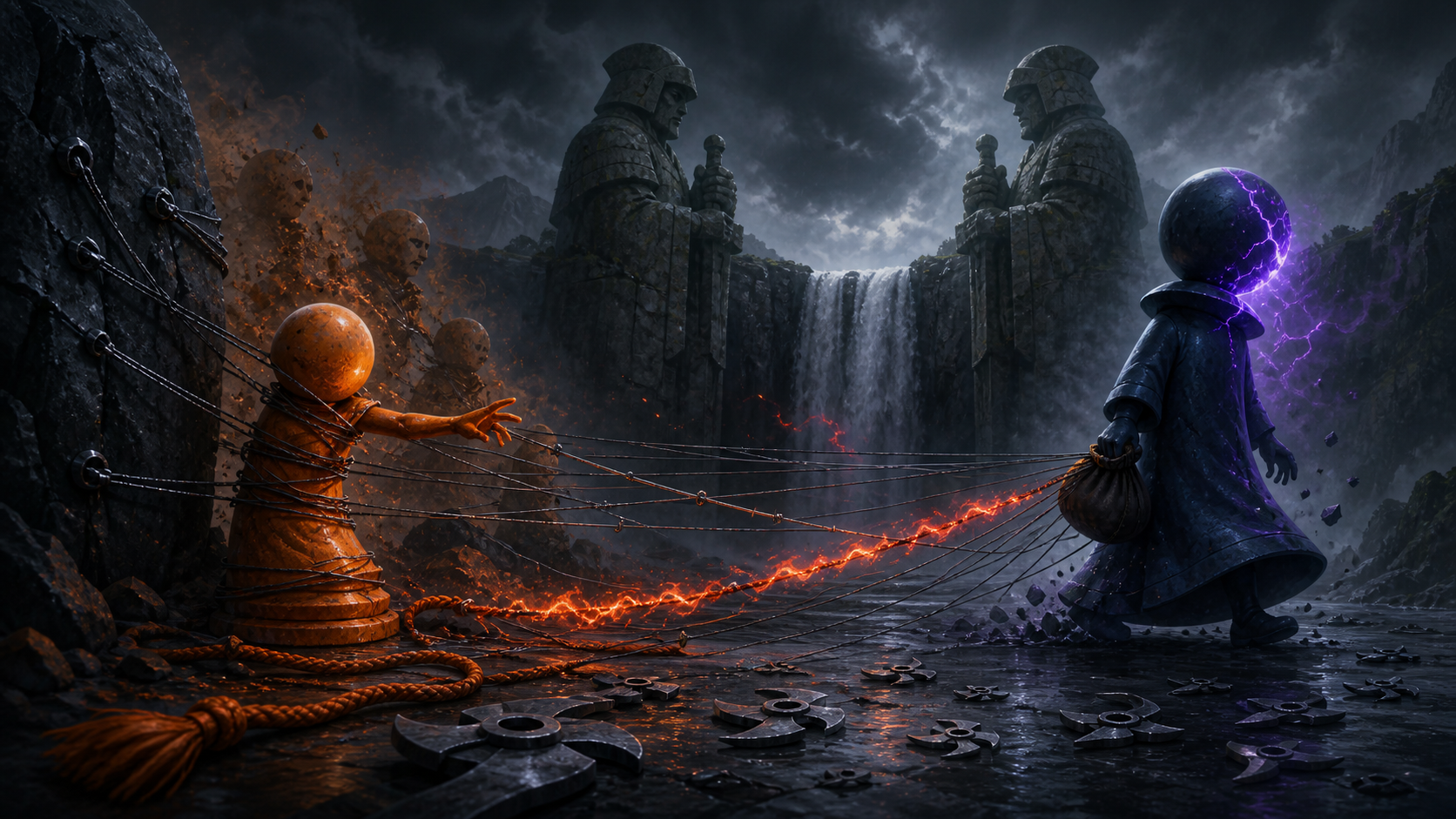
A Cry on Deaf Ears
Naruto reaches Sasuke and learns the departure is deliberate, then Sasuke turns stolen tools, wire and fire against the bond holding on.
RaeRae Reacts
Episode 128 finally removes every carrier, container and enemy standing between Naruto and Sasuke.
The truth is worse without them.
Sasuke is not waiting to be rescued.
He says he will abandon everyone in Konoha for power, turns his back and uses the curse mark to enforce that choice.
Naruto argues that people care.
Sasuke treats caring as the chain he needs to cut.
Then he steals Naruto's weapon pouch, defeats his clones, outthrows him with shuriken and uses Naruto's own wire to bind him to a rock before setting it on fire.
That is not mind control.
It is a deliberate answer delivered through superior skill and borrowed power.
Naruto's cry falls on deaf ears because Sasuke already decided what bonds mean.
The Valley Leaves Them Alone Together
Naruto catches Sasuke at the Valley of the End.
No Sound Four remain between them. Kimimaro is dead. Naruto's teammates lie scattered behind the pursuit, and nobody stands beside him to absorb another delay.
The mission has reached its simplest and hardest form.
One boy wants to leave.
One refuses to let him.
The statues above them make the place more than a dramatic arena. Hashirama Senju and Madara Uchiha represent another bond that became world-shaping conflict.
Naruto Asks the Question Directly
Naruto asks whether Sasuke will truly turn his back on everyone in Konoha just to become stronger.
Sasuke says yes.
There is no hesitation and no request for understanding.
Naruto expected resistance, anger or evidence that Orochimaru's people forced the decision. A clear yes removes the comforting version where opening the container completes the rescue.
Sasuke chose this route because revenge against Itachi has become the only future he considers meaningful.
Konoha offers teammates, teachers and people waiting for him.
Orochimaru offers power without asking him to heal first.
Sasuke chooses the offer that serves the past.
Then he begins walking away again.
Naruto's Argument Is Care
Naruto cannot understand how Sasuke dismisses the people behind him.
Sakura begged Naruto to bring him back. Kakashi tried to warn Sasuke about revenge. Choji, Neji, Kiba, Akamaru and Shikamaru risked their lives along the route.
Naruto reads that effort as proof.
You matter.
You have a home.
You are not alone enough to surrender yourself to Orochimaru.
The argument comes from Naruto's own survival. Recognition and connection pulled him away from the isolation that once defined his life.
He assumes the same answer should reach Sasuke.
Sasuke hears something else.
Every bond is another voice asking him to delay revenge.
Sasuke's Dream Lives in the Past
Sasuke does not imagine his dream as a future he can build with Team 7.
It exists behind him, in the night his clan died and the brother he intends to kill.
That orientation explains why ordinary appeals fail.
Naruto talks about everyone waiting at home.
Sasuke measures whether home moves him closer to Itachi.
Friendship, village loyalty and even safety become distractions if they soften hatred or redirect time toward a life not organized around revenge.
Orochimaru's manipulation succeeds because it agrees with Sasuke's premise. It does not ask whether revenge should define him. It promises tools that might make revenge possible.
Naruto is trying to change the premise while Sasuke is already evaluating weapons.
They are not having the same conversation.
Naruto Throws the First Punch
Sasuke turns away, and Naruto grabs him.
The punch echoes across the valley.
Naruto wants impact to accomplish what words did not. If Sasuke will not acknowledge the people waiting for him, Naruto will knock that recognition back into place and drag him home.
It is emotional, understandable and still force.
The rescue now requires Naruto to override Sasuke's choice because he believes it was built through trauma and exploitation.
Naruto chooses coercion over letting Orochimaru have him.
Sasuke chooses violence over being returned.
Sasuke Spits the Answer Back
Sasuke appears almost unaffected by Naruto's punch.
He spits blood onto Naruto's face.
The gesture turns injury into contempt. Naruto managed contact, but Sasuke refuses to let the blow define the exchange.
Then curse-mark strength supplies the comparison.
Sasuke grabs Naruto by the shirt, lifts him and sends him metres away with a punch that inflicts far more damage than Naruto managed.
The borrowed power makes the difference visible.
Sasuke did not leave because Orochimaru already taught him every technique he needs. He left because the curse mark demonstrated how rapidly surrendering to Orochimaru's system could increase his strength.
The first exchange rewards the decision in exactly the language Sasuke values.
Naruto Decides Words Are Over
Naruto resolves to bring Sasuke back by force.
The title tells us why.
The cry did not reach him.
Naruto cannot present one more list of people who care and expect a different result. Sasuke has already classified those bonds as acceptable losses.
Force becomes Naruto's remaining method, but it does not settle the emotional argument. Winning a fight can stop Sasuke's feet. It cannot automatically make Sasuke value the home he tried to abandon.
Naruto is fighting for the chance to continue that argument later, somewhere outside Orochimaru's control.
Sasuke is fighting to prevent later from happening at all.
That gives both of them a reason to treat the battle as necessary.
Sasuke Controls the First Exchanges
Naruto charges.
Sasuke kicks him into the water and steals one of his weapon pouches.
The theft is more than humiliation. It removes Naruto's tools while expanding Sasuke's available options.
Naruto responds with shadow clones, his most trusted answer to a stronger opponent.
Sasuke defeats them quickly.
The matchup differs from Kimimaro because Sasuke knows Naruto's habits personally. He trained beside him, competed with him and watched the clone technique develop from academy surprise into battlefield standard.
Naruto brings familiar tools against someone who understands where the real body likes to hide inside the noise.
Sasuke is not merely stronger in the moment.
He is informed.
Shuriken Skill Exposes the Gap
Naruto attacks from range with shuriken.
Sasuke answers with better control.
This is the kind of technical gap Naruto's huge chakra supply cannot erase by itself. Sasuke's weapon work comes from precision, timing and years of Uchiha training.
Naruto can throw more.
Sasuke uses each tool with clearer purpose.
The exchange reinforces why Sasuke feels entitled to judge the current difference between them. He has always measured himself against elite skill and against Itachi's impossible standard.
Naruto's growth threatens that hierarchy, but it does not mean Naruto surpasses him in every category.
Here, Sasuke turns fundamentals into control of the battlefield.
Sasuke Uses Naruto's Own Wire
Sasuke takes wire from Naruto's weapon pouch and binds him to a rock.
The trap is precise, efficient and personal.
Naruto supplied the equipment. Sasuke supplies the technique.
The wire restricts Naruto's movement while keeping Sasuke outside immediate striking range.
Sasuke does not need the curse mark for every advantage.
His ordinary shinobi training remains excellent.
That makes the departure more dangerous because Orochimaru is not starting with a helpless child. He is acquiring a highly capable one whose desperation makes additional power easy to sell.
Dragon Fire Closes the Episode
Sasuke ignites the wire with Fire Release: Dragon Fire Technique.
Flame travels along the line toward Naruto and erupts against the rock.
The endpoint is brutally symbolic without needing to get cute about it.
Naruto tried to use their bond as a line pulling Sasuke home.
Sasuke turns a literal line into a weapon and burns the person holding on.
The attack does not prove Sasuke feels nothing. It proves he is willing to hurt Naruto enough to keep moving.
That distinction will matter throughout their relationship.
Sasuke's bonds are not absent.
They are present enough that he believes he must sever them deliberately.
What Changes After Episode 128
Naruto confronts Sasuke at the Valley of the End.
Sasuke confirms he will abandon everyone in Konoha for power.
Naruto argues from the people waiting for him and the bonds he is discarding.
Sasuke begins to leave anyway.
Naruto grabs him and lands the first punch.
Sasuke spits blood onto Naruto and answers with curse-mark-enhanced strength.
Naruto decides to bring Sasuke back by force.
Sasuke kicks him into the water and steals a weapon pouch.
He defeats Naruto's shadow clones and controls the shuriken exchange.
Sasuke uses Naruto's own wire to bind him against a rock.
Dragon Fire ignites the restraint and scorches the position.
The confrontation becomes open combat, while Sasuke's family history remains for the next episode.
The Valley of the End gives their argument an inherited stage
Naruto and Sasuke stand beneath founders whose conflict shaped the village long before either boy was born. They do not know every detail of that history, but the landscape still places their private rupture inside a larger pattern of intimacy becoming war.
The statues add weight without removing choice. History can make repetition easier to imagine. It cannot throw the first punch for them.
Naruto arrives carrying a mission built from other children’s bodies
Choji, Neji, Kiba, Akamaru, Shikamaru, and Lee have all spent blood and chakra to keep the road open. Naruto does not yet know who survived. He knows only that every delay was purchased by somebody who trusted him to reach Sasuke.
That pressure makes his desperation understandable. It also means the confrontation is never only about what Naruto wants from his friend.
Asking why is the right first move
Naruto does not begin with a polished speech. He asks Sasuke why he would choose Orochimaru and abandon people who care about him. The question is blunt because Naruto cannot reconcile Sasuke’s decision with the bond he thought they shared.
A direct question creates one last opening for explanation. Sasuke answers, but he does not answer from a place Naruto can reach by repeating that Konoha is home.
Naruto’s argument is care, and care alone is not enough
Naruto believes bonds saved him from the isolation that once defined his life. He therefore treats connection as the obvious alternative to Sasuke’s departure. If friendship gave Naruto a future, surely friendship should be able to give Sasuke one too.
The belief is loving and incomplete. Sasuke’s trauma, revenge, and experience of village life are not identical to Naruto’s. A bond can offer a reason to stay without settling whether the place itself has earned trust.
Sasuke’s dream lives with the dead
His goal points backward toward the night his clan was murdered and forward only as far as killing Itachi. Everything else is measured against that task. Team Seven matters, but Sasuke experiences attachment as a force that might soften the hatred he believes he needs.
He is not leaving because he feels nothing. He is leaving partly because feeling something has become frightening.
Orochimaru turns Sasuke’s grief into a false binary
The promise says Sasuke must choose between bonds and power, between Konoha and revenge, between remaining a person among people and becoming strong enough to kill his brother. Those choices are presented as mutually exclusive because isolation makes Sasuke easier to control.
A predator does not need every promise to be true. He needs the child to believe no third path exists.
Naruto sees departure as rejection of everyone who sacrificed
Sakura pleaded with Sasuke. The retrieval team followed. Friends are now injured across the forest. Naruto cannot separate Sasuke’s choice from the visible cost paid to stop it.
His anger therefore contains grief, fear, and a sense of betrayal. The feelings are legitimate. They still do not give Naruto ownership of Sasuke’s body or future.
Sasuke hears care as another demand
Konoha has assigned roles, praised talent, failed to heal him, and continued functioning around the massacre that destroyed his family. Naruto’s insistence that he return can sound like one more person deciding what Sasuke should do without fully understanding why he cannot remain still.
That does not make Orochimaru safe. It explains why the word home has less persuasive power for Sasuke than Naruto expects.
The first punch is where dialogue becomes enforcement
Naruto decides he will drag Sasuke back if words fail. The mission authorized force, and Sasuke is walking toward an adult who wants his body. Immediate intervention has a protective rationale.
Still, the moment deserves discomfort. Rescue becomes ethically complicated when the person being rescued refuses, especially when the rescuer cannot yet offer a plan beyond returning him to the conditions he rejected.
Sasuke fights as if emotional distance can be manufactured
Every strike says the bond is over. The intensity says the opposite. If Naruto meant nothing, Sasuke would not need to prove separation through violence.
He tries to convert attachment into an enemy he can defeat. The fight becomes a ritual for destroying the part of himself that still responds to Naruto.
Naruto refuses the version of Sasuke that calls connection weakness
Naruto knows what life without acknowledged bonds did to him. He cannot watch Sasuke name isolation strength without challenging the lie. His insistence carries lived knowledge, not simple optimism.
The tragedy is that Naruto has the right warning and an inadequate language for delivering it. He can identify the cliff without yet building a bridge away from it.
Sasuke controls the early exchanges through precision
He reads Naruto’s approach, redirects momentum, and uses timing instead of wasting movement. The skill gap is not a judgment about who cares more. Sasuke has trained specifically to make his body serve one narrow objective.
Naruto’s emotion provides stamina and urgency. It also makes his attacks easier to anticipate when anger replaces coordination.
Shuriken and wire show how carefully Sasuke prepares space
Sasuke uses tools to create angles, bind movement, and turn Naruto’s position against him. The exchange recalls the technical intelligence that made him a vital Team Seven partner.
That memory sharpens the loss. The same abilities once used beside Naruto are now being used to demonstrate that partnership can be severed.
Dragon Fire turns Naruto’s restraint into immediate danger
Once the wire fixes Naruto against rock, flame travels along the line. Sasuke is no longer merely keeping distance. He accepts an attack that could cause catastrophic injury.
The escalation proves how far he is willing to go to protect the decision to leave. Trauma explains the desperation. It does not make Naruto’s body expendable.
Neither boy has enough information for the argument he is having
Naruto does not know the political truth surrounding the Uchiha massacre. Sasuke does not know what Orochimaru ultimately intends beyond the promise of power. Both make life-changing claims inside systems that have withheld essential facts.
Their agency remains real, but informed consent is impossible when adults manipulate the available story.
Kakashi’s earlier lesson about comrades reaches its limit
Team Seven learned that abandoning comrades is worse than breaking rules. Naruto treats that lesson as a command to retrieve Sasuke regardless of resistance. Sasuke treats departure as necessary because staying with comrades threatens his goal.
A team ethic cannot heal every wound if the institution behind the team refuses to explain, repair, and protect.
Sakura’s plea remains present even when she is absent
Naruto promised to bring Sasuke back after Sakura could not stop him. Her fear helps propel the mission. Yet Sakura’s feelings cannot settle Sasuke’s choice, and Naruto’s promise cannot guarantee an outcome.
Children keep making impossible promises because the adults around them have offered no adequate process for crisis, trauma, or defection.
The retrieval order treats Sasuke as both endangered child and village asset
Konoha has reason to prevent Orochimaru from taking a young shinobi with the Sharingan. The village also has a duty to protect Sasuke as a child being groomed. Those interests overlap, but they are not identical.
Sasuke has lived through being valued for the Uchiha name. Any rescue that ignores that history risks sounding like another claim on his body.
Naruto needs a future-facing argument
He can tell Sasuke that friends care and that Orochimaru is dangerous. He cannot yet describe how Sasuke might pursue truth, justice, and strength without surrendering himself or pretending the massacre no longer governs him.
“Come back” names a location. Sasuke needs evidence that returning could lead somewhere different.
Sasuke needs freedom from the idea that pain must produce vengeance
He believes failing to kill Itachi would betray his family. The obligation makes grief function like a command issued by the dead. No amount of ordinary happiness feels permissible while the command remains unfinished.
Healing would not require forgetting his clan. It would require letting their lives mean more than the violence that ended them.
The cry goes unheard because both boys speak through survival strategies
Naruto clings tighter when he fears abandonment. Sasuke cuts harder when he fears attachment will weaken his purpose. Each response activates the other. Naruto’s pursuit confirms Sasuke feels controlled; Sasuke’s withdrawal confirms Naruto expects to be left.
The cycle is emotionally coherent and profoundly dangerous. Love needs more than intensity to interrupt it.
The episode ends before the moral question can become comfortable
Dragon Fire leaves Naruto in immediate peril and makes Sasuke’s choice impossible to romanticize as simple independence. Orochimaru’s influence has not removed Sasuke’s agency, but Sasuke is using that agency to harm someone trying to keep him from exploitation.
We can understand the wound and still name the harm.
RaeRae’s full take
Episode 128 hurts because Naruto and Sasuke are both saying something true with a method that makes the truth harder to hear. Naruto knows isolation can eat a child alive. Sasuke knows affection does not magically repair a village that never helped him make sense of slaughter, grief, or inherited expectation.
Naruto’s care is real, but “come home” cannot be the whole plan. Sasuke’s need for agency is real, but Orochimaru is not freedom. He is another adult who sees an Uchiha body and starts calculating what it can provide.
By the time the wire tightens and the fire climbs it, the argument has become bodily force. I understand why Naruto refuses to leave. I understand why Sasuke refuses to be carried. Understanding both boys does not require pretending every choice they make is safe.
RaeRae checkpoint: Naruto is right that Orochimaru is dangerous. Sasuke is right that care does not erase his agency. A real rescue has to protect the child without treating the child as property.
RaeRae's Verdict
“A Cry on Deaf Ears” is painful because Naruto finally reaches Sasuke and discovers distance was never the only obstacle.
Sasuke says yes.
Yes, he will leave everyone.
Yes, power matters more.
Yes, he will hurt Naruto to enforce the decision.
Then he demonstrates exactly why Orochimaru's offer tempts him. The curse mark amplifies his strength, while his own skill dismantles the clones, wins the weapon exchange and turns Naruto's pouch into a trap.
Naruto is not fighting a barrel anymore.
He is fighting a friend who believes the rescue itself threatens his future.
Words fail.
Fire answers.
The bond remains, but Sasuke is trying to burn through it.
Receipts and official routes
- Episode number and licensed title: Naruto Official Site.
- Japanese title, synopsis, and March 30, 2005 special broadcast record: TV Tokyo.
- Streaming availability varies by region; use the licensed route maintained in the episode directory.