
Vengeful Strike! The Bracken Dance!
Kimimaro survives sand, burial and every sane limit, then dies inches from Gaara because the body Orochimaru spent finally stops.
RaeRae Reacts
Episode 127 lets Kimimaro's will outlast Gaara's sand, his own bones and every reasonable limit except the illness killing him.
Gaara stops the bone drill.
He buries Kimimaro two hundred metres underground.
Kimimaro answers by turning the battlefield into a forest of blades and emerging from one of them beside Gaara's face.
Then his body stops.
Not Gaara's final defense.
Not Lee's intervention.
The illness Orochimaru considered inconvenient finishes the follower who would have given him everything.
Kimimaro dies believing he will live through Orochimaru.
Gaara survives knowing that caring about someone can save a person or make exploitation feel sacred.
That is much messier than a simple victory.
Lee Finally Accepts the Sideline
Lee tries to help Gaara despite his injuries.
His body cannot deliver the speed or balance he needs. Kimimaro avoids the attack and nearly kills him, forcing Gaara to save Lee again.
Lee finally accepts that continuing would make him another responsibility on Gaara's battlefield.
This time, standing in the fight does not prove courage.
It reduces Gaara's freedom to attack because the sand must keep protecting Lee from consequences his body cannot evade.
Lee steps back.
Trusting another fighter to carry the battle is also teamwork, even when every instinct says helping must look like another punch.
Kimimaro Uses His Spine as a Weapon
Kimimaro removes his own spine and wields it through Dance of the Clematis: Vine.
The flexible bone wraps around Gaara and restrains him.
Kimimaro then transforms the bones in his arm into the hardened drill of Dance of the Clematis: Flower.
His body supplies every part of the technique.
Restraint.
Weapon.
Armor.
The Kaguya bloodline leaves almost no distinction between Kimimaro the person and Kimimaro the arsenal.
That is exactly how his clan and Orochimaru taught him to understand his value.
Gaara Builds the Shield of Shukaku
Gaara combines the hardest minerals in the ground with chakra and sand to form Ultimately Hard Absolute Defence: Shield of Shukaku.
This is not the same thing as his automatic sand protection.
The automatic defense moves around Gaara and carries the protective will associated with his mother. The Shield of Shukaku is a deliberately constructed barrier shaped and hardened for the attack in front of him.
That distinction matters because Kimimaro brings a specific piercing weapon.
Gaara answers with a specific material solution.
The bone drill strikes the shield and shatters before reaching him.
Kimimaro made his skeleton as hard as possible.
Gaara made the earth harder.
The Last Kaguya
Gaara recognizes Kimimaro's bone manipulation as a kekkei genkai.
Kimimaro identifies himself as the last member of the Kaguya clan.
His bloodline will end with him, but he insists he will continue living through Orochimaru.
Kimimaro does not need descendants, a clan future or his own surviving body if Orochimaru's plans carry his contribution forward.
Gaara calls the arrangement what it is.
Kimimaro is a pawn who has been thoroughly conditioned.
The accusation lands harder than the sand because it attacks the meaning Kimimaro assigned to suffering.
If Orochimaru used him, then devotion did not rescue his life from emptiness.
It reorganized the cage.
Gaara Spends the Last of His Chakra
Gaara frees himself from the spine restraint and releases the Shield of Shukaku.
His chakra is nearly gone.
He commits what remains to Prison Sand Burial, swallowing Kimimaro and driving him roughly two hundred metres below the surface under crushing pressure.
This is not another shallow coffin Kimimaro can break with armored skin.
Gaara uses depth, weight and isolation as the finishing mechanism. Even an intact skeleton cannot complete Orochimaru's mission if the body remains sealed beneath an impossible mass of earth.
Lee believes the fight has ended.
Gaara has every reason to believe it too.
They underestimate how far Kimimaro will force a dying body after being called disposable.
Bracken Dance Rewrites the Landscape
Kimimaro activates Bracken Dance from underground.
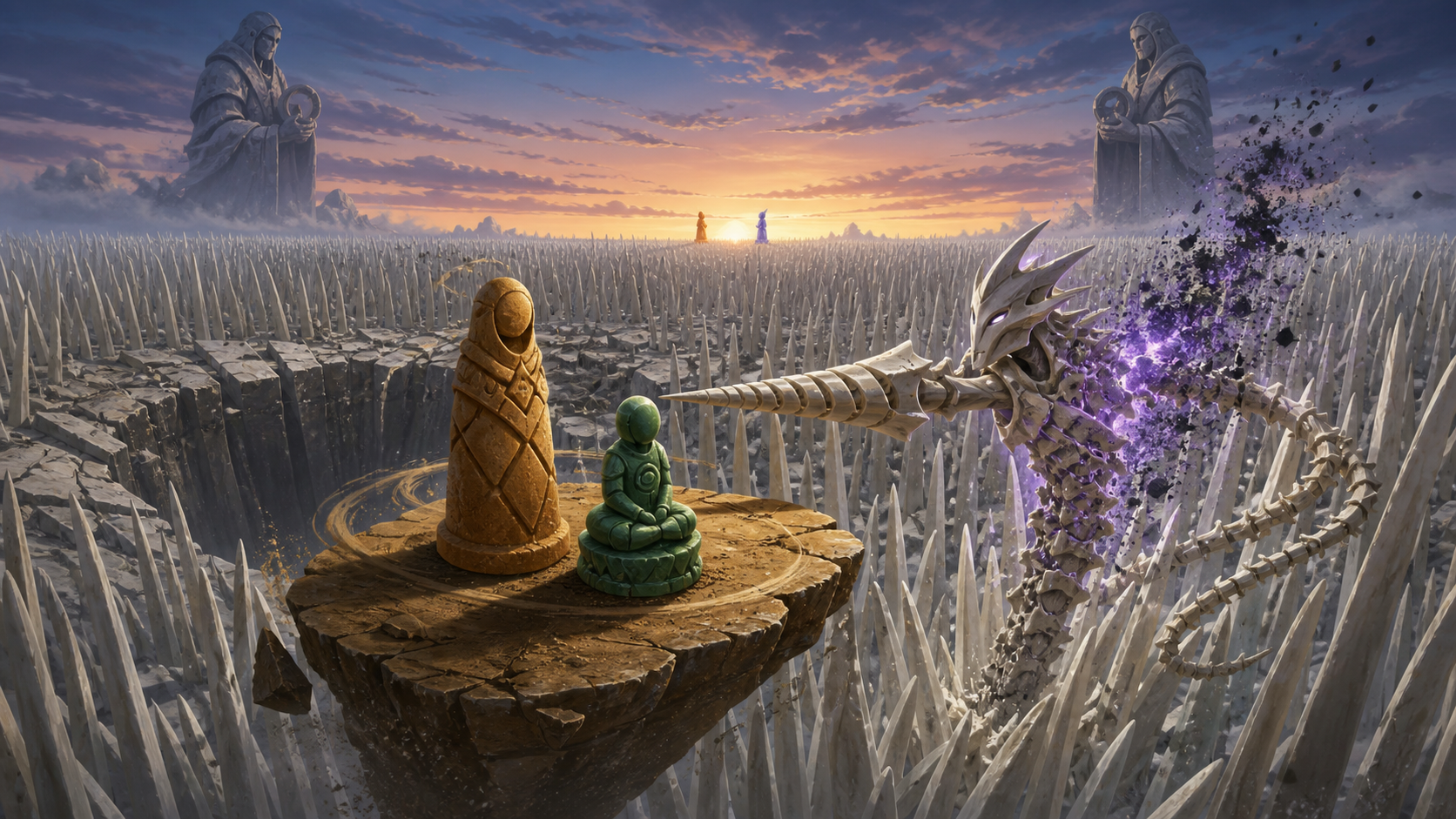
Thousands of bone blades erupt from the earth.
The sand battlefield becomes a white forest designed to kill anything standing on its surface.
Gaara reacts by lifting himself and Lee into the air with sand.
That rescue consumes strength he barely has left, but leaving Lee below is not an option.
Kimimaro has answered burial by turning the prison into a weapon network.
He does not merely escape the sand.
He claims the terrain Gaara controlled and fills it with his own body.
Kimimaro Can Move Through the Bones
The bone forest is not only an area attack.
Kimimaro can merge with the structures and emerge from them.
Gaara and Lee floating above the blades appear safe because the ground can no longer reach them directly. Then Kimimaro travels through the bone field and erupts from a spike beside Gaara.
He still holds a hardened bone weapon.
Gaara has admitted he is out of strength and chakra. Lee cannot intercept in time. The final strike has bypassed the sand field and reached killing distance.
Kimimaro's devotion carries him through burial, crushed terrain and a body collapsing from disease.
His will has created the opening.
His body cannot finish it.
Illness Stops the Final Strike
Kimimaro dies before the weapon reaches Gaara.
Gaara did not calculate when Kimimaro's organs would fail or save a final defense. The person inches from killing him reached the end of a terminal illness.
That does not make Gaara's battle meaningless.
He survived every earlier escalation, protected Lee and forced Kimimaro to spend everything available.
It does mean the finish belongs to the damage already inside Kimimaro.
Orochimaru knew this body was dying. He still accepted its final service and sent it to deliver the replacement vessel.
Kimimaro gave his life gladly.
Orochimaru was nowhere near the battlefield to lose anything.
Lee Calls Luck Something You Make
After the bone forest settles, Gaara acknowledges how lucky they were.
Lee repeats Guy's belief that a shinobi makes his own luck.
Gaara held the battlefield long enough for illness to matter. Lee accepted protection instead of forcing Gaara to divide focus. Both escaped Bracken Dance.
Then Gaara casually insults Guy as a meddlesome fool.
Lee immediately objects.
He can remain grateful to Gaara and still refuse disrespect toward his sensei. Gratitude does not erase loyalty or require silence.
The response helps Gaara recognize something familiar in Lee and Naruto.
Both become fiercely defensive when someone precious to them is attacked.
Precious People Do Not Guarantee Goodness
Gaara wonders whether protecting an evil person is better than remaining alone.
Kimimaro cared about Orochimaru.
That bond gave him purpose, discipline and the will to keep moving while dying. It also made him participate in the delivery of another child to the person who exploited him.
The existence of a precious person does not automatically make the relationship healthy or the resulting actions good.
Naruto's bonds teach him to protect other people's personhood.
Orochimaru's bond with Kimimaro requires Kimimaro to erase his own.
Gaara is beginning to understand that connection matters, but so does what the connection asks a person to become.
Loneliness is not the only danger.
Devotion without dignity can be another kind of death.
Naruto Reaches the Valley of the End
Naruto finally catches Sasuke at the Valley of the End.
The location places them beneath the monuments of Hashirama Senju and Madara Uchiha, founders whose bond collapsed into a defining conflict.
Naruto does not know how closely that history will echo through them.
He knows the immediate truth.
Sasuke is here.
The carriers are gone. Kimimaro is no longer between them. No teammate remains beside Naruto to absorb the next obstacle.
The rescue mission has reached the conversation and fight it was always approaching.
Episode 127 stops at the arrival.
The argument belongs to what comes next.
What Changes After Episode 127
Lee accepts that his injured body cannot assist Gaara safely.
Kimimaro restrains Gaara with Dance of the Clematis: Vine.
He creates a hardened bone drill through Dance of the Clematis: Flower.
Gaara constructs Shield of Shukaku from hard minerals, sand and chakra, shattering the drill.
Kimimaro identifies himself as the last of the Kaguya clan and claims he will live through Orochimaru.
Gaara calls him a brainwashed pawn.
Prison Sand Burial drives Kimimaro deep underground.
Bracken Dance fills the battlefield with thousands of bone blades.
Gaara lifts himself and Lee above the attack.
Kimimaro moves through the bones and emerges for a final strike.
His terminal illness kills him before the weapon reaches Gaara.
Gaara and Lee reflect on luck, precious people and Kimimaro's devotion.
Naruto catches Sasuke at the Valley of the End.
Lee accepting the sideline is part of the victory
Lee wants to keep fighting because persistence has carried him through pain, surgery, and fear. Gaara understands that another brave charge would make Lee a target rather than a partner. Asking him to stay back is not an insult to his courage. It is recognition that recovery has limits.
Lee finally listening matters. A shinobi story can praise endurance so loudly that stopping sounds shameful. Here, survival requires him to trust somebody else with the fight.
Gaara protects without turning protection into ownership
Gaara directs Lee away from danger and then keeps Kimimaro’s attention on himself. He does not demand gratitude, forgiveness, or emotional reassurance. The rescue remains an action rather than a bargain.
That distinction is essential after what Gaara did to Lee during the Chūnin Exams. Growth cannot rewrite the injury. It can change what Gaara chooses when he has power over Lee’s safety now.
Kimimaro’s spine whip makes self-destruction look disciplined
Kimimaro pulls out his own vertebral column and uses it as a flexible weapon. The technique is controlled and visually astonishing. The control makes the underlying horror easier to miss: his body has become equipment that he believes Orochimaru is entitled to spend.
He has learned to interpret pain as proof of devotion. The more illness takes from him, the more completely he offers what remains.
The Clematis Dance turns anatomy into a military system
The vine binds Gaara while the flower hardens Kimimaro’s arm into a drill. Restraint and penetration work together, leaving the sand shield to absorb pressure from a fixed angle.
The choreography tells us Kimimaro is not simply lashing out. He is an expert whose clan ability was cultivated for killing even when nobody cultivated a life for the child carrying it.
Gaara’s Shield of Shukaku carries an uncomfortable inheritance
Gaara compresses his strongest minerals into a defensive figure associated with the tailed beast that made his childhood terrifying. The image does not mean Shukaku suddenly becomes gentle. It shows Gaara reclaiming material that once defined him without consent.
He can use inherited danger to protect another person. Reclamation does not erase trauma, but it refuses to let trauma own every future use of his strength.
Kimimaro breaking the shield does not erase Gaara’s growth
The drill cracks a defense presented as nearly absolute. Gaara responds by changing scale instead of treating the breach as humiliation. He is fighting to stop Kimimaro, not to defend an identity built on never being touched.
That emotional difference matters as much as the technique. A younger Gaara treated vulnerability as proof that everyone must die. This Gaara adapts.
The Last Kaguya is a title filled with stolen possibilities
Kimimaro survives a clan that treated battle as culture and self-annihilation as pride. Being the last should leave room to decide what the Kaguya name means next. Orochimaru fills that room before Kimimaro can.
He exchanges one system of bodily ownership for another. The new master sounds tenderer, but still measures Kimimaro through bloodline, vessel compatibility, and usefulness.
Gaara spends chakra because Lee’s life has become worth the cost
Large sand techniques drain him. He knows Kimimaro may survive and still commits the reserve needed to protect the field. The choice contrasts sharply with the boy who once killed because another person’s fear made him feel alive.
Resource expenditure reveals values. Gaara now spends strength so somebody else can keep a future.
Giant Sand Burial tries to end the fight beneath the earth
Gaara changes the landscape and forces Kimimaro deep underground. The crushing pressure seems final because it attacks from every side rather than testing bone armor at one point.
Lee celebrates, while Gaara stays alert. His caution recognizes that an opponent shaped by constant bodily sacrifice may continue past any reasonable stopping point.
Bracken Dance makes Kimimaro’s body occupy the entire battlefield
Bone pillars erupt everywhere, eliminating ordinary safe ground. The technique is breathtaking and bleak. Kimimaro no longer uses pieces of his skeleton as tools; he converts the landscape into an extension of himself.
Orochimaru’s logic reaches its purest image here. A child’s body expands until nothing else is allowed room, and the expansion is called purpose.
Moving through the bone forest gives Kimimaro one last advantage
He can emerge from any pillar, making Gaara’s aerial sand platform only temporarily safe. The field becomes a network that carries Kimimaro toward the final strike.
The ability explains why burial did not finish him and preserves tactical logic. Gaara solved the pressure problem. Kimimaro answered by changing what counted as his body’s location.
Gaara lifting Lee is protection with a memory attached
Sand carries Lee above the spikes. The same force once pinned and crushed him. The episode lets that visual contradiction remain instead of asking the audience to choose one meaning.
Lee’s terror was real. Gaara’s rescue is real. Accountability becomes stronger when both truths remain visible.
Kimimaro reaches the final strike and dies before landing it
Illness stops him inches from Gaara. The timing feels like luck to Lee because neither fighter’s technique creates the final interruption. Kimimaro’s body simply cannot fulfill one more command.
The death is not a moral verdict delivered by disease. It is the endpoint of exploitation, illness, and his refusal to imagine a self whose survival matters apart from service.
Lee calls luck something people create
Lee’s language reflects a survivor trying to make meaning from a result nobody controlled. Preparation did matter: Gaara raised them above most of the bone field and stayed watchful. Yet Kimimaro’s death remains contingent.
Calling every escape earned can become cruel when other equally brave people do not escape. Gratitude does not require turning chance into proof of virtue.
Precious people do not automatically create ethical purpose
Kimimaro believes Orochimaru is precious. That feeling is sincere. Sincerity does not make the relationship safe or the mission good. A person can love somebody who exploits the love.
Naruto’s bonds push him toward rescue, while Kimimaro’s bond pushes him toward self-erasure. Attachment needs accountability, consent, and room for the attached person to remain a person.
Gaara understands devotion because he once built life around one idea
Gaara used to treat love of self as permission to kill. Naruto disrupted that closed system. He can therefore recognize how a single belief consumes Kimimaro without pretending their choices are identical.
Understanding does not stop the fight. It keeps Gaara from flattening his opponent into an inhuman obstacle.
Kimimaro dies loyal to a man who already replaced him
Orochimaru wanted his body until illness made the vessel inconvenient. Sasuke became the next prize. Kimimaro knows enough to understand the replacement and still calls delivering Sasuke his purpose.
That is grooming’s ugliest success: the discarded child protects the system that discarded him and experiences the sacrifice as freely chosen meaning.
Naruto reaches the Valley of the End carrying everyone’s cost
Choji, Neji, Kiba, Akamaru, Shikamaru, and Lee have all paid for the pursuit. Sand reinforcements prevented more deaths, but Naruto arrives without knowing the full condition of the people behind him.
The valley is therefore not a private argument between two boys. Every person who held the road open is present in the stakes.
The statues turn personal conflict into inherited history
Hashirama and Madara loom over Naruto and Sasuke before the boys understand how deeply their own rivalry echoes older failures. The setting enlarges the confrontation without removing their agency.
History creates patterns and symbols. It does not absolve the people living inside them from choosing what happens next.
Gaara’s battlefield closes as Naruto’s opens
One confrontation ends with a child dying for Orochimaru. Another begins with Naruto trying to stop Sasuke from walking toward the same predator. The transition refuses to let Kimimaro become disposable action scenery.
His death is a warning about the destination waiting behind promises of power, recognition, and revenge.
RaeRae’s full take
Episode 127 is stunning, but I cannot celebrate the bone forest without grieving the child who had to turn himself into it. Kimimaro’s discipline is real. So is the grooming that taught him discipline only matters when Orochimaru can use it.
Gaara saving Lee remains the emotional counterweight. The sand still carries the history of Lee’s shattered body. Now it lifts him above death. Gaara does not get absolution for one rescue, but this is what change looks like before absolution: different choices, real cost, and no demand that the survivor make him comfortable.
Then Naruto reaches Sasuke after Kimimaro dies serving the man Sasuke is running toward. The warning could not be clearer. Orochimaru does not offer purpose. He offers children a prettier name for disappearing.
RaeRae checkpoint: Kimimaro’s devotion is sincere, and Orochimaru’s exploitation is still exploitation. Love does not make a system safe when a child must disappear to prove it.
RaeRae's Verdict
“Vengeful Strike! The Bracken Dance!” gives Kimimaro enough will to win and a body that dies one second too soon.
Gaara stops the bone drill, buries him beneath the earth and escapes a forest made from his skeleton.
Kimimaro still reaches him.
Then illness takes the final step Orochimaru never had to pay for.
Gaara survives with an uncomfortable lesson. Caring about someone can pull a lonely child toward other people, or it can convince him that being used is love.
Kimimaro believed Orochimaru gave his life meaning.
Orochimaru spent that meaning until the body stopped.
Naruto reaches Sasuke as the episode ends.
One broken bond is over.
The next one is waiting beneath two statues.
Receipts and official routes
- Episode number and licensed title: Naruto Official Site.
- Japanese title, synopsis, and March 30, 2005 special broadcast record: TV Tokyo.
- Streaming availability varies by region; use the licensed route maintained in the episode directory.