
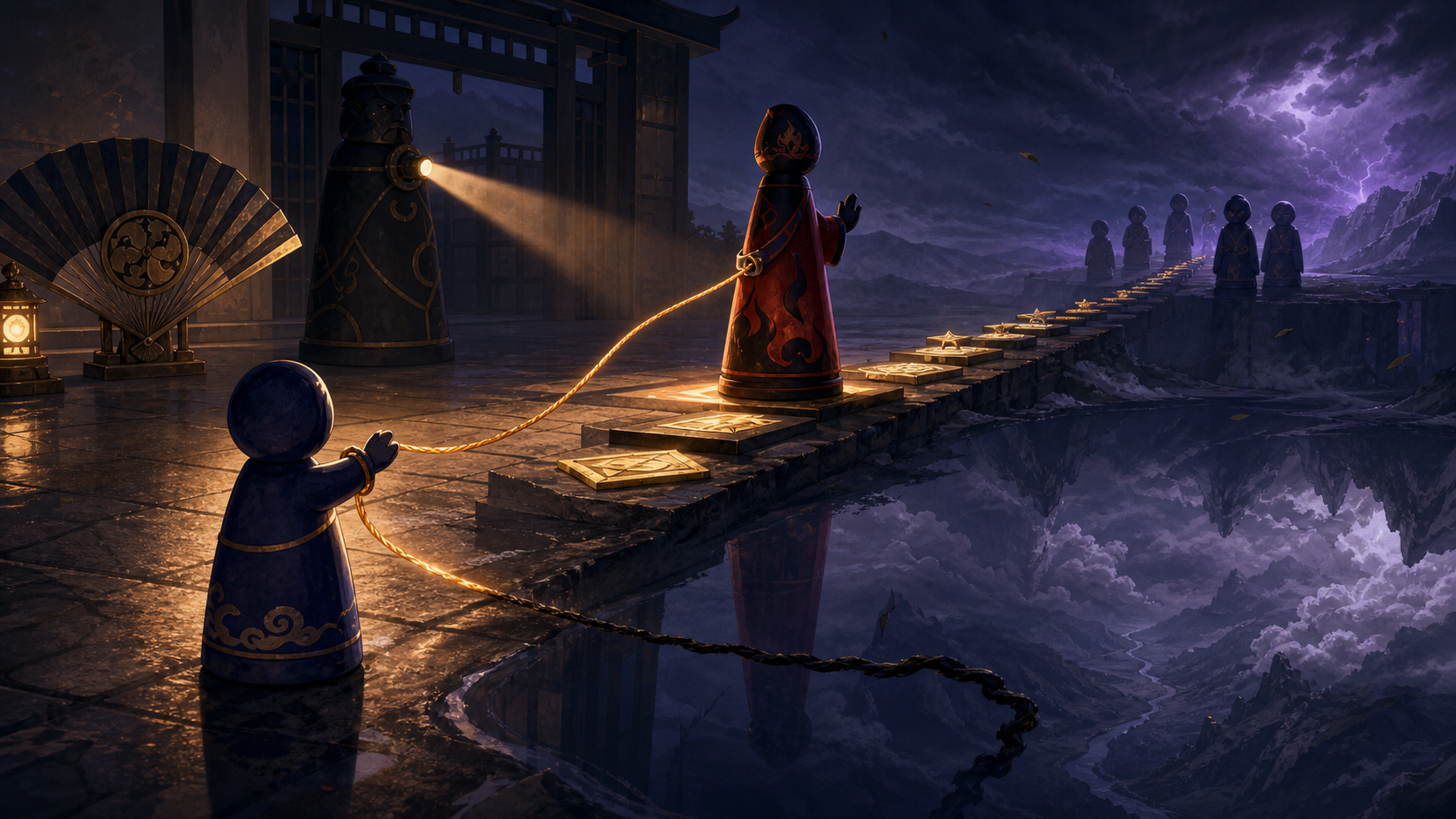
Brothers: Distance Among the Uchiha
Before hatred owned Sasuke’s future, love, comparison and Fugaku’s attention made Itachi the standard he could never reach.
RaeRae Reacts
Episode 129 explains why Sasuke talks about hatred like a training method.
Before Itachi became the person Sasuke wanted to kill, he was the brother Sasuke adored.
He carried Sasuke on his back.
He explained the Uchiha crest and the Military Police.
He remained kind even while talent, clan duty and Fugaku's attention made the distance between them feel impossible.
That history matters because hatred did not replace an empty relationship.
It invaded the most important one Sasuke had.
Naruto offers new bonds at the Valley of the End.
Sasuke answers from a childhood where love, comparison and family approval taught him that power determined who deserved to be seen.
Itachi was his hero first.
That is exactly why the wound owns him now.
Naruto Gets Up From the Fire
Naruto emerges from Sasuke's Dragon Fire attack and keeps fighting.
The wire restraint and flames did not end the pursuit. Naruto reaches Sasuke again and lands more blows, trying to turn physical persistence into an answer Sasuke cannot ignore.
Sasuke absorbs the punishment with unsettling calm.
Blood falls.
His expression barely changes.
Sasuke accepts pain as the cost of leaving.
Naruto cannot make that cost high enough through ordinary blows to reverse a decision built around revenge.
Sasuke Is Not Even Using Sharingan
Sasuke tells Naruto he has not activated Sharingan.
The statement is both tactical information and humiliation.
Naruto is throwing everything emotional into the exchange while Sasuke claims he has not needed the Uchiha advantage most associated with his combat skill.
Then Sasuke blocks, counters and drives Naruto from the top of the statue.
They fall, and Sasuke beats him down with ruthless control.
The weapon pouch lands beside Naruto like a discarded receipt from the previous trap.
Sasuke wants Naruto to understand that catching him did not make them equal and that determination alone cannot close every technical difference.
He is proving why he values power while using Naruto as the demonstration.
Power and Hatred Are the Plan
Sasuke tells Naruto that surpassing Itachi requires power and hatred.
Not healing.
Not time.
Not a life large enough to make revenge less central.
Power gives him the means to kill Itachi. Hatred keeps the objective sharp enough that comfort, friendship and fear cannot redirect him.
Sasuke treats both as disciplines.
That is why Orochimaru's offer fits so neatly. The curse mark provides immediate power, while leaving Konoha demands a public act of hatred against the people asking him to stay.
Every bond he hurts becomes evidence that he can prioritize Itachi over everything else.
Young Sasuke Adored Itachi
The flashback returns to a Sasuke who wanted Itachi's time more than his defeat.
Itachi was talented, admired and already carrying expectations far beyond his age. Sasuke saw skill without yet seeing the political pressure wrapped around it.
He wanted to train with him.
He wanted stories, attention and proof that being the younger brother meant closeness rather than permanent comparison.
Itachi often responded with affection even when he could not give Sasuke the time requested.
The familiar forehead tap postponed plans without making the rejection feel cruel.
Sasuke believed there would always be another day.
Itachi Was a Brother and a Standard
Itachi occupied two roles Sasuke could not separate.
He was the older brother who cared for him.
He was also the prodigy every adult used to define Uchiha excellence.
Sasuke did not merely want Itachi's affection. He wanted to become someone worthy of the attention Itachi received.
That turns love into measurement.
Every academy success feels smaller beside Itachi's record. Every new technique arrives with an older example already mastered. Sasuke can improve rapidly and still experience himself as behind.
The distance in the title is not emotional neglect alone.
It is the impossible scale created when a child uses an extraordinary sibling as the minimum standard for belonging.
Fugaku's Attention Belongs to Itachi
Fugaku directs his attention toward Itachi's development, assignments and position inside the clan.
Sasuke notices.
He admires his brother and envies what that admiration seems to cost him. Fugaku's focus turns Itachi's success into the route Sasuke believes he must follow to receive equal recognition.
It is a child trying to understand the rules of his father's approval.
If elite performance earns attention, then Sasuke must perform.
If Itachi remains unreachable, then Sasuke remains secondary.
Sasuke begins carrying a burden nobody his age should have to name.
The Uchiha Crest Carries Institutional Weight
Itachi explains clan history and the role of the Konoha Military Police to Sasuke.
The Uchiha crest is not merely a family logo sewn onto clothing.
It represents identity, authority and a duty the clan understands as proof of its place inside the village.
Young Sasuke receives that history through the brother he admires. Clan pride and brotherly love connect before he recognizes the political strain surrounding either one.
Itachi stands at the center of those expectations.
He is the prodigy capable of carrying the crest into elite village service, the son Fugaku watches and the brother Sasuke wants to follow.
The more institutions place on Itachi, the farther away he becomes from ordinary family life.
Sasuke sees distance before he understands its cause.
Sasuke Tries to Close the Gap
Young Sasuke trains because improvement appears to solve everything.
Skill could earn Fugaku's attention.
Skill could make Itachi take him seriously.
Skill could prove he deserves the crest and the family name.
Itachi's achievements keep moving the standard beyond reach. Sasuke's success never arrives where adults appreciate it on its own terms.
It arrives beside the memory of what Itachi accomplished younger, faster or at a higher level.
Sasuke learns to experience progress as insufficiency.
That habit survives into Team 7. Naruto's growth does not simply impress him. It threatens the ranking Sasuke uses to reassure himself that he is still moving toward Itachi.
Itachi Starts Pulling Away
The affectionate older brother begins changing.
Clan members question his behavior and loyalty. Itachi's relationship with Uchiha expectations becomes tense, and the prodigy once presented as family pride starts resisting the role built around him.
Sasuke sees fragments.
He does not possess the political information needed to interpret them. He knows Itachi is less available, adults are suspicious and the family atmosphere no longer feels stable.
The distance becomes emotional as well as technical.
Sasuke cannot catch Itachi through training if Itachi is moving somewhere the family will not explain.
Admiration begins mixing with anxiety.
The brother who made Sasuke feel protected now appears increasingly unreachable inside the same home.
The Present Fight Carries the Old Comparison
At the Valley of the End, Sasuke fights Naruto while measuring himself against Itachi.
That triangle defines the conflict.
Naruto sees a teammate choosing Orochimaru.
Sasuke sees another bond that might weaken the hatred required to close the original distance.
Naruto's growth makes the problem worse. If Sasuke remains in Konoha and Naruto keeps advancing, Sasuke fears becoming the lesser brother and the lesser teammate at once.
Orochimaru offers a way to avoid the slow uncertainty of growth beside other people.
He offers acceleration.
The curse mark lets Sasuke feel the difference immediately as he overwhelms Naruto without Sharingan.
That reward makes exploitation look like proof.
Hatred Is Love With Its Future Removed
Sasuke says his dream lives in the past because the future he imagined with Itachi died with the clan.
Hatred preserves the relationship in its most painful possible form.
Itachi remains central to every training decision, risk and bond Sasuke abandons. Killing him becomes a way to complete a connection Sasuke cannot mourn normally.
Naruto asks Sasuke to choose people who exist in the present.
Sasuke believes doing so would betray the child who loved his family and failed to protect it.
That is why the cry cannot reach him through volume alone.
Naruto is asking Sasuke to imagine a future.
Sasuke still believes loyalty belongs to the past, even when that loyalty takes the form of revenge.
What Changes After Episode 129
Naruto survives Dragon Fire and continues attacking Sasuke.
Sasuke absorbs repeated blows and reveals that he is not using Sharingan.
He blocks, counters and overwhelms Naruto in the physical exchange.
Sasuke says power and hatred are necessary to surpass Itachi.
His childhood reveals deep admiration for his older brother.
Itachi behaves affectionately toward Sasuke while elite duties consume his time.
Fugaku's attention toward Itachi makes Sasuke's admiration inseparable from comparison and jealousy.
Itachi explains Uchiha and Military Police identity to Sasuke.
Young Sasuke trains to earn recognition and close the technical distance.
Itachi's achievements make Sasuke experience progress as inadequacy.
Itachi begins distancing himself from the clan.
Clan suspicion grows around the prodigy Sasuke still loves.
The father-and-son fracture and deeper family collapse remain for Episode 130.
Naruto surviving the fire does not make Sasuke’s choice harmless
Naruto rises after Dragon Fire because his durability and refusal to quit have always been extraordinary. Survival can tempt the audience to treat the attack as ordinary rivalry. The wire, flame, and intent still mark a serious escalation.
Sasuke is trying to sever connection through force. Naruto’s ability to endure does not reduce Sasuke’s responsibility for deciding that his friend’s body can absorb the cost.
Sasuke fighting without the Sharingan is a message
He controls the early exchange while withholding the clan ability that usually defines his advantage. The choice tells Naruto that the gap exists even before Sasuke reaches for inherited power.
It also performs the comparison that has haunted Sasuke since childhood. Strength must be visible, undeniable, and humiliating to the person standing across from him because ordinary competence never felt sufficient at home.
Power and hatred sound like a plan because grief never received another one
Sasuke tells Naruto he needs strength and hatred to reach Itachi. The formula gives direction to pain that otherwise has nowhere to go. Train, hate, kill: each verb is measurable in a way mourning is not.
A clear plan can still be destructive. Orochimaru succeeds by offering acceleration without asking whether revenge should remain the only future available.
Young Sasuke adored Itachi before he feared him
The memory begins with a little brother reaching toward someone admired, not an enemy being catalogued. Itachi was patient, skilled, and close enough to represent the person Sasuke hoped to become.
That affection matters because later hatred does not replace it cleanly. The violence of the massacre occupies a relationship that once felt safe, leaving Sasuke to carry love and terror in the same name.
Itachi was a brother and the household standard
Adults discussed Itachi’s achievements as evidence of what an Uchiha child could become. Sasuke did not merely admire him. He learned to measure his own worth against a prodigy several years older and already moving through institutions designed for adults.
Sibling comparison becomes especially damaging when family approval appears scarce. Admiration starts to feel like a race for permission to matter.
Fugaku’s attention organizes the emotional economy of the house
Sasuke watches his father invest pride, instruction, and expectation in Itachi. The problem is not that Itachi deserves no recognition. The problem is that Sasuke experiences paternal attention as a limited resource distributed according to performance.
A child in that system learns that love arrives after achievement. Falling behind therefore threatens belonging, not merely ambition.
Mikoto offers warmth inside a structure she does not dismantle
Sasuke’s mother notices him and helps interpret the family around him. Her care provides comfort, but comfort cannot fully counter a hierarchy reinforced by the clan head and the village’s treatment of Itachi.
Private tenderness matters. Structural pressure still enters the home through missions, status, secrecy, and expectations attached to the Uchiha name.
The crest carries family pride and institutional surveillance
For Sasuke, the fan symbol represents lineage, skill, and a place within something larger. The village also associates that lineage with the police force and political suspicion. The child inherits pride before he can understand the conflict surrounding it.
Identity becomes a uniform others interpret for him. Achievement feels like the safest way to control what the symbol means.
Sasuke trains to close a distance no child could reasonably close
He practices because effort is one part of life he can command. Every improvement promises that his father might look directly at him and that Itachi might recognize him as a peer.
The distance remains because the standard keeps moving. Itachi’s career advances, adult tensions deepen, and nobody tells Sasuke that worth was never supposed to depend on catching him.
Itachi’s forehead tap becomes affection mixed with postponement
The gesture carries warmth, but it repeatedly sends Sasuke away with a promise of later. Sasuke receives enough affection to keep reaching and enough distance to keep wondering what he lacks.
After the massacre, even a loving memory becomes unstable. The hand that touched his forehead belonged to the person who would place him inside a nightmare.
Itachi starts pulling away under pressures Sasuke cannot see
Sasuke notices absence, tension, and changes in behavior without access to the political machinery surrounding his brother. Adults keep secrets while expecting the child to interpret the consequences correctly.
That information gap later makes manipulation easier. Sasuke knows something broke but has only Itachi’s cruelty as the explanation presented to him.
The village turned a teenager into a point of collision
Itachi carried duties to clan, village, family, and covert authority before he had the maturity or freedom to resolve them safely. Recognizing that exploitation does not excuse the choices that devastated Sasuke.
It does locate responsibility beyond a story about one inexplicably evil brother. Systems created the impossible position and then left a younger child inside the result.
Sasuke’s childhood competition was never emotionally neutral
Learning shuriken or fire style might look like ordinary sibling emulation. For Sasuke, each skill answered a deeper fear: if he could not equal Itachi, perhaps his father would never see him and the clan would never need him.
Performance became a request for attachment. Failure therefore landed as relational rejection.
Present-day combat repeats the old comparison
Sasuke looks at Naruto and sees another person whose growth threatens his position. Naruto’s victories show that effort, bonds, and unpredictable strength can outpace the identity Sasuke built around being the talented one.
The rivalry activates the same wound Itachi did. Sasuke interprets another person’s progress as evidence that he is again becoming irrelevant.
Naruto does not understand the family room he has entered
Naruto knows loneliness, rivalry, and the desire for acknowledgment. He does not know what it was like to adore a brother, lose an entire clan, and be forced to relive the murders through that brother’s technique.
Shared pain creates empathy, not automatic equivalence. Naruto needs curiosity alongside conviction if he wants his care to reach Sasuke.
Sasuke does not understand what his departure repeats for Naruto
Naruto spent childhood being avoided without explanation. Sasuke’s decision activates the terror that any hard-won bond can disappear the moment Naruto depends on it.
Sasuke has a right to agency. He is still responsible for the way he uses Naruto’s attachment as a target during the fight.
Hatred is not the opposite of love here
Sasuke’s hatred depends on the importance Itachi once held. A stranger could not have created the same rupture. Revenge preserves the brother at the center of Sasuke’s life even while promising to destroy him.
That is why simply telling Sasuke to let go cannot work. He would hear a demand to abandon his family twice, first in death and then in memory.
Orochimaru benefits from every adult failure in the flashback
Fugaku’s conditional attention, the clan conflict, village secrecy, Itachi’s violence, and the absence of meaningful trauma care all narrow Sasuke’s imagination. Orochimaru enters after the narrowing and calls himself the only route left.
Predators often look powerful because institutions have already removed the alternatives.
Skill cannot answer the question Sasuke is asking
Sasuke wants enough power to make the past stop defining him, yet every new technique is acquired for a goal created by that past. Advancement ties him more tightly to the massacre rather than freeing him from it.
The question underneath combat is whether he mattered to his family. No victory over Naruto can provide the answer.
Itachi’s excellence damaged both brothers differently
Adults used Itachi’s talent until his personhood disappeared beneath obligation. Sasuke experienced the same talent as a wall between himself and recognition. One child was valued for being exceptional; the other feared he would be unloved unless he became exceptional too.
A family and village can harm children through opposite positions in the same hierarchy.
The episode gives context without turning harm into destiny
Sasuke’s history explains why he reaches for hatred and why Naruto’s appeal fails. Explanation should deepen accountability rather than dissolve it. Sasuke remains capable of choosing, even while choices are constrained by trauma and manipulation.
The important question is what support could widen those choices before Orochimaru closes them further.
Naruto keeps standing because he refuses inherited conclusions
He has been told that jinchuriki isolation, village suspicion, and rivalry determine what people become. His life has given him reasons to reject those conclusions. He therefore refuses to accept Sasuke’s claim that hatred is the only serious path.
Refusal is powerful. To become rescue, it will need listening, safety, truth, and adults willing to repair what they helped break.
RaeRae’s full take
Episode 129 shows why Sasuke’s obsession cannot be reduced to jealousy or attitude. He loved Itachi, chased him, measured himself against him, and learned that paternal attention followed performance. Then the person at the center of that emotional world destroyed it.
Hatred gives Sasuke a schedule for grief. Get stronger. Find Itachi. Kill him. Orochimaru knows exactly how to exploit a child who mistakes a measurable objective for healing.
Naruto is right to reject the road, but care needs more language than “come back.” Sasuke needs a future where the Uchiha are remembered without his body becoming revenge, village property, or Orochimaru’s next container. Nobody has shown him that future yet.
RaeRae checkpoint: Sasuke’s hatred grew inside love, comparison, secrecy, and untreated grief. Context explains the road. Orochimaru still does not become a safe destination.
RaeRae's Verdict
“Brothers: Distance Among the Uchiha” shows that Sasuke's hatred did not begin where love ended.
It grew inside love.
Itachi was the brother who carried him, taught him and made the Uchiha name feel important. He was also the standard Sasuke could never reach and the son Fugaku watched most closely.
When that brother became distant, then murderous, Sasuke organized his whole life around closing the gap through revenge.
Naruto offers a future built from people who choose him now.
Sasuke keeps choosing the past because Itachi still defines what power, recognition and family mean.
The distance between the brothers became Sasuke's identity.
He would rather walk into Orochimaru's hands than admit he needs a dream that does not end with Itachi dead.
Receipts and official routes
- Episode number and licensed title: Naruto Official Site.
- Japanese title, synopsis, and April 6, 2005 broadcast record: TV Tokyo.
- Streaming availability varies by region; use the licensed route maintained in the episode directory.