
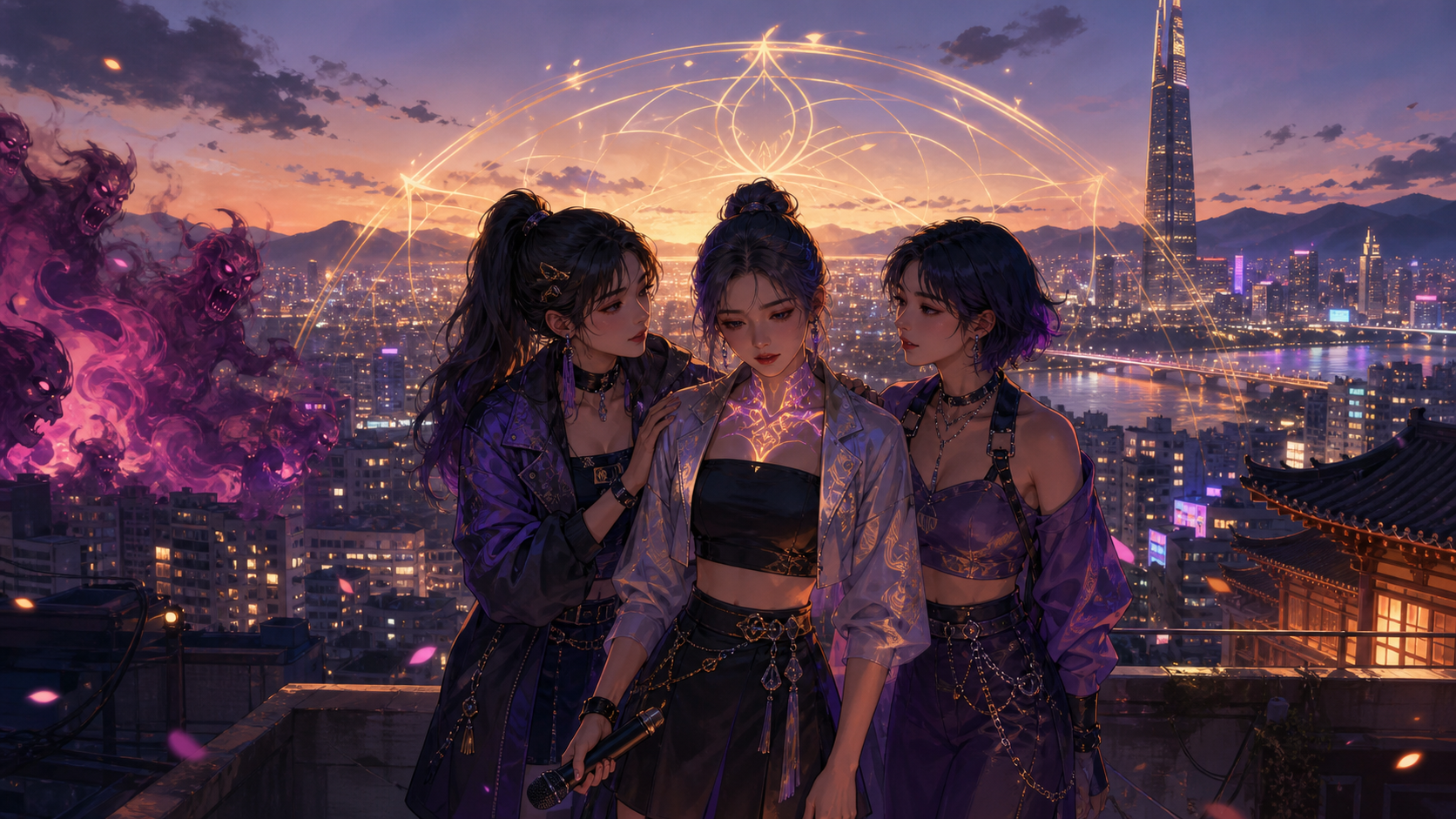
KPop Demon Hunters Review
I expected a fun movie with pretty fights and songs designed to move into my brain without paying rent. I did not expect Korean folk art, idol labor, inherited shame, a doomed demon boy, female friendship, and a tiger built like a dropped dumpling to work together this well.
The short version before I start pointing at roof tiles
KPop Demon Hunters works because the screenplay never treats the ridiculous premise as an apology. Rumi, Mira, and Zoey are HUNTR/X, global K-pop stars whose voices also maintain the Honmoon, a supernatural barrier protecting human souls from demons. Their new rivals, the Saja Boys, are demons packaged as a boy group because apparently evil has finally discovered photocard marketing.
The movie could have stopped at that joke and still been entertaining. The movie refuses. Rumi is half demon, has spent her life hiding the marks on her skin, and believes one perfect performance will erase the part of herself she has been trained to fear. Jinu, the Saja Boys’ leader, recognizes the same shame because Gwi-Ma has been feeding on his for centuries. Their relationship goes past enemies-to-lovers bait. They recognize the same prison in each other, then make very different choices about leaving the system.
Mira and Zoey keep the story from collapsing into the Rumi-and-Jinu show. They have lives beyond approving Rumi’s healing. Her secrecy hurts them. The movie lets that hurt sit there for a while instead of patching the hurt with one friendship speech. The final reconciliation works because Rumi finally stops auditioning for acceptance. She shows them the thing she was hiding.
The songs are doing plot work, not taking commercial breaks
“How It’s Done” introduces HUNTR/X through competence. They fight, eat, complain, perform, and land at a stadium without the movie pausing to explain every rule. “Golden” is the emotional trap disguised as an empowerment anthem. Rumi believes reaching the note and sealing the Golden Honmoon will fix her body, her voice, and her life. The song sounds victorious while the story quietly shows how much panic is holding that victory up.
“Soda Pop” is predation in pastel. The Saja Boys do not arrive looking dangerous; they arrive consumable. Their choreography and sweetness turn fandom attention into something they can literally drink. “Your Idol” removes the sugar coating and says the quiet part out loud: devotion can become surrender when the performer is designed to occupy every empty space in the fan’s life.
Then “What It Sounds Like” rejects the whole perfect-golden-barrier fantasy. Rumi does not win by becoming pure enough. HUNTR/X wins when all three voices return with the truth still attached. The Rainbow Honmoon matters because sameness was never the answer. Gold was the old assignment. The rainbow is what they make after they stop obeying the old barrier.
Rumi’s voice is not failing her. Her secret is choking her voice.
The movie makes shame physical without pretending to be subtle. Rumi’s throat tightens. Her notes crack. The demon patterns spread. Celine teaches her to cover them and promises that finishing the Honmoon will make them disappear, which is a terrible thing to tell a child even when you believe you are protecting her.
Celine is one of the reasons I want more movie. She clearly loves Rumi, but her love has rules built into her love. She raised a half-demon girl inside a demon-hunting tradition and never questioned whether “destroy every demon” could survive contact with the child in front of her. That is not cartoon villainy. That response is inherited fear wearing the clothes of duty.
Rumi’s breakthrough is not “I am secretly perfect.” Thank goodness. She is dangerous, frightened, talented, selfish, loving, dishonest, brave, and tired. The film allows every contradiction to belong to one girl.
Jinu is not redeemed because he is pretty
He is pretty. Let us not lie during a review about K-pop demons.
But Jinu’s tragedy comes from the choice he made when he was poor, hungry, and desperate to escape the life his family had. He gained status and abandoned them. Gwi-Ma does not need to invent new pain; he keeps Jinu obedient by replaying the old pain until guilt feels like identity. Rumi offers him a future in which confession does not automatically end in disgust. He almost accepts that future.
His sacrifice lands because the film does not pretend one good act refunds everything. He returns what remains of his soul to Rumi. The act is love, but the sacrifice is also the first choice he makes that Gwi-Ma does not own.
The Korean details are not wallpaper
Derpy Tiger and Sussie are a folk-painting joke
The tiger-and-magpie pair comes from minhwa, particularly the hojakdo or jakhodo tradition. The tiger is often deliberately foolish rather than majestic, while the magpie is clever and alert. Derpy’s face is not the animators failing to draw a tiger. The joke is hundreds of years old. The three-eyed magpie updates the supernatural messenger without losing the pairing.
“Saja” is doing two jobs
The Saja Boys are pretty men in black hats, but jeoseung saja refers to Korean grim reapers. Their gat-inspired silhouettes turn traditional death imagery into boy-group styling. They are idols and escorts to the afterlife at the same time. Yes, that is extremely on the nose. The choice is also delicious.
The hunters’ weapons tell you who they are
Rumi carries a saingeom, the Four Tiger Sword. Mira’s weapon is a curved moon sword, and Zoey uses spirit blades. The animation team connected their flowing, iridescent energy to sound made visible, drawing on cymatics,the patterns created by vibration. Their music does not merely power the weapons. The weapons behave like music.
The norigae are character design, not random tassels
The charms associated with traditional Korean dress give each HUNTR/X member a representative color while mixing other colors into the design. That fits the larger visual rule: the trio do not dress identically, but they still look like they belong together. The movie keeps foreshadowing unity without uniformity long before the screenplay says so aloud.
Seoul is geographically present
The rooftops in Bukchon Hanok Village, Cheongdam Bridge over the Han River, the COEX screen, Namsan Tower, and Seoul Olympic Stadium are not “Asian city” filler. The production used real location research and even satellite data before stylizing the city. The fantasy is allowed to live in a recognizable Seoul instead of replacing Seoul.
Easter eggs, callbacks, and tiny acts of fan service
- TWICE and MEOVV appear in the Idol Awards hallway. TWICE’s “Strategy” also appears on Bobby’s phone chart, and Jeongyeon, Jihyo, and Chaeyoung perform the alternate “Takedown.”
- “Love Maybe” plays when Rumi meets Jinu. The song comes from Business Proposal, which starred Ahn Hyo-seop, Jinu’s voice actor. Maggie Kang said the song was already in the cut before he was cast, making the joke accidental and somehow better.
- The opening ramyeon is character work. The film refuses the “idols do not eat” fantasy immediately. They are inhaling noodles while saving a plane and arguing about work.
- The Golden Honmoon was never the final color. Iridescence appears in costumes, weapons, and Rumi’s markings throughout the movie. The Rainbow Honmoon is not a surprise color effect; the film has been leaking that answer around the edges.
- “Your Idol” turns concert iconography into ritual. The Saja Boys’ stage, the Namsan beacon, fan synchronization, and mass attention convert familiar idol spectacle into a soul-harvesting ceremony.
- The bathhouse gag is culturally located. The fight does not happen in a generic spa. The movie uses an ordinary Korean public space and lets supernatural chaos crash into the subway without stopping for a tourist brochure.
What did not completely work for me
The movie moves like the production is late for its own concert. Mira and Zoey needed more individual story. Celine needed at least one scene that explained how she convinced herself hiding Rumi was the loving choice. The hunter lineage, the rules of the Honmoon, and the history of Rumi’s parents are visibly standing behind a locked sequel door.
I also wanted the film to sit longer with Jinu’s betrayal. Rumi is devastated, but the plot has already started sprinting toward the finale. The emotion survives because the songs carry the emotion; the screenplay could have given the reconciliation another five minutes and survived too.
Those are not tiny complaints. They are also the complaints I make when I want more of a world rather than less.
The plot works because every system asks for performance
Rumi, Mira, and Zoey do not live two separate lives where pop music fills the daytime and demon hunting begins after dark. The same skill powers both jobs. Their voices move crowds, maintain the Honmoon, and turn public feeling into protection. Performance is labor, weapon, ritual, and promise at once. That construction keeps the premise from becoming a costume change between concert scenes and fight scenes.
The overlap also creates the central danger. HUNTR/X cannot simply cancel a show when the supernatural workload becomes unbearable because the audience participates in the shield. Fans give attention, belief, and emotional energy. The trio returns that energy as music and protection. Nobody in the crowd knows the full contract, but the film makes fame feel materially connected to collective safety.
Rumi therefore cannot solve her problem by walking away from celebrity. Her voice is tied to the duty Celine taught her, the friends who built a career beside her, and the people who trust the group without knowing what happens backstage. Secrecy becomes part of the institution. The system needs Rumi to sound perfect while denying her any safe place to admit why perfection is becoming impossible.
The Honmoon is a boundary, a stage, and a bad family inheritance
The Honmoon begins as a protective barrier with a finish line. HUNTR/X must make the shield golden, seal the demons away, and complete a task passed through generations of women. That goal sounds clean enough to organize a musical. The closer the trio gets, the more the film reveals how badly Celine has explained what protection requires.
Gold represents completion, but completion carries a troubling fantasy. Rumi believes the Golden Honmoon will burn away her demon marks and make her fully acceptable. A barrier designed to keep demons outside becomes the imagined tool for cutting the unwanted part out of her body. Public safety and personal purification collapse into the same project.
The finale replaces pure gold with a rainbow because the system cannot become humane by achieving the original target more efficiently. Rumi, Mira, and Zoey rebuild protection through truth shared with one another and the crowd. The changed color does not announce that every danger has vanished. The new shield records that difference was included in the defense rather than removed before protection could begin.
The opening sells competence before asking us to see the cost
“How It’s Done” introduces HUNTR/X at full speed. The sequence needs viewers to believe that these women can manage a private jet, fan expectations, choreography, monsters, weapons, jokes, and a stadium without losing the beat. Their confidence is not a placeholder waiting for a man to explain the real problem. The trio already knows the work.
That competence matters because the story later shows what the performance conceals. Rumi can lead a battle and still panic when her marks spread. Mira can look unshakable while fearing that another group fracture is beginning. Zoey can deliver jokes while noticing that the emotional temperature has changed. Friendship does not erase professional discipline. Professional discipline does not eliminate fear.
The movie earns later vulnerability by first showing why the world believes the group has everything handled. A weaker script would begin with obvious dysfunction and spend the story teaching the women teamwork. This film begins with a functioning team and asks what secrecy does to people who already love one another and already know how to cooperate.
“Golden” is a victory song built around a body refusing the assignment
“Golden” has to operate as a plausible global hit, an act of musical-theater exposition, and a physical crisis. The melody climbs because the group is reaching for the Honmoon’s final form. Rumi’s highest note becomes the point where ambition, vocal technique, inherited duty, and demon identity collide inside one throat.
The sequence becomes sharper when the lyrics promise a true self while Rumi is hiding the most important truth about herself. She sings about becoming what she was meant to be, but Celine has taught her that destiny requires erasure. The song sounds like liberation to the audience and feels like a deadline to the singer.
Her damaged voice is not a simple punishment for lying. The failure shows how shame enters the body. Rumi monitors her skin, breath, posture, tone, clothing, schedule, and proximity to friends. Every performance requires extra labor because she must manage the song and the possibility of exposure. The body eventually refuses to keep those tasks separate.
Netflix’s production interviews describe the song as a difficult narrative assignment from the beginning. The track needed to reveal personal struggle, advance the supernatural goal, and remain convincing K-pop outside the film. That dual demand explains why the scene lands. The music was not written as a detachable promotion and pasted over the plot afterward.
“Soda Pop” weaponizes everything audiences enjoy about manufactured sweetness
The Saja Boys do not challenge HUNTR/X by becoming darker, louder, or visibly monstrous. They arrive as polished appetite. “Soda Pop” uses bright color, easy flirtation, synchronized charm, and an aggressively memorable hook to make consumption feel harmless. The song steals attention while pretending to offer a treat.
That strategy understands idol competition better than a generic evil-boy-band joke. Fans do not abandon one group because a villain gives a speech. Attention moves because another performance creates novelty, desire, collectability, and a social reason to participate. The demons package extraction as fandom pleasure.
Jinu knows that public affection can become infrastructure. Every chant and replay weakens the girls’ access to the emotional energy behind the Honmoon. Gwi-Ma does not need fans to understand the supernatural mechanics. The plan only needs a market where attention can be redirected at scale.
The comedy works because the song really is catchy. Viewers experience a small version of the problem while watching. We know the performers are demons and still understand why the crowd responds. The film never asks the audience to believe that bad art conquered people through stupidity. Seduction succeeds because craft and manipulation can occupy the same three minutes.
“Your Idol” removes the sugar and keeps the contract
“Your Idol” reveals what “Soda Pop” was selling. The performance turns fandom devotion into surrender. The Saja Boys stop offering a sweet distraction and demand identity, loyalty, and soul. Their visual transformation makes the underlying relationship visible, but the mechanics have not suddenly changed. The audience has been trained to give more.
The number also mirrors HUNTR/X in an uncomfortable way. Both groups rely on collective emotion, choreographed image, repeated hooks, and fans who invest personal meaning in performers. The moral difference cannot rest on one group being authentic while the other uses production. HUNTR/X is produced too. The difference lies in whether the relationship returns care or consumes the people providing care.
That distinction allows the film to criticize parasocial power without treating fans as fools. Fans are vulnerable because music matters, community matters, and performance can carry real comfort. Gwi-Ma exploits those needs. HUNTR/X survives only after the trio stops asking the audience to worship perfection and allows the crowd to witness imperfection without turning away.
Rumi’s marks turn shame into a visible production schedule
The glowing patterns on Rumi’s body work because they are beautiful enough to complicate the fear attached to them. Celine treats the marks as contamination. The color and movement tell viewers that the demon inheritance also belongs to Rumi’s visual identity. Hiding them requires clothing, timing, isolation, and constant attention.
Shame stories often stay inside dialogue. A character says she feels broken, another character says she is loved, and the conflict resolves through reassurance. Rumi’s marks spread when the secret gains pressure. Her voice changes. Costumes stop functioning as cover. Friends notice absences and evasions. The private belief creates practical problems that reassurance alone cannot fix.
The film also avoids making disclosure automatically safe. Rumi has evidence that demon identity attracts violence. She was raised by a hunter who framed secrecy as survival and promised purification as the only acceptable future. Telling Mira and Zoey risks her friendships, career, mission, and body. Fear is not irrational simply because the audience knows her friends care.
The eventual reveal becomes painful because Rumi loses control of when and how people learn. Public exposure is used against her. The story understands that truth can be necessary and weaponized at the same time. Honesty becomes healing only when Rumi gains relationships and structures capable of holding the truth without using the truth as a reason to erase her.
Celine is the adult failure hiding inside the heroic tradition
Celine loves Rumi and still builds a childhood around conditional acceptance. That contradiction makes her more disturbing than a flat abusive mentor. She protects the child from hunters who might kill her, trains her, gives her a mission, and offers a future. Every act of care carries the message that safety depends on becoming less demon.
The promise of a Golden Honmoon organizes Rumi’s life around delayed belonging. Work hard enough, sing perfectly enough, protect enough people, and the unacceptable part will disappear. The formula resembles institutions that welcome marginalized people only after they learn to minimize the difference that made inclusion uncomfortable.
Celine’s choices also damage Mira and Zoey because secrecy shapes the whole team. They are asked to trust a leader whose central fear cannot be named. When Rumi withdraws, the friends receive behavior without context. Celine protects one secret by transferring confusion and risk to two other young women.
A stronger continuation should not redeem Celine through one apology. Repair would require her to admit what she knew, why she chose purification, what previous hunters taught her, and what alternatives she refused to imagine. Love matters. Accountability matters because love did not prevent the harm.
Mira and Zoey keep the movie from becoming one gifted woman’s pain
Rumi carries the central secret, but HUNTR/X works because Mira and Zoey possess judgment beyond supporting the leader. Mira notices evasions and pushes against decisions that endanger the group. Zoey tries to hold connection without pretending that every fracture can be joked away. Both women have professional stakes and emotional boundaries.
Their anger after the reveal is not proof that Rumi should have stayed silent. Anger shows that secrecy had consequences. Friends can love someone and still feel manipulated when a shared mission was built around information they were denied. The film gives that reaction enough room to keep reconciliation from becoming automatic.
The final repair begins when the trio sings together differently. Rumi no longer performs perfection for her friends. Mira and Zoey do not rescue her by declaring that nothing matters. They choose her with new information, then change how the group uses its voice. Friendship becomes believable because acceptance includes the work of rebuilding trust.
The movie could still give both women more interior life. Mira’s family rupture and Zoey’s Korean diaspora perspective invite fuller stories. Their histories should shape future conflicts rather than remain efficient character notes. The first film establishes that the trio matters. A sequel will need to prove the other two women are not permanent satellites around Rumi’s identity crisis.
Jinu is compelling because recognition arrives before redemption
Jinu and Rumi connect through shame before either person has earned trust. He recognizes the marks and the fear behind them. She recognizes someone who understands what secrecy does over time. That recognition creates intimacy, but intimacy does not erase his participation in Gwi-Ma’s plan.
The story keeps the relationship useful by allowing Jinu to help and betray. He offers information, shares his past selectively, manipulates Rumi, and eventually chooses a costly act against the master who owns his shame. Beauty does not turn those choices into innocence.
His sacrifice works because the film frames freedom as one decision made after centuries of surrender, not as a clean moral account. Jinu cannot return every soul, undo every deception, or claim a future simply because he feels regret. He can refuse Gwi-Ma at the moment refusal becomes possible and give Rumi a chance to act.
The romance remains intentionally incomplete. Attraction, recognition, and grief are present, but the film does not build a conventional couple ending. Rumi’s final belonging comes through friendship, truth, music, and a changed protective system. Jinu matters without becoming the man whose love teaches her to accept herself.
Gwi-Ma understands shame better than the hunters do
Gwi-Ma gains power by repeating the private accusation a person already fears. The villain does not invent shame from nothing. He finds the story someone has learned about being unworthy and turns repetition into control. Jinu remains bound because the past has been organized into a debt he believes cannot be survived honestly.
Rumi is vulnerable for the same reason. Celine taught her the accusation in protective language. Demon marks mean danger. Purification means safety. Gwi-Ma can then speak through beliefs that arrived from someone Rumi trusted. The villain’s voice works because family and institution prepared the route.
The movie’s solution is not positive thinking. Gwi-Ma loses access when shame becomes speakable inside relationships that do not require erasure. Rumi names and displays what had to remain hidden. Mira and Zoey respond with action. The audience participates through a performance that no longer promises purity.
Gwi-Ma could use more physical and political specificity. The film gives him tremendous symbolic force while leaving the demon economy thin. Future stories should explain how souls, hierarchy, memory, and contracts operate without reducing him to a lore lecture. Shame becomes more frightening when viewers understand the institution built around shame.
Korean cultural detail is part of the machinery
The film does not place Korean objects around an otherwise generic fantasy. Seoul geography shapes movement. Idol culture shapes labor and public identity. Food creates comedy and intimacy. Traditional silhouettes influence demons and guardians. Music connects an international industry to a specifically Korean system of training, aesthetics, language, and fandom.
The Saja Boys’ gat immediately links the group’s supernatural image to recognizable Korean dress and to the visual language of grim reapers popularized through Korean storytelling. The choice does more than look elegant. A hat associated with historical status and later screen mythology becomes part of a modern idol concept built to harvest attention.
The tiger and magpie draw from Korean folk painting traditions where the powerful animal and smaller bird can carry humor, warning, satire, and protection. The movie lets the tiger remain majestic and ridiculous. That tonal mixture fits the story better than turning every cultural reference into solemn educational content.
Viewers unfamiliar with those references can follow the plot because function arrives through action. Curious viewers can discover additional meaning afterward. That is how cultural specificity should work in popular fantasy. The story remains legible while the world rewards attention beyond the first viewing.
The tiger and magpie prove that cute companions can carry history
Derpy does not become memorable only because the design is adorable. The tiger’s uneven body, huge face, and uncertain dignity make the character feel connected to folk-art humor rather than to a generic market-tested animal sidekick. The three-eyed magpie adds a slightly uncanny intelligence that keeps the pair inside the supernatural world.
The companions also complicate Jinu. He cares for creatures even while participating in a plan that will consume human souls. Small acts of tenderness do not cancel betrayal, but they reveal that Gwi-Ma has not reduced him to one function. The audience sees a person capable of care before he is capable of freedom.
Merchandise appeal is obvious, and the film knows the appeal. Commercial usefulness does not make the designs empty. Popular animation has always turned memorable shapes into products. The better question is whether the shape carries story before the product arrives. Derpy and the magpie pass that test.
The animation treats K-pop staging as character language
Concert scenes do not animate dance as decorative movement over a finished track. Formation, camera angle, crowd response, facial performance, costume, lighting, and vocal assignment tell viewers how the group is functioning. HUNTR/X looks strongest when the members can occupy separate identities inside one synchronized performance.
The animation team has described a color philosophy that resisted rigidly assigning one simple shade to each woman. Tertiary colors, K-drama-inspired softness, and exposed facial lighting allow characters to move through more than one emotional category. Feminine color does not disappear during action. Purple, pink, and dreamlike light remain present on the speeding subway fight.
That choice matters because animation often proves seriousness by darkening the palette and hardening women’s silhouettes. This film lets glamour, softness, comedy, danger, and physical force share the frame. A couture costume can remain fashion while the body inside performs combat.
Action stays readable because the camera tracks objective and rhythm. Weapons have different visual identities. Movement builds around choreography rather than abandoning choreography once monsters appear. The best sequences feel like music video, fight scene, and emotional argument without one layer interrupting the others.
The soundtrack behaves like a screenplay
Every major song changes what the characters can do next. “How It’s Done” establishes mastery. “Golden” creates the impossible target and exposes Rumi’s failing voice. “Soda Pop” redirects fandom. “Your Idol” converts desire into open control. “Free” gives Rumi and Jinu a private language for a future neither has earned. “What It Sounds Like” rebuilds the group around disclosure rather than perfection.
The tracks also survive outside the movie because the production did not treat K-pop authenticity and narrative clarity as opposing goals. Netflix’s interview with THEBLACKLABEL lyricist Danny Chung describes weekly cross-continental collaboration and a refusal by either the film team or music team to abandon its standards. The film needed story songs that still behaved like songs an audience would replay voluntarily.
That success creates a useful danger. A soundtrack this strong can make weak transitions feel finished. The movie sometimes moves quickly because the next number carries emotional information that a slower scene might have developed differently. Rewatching reveals how much character work has been compressed into vocal performance.
Idol labor is glamorous because labor remains visible
HUNTR/X rehearses, travels, records, performs, manages publicity, protects fans, and fights demons. The joke depends on an impossible workload, but the workload also reflects an industry where polished ease requires training, monitoring, teamwork, and public availability.
The film celebrates K-pop without pretending the system is naturally gentle. Rumi’s body becomes a production problem when her voice falters. The team must protect a schedule while handling fear. Fans expect access to a version of the group that cannot show every private condition.
At the same time, the movie does not reduce idols to victims. Mira, Zoey, and Rumi possess skill, pleasure, ambition, humor, and creative authority. Performance is not merely the cage. Performance is also how they communicate, protect people, and understand one another.
A fuller industry critique would need managers, contracts, sleep, money, security, online scrutiny, and the uneven power between performers and companies. The film uses idol labor as emotional architecture rather than documentary subject. That choice works for the story while leaving substantial ground for future installments.
Comedy keeps the mythology from becoming homework
The movie understands that a supernatural cosmology can survive a joke. Bathhouse confusion, food, fan behavior, Derpy’s body, and the Saja Boys’ exaggerated sweetness release pressure without announcing that the serious material was fake.
Humor also protects the trio from becoming symbols before they become people. Mira and Zoey can be annoyed, hungry, competitive, affectionate, and ridiculous. Rumi’s shame matters more because her life contains textures beyond shame.
Some jokes arrive so quickly that emotional aftermath loses space. The film’s confidence occasionally becomes impatience. A longer scene after the group rupture could have allowed each friend to articulate what trust meant before the finale required action.
Where the movie moves too fast
Celine’s history is the largest missing piece. Viewers need more than the fact that she raised Rumi and inherited hunter doctrine. The story should show whether she ever questioned purification, what happened to Rumi’s mother, and why a loving guardian accepted a future built around removing part of a child.
Mira and Zoey also deserve conflicts that cannot be summarized as reactions to Rumi. Their family histories, ambitions, songwriting, choreography, and relationships to Korean identity could change how the team handles fame and duty. The film plants enough material to make the absence visible.
Demon society remains functional but thin. Gwi-Ma rules through shame, souls, and fear, yet the world beneath him rarely feels populated beyond henchmen and the Saja Boys. Jinu’s long history would gain weight if viewers understood what centuries of service actually required.
The final battle resolves several emotional and supernatural problems almost simultaneously. Music carries the momentum, but the changed Honmoon deserves a clearer explanation of what remains open, what protection now costs, and whether Rumi’s demon inheritance has altered the hunters’ mission permanently.
The ending chooses relationship over purification
Rumi does not win by hitting the note that would have completed Celine’s plan. She wins after the marks become visible, the group breaks, Jinu makes his final choice, and Mira and Zoey return with enough truth to choose a different performance.
“What It Sounds Like” matters because the title shifts attention from visual purity to shared sound. The trio is not promising an image without contradiction. They are building protection from voices that carry different histories and remain together.
The Rainbow Honmoon gives the change a physical record. Gold would have announced completion according to the inherited system. Multiple colors show that protection now contains what the old doctrine tried to remove. The image is emotionally clear even if the mechanics remain open.
Rumi’s marks do not vanish. Jinu does not return as a reward. Celine’s harm is not erased. The crowd survives, friendship is repaired enough to continue, and the next stage of accountability remains unfinished. That restraint keeps the ending from turning acceptance into magic medicine.
Cultural and industry impact
The film’s reach matters because Korean-centered animation, K-pop songwriting, female action, and a movie-musical structure were not treated as separate niche products. Audiences accepted all of them inside one commercial event. The soundtrack became part of the film’s global life rather than a temporary marketing attachment.
Netflix now describes the movie as its most popular English-language film and continues to document major soundtrack and awards milestones. Those company claims should be read as corporate reporting, but the scale is difficult to dismiss. The songs moved beyond the screen, and the visual language became recognizable far outside existing animation or K-pop fandoms.
Success does not prove that access is equal. One hit can become a new benchmark used to deny projects that cannot promise the same numbers. The useful legacy would be more culturally specific animated films receiving ordinary development trust, strong marketing, and room to fail without representing an entire region.
Where to watch in the U.S.
As of August 2026, KPop Demon Hunters is streaming in the United States on Netflix. Netflix’s current film and production pages describe the title as available only on the service. Availability can change, so readers should confirm the listing inside Netflix before planning a watch.
The original soundtrack is also widely available through major music services, but the songs cannot replace the film’s visual and narrative context. The best first viewing keeps subtitles or captions available because Korean terms, layered lyrics, and fast dialogue reward attention.
Scene analysis: the subway fight makes softness move at full speed
The subway sequence is one of the clearest demonstrations of the film’s visual argument. HUNTR/X fights across a moving train while the city remains visible around them. The environment does not disappear into an abstract action tunnel. Seoul, commuters, bridges, water, and performance color remain part of the danger the group is protecting people from.
The scene uses dreamy purples and pinks instead of switching to military gray to prove that combat has become serious. Soft light exposes faces and fabric while weapons create harder lines through the frame. The production team’s choice to preserve feminine color during action prevents strength from being defined as a temporary escape from the group’s visual identity.
Each fighter also occupies a different rhythm. Rumi moves with the pressure of leadership and vocal control. Mira’s attacks feel direct and grounded. Zoey’s movement carries speed and improvisation. Choreography tells viewers how the women solve problems together before dialogue has to name their roles.
The sequence could have been a showcase disconnected from character. Instead the fight establishes why HUNTR/X has earned public confidence and why later fracture is dangerous. A team this practiced does not break because the members forgot cooperation. The break arrives because one truth was never allowed inside the cooperation.
Scene analysis: public exposure turns the stage into a weapon
Rumi’s reveal hurts because the stage was previously the safest place for controlled identity. She knows the lighting, costume, choreography, audience timing, and shape of every performance. Exposure takes that machinery and reverses its purpose. The space built to display mastery becomes the place where she cannot control what people see.
The Saja Boys and Gwi-Ma understand that shame requires witnesses. Private knowledge could lead to conversation. Public revelation creates panic before context. Mira and Zoey see the marks inside a crisis engineered to make hesitation costly. Fans receive an image without the history needed to interpret the image.
The scene therefore critiques more than secrecy. Public culture rewards instant judgment. A performer’s body can become evidence before the person speaks. The movie gives Rumi enough responsibility to keep the moment morally complicated. She lied and made dangerous choices. The public attack remains abuse because truth was delivered to destroy her ability to explain.
Recovery must happen on another stage because performance itself needs repair. The final song does not return the trio to the old image. Rumi enters visibly marked, Mira and Zoey stand beside her with full knowledge, and the audience contributes after witnessing a more complete person.
Easter eggs matter when they point back to structure
The film invites repeat viewing through weapon shapes, costume shifts, background spirits, Seoul locations, food, folk-painting references, and changes in the Honmoon. The strongest details do not exist only so fans can freeze a frame and feel clever. They clarify how tradition and modern performance occupy the same world.
The Saja Boys’ clothing moves from attractive idol styling toward the visual language of death and spiritual threat. HUNTR/X costumes shift with the group’s emotional condition rather than assigning each member one permanent brand color. The tiger and magpie carry folk-art humor into scenes that also reveal Jinu’s remaining capacity for care.
Rumi’s marks change how earlier clothing choices read on a second viewing. High collars, controlled exposure, and private moments become part of the labor of concealment. Celine’s language about the Honmoon sounds less like simple guidance once viewers understand that Rumi has attached bodily purification to the mission.
Even the title works as a compact joke and mission statement. K-pop provides the public form, demon hunting provides the inherited duty, and the film refuses to separate them into respectable culture and disposable entertainment. The collision is the worldbuilding.
Why this movie mattered differently to Korean viewers
KPop Demon Hunters did not become monumental simply because Korean culture appeared in a successful American studio movie. Korean faces, language, food, music, cities, and spiritual traditions had appeared on global screens before. The difference was control. Director and creator Maggie Kang built the fantasy from a Korean point of view, then trusted the audience to catch up. Seoul is not treated like a travel brochure that needs a tour guide. The characters eat, travel, argue, rehearse, shop, perform, and hunt demons in a city that already belongs to them. Korean details are allowed to be ordinary, funny, sacred, commercial, tacky, beautiful, and contradictory at the same time. That range matters because representation stops feeling like a museum display once a culture is allowed to contain more than dignity.
For Korean and Korean diaspora viewers, recognition arrived in layers. Some viewers recognized rooflines, street layouts, food, gestures, jokes, idol-industry habits, or the emotional weight of a word before subtitles could explain anything. Others recognized a more private pattern: the demand to protect family or community honor by hiding whatever might embarrass the group. Rumi’s demon marks are fantasy, but the rules surrounding those marks are painfully social. She learns that love is conditional on successful concealment. She can be adored as long as the public never sees the part of her body that contradicts the role assigned to her. The film gives that pressure a supernatural vocabulary without pretending the pressure is fictional.
The movie also refuses the old bargain that often governs Asian representation in Western entertainment. Korean culture does not have to become less Korean to appear universal. The film does not flatten Korean folklore into a generic East Asian mythology package, and the hunters do not become culturally neutral superheroes once the action begins. Their music, weapons, clothing details, demon language, spiritual duties, and public identities remain connected. Global audiences met the story through specificity. That success challenged decades of industry caution that treated Asian-centered stories as niche while stories centered on white American families were allowed to represent everyone.
The emotional victory is not that the world finally approved of Korea. Korea did not need an animated movie to become culturally important. The victory is that an animated feature shaped by Korean creators and Korean cultural memory could reach a global mass audience without translating itself into blandness. Children could love Derpy Tiger before learning about minhwa. Pop fans could sing “Golden” before understanding how the Honmoon connects performance, duty, ancestry, and protection. Curiosity followed pleasure. The film made Korean culture approachable without making Korean culture disposable.
Asian representation without the respectable-mask assignment
Asian characters in Western family entertainment have often been asked to carry an exhausting burden. They must be impressive enough to justify their presence, culturally clear enough to teach an audience, and harmless enough not to unsettle anyone. KPop Demon Hunters gives its Asian women permission to be louder and stranger. Rumi lies. Mira gets angry. Zoey performs confidence while reading every shift in the room. Celine makes a damaging adult choice and maintains that choice for years. The women are not required to behave as ideal representatives of Korean womanhood before the story grants them interior lives.
That freedom extends to beauty. HUNTR/X are glamorous because the movie understands glamour as labor, armor, pleasure, and communication. Their styling is not proof that serious Asian characters must reject femininity. The film knows a stage costume can be a weapon without turning every lipstick tube into empowerment copy. Mira’s sharp silhouettes, Zoey’s kinetic styling, and Rumi’s controlled visual center tell us how the group distributes energy. The costumes change how bodies move through choreography and combat. Beauty carries story information.
The Saja Boys complicate representation from another direction. They parody the construction of male idol desire while remaining attractive enough for the parody to work. Their faces, gestures, styling, and fan-service choreography are not mocked because Korean pop music is supposedly silly. The movie aims its joke at manipulation. Gwi-Ma studies what fans want, packages danger inside that desire, and sells access to an audience that believes participation is intimacy. The satire works because the filmmakers understand the appeal. A bad parody would stand outside K-pop and sneer. This film gets close enough to know why the trap feels good.
The cast also carries a diaspora story. Korean and Asian diaspora performers give English-language voices to characters whose cultural lives are not framed as foreign. That combination matters. Diaspora identity is often treated as a diluted copy of an “authentic” homeland identity or as a permanent explanation exercise for white audiences. The film makes room for people whose relationship to Korea moves through language, music, family, memory, and distance. Cultural belonging does not require every character or performer to pass the same test.
The animation understands that K-pop is built for cameras
The movie’s biggest technical achievement is not merely attractive character design. The animation understands that an idol performance exists simultaneously for the people inside the venue, the cameras, the edit, the audience watching on phones, and the fan who will replay three seconds until the movement becomes muscle memory. Concert scenes are staged around that layered audience. A pose lands for the fictional crowd, but the camera angle also creates a shareable image for viewers outside the story. The movie does not animate a concert as background spectacle. Performance becomes a system of sight lines, rhythm, facial control, costume motion, lighting cues, and audience response.
HUNTR/X move differently when they are selling a song, fighting demons, or trying to hide a fracture inside the group. The animation exaggerates movement without abandoning character. Mira attacks with long, decisive lines. Zoey rebounds quickly and turns space into play. Rumi often holds the center, which makes every break in her control more visible. A live-action camera might capture a performer losing breath or missing focus by accident. Animation must choose every failure. When Rumi’s body stops obeying the performance contract, the film makes the disruption legible through posture, timing, voice, and the reactions of the women who know her best.
The subway fight is an especially strong example because the sequence refuses to choose between comedy and competence. Food, cramped space, commuters, and demonic violence collide while the hunters keep moving like a team that has solved this problem many times. The scene establishes professional ease before the story begins dismantling that ease. Viewers need to believe HUNTR/X are genuinely excellent together. Otherwise, the later separation would be a plot requirement instead of a loss.
The film also uses stylization to move between public performance and internal panic. Stages expand into emotional architecture. Demon spaces compress choices. Reflections and screens multiply identities. Crowds become sources of energy, judgment, danger, and rescue depending on who controls the story being told. The visual language is not realistic, but the emotional geography is precise. Rumi can stand in a packed venue and still appear trapped inside the smallest room in the film.
Sony Pictures Animation helped normalize the idea that a major animated feature does not need one house style. KPop Demon Hunters benefits from that freedom, but the film does not simply imitate the fractured comic-book energy associated with the studio’s Spider-Verse work. The surfaces are smoother, the pop staging is more camera-conscious, and the movement is tuned to choreography. The movie borrows permission, not a costume. Korean visual references, idol photography, music-video grammar, anime influence, fashion illustration, and contemporary CG animation are folded into one production language.
Every major song changes who controls the story
A weak animated musical stops the plot, performs a song, then restarts the plot in the same emotional position. KPop Demon Hunters uses songs as transfers of power. “How It’s Done” sells the public HUNTR/X story: absolute competence, group unity, and a job completed with enough style to become entertainment. The song makes the team’s public identity feel earned. That foundation matters because later songs can expose what the brand leaves out.
“Golden” begins as aspiration and becomes evidence. Rumi wants the song to prove that she can reach the future promised by Celine, but her body turns the performance into an argument. The voice problem is not random stage fright. Her secret has reached the point where discipline cannot keep the contradiction quiet. The song’s height becomes cruel because the melody asks her to rise while shame closes her throat. Audiences hear triumph and distress at the same time.
“Soda Pop” introduces the Saja Boys through sweetness so controlled that menace can hide in plain sight. The choreography offers the familiar rewards of idol performance: synchronization, individual charm, fan recognition, and a chorus designed for immediate memory. Gwi-Ma’s system does not defeat fandom by opposing pleasure. The system enters through pleasure. Fans are not stupid for responding. The trap was engineered by someone who respects the power of desire enough to weaponize desire.
“Your Idol” changes the contract. The seduction no longer needs to pretend innocence because attention has already been captured. The performance becomes darker, but the underlying transaction remains familiar. Give us devotion. Give us identity. Give us enough of yourself that leaving feels like betrayal. The demonic premise sharpens a real concern inside celebrity culture without claiming every performer or fan relationship is predatory.
“Free” is quieter because Rumi and Jinu briefly imagine identity outside the systems that trained them. The song does not erase what either character has done. Recognition creates a possible exit, not automatic absolution. Jinu hears the version of shame he knows inside Rumi’s story, and Rumi sees a person rather than the enemy category assigned to him. Their connection is dangerous precisely because empathy can be real while trust remains incomplete.
“What It Sounds Like” resolves the musical argument by changing the source of power. Perfection protected by secrecy cannot hold the Honmoon. Honest voices joined by relationship can. The point is not that pain automatically creates better art. The point is that a group forced to hide its fracture cannot use the full truth of the group. Mira and Zoey do not rescue Rumi by applauding her confession from a safe distance. They re-enter the performance with her. The final sound belongs to a relationship that survived information the old system said would destroy the group.
Five scenes that explain why the movie kept traveling
The opening demon fight establishes the central joke and the central promise. HUNTR/X can save people and maintain the show because the work has become routine. Competence is fun to watch. The scene also plants the danger of making heroism look effortless. Fans see the finished performance, not the exhaustion, planning, concealment, or fear required to keep the system running. The movie earns later criticism of idol labor because the opening first lets us enjoy the fantasy.
The first serious disruption in Rumi’s voice changes the genre. Until that moment, the demon-hunting plot can still be enjoyed as a bright supernatural adventure. The failed note reveals that the real threat is already inside the rules of the hunters. Rumi is not becoming evil. She is losing the ability to hide the evidence used to define her as contaminated. The camera makes a private bodily crisis public enough to threaten the group brand.
The Saja Boys’ public arrival shows how quickly attention can become reality. Their music does not need to be morally good to move bodies or shape the market. Fans organize around the new object of desire, and institutional logic follows the crowd. HUNTR/X cannot defeat that shift by insisting they deserve loyalty because they worked harder or arrived first. Popular culture does not distribute attention according to fairness. The hunters must understand what the rival performance is doing.
Rumi’s exposure is the movie’s emotional breaking point because every protective lie becomes a weapon at once. The crowd sees the marks without the years of context. Mira and Zoey learn the truth in the worst possible setting. Celine’s secrecy strategy produces exactly the catastrophe secrecy was supposed to prevent. Gwi-Ma does not create the shame. He schedules the reveal, controls the frame, and lets an existing social rule complete the damage.
The final performance works because the film has made harmony political. The Honmoon cannot be repaired through a cleaner solo, a stronger weapon, or a better lie. Rumi returns without the protected image that once made leadership possible. Mira and Zoey return with anger that has not magically disappeared. The audience joins without receiving a lecture on every supernatural rule. Sound becomes collective action, but the movie keeps the action personal. Three friends decide the truth is survivable before the world can follow them.
Celine is not a villain, which makes her failure harder to excuse
Celine believes concealment is protection because concealment helped her survive a system built around purity. That history explains her choice. Explanation does not remove responsibility. She trains Rumi to interpret her own body as an emergency that must remain invisible. Every achievement becomes conditional. Every sign of strain becomes proof that Rumi has not worked hard enough. Love and discipline become impossible to separate.
The film is sharpest when Celine’s failure resembles respectable care. She is not screaming hatred at a child. She offers training, purpose, family history, and a future. The harm lives inside the condition attached to those gifts. Rumi can inherit the mission if she amputates the evidence that she does not fit the mission’s preferred story. Many families, industries, and communities use the same structure without demons or magic. We will protect you if you help us pretend the problem does not exist.
Celine also represents an institutional problem. The hunter tradition has no healthy procedure for a child whose identity crosses the boundary the institution was built to defend. Instead of questioning the boundary, the adult teaches the child to become an exception in secret. That solution protects the institution from learning. Rumi carries the entire cost of preserving a rule that cannot account for her existence.
The ending does not need Celine to become monstrous. The more useful criticism is that a caring adult can repeat a harmful system while sincerely believing she is minimizing danger. Good intentions can make accountability slower because the adult keeps pointing to sacrifice as proof of love. Rumi’s freedom begins when the secret stops controlling every relationship, not when the story proves Celine never cared.
Where the movie still leaves bruises under the glitter
The movie moves fast enough that several relationships receive the emotional outline of a deeper story rather than the full weight. Mira and Zoey are essential to the ending, yet Rumi’s secrecy often dominates the middle so completely that their separate fears receive less room. Mira’s anger carries the burden of betrayal, but the film could have spent more time showing what leadership and loyalty cost her before the rupture. Zoey often keeps scenes moving and softens collisions, which risks turning emotional intelligence into support labor that the story notices only when the group breaks.
Jinu’s history also invites questions the runtime cannot fully answer. The movie gives him enough pain to make recognition possible and enough participation in harm to prevent an easy redemption. That balance is strong. The speed of his final choice, however, asks viewers to complete part of the moral bridge themselves. Sacrifice proves what he chooses at the end. Sacrifice does not automatically repair what he helped Gwi-Ma do to other people.
Gwi-Ma works as a force of shame, appetite, and control more than as a fully layered personality. That choice serves the fable, but the film occasionally uses his power to simplify mechanics that deserve clearer boundaries. How much agency remains once a person is captured? What exactly strengthens the Honmoon? Why do particular performances alter spiritual architecture? The emotional rules are consistent enough to carry the climax, yet the fantasy system sometimes depends on momentum.
The film also risks allowing its enormous success to hide the conditions behind animated labor. Celebrating a culturally specific global hit should include the artists, technicians, designers, choreographers, musicians, writers, performers, and production workers who built the experience. A movie about invisible labor becoming public should not be discussed as if a brand manifested the work by itself. The industry lesson is not merely “make more Korean stories.” The lesson is to fund culturally knowledgeable creators, give them authority, credit the labor clearly, and stop treating specificity as a risk that must be justified after success.
The industry impact became too large for the old draft
By the film’s first anniversary, Netflix reported more than 600 million views since the June 20, 2025 debut. The company described the movie as its most popular original title and the only title to remain in the Global Top 10 for 52 consecutive weeks. Those numbers matter because sustained viewing tells a different story than one explosive premiere. Families replayed the movie. Fans returned for songs and favorite scenes. New viewers arrived through charts, memes, performances, awards, and word of mouth. The film became part of everyday popular culture rather than one successful release weekend.
The soundtrack expanded that reach. Netflix reported more than 15 billion soundtrack streams by the first anniversary. The songs did not remain promotional material attached to a movie. They lived as pop records, choreography challenges, vocal showcases, fan arguments, covers, and entry points into the story. Earlier in the run, the soundtrack became the first to place four songs simultaneously in the Billboard Hot 100 Top 10. That record showed how thoroughly the fictional groups crossed into real listening habits.
The sing-along theatrical events exposed another industry mistake. Streaming releases are often treated as the opposite of communal cinema, yet audiences filled theaters to sing with a movie they could already watch at home. The event worked because the music had created shared ritual. Viewers were not paying merely to access the film. They were paying to be present with other people who knew when to shout, laugh, and sing. A streaming phenomenon generated theatrical demand after release instead of using theaters only as a marketing runway.
The awards record carried cultural weight too. Netflix’s 2026 anniversary report states that the film and “Golden” won Academy Awards for Best Animated Feature and Best Original Song. “Golden” became the first K-pop song to win an Oscar, and Maggie Kang became the first woman of Korean descent to win Best Animated Feature. Awards do not determine cultural value, but institutions affect which achievements get archived, funded, taught, and remembered. The wins made the old dismissal harder for gatekeepers to describe Korean-centered animation as a temporary algorithmic accident.
The largest impact may be permission. Young Korean and Asian viewers saw a story in which cultural knowledge was not a private reference hidden beneath a Western default. Creators saw evidence that audiences would follow unfamiliar folklore when the characters, jokes, songs, and stakes were emotionally clear. Studios saw a Korean woman’s specific creative vision become the company’s largest title. The next question is whether the industry will learn the structural lesson or imitate only the surface. Copying neon, idols, demons, or Korean words would miss the achievement. The film succeeded because culture shaped the story’s logic.
Why CVM Sekai files this under Korean Animation
The production is international. Sony Pictures Animation produced the film, the primary dialogue is English, and artists and performers worked across countries. Filing the movie only as Western Animation would describe corporate geography while missing creative identity. Filing the movie only as Japanese Anime would be wrong. CVM Sekai uses Korean Animation here because Korean culture, Korean creative leadership, Korean folklore, Korean music-industry knowledge, Korean locations, and Korean diaspora performance are central to what the film is.
The label does not claim every worker or production office was Korean. The label tells readers which cultural tradition organizes the movie. Taxonomy should help a fan understand the work, not force a global production into one passport. KPop Demon Hunters belongs in the Korean Animation shelf because removing Korea would not leave the same story with different decoration. Removing Korea would collapse the story’s spiritual system, music culture, visual references, social pressure, humor, and emotional argument.
The ending became larger after the audience answered the movie
On first watch, the ending says Rumi no longer has to choose between belonging and the body she was taught to fear. After the film’s global run, the ending carries another layer. Audiences did not embrace the movie because every Korean reference was already familiar. They embraced the movie while learning. That response weakens the old studio excuse that cultural specificity blocks emotional access. Viewers understood shame, friendship, performance pressure, seduction, and the terror of public exposure before they knew every word attached to the mythology.
The final crowd does not repair the Honmoon by becoming Korean experts. The crowd responds to truth carried through performance. That distinction explains the film’s international reach without turning universality into cultural erasure. Emotion opens the door, but specific culture gives the emotion a body. The songs sound inseparable from the idol system being examined. The Honmoon carries a Korean spiritual and communal framework. The tiger and magpie arrive with a visual history. The result travels because the movie gives audiences something concrete to love.
Rumi’s final choice also refuses a purity ending. Her marks do not need to disappear before she can lead. The visual evidence once treated as contamination becomes part of the public image. That choice matters to viewers whose bodies, families, accents, names, identities, or histories have been treated as problems to manage before acceptance can begin. The film does not promise public confession is always safe. Rumi confesses inside a fantasy climax with friends capable of fighting beside her. The story’s sharper claim is that a system requiring permanent concealment was never offering safety in the first place.
The last performance therefore works as both spectacle and correction. HUNTR/X do not return to the original brand with one new costume detail. The group becomes something the old hunter tradition could not imagine. Their harmony is stronger because disagreement, betrayal, grief, and identity are no longer edited out of the sound. The ending is optimistic, but the optimism is earned through structural change. Rumi does not win by enduring the old rules more gracefully. The group wins by refusing the rule that made honesty incompatible with protection.
The RaeRae verdict
KPop Demon Hunters understands why idol music and demon hunting belong together. Both depend on performance, ritual, collective energy, carefully maintained images, and the fear of what happens when the audience sees the person underneath. The movie does not expose performance as fake. The movie asks what performance becomes when the person is finally allowed inside the performance.
I loved the songs. I loved the ridiculous faces. I loved that female friendship remained the emotional ending even after the movie handed me a tragic demon romance with cheekbones. Most of all, I loved that the story did not make Rumi earn love by erasing the evidence of where she came from.
Sources and panda receipts
Netflix: film, cast, songs, awards, and official Easter eggs
Netflix animation-team deep dive: weapons, colors, costumes, and Rainbow Honmoon
Netflix guide to the real Seoul locations
Oral history of “Golden”
Netflix one-year report: viewership, soundtrack, theatrical events, and awards
The Korea Times: tiger, magpie, grim reapers, and Korean folklore
Korea JoongAng Daily: folk symbols and cosmology
The Academy: 2026 awards record
The final receipt is the movie’s refusal to make shame disappear through applause alone. Rumi’s voice reaches the crowd, but the emotional repair begins earlier, when secrecy stops controlling every relationship around her. The performance works because confession changes the terms of belonging. Fans can celebrate the song while still noticing how much labor the girls perform to remain marketable, protected, and emotionally useful at the same time. That tension is why the ending stays with me. Victory is loud. Trust returns in smaller decisions made after the stage lights stop deciding who deserves to be heard. The movie understands that a healed voice is not a flawless voice. It is a voice no longer negotiating for permission to exist.
Song deep dive
What It Sounds Like: HUNTR/X stopped singing for perfection and built something stronger.
Related RaeRae Reacts
Free: Rumi and Jinu almost chose honesty before shame collected its debt.