
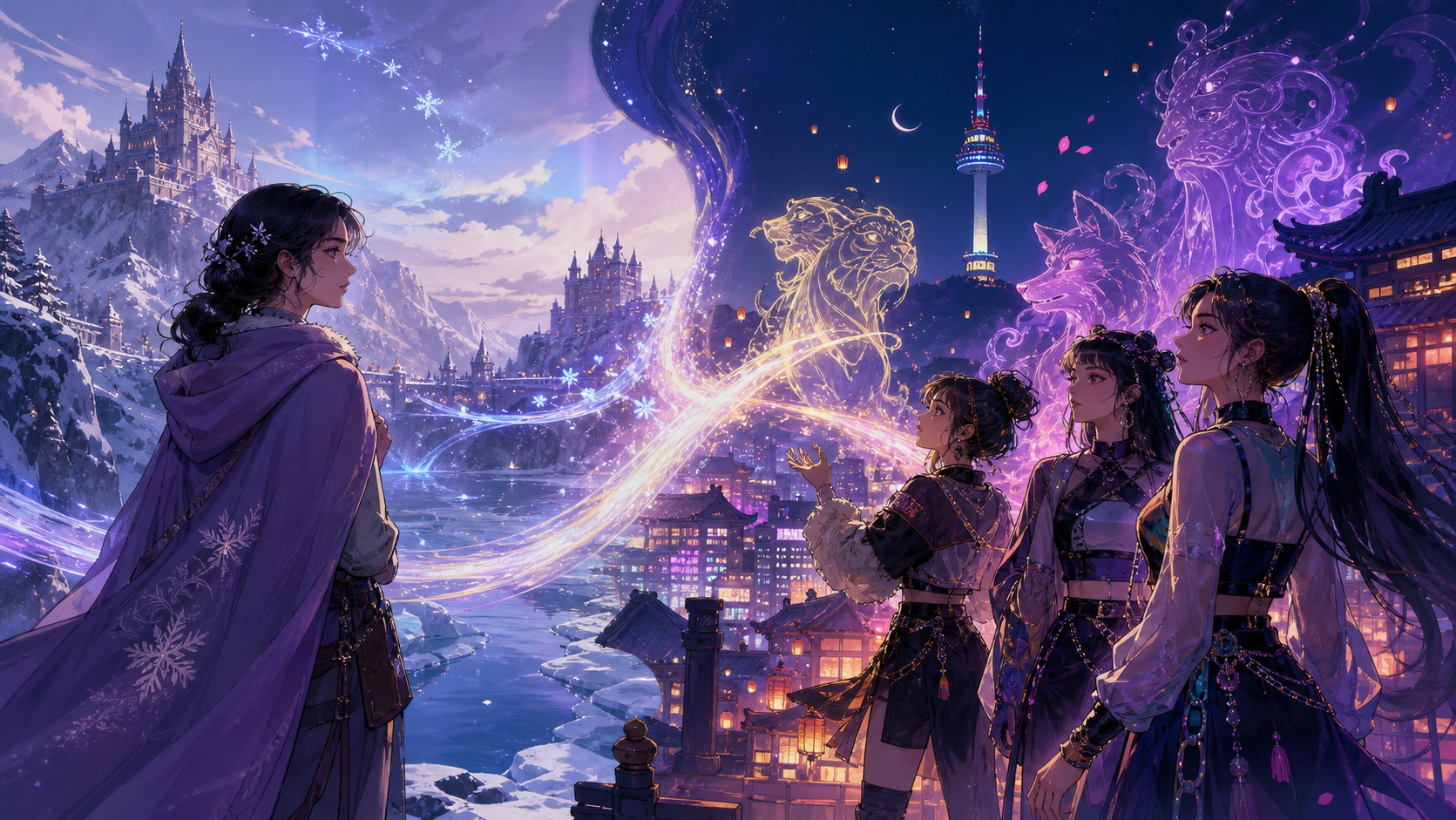
Frozen Was Universal. KPop Demon Hunters Had to Prove Korea Was.
Both movies give us women hiding dangerous power and songs about finally telling the truth. Frozen arrived with the Disney name, so audiences treated the kingdom like everybody’s story before pressing play. Korean fantasy had to prove that cultural specificity could belong to everybody too.
I love KPop Demon Hunters, which means I have now reached the dangerous stage of affection where I start comparing its treatment with a movie backed by the Disney industrial weather system.
Frozen is the obvious comparison, and not because “Golden” is the Korean “Let It Go.” It is not. The films have different structures, villains, family systems, romances, musical languages, and cultural jobs. But both center a woman whose body carries power she has been taught to hide. Both turn confession into a musical event. Both reject a familiar romantic rescue in favor of love between women. Both became sing-along phenomena much larger than the films that contained them.
The difference I keep circling is what each movie was allowed to be on arrival.
Frozen had a family name. KPop Demon Hunters had a suspiciously specific title.
When Frozen opened in 2013, critics read it through the Disney canon. Reviews asked whether the studio had returned to form, whether the songs belonged beside earlier classics, and how the sister story revised the princess formula. “Disney” supplied cultural permission. A Scandinavian-inspired kingdom, a talking snowman, trolls, Broadway songs, and a cursed queen did not make the film niche. They made it a fairy tale.
KPop Demon Hunters had Sony Pictures Animation craftsmanship and Netflix distribution, but the title sounded like three market categories stacked in a trench coat. K-pop. Demons. Hunters. To fans, that was a promise. To plenty of adults and critics, it looked like a brightly colored children’s product engineered from a trend.
Then people watched it. The critic score climbed, the audience score went ridiculous, the soundtrack invaded the charts, sing-along screenings topped the box office, and by 2026 the movie had won the Academy Awards for animated feature and original song. The “niche” story became Netflix’s biggest film phenomenon and did the very thing universal stories supposedly do: strangers carried it into their own lives.
“Let It Go” was allowed to mean more than one thing
Elsa’s song was discussed as liberation, isolation, queer resonance, self-acceptance, dangerous avoidance, female power, Broadway spectacle, and a song parents begged their children to stop singing in the car. Nobody required one official interpretation before taking the song seriously. Its contradictions became part of its life.
“Golden” also holds two truths. The song is an empowerment anthem and a panic attack with excellent production. Rumi sings about becoming what she is meant to be while secretly believing she must hit one impossible note so the marks on her body will disappear. The triumph is real. The bargain underneath it is awful.
That should have made “Golden” catnip for the same kind of cultural reading. Eventually it did. But first, a surprising amount of conversation treated the music as proof that the film had become popular, while Frozen was treated as popular because its music revealed the film’s meaning. One soundtrack was evidence. The other was text.
Specificity does not cancel universality
Frozen borrows Nordic settings, architecture, names, music, clothing, and Sámi elements. General audiences were not expected to arrive with a Scandinavian studies degree. They were allowed to recognize what they could and feel the rest.
KPop Demon Hunters asks for the same trust. A viewer does not need to know the history of minhwa to love Derpy Tiger. Knowing the tiger-and-magpie tradition makes the joke richer; it is not an entry exam. You do not need to translate jeoseung saja before the Saja Boys can work as demon idols. You do not need to locate Cheongdam Bridge on a map to understand friends fighting above a city they are trying to save.
People often call a Western story universal when they mean its cultural shorthand has been distributed long enough to feel neutral. Korea is not less universal. Some viewers are simply less practiced at seeing Korean details without labeling the whole experience “for somebody else.”
The female-power comparison is where things get interesting
Elsa’s danger comes from repression. The more she fears exposure, the less control she has. Rumi’s voice fails for a similar reason, but her shame is attached to lineage and a training system that divided the world into hunters and demons before she was born.
Elsa runs away and briefly mistakes solitude for freedom. Rumi stays onstage and mistakes perfect performance for freedom. Elsa builds an ice palace. Rumi tries to build a Golden Honmoon. Both women create something spectacular while still obeying the fear that drove them there.
The endings split. Anna’s act of love restores Elsa to relationship. Rumi chooses public truth, accepts her demon marks, and returns to Mira and Zoey without a cleaned-up body. HUNTR/X then creates a Rainbow Honmoon rather than completing the golden one inherited from earlier hunters. Frozen repairs the kingdom. KPop Demon Hunters changes the cosmology.
That difference matters. Rumi does not merely learn to control her power. She discovers that the supposedly pure system was wrong about what deserved protection.
Disney made theatrical abundance look natural
Frozen received a traditional global theatrical campaign, years of Disney brand trust, merchandise, soundtrack promotion, and the cultural weight of the princess line. Its success was enormous and deserved, but it was not an accident that occurred in a vacuum.
KPop Demon Hunters launched on streaming. Its theatrical life arrived later as a sing-along victory lap after viewers had already turned it into an event. When those screenings topped the box office, the story became “Netflix finally has a theatrical hit,” which is funny because audiences had done the part a normal distributor spends months arranging.
I am not arguing that the film was ignored. The critical response became excellent. The awards followed. What interests me is the order of belief. Frozen was welcomed as a major cultural object and then proved it. KPop Demon Hunters proved it repeatedly until institutions adjusted the label.
And no, one success does not mean the gate disappeared
The movie’s record-breaking run can become its own trap. Hollywood loves a breakthrough because a breakthrough lets everyone pretend the barrier is gone. One Korean-centered animated musical wins everything, and suddenly the next culturally specific project is asked why it is not producing the same charts, costumes, memes, children screaming lyrics, and award speeches.
Frozen was allowed to create a franchise because Disney franchises things as naturally as breathing. KPop Demon Hunters now has a sequel, but the creators still have to protect the thing people connected with: not generic neon “Asian” coolness, not a pile of K-pop references, but Korean characters living inside Korean visual and mythic language while being funny, messy, commercial, and emotionally legible.
What both movies understand about hidden power
Frozen and KPop Demon Hunters work because power is never only a cool ability. Elsa’s magic is tied to fear, family discipline, and the belief that love becomes dangerous when she loses control. Rumi’s voice and demon heritage are tied to secrecy, shame, duty, and a public identity built around destroying the thing she partly is. Both women perform competence while hiding the condition that makes competence exhausting.
The songs do narrative work because singing exposes contradictions that dialogue can keep managed. “Let It Go” sounds like freedom while Elsa is isolating herself on a mountain. “Golden” sounds like destiny while Rumi is trying to outrun a truth that could destroy her group. Viewers do not need to share the characters’ cultures to understand the gap between what a woman performs and what she fears people will discover.
Universal emotion does not require a culture-free setting. The specific rules create the pressure. Elsa’s royal obligations, family history, and magical inheritance shape her crisis. Rumi’s idol career, team loyalty, demon-hunting tradition, and Korean visual world shape hers. Remove those structures and both stories become thinner.
The gatekeeping happens before the audience arrives
Studios often talk about audience appetite as though viewers independently decide which stories feel universal. Distribution makes that decision first. Theater counts, dubbing, marketing budgets, homepage placement, press access, merchandise, school partnerships, and years of brand trust determine which movie enters daily life as an event.
Frozen arrived through a Disney machine trained to convert one release into songs, toys, costumes, theme-park appearances, television specials, sequels, and family tradition. A child did not need to search for Arendelle. Arendelle arrived at the grocery store. Familiarity then looked like proof that the story naturally belonged to everyone.
KPop Demon Hunters benefited from Netflix reach and Sony Pictures Animation craft, but its success still had to be interpreted through qualifiers. Commentators explained K-pop, Korean food, folklore, idol training, and why global viewers might connect. The same curiosity can be useful, yet constant explanation marks the story as culturally exceptional while Western fantasy remains the invisible default.
Specific details create the invitation
The tiger, magpie, gat, bathhouse humor, food, performance culture, and family expectations do not block emotional access. Those details give viewers something to enter. Audiences learn unfamiliar rules through character desire, conflict, repetition, and consequence. Nobody needs a graduate seminar before caring whether friends will accept a hidden part of someone’s identity.
Western viewers already practice this skill constantly. Most children have never lived in a monarchy, inherited ice magic, met a talking snowman, or traveled by reindeer. Fantasy trains them to accept unfamiliar conditions because the story makes the conditions matter. Asking Korean fantasy to dilute itself assumes cultural learning becomes difficult only when the culture is not European or American.
A story can still mishandle specificity. Decorative references without social meaning can become a checklist. Explanatory dialogue can flatten living culture into trivia for outsiders. The strongest details affect relationships, jokes, design, labor, family expectations, and the rules of the supernatural world.
What the industry should change
Stop using one breakout success as proof that the access problem has been solved. A single Korean-centered animated hit does not create equal development budgets, marketing support, theatrical access, or executive trust for the next ten projects. Success can become another obstacle when every new story is required to repeat the same numbers before receiving ordinary confidence.
Fund culturally specific projects before a trend proves profitable. Hire writers, directors, designers, musicians, historians, and cultural advisers early enough to shape the premise. Build translation and dubbing as creative work rather than cleanup. Market emotional hooks without hiding the culture that produced them.
Critics can also stop treating Western references as neutral knowledge. If an article explains a Korean dokkaebi, the same piece can explain the European folklore behind an ice palace or royal curse. Equal curiosity makes all fantasy cultural instead of assigning culture only to stories outside the default.
The better system would allow Frozen to remain Scandinavian-inspired corporate fantasy and KPop Demon Hunters to remain unmistakably Korean without forcing either movie to represent an entire civilization. Characters deserve room to be messy, commercial, funny, romantic, and culturally rooted at the same time.
The RaeRae verdict
Frozen and KPop Demon Hunters both deserved their receptions. This is not a demand to push Elsa off the mountain so Rumi can stand there. I like both movies. I have survived “Let It Go” in a home with children. I know what that song did to civilization.
The comparison exposes something else: “universal” is often an honor granted early to familiar Western stories and awarded late to everybody else after the numbers become embarrassing to ignore.
KPop Demon Hunters did not succeed by sanding Korea away. The film succeeded because the tiger stayed derpy, the magpie kept three eyes, the demons wore gat, the girls ate ramyeon, the songs behaved like K-pop songs, and Rumi’s shame still made sense to people who had never seen any of those things before.
Sources and receipts
Rotten Tomatoes: KPop Demon Hunters reception
Netflix: viewership, awards, songs, and film background
Associated Press: the sing-along theatrical box-office win
The Academy: KPop Demon Hunters’ 2026 wins
Rotten Tomatoes’ contemporary Frozen critics consensus
Metacritic: Frozen’s contemporary critical reception
TIME: Frozen’s early cultural phenomenon
The Korea Times: Korean folklore in the film