
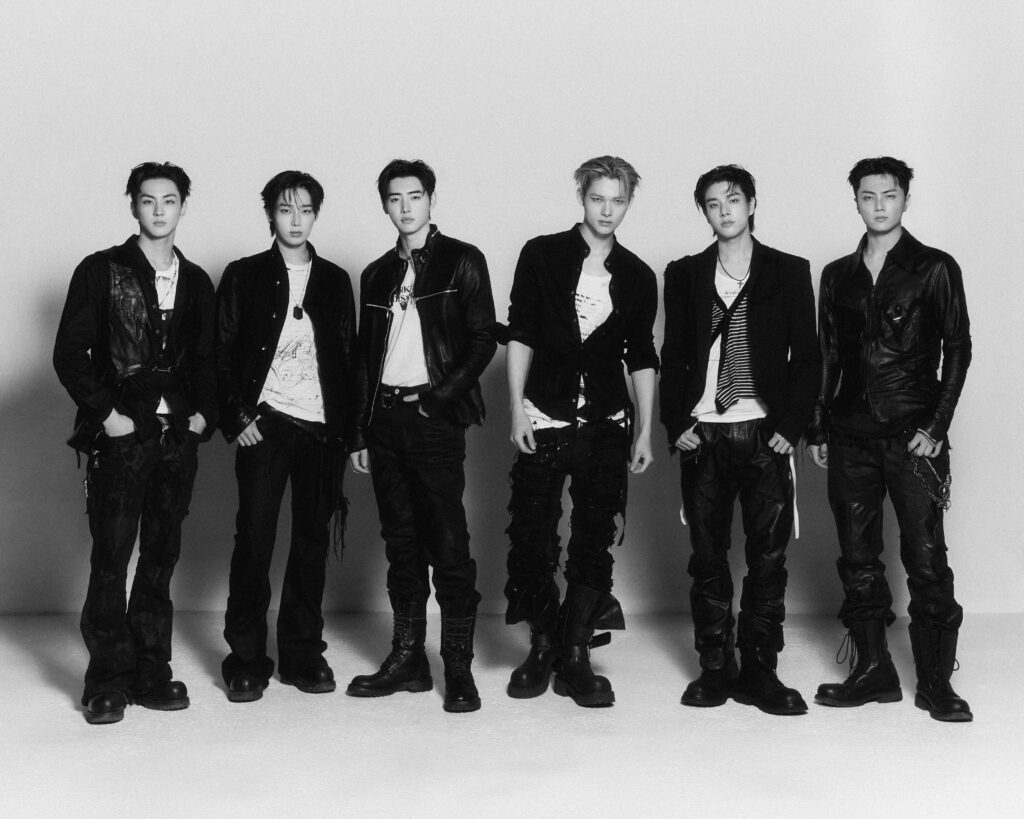
KNIFE
The vampires discovered trap music, bad decisions and a very expensive barbershop, then called the escape romantic.
Released: January 16, 2026
Lineup: Jungwon, Jay, Jake, Sunghoon, Sunoo and Ni-ki
Former member: Heeseung, now EVAN
Director: Ximin Oh of NOISYROOM
Sound: Trap drums, cutting synths and low-slung delivery
Story role: Fugitives choosing risk together
What changed every time I replayed it
First play: The vampires discovered trap music, bad decisions and a very expensive barbershop. The low drums, cutting synths and chant made seven men look dangerous while saying “knife” enough times to concern airport security.
Second play: The Clyde and Bonnie line made the story click. This is not a breakup song or a rescue fantasy. The lovers already chose the fugitive life. Fear did not disappear; they converted it into swagger.
Third play: I heard the structure’s limit. Once the chant lands, the arrangement protects it instead of twisting the blade. I wanted another verse or a bridge that changed the temperature before the exit.
Fourth play, video only: Ordinary hiding places became the smartest choice. Barbershop, café and kitchen scenes put supernatural hunger inside daily routines. The immortals are not brooding in a castle. They are trying to look normal while consuming sensation like they may leave in ten minutes.
Fifth play, choreography: The song became sharper. Blade-shaped hands, compact formations and abrupt direction changes gave the repeated chorus a physical reason to exist. Ni-ki stretched the groove, Jungwon snapped it back, and Jay attacked the harder phrases like he had waited several albums for permission.
Where I landed: I like “Knife” more as a complete audiovisual event than as a lonely audio file. The recording brings attitude. The bodies supply consequence.
What “Knife” means
The knife is risk. It is also the line the couple has decided to walk together. The chorus places them on a cold blade, dancing as if they are inside a movie and comparing themselves to Clyde and Bonnie. The point is not that danger appeared unexpectedly. They rolled the dice. They know exactly what they chose.
Inside THE SIN : VANISH, the song arrives during an escape story. The vampires are fugitives, hunted because their relationship crosses a boundary the surrounding world considers unacceptable. “Knife” is the moment fear turns into swagger. If society has already decided they are monsters, they may as well stop asking for polite permission.
That makes the romantic fantasy darker than “I will protect you.” The narrator admits anxiety and confusion, but keeps moving because the lover’s calm has become part of his courage. They are not safe. They are together. The song treats those facts as enough.
The song: sharp attitude, slightly blunt structure
“Knife” runs on contrast. The production is hard and metallic, yet much of the vocal delivery sits back in the beat. The members do not sound panicked. They sound amused that the pursuers still think fear will send them home.
Gaeko’s involvement matters. The phrasing leans closer to Korean hip-hop than the elegant dark-pop glide many listeners associate with ENHYPEN. The chorus is not trying to become another “Bite Me.” It is repetitive, physical, and built for a room full of people to shout while copying the blade gesture with their hands.
That choice is also the song’s weakness. Once the central chant lands, the arrangement mostly protects it. The track is short, the bridge does not radically change the temperature, and the ending arrives while I am still waiting for one final escalation. A knife should leave a cleaner cut than this fade from the room.
The vocal colors help. Heeseung and Sunghoon bring a thread of unease under the confidence. Jay sounds naturally at home in the harder attack. Jake gives the English phrases ease instead of classroom pronunciation. Jungwon’s clipped precision keeps the hook tight, while Sunoo adds expression to a song that could otherwise become one continuous smirk. Ni-ki treats the rhythm as a personal invitation to misbehave.
The romance is not healthy, but the story knows that
At the personal level, “Knife” captures the chemical rush of choosing somebody even when the choice will make life harder. The narrator does not confuse danger with a surprise. He sees the blade, names the fear and steps forward anyway. That makes the fantasy more honest than a rescue story where love magically removes consequences.
At the interpersonal level, the lovers operate as partners. The Clyde and Bonnie reference is reckless, but it removes the passive person waiting to be saved. They choose the escape together. The problem is that shared danger can feel like intimacy even when the relationship has no room to breathe. “Nobody understands us” can be romantic truth or the first sentence in a terrible group chat.
At the social level, ENHYPEN’s vampires remain useful because monsters reveal who gets treated as unacceptable. The surrounding world calls the relationship taboo, watches the couple and turns public space into surveillance. If society has already named them dangerous, swagger becomes armor. They stop begging the hunters to recognize their humanity and start performing the accusation on their own terms.
A Buddhist lens keeps the thrill from becoming wisdom. Craving promises freedom while tightening attachment. The fugitives chase sensation, food, speed, games and risk because the next jolt proves they are alive. The pleasure is real. So is the trap. The video understands both, which is why the smiling barbershop vampires still look hunted.
The escape fantasy still has a boss
The barbershop and café make the rebellion look casual, but the members are still fugitives. That difference matters. Freedom is not the same as having one unsupervised afternoon. The vampires can flirt, eat, dance, and wreck the furniture, yet every pleasure happens under the pressure of being found. The video gives them ordinary life in short bursts because ordinary life is the thing the system keeps denying them.
That is a useful idol-industry parallel. ENHYPEN sell danger, appetite, and supernatural freedom inside one of the most controlled jobs in entertainment. Schedules, cameras, contracts, public behavior rules, and fandom expectations follow an idol into spaces that would be private for most people. A performer can look untouchable on screen while asking permission for basic choices off screen. The contradiction does not ruin the fantasy. It explains why the fantasy has teeth.
The group’s lineup change adds another layer whether the video planned it or not. Heeseung left the group and now works as EVAN, while the six continuing members have to prove that ENHYPEN still means ENHYPEN. “Knife” turns that uncertainty into attitude. The six do not perform grief for an audience that wants a clean emotional script. They keep moving. That can read as cold if a fan expects public closure, but work does not pause until every relationship makes sense to strangers.
A Confucian lens makes the tension sharper. Loyalty to a group matters, but loyalty is not obedience without limits. A healthy relationship asks what each person owes the others and what the group owes each person. Fans often demand sacrifice in only one direction, then call it brotherhood. If staying destroys somebody, leaving may be the responsible choice. If the remaining members continue without rewriting the past, that can also be responsible.
My military brain recognizes the posture. When a team changes, the mission does not wait for everyone to finish processing the change. People cover the gap, check the equipment, and move. That practical response can look emotionally flat from outside. It is often how people protect the work and one another while the private part catches up later. “Knife” has that forward pressure. The song keeps its face hard because hesitation would let the hunters close the distance.
The video is still selling a fantasy, and I am not assigning a secret documentary to every haircut. The point is that the fantasy works because the group has real pressure around it. Six vampires choosing motion over explanation feels convincing when six performers are doing the same thing in public.
The music video: dopamine-addicted vampires on the run
Director Ximin Oh drops the seven members into ordinary places such as a barbershop, café, and kitchen, then lets supernatural danger leak through the furniture. That choice changes the vampire fantasy. They are not brooding in a remote palace. They are hiding in public, consuming ordinary life with the appetite of people who know they may have to leave in ten minutes.
Korean and Japanese coverage described them as dopamine-addicted vampires who treat taboo like play. That is exactly the energy. They do not merely survive pursuit. They seek sensation inside it. Food, speed, games, sharp objects, performance, and risk all become proof that they are still alive.
The video also keeps surveillance close. Eyes, cameras, watchers, and police presence suggest that the fugitives cannot disappear simply by changing locations. Even the playful spaces feel observed. They perform harder because privacy is already gone.
Then there is the car imagery, which split viewers. Some fans saw another exciting chapter in the running-couple story. Others felt ENHYPEN had returned to familiar vehicle shots and digital effects without finding a new visual grammar. Both reactions are fair. The speed fits the story. Repetition does not automatically become symbolism because the car is expensive.
Easter eggs and surprises
- Clyde and Bonnie: The lyric reverses the familiar order and frames the lovers as willing criminal partners. Nobody is waiting passively in a tower.
- The floating blade: The knife is both threat and invitation. Everyone reaches toward it because risk is the center of the pact.
- Ordinary locations: Barbershop, café, and kitchen scenes put immortal hunger inside daily human routines. Hiding is not peaceful when every normal room can become a chase scene.
- The eye and surveillance: Fans connected repeated watcher imagery to the album’s mysterious accomplice and the idea that the fugitives are being tracked.
- The hand choreography: The point move shapes a blade with the members’ hands, turning the title into something the body repeats even when the lyric pauses.
- Jay’s literal knife: Fandom treated the prop like a member finally making its debut. Honestly, after years of lore objects, the knife deserved a schedule.
- The movie language: The song calls the escape cinematic, and the MV answers with chase framing, police pressure, game imagery, and cool poses that know fugitives have never looked this moisturized.
The performance is doing unpaid labor
“Knife” becomes more convincing when the full choreography is visible. The blade-shaped hands, abrupt direction changes, and compact formations give the repeated chorus a reason to exist. Small sounds in the production receive physical accents. Ni-ki stretches the groove, Jungwon snaps it back into alignment, and Jay attacks the harder phrases like he has been waiting several albums for permission.
This is why judging ENHYPEN from audio alone can feel incomplete. Their title tracks often divide the work between recording, camera, and bodies. Here the recording brings attitude. The choreography supplies consequence.
The counterargument
The loudest criticism was not that “Knife” is bad. It was that the song does not sound specifically like ENHYPEN. Some listeners heard ATEEZ or NCT territory, too much processing, a generic modern trap track, and a video repeating cars and effects that the group had already used.
I understand the complaint. ENHYPEN’s best work can make dark romance feel uniquely theirs within seconds. “Knife” takes longer to reveal that identity because the production speaks in a broader K-pop hip-hop accent.
My counterargument is the album context. The fugitives have left the gothic room. Swagger is the emotional development. The sound needs to feel less elegant because the story has moved from longing to active escape. I still want a stronger final section. I do not need the group to remake “Bite Me” every time fandom gets nervous.
RaeRae verdict
I like “Knife.” It is cocky, physical, and more fun than its exhausted fugitive plot has any right to be. It is not my favorite ENHYPEN title track, and I am not going to pretend the chorus develops simply because seven beautiful people execute it with dangerous eye contact.
The music video and choreography raise the score. The song gives them a blade. The performance makes it sharp.
Best part: the contrast between public hiding places and shameless performance.
Biggest complaint: it needs one more musical escalation before the ending.
Replay danger: medium on audio, high with the video.
Final rating: 8.1/10 for the song, 8.8/10 for the full audiovisual event.
Receipts
- BELIFT LAB discography
- Official Weverse release and MV notice
- Weverse Magazine album review
- Billboard Japan on the MV concept
- Production credits from COREO
Keep digging: Start with the ENHYPEN group profile, then meet Jungwon, Jay, Jake, Sunghoon, Sunoo, Ni-ki, and former member Heeseung / EVAN.