
Isaak
He arrives in Kynswood carrying an upstairs accent, a little bow, and the kind of gossip adults dismiss—then spends one afternoon connecting drought, plague governance, servant ambition, and a murdered man.
Profile
Isaak is a minor page with a major narrative function: he makes information cross the castle’s internal class border.
Isaak is a young page from the Hayholt’s upstairs residence, three or four years younger than Simon and Jeremias. He has a thin, pale face that colors in the heat, carries an arch or small bow, speaks in a haughty upstairs tone, envies Jeremias’s possible guard introduction, and joins Morgenes’s drought-driven Kynswood expedition.
His scene could have been simple child comedy. Instead, Isaak brings news from Meremund: plague, family connection, Guthwulf’s response, and the burning of homes. His chatter gives the servant boys a view into the upstairs information network while exposing how rumor, kinship, and official action travel through children.
He also witnesses the expedition’s final rupture. The group goes into a shrinking wood for mushrooms and herbs because the drought has altered ordinary supply. They find a weeks-old northerner with a broken arrow buried in his torso. Isaak begins the chapter as a slightly superior page and ends it among children staring at evidence of concealed violence.
The profile should not inflate him into a secret analyst or future hero. Book 1 gives one concentrated appearance and a clear set of functions: class contrast, age contrast, information transfer, ambition comparison, drought ecology, plague politics, and shared witness. Deep coverage means making those functions legible while preserving the child himself.
Isaak remains last confirmed alive in the completed volume. No later-volume event belongs here until sequential reading reaches it. His current image is an explicitly child-safe Book 1 milestone, designed for later age progression without replacing this younger identity.
The Dragonbone Chair · Chronology
One drought-hot afternoon takes Isaak from upstairs confidence to a body nobody can explain away.
Drought sends a doctor and children looking for what ordinary supply no longer provides
On a hot Feyever afternoon, Morgenes leads Simon, Jeremias, Isaak, and younger boys into Kynswood for mushrooms and herbs. The expedition is practical, not recreational. Drought has changed the availability of medicinal materials and made the small forest more important.
Simon is assigned responsibility for the younger boys. Isaak therefore enters not as Simon’s equal but as one of the children placed under his emerging care.
Voice and clothing carry hierarchy before anybody explains it
Isaak’s haughty tone marks residence and status. He comes from upstairs service, where proximity to noble households gives a child cleaner presentation, different information, and confidence that distinguishes him from working boys like Simon and Jeremias.
He is not a prince. His superiority exists inside service, proving the servant world has its own layers. “Upstairs” can be privilege relative to a chandler’s assistant even while remaining subordinate to nobility.
Family relation turns distant crisis into credible household news
Isaak says his master’s wife’s brother is Meremund’s mayor. The chain matters because it explains how information about the plague reaches him. He is not presented as an eyewitness.
The canonical profile keeps the source chain visible: mayor to family connection to residence talk to page to expedition companions. Each handoff can preserve fact, distort detail, or add interpretation.
Containment becomes execution when homes are sealed and burned with families inside
Isaak reports that Guthwulf sealed plague-stricken households, heard people howl, and burned the homes unopened. The account links disease governance to military power and makes the impossibility of victim testimony part of the horror.
Book 1 presents this through reported speech, so the profile attributes it to Isaak’s news rather than pretending direct observation. The political meaning remains: emergency authority can make killing sound like containment.
The younger page sees a guard introduction as possibility, not yet as class humiliation
Isaak envies Jeremias’s potential introduction to the Erkynguard. The reaction confirms that military service carries aspirational prestige across different servant ranks.
He does not yet know Breyugar will reject the older boys. For Isaak, the letter is access. For the reader, his envy helps measure how powerful the fantasy remains before the gate closes.
The pale page visibly colors while the land dries around him
Isaak’s thin pale face flushes in the heat. The physical detail is small and precise, grounding the unnatural season in a child’s body rather than leaving drought as landscape.
He is equipped with a small bow, but the expedition’s real challenges are heat, gathering, rumor, and discovery. The weapon does not make him a warrior.
The forest meant to provide medicine produces a warning with the identifying evidence broken off
The children and Morgenes find a northerner dead for weeks with a broken arrow buried in his torso. The snapped shaft frustrates easy identification. Isaak shares the discovery but does not solve it.
The corpse changes the scale of everything he has said. Plague, northern movement, political rumor, and military ambition no longer float safely upstairs. Violence is physically present in Kynswood beside the Hayholt.
Upstairs, downstairs, and rank within service
Isaak proves that “servant class” is not one flat floor.
The Hayholt’s labor world contains gradients. Simon works in scullery and errands before apprenticeship. Jeremias assists a chandler. Isaak serves upstairs as a page. All remain subordinate, but their clothes, speech, information, patrons, and imagined futures differ.
Isaak’s haughtiness can be annoying without making him a villain. Children imitate the hierarchies that organize adults around them. An upstairs tone may be one of the few status resources available to a boy who still answers to a master and noble household.
His family-information access demonstrates the benefit. Because his master’s wife is connected to Meremund’s mayor, Isaak hears about plague response far beyond his age or formal authority. Proximity to a privileged household creates an information advantage that travels with him into Kynswood.
Yet the advantage does not free him from envy. Jeremias’s possible guard letter represents another kind of access, and Isaak wants it. Hierarchy does not eliminate aspiration; it multiplies small comparisons. The upstairs page can look down on working boys and still believe one of them may be approaching a door closed to him.
The expedition temporarily rearranges rank. Simon is made responsible for younger children, including the page. Knowledge and duty move across household status. Isaak’s blue tunic cannot protect him from heat or prevent him from witnessing a murdered body.
News, rumor, and evidence
Isaak teaches the fandom page how to cite a child correctly: preserve the source chain and do not downgrade the consequence.
The plague account reaches the reader through multiple layers. Isaak identifies a family connection to Meremund’s mayor and repeats what is known or believed about Guthwulf’s measures. He is a reporter inside the scene, not the original witness.
That distinction matters. A bad profile turns every reported detail into omniscient fact or dismisses all child speech as gossip. The text gives enough specificity to treat the report seriously while still labeling its route. Responsible fandom can hold both.
The content is politically explosive. Sealing sick families inside their homes and burning them makes state containment indistinguishable from execution. The victims’ cries do not produce review, testimony, or appeal. Emergency action closes the evidentiary loop by killing the people who could contest it.
Isaak’s age sharpens rather than trivializes the scene. Children overhear governance. They repeat adult explanations before fully understanding them. The horror of the policy travels as residence news, which shows how quickly atrocity can become household conversation.
The murdered northerner provides a different evidence problem. The body is direct; the killer and affiliation are not. The broken arrow suggests identifying information has been removed or lost, but intention remains unproved. Isaak’s chapter therefore pairs reported certainty about distant violence with immediate uncertainty about nearby violence.
Children inside adult crisis
Book 1 does not keep plague, drought, displacement, and murder outside the children’s field of vision.
Isaak is young enough that the art must remain explicitly child-safe, yet the narrative does not protect him with a child-only subplot. He walks through environmental crisis, hears of families burned alive, competes over military access, and helps discover a corpse.
This is not evidence that Osten Ard treats children as miniature adults in every respect. Simon is assigned responsibility for the younger group precisely because age differences matter. Isaak’s physical vulnerability appears in his thin build and flushed face.
The small bow is a useful symbol if handled carefully. It suggests preparation, status, or training without proving combat experience. The canonical image keeps it slung while Isaak studies a mushroom. Knowledge gathering, not weapon display, defines the verified scene.
His presence also prevents Simon and Jeremias from occupying the universal category of “boys.” They are older, more physically developed, and already planning escape into the guard. Isaak’s youth makes their adolescence visible by contrast.
When the group finds the northerner, the story refuses to separate education from danger. Morgenes’s herb lesson becomes an encounter with political evidence. Isaak learns that the woods beside home contain consequences adults have not explained.
Relationships
Isaak’s brief scene builds a network of masters, family information, older boys, medicine, ambition, and death.
Doctor Morgenes
Morgenes brings Isaak into Kynswood for herbs and mushrooms. The doctor’s practical need places the page inside a scene of ecology and evidence.
Simon
Simon is made responsible for the younger boys. Isaak’s presence tests his movement from supervised servant toward accountable apprentice.
Jeremias
Isaak envies the chandler boy’s possible guard introduction, revealing how patronage can make a lower-status peer appear suddenly advantaged.
Isaak’s unnamed master
The master anchors Isaak’s upstairs role. Book 1 does not identify the person or specify duties beyond page service.
Master’s wife and Meremund’s mayor
The wife’s brother is the mayor, providing the reported route by which plague news reaches the residence and Isaak.
Duke Guthwulf
Isaak attributes the sealing and burning of infected homes to Guthwulf. He reports rather than witnesses the acts.
The unidentified northerner
The corpse turns expedition into investigation. Isaak witnesses the evidence but supplies no theory of killer or allegiance.
The Erkynguard
The guard introduction fascinates him as upward possibility. Breyugar’s later rejection of the older boys remains outside Isaak’s immediate knowledge.
Kynswood
The drought-reduced forest supplies herbs, heat, class mixing, political news, and a concealed body within one concentrated afternoon.
Fandom notes and scope control
Isaak deserves more than “a page who found a body,” but not an invented adulthood.
Book 1 supplies exact age relation rather than exact age: three or four years younger than Simon and Jeremias. The portrait interprets that relation as roughly ten or eleven for a child-safe visual milestone. The numeric age is art continuity, not a direct quotation.
The source says he carries an “arch,” understood in context as a bow. The profile preserves that note without converting Isaak into an archer, soldier, or combatant. No scene establishes that he fires it.
What the text describes
Isaak has a thin pale face that colors in the heat, already carries the bow, speaks with a haughty upstairs tone, envies Jeremias’s introduction, shares Meremund news, and joins the Kynswood discovery.
What remains unknown
Book 1 does not give surname, exact age, parents, birthplace, master’s identity, eye color, hair color, height, formal education, bow skill, later duties, or final fate. The blue tunic, light-brown hair, herb basket, and safely slung bow are coherent visual decisions, not added biography.
Canonical identity and child-art lock
Pale, slight, heat-flushed, neatly dressed, self-important, curious, and unmistakably a child.
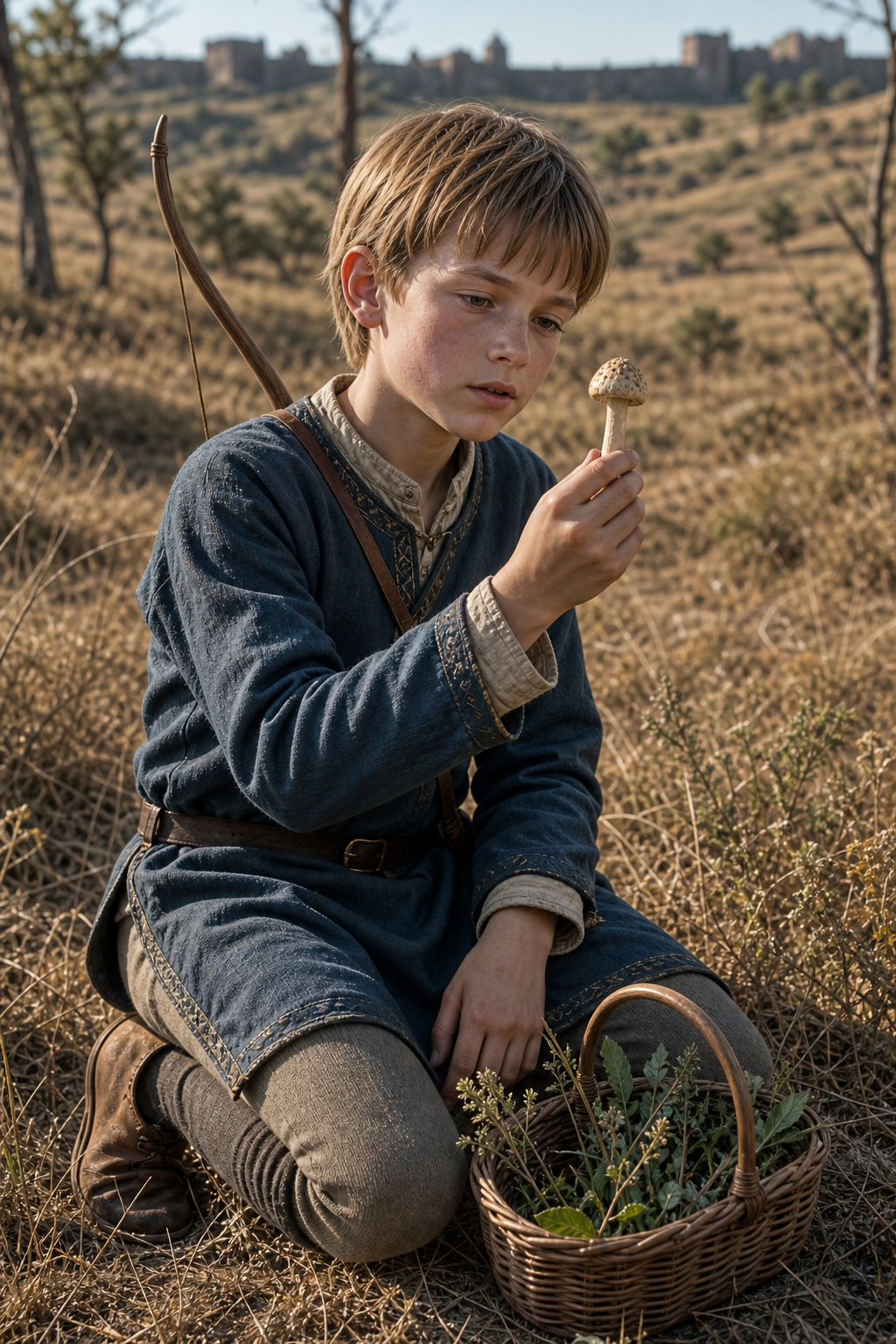
The Book 1 image fixes Isaak as a slight preteen with a narrow pale face flushed by heat, light-brown page-cut hair, alert eyes, neat muted-blue wool tunic with simple trim, linen underlayer, belt, hose, boots, herb basket, and small wooden bow safely slung behind him.
He kneels in dry Kynswood studying a mushroom while the Hayholt wall sits beyond drought-yellow grass. The image centers gathering and observation, not combat. His cleaner clothing distinguishes upstairs service without dressing him as nobility.
On the record
What this profile can prove today
This canonical profile covers Isaak through The Dragonbone Chair: age relation, physical description, upstairs page status, haughty tone, small bow, Kynswood expedition, heat flush, Meremund family-information chain, plague report, Guthwulf allegation, envy of Jeremias’s guard introduction, and discovery of the murdered northerner.
Source: owner-accessed Kindle edition of The Dragonbone Chair, verified front-to-back through page 652 of 652 and reconciled with the complete Book 1 character manifest. Later-volume material is intentionally excluded until sequential reading reaches it.
The Dragonbone Chair hub → · Book 1 characters → · Simon → · Jeremias → · Doctor Morgenes → · Series hub →