
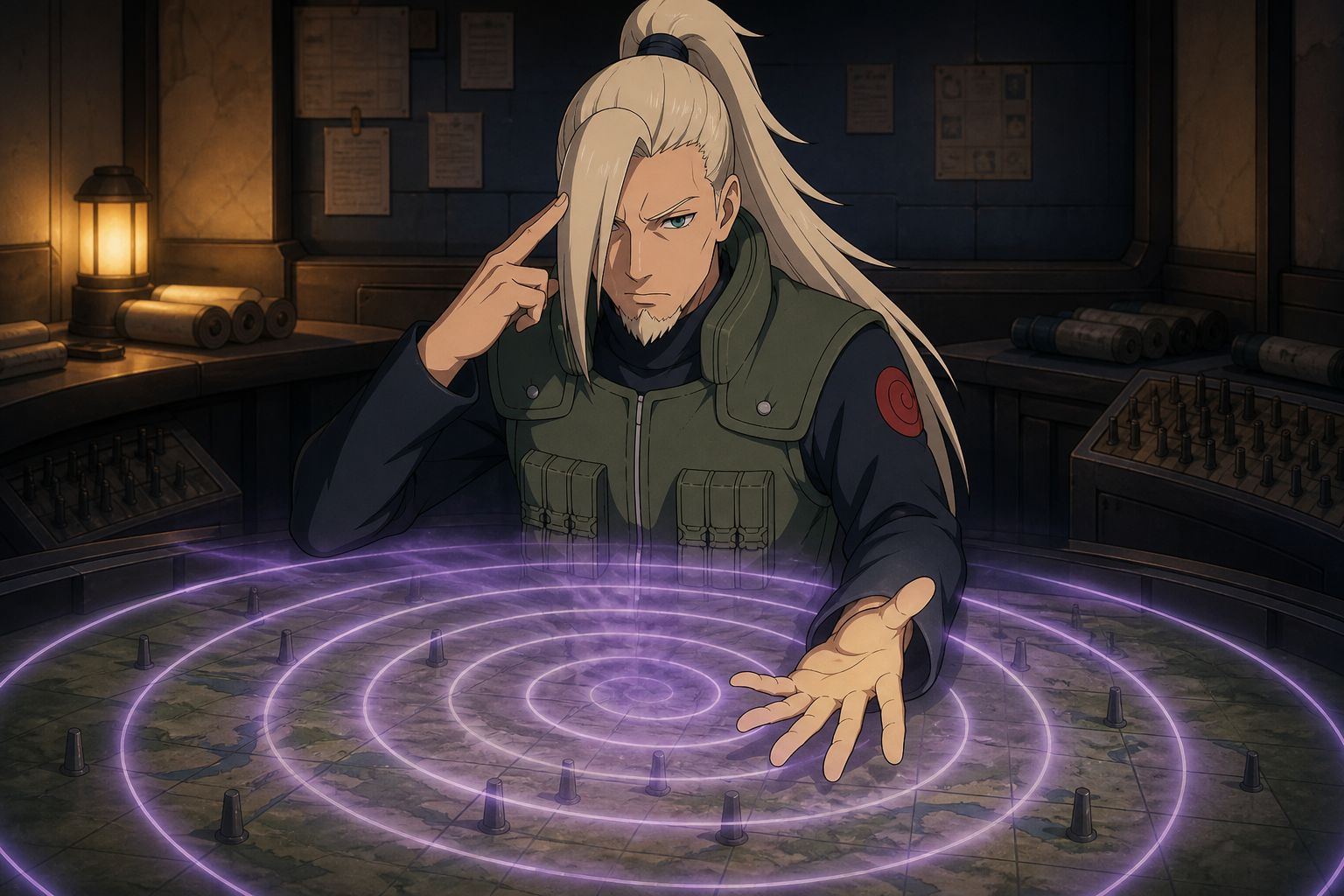
Naruto · Complete Character Profile
Inoichi Yamanaka
Konoha calls him a clan head, interrogator and battlefield communicator. RaeRae calls him the man who proves that information is a weapon, care is infrastructure, and a father’s last words can still move an army.
The bottom line
Inoichi Yamanaka’s complete Naruto profile covers Yamanaka mind techniques, Ino-Shika-Chō, Ino, Konoha intelligence, war communications, death and legacy.
Inoichi Yamanaka is one of the adults keeping Naruto’s world alive while flashier men collect the posters. He reads hostile minds, coordinates field intelligence, maintains a hereditary formation, raises a daughter who can challenge him, and dies sending useful information instead of wasting his last seconds on a speech about himself. That résumé deserves more than “Ino’s dad.”
His story also exposes one of Konoha’s ugliest habits. The village praises sacrifice so often that skilled adults become equipment with names. Inoichi accepts duty, but acceptance does not make the cost clean. His final transmission helps the Allied Shinobi Forces survive. It also leaves Ino Yamanaka to process her father’s death while continuing the job he taught her. Naruto loves inheritance. Inoichi makes us look at the bill attached to it.
Inoichi Yamanaka essential file
The published character record does not provide Inoichi’s Academy graduation age, chūnin promotion age, a D-through-S mission breakdown, or a numerical databook combat-stat sheet. The previous live copy listed invented promotion ages and 647 missions. Those numbers are removed. A reference box is supposed to clarify the record, not reward counterfeit confidence.
Name and design: a mountain family carrying flowers into a war room
Yamanaka is written with characters commonly read as “in the mountains.” Inoichi’s given name participates in the clan’s long-running boar wordplay, while the family business and naming habits keep flowers close to the clan identity. Translation notes should stay modest because names can carry sound, pun and family pattern at the same time. A profile becomes silly when one dictionary gloss is treated like Kishimoto hid a full prophecy inside every syllable.
Visually, Inoichi shares the pale blond hair that helps readers recognize the Yamanaka line immediately. His long hair, goatee, flak jacket and adult build give him a practical elegance. He looks related to Ino without becoming an older copy of her. The design also avoids dressing intelligence work like mad-scientist theater. Inoichi can enter a mind, extract information and relay strategy across a battlefield while still looking like a Konoha professional who expects to return to a family home.
That normalcy is important. Naruto often hides institutional violence behind ordinary uniforms. Inoichi’s tools are invasive, but the series does not mark him as monstrous with horror-costume shorthand. The ethical question therefore stays where it belongs: in what he does, why he does it, what safeguards exist, and who pays when Konoha decides an enemy mind is a usable room.
Yamanaka Flowers keeps beauty beside intelligence work
Inoichi is also identified as proprietor of Yamanaka Flowers, and cultivating flowers is listed among his interests. That detail is not soft garnish taped onto the interrogator. It places clan life inside an ordinary village economy where people sell arrangements, mark celebrations, and carry grief through plants while the same family supplies invasive intelligence techniques to the state.
The contrast makes the Yamanaka more interesting, not less coherent. Flower cultivation requires attention, timing, memory, and care for living material that cannot be bullied into blooming. Mind work also depends on attention, but shinobi institutions can turn attention into extraction. Inoichi lives at that uncomfortable intersection. He can raise bush clover as a symbol for his daughter and enter another person’s memories for Konoha before dinner.
The Yamanaka clan is not “the mind-control family” and done
The Yamanaka clan’s secret techniques work through consciousness, possession, telepathy, sensory connection and information transfer. That range makes the clan valuable in combat, interrogation, communications and village security. One bloodline can therefore serve several departments that fandom often treats as unrelated. Konoha’s flower shop and its intelligence division are not random halves of Ino’s life. Both depend on reading conditions, recognizing signals and handling living things with precision.
Inoichi leads the clan during an era when inherited techniques remain strategic state resources. The story never gives us a neat public charter explaining where family authority ends and village command begins. That absence deserves notice. Konoha benefits from generations of Yamanaka knowledge, while the family carries responsibility for training, secrecy and deployment. The arrangement looks honorable from the Hokage Monument. From inside the household, inherited service can feel like a career chosen before a child understands the job.
Inoichi does not erase that tension, but he improves the inheritance by taking Ino seriously. He does not freeze clan knowledge at his own level or demand that his daughter remain a weaker copy. By the war, her reach begins surpassing the scale fans associated with him. A fragile patriarch would resent that. Inoichi’s legacy depends on welcoming it.
The original Ino-Shika-Chō is a working system, not nostalgic wallpaper
Inoichi, Shikaku Nara and Chōza Akimichi form the previous generation of Ino-Shika-Chō. The names produce the familiar boar-deer-butterfly pattern, but the formation survives because the abilities solve one another’s weaknesses. The Yamanaka member can seize or contact a mind while leaving the body vulnerable. The Nara member restrains movement and creates tactical openings. The Akimichi member supplies protection, area control and decisive physical force.
That design is one of Naruto’s clearest arguments for interdependence. None of the three needs to be “the strongest” in every category. The point is that specialization becomes safer and more powerful when partners understand the cost of each role. Shikaku can build a plan because Inoichi can move information. Inoichi can risk mental techniques because Chōza can protect the body. Chōza can commit force because the others shape the target and timing.
The trio also becomes a social institution passed to their children. Tradition helps Shikamaru, Ino and Chōji inherit trust faster than strangers could build it. Tradition also pressures them to perform old relationships on command. Asuma Sarutobi succeeds because he turns a clan arrangement into an actual team with chosen loyalty.
Festival father and Konoha defender belong to the same adult
Inoichi first appears around the Chūnin Exam festival with Shikaku and Chōza. The anime lets the older friends drink, talk, and tease him about raising a daughter. Then Konoha Crush turns the reunion into defense. Inoichi uses Mind Body Disturbance to make invading shinobi attack their own allies while the original formation protects the village.
The shift matters because it prevents the intelligence officer from becoming a war-room prop. He has a household, a flower shop, old friends, and a daughter whose exam is happening under the same stadium used to conceal an invasion. When he says the trio was once known across nations, Chōza answers that they still are. The boast lands because their cooperation is not nostalgia. It still changes who survives.
Inoichi raises a daughter, not a replacement part
Ino’s confidence, bluntness and social intelligence do not appear from nowhere. Inoichi’s parenting is not documented with the scene count Sakura or Sasuke receive from their central relationships, so a careful profile cannot invent nightly lessons and perfect conversations. What the record does show is a father embedded in the same clan system his daughter will inherit, a veteran who recognizes her capability, and a man whose final trust lands on her rather than around her.
He also exists beside a flower-shop household. That detail gives the family a civilian-facing life outside classified work. Customers do not need to know who interrogated an enemy operative last night. Flowers, memorials, celebrations and village commerce continue. Ino grows up learning that a person can be a shinobi, worker, friend, daughter and future clan leader without pretending one identity cancels the rest.
Their final relationship beat is brutal because the war does not grant private time. Inoichi cannot sit beside Ino, explain everything and close the relationship with polished wisdom. He sends information while headquarters is targeted. She receives death as both daughter and communications ninja. The scene works because love and labor arrive on the same channel. That is not healthy work-life balance. That is war stealing the boundary altogether.
Teaching Ino means accepting that medical training strengthens the inheritance
In the anime’s joint Chūnin Exam material, Inoichi teaches Ino a higher Yamanaka technique but worries that her medical training has pulled attention from clan practice. Tsunade answers the concern directly: medical ninjutsu develops the chakra control Ino needs to perform mind techniques more safely and precisely.
Inoichi listens. That response matters more than being initially correct. Clan elders can mistake tradition for a closed curriculum, especially when a daughter combines fields the previous generation kept separate. Inoichi recognizes that Ino may become the strongest member of the clan because she is not copying him cleanly. Her medicine, sensory growth, relationships, and telepathy make the inheritance larger. A proud father should be able to survive being surpassed.
Complete technique shelf: power enters the mind, and the body pays for the trip
Mind Body Switch Technique
The clan’s signature possession technique sends the user’s consciousness into a target. The reward is direct control. The danger is immediate: the user’s own body becomes helpless, a missed shot can leave consciousness exposed, and harm to the occupied body can rebound on the user. Accuracy, protection and timing are therefore part of the technique, not footnotes for people trying to rank it.
Mind Body Disturbance and higher control
Advanced Yamanaka applications can disrupt or manipulate targets without reducing every encounter to the basic straight-line exchange audiences first learn through Ino. Inoichi’s experience supports a broader professional shelf than one classroom demonstration. Still, mental techniques do not become a universal “I win” button. Range, resistance, divided attention, target conditions and the user’s physical vulnerability keep consequences in the room.
Mind transmission
Telepathic communication becomes Inoichi’s defining wartime function. The technique can carry messages across distance and, with relay support and equipment, connect command to enormous groups. The official technique description emphasizes that effectiveness varies by user, number of recipients and distance. That variability is the whole point. The jutsu is a network whose scale depends on skill and infrastructure, not magic Wi-Fi with infinite bars.
Sensory and interrogation applications
Inoichi searches memories, identifies information and works with Konoha’s intelligence apparatus. Mental entry can save lives when an attack is coming. It can also violate the most private territory a person owns. Naruto rarely slows long enough to draft a civil-liberties policy, so RaeRae will say the uncomfortable part: useful intelligence does not automatically make every method righteous. Context, necessity and accountability still matter.
The body always remains inside the mind technique
Yamanaka techniques can look clean because the decisive action happens through consciousness. The body disagrees. Mind transfer leaves the user’s own body vulnerable. Mass telepathy strains Inoichi hard enough to cause bleeding and fatigue. Interrogation devices accelerate memory search, but mental traps can injure or mislead the operator.
Inoichi’s war network also depends on other specialists and machines. He cannot sense every hidden enemy without stable chakra information, cannot deliver a strategy nobody creates, and cannot keep an unlimited connection open because the plot needs convenience. These limits make his contribution more impressive. He holds a network together while knowing every additional mind increases the load.
Konoha intelligence turns another person’s interior into state territory
Inoichi’s work after Jiraiya’s death and during Pain’s approach shows why Konoha depends on specialized analysts. A captured Amegakure ninja may hold information that determines whether thousands live. Interrogators cannot wait for a villain to provide a helpful slideshow. Inoichi’s ability gives the village access to memories, associations and operational clues that ordinary questioning may never reach.
The moral problem does not disappear because Pain is dangerous. Shinobi villages normalize body invasion, child deployment, assassination and psychological coercion while calling the whole package duty. Inoichi is more humane than the system’s cruelest operators, but competence inside an invasive institution is still worth examining. The series gives us enough to understand necessity. It gives us less about consent, false interpretation, trauma after extraction or limits on what officers may search.
That gap is not proof Inoichi abuses everyone. A fan site should not manufacture crimes to sound daring. The gap is evidence that Naruto’s political imagination spends more time on heroic intentions than administrative safeguards. Inoichi becomes interesting because he is a decent man holding a power that would terrify any civilian who understood it.
Pain’s assault proves intelligence work is action even when nobody throws a punch
During the investigation into Pain, Inoichi works with the information recovered from Amegakure. The plot’s urgency depends on connecting Jiraiya’s clues, the captured operative and Konoha’s available knowledge before the enemy arrives. When Pain attacks anyway, the audience sees the cruel limit of intelligence: knowing more can improve response without guaranteeing prevention.
The arc also places Inoichi near the village’s logistical center while his daughter fights and survives elsewhere. Naruto’s adults are often separated from their children by assignments that both understand professionally and fear personally. Inoichi cannot hover over Ino. She cannot demand that her father stop doing a job that protects everyone. The family’s duty works because they trust one another, and that trust is precisely what the village consumes.
After mass destruction, Konoha rebuilds its structures and personnel networks. Intelligence is part of that reconstruction. Walls can be raised again. Institutional memory, trained specialists and communication habits take longer. Inoichi belongs to the invisible continuity that lets a village function after the dramatic battle has ended and the hero has received applause.
Hanare and Yūdachi expose the ethics of entering a mind
The anime places Inoichi in charge of interrogating Hanare. When conventional methods fail and a childhood memory of Kakashi appears, he sends her to Kakashi to test recognition. During Pain’s assault, the manga gives him a harsher task: probing Yūdachi’s protected memories with an amplification device until he finds Pain’s demand for corpses.
Skill does not settle consent. Konoha treats an enemy mind as state territory because the village is under threat, and Pain’s booby traps prove the other side understands that mental space is a battlefield. Inoichi can be calm, perceptive, and less cruel than another interrogator while still participating in coercive extraction. Ethics needs rules stronger than “the operator seems nice.”
War headquarters: Shikaku makes the plan, Inoichi gives the plan a nervous system
During the Fourth Shinobi World War, Inoichi serves at Allied Shinobi Forces headquarters with Shikaku and senior representatives from the coalition. Strategy without transmission is a notebook. Transmission without strategy is noise. The pair turns observation into orders and orders into coordinated movement across forces that were enemies not long before.
That achievement is political as well as technical. Five major villages cannot cooperate merely because leaders declare unity. Soldiers need common information, trusted channels and enough speed to react before old suspicion takes control. Inoichi’s telepathy helps create temporary shared attention. For a story obsessed with whether people can understand one another, the communications room is one of the franchise’s most literal answers.
The macro view matters. Naruto and the major fighters shape the battlefield. Headquarters manages thousands of bodies, supplies, divisions and decisions beyond the camera’s favorite duel. Inoichi represents every worker whose competence makes heroism possible: dispatcher, analyst, medic, technician, interpreter, operator. Fandom calls these roles “support” as if support means optional. Remove the network and watch the stars start guessing.
Sensing and telepathy turn one specialist into battlefield infrastructure
Inoichi is described as the strongest sensor of his clan and can follow a target through a stable chakra signature. At Allied headquarters he works with Ao to support a wide detection barrier and the Sensing Water Sphere, giving command a changing picture of multiple battlefields instead of isolated reports.
His telepathy then distributes Shikaku’s plans across distance. He connects individuals, divisions, Naruto and Killer B, and finally the entire Alliance. When asked for a fifteen-second broadcast, he bargains down to ten, pushes through twenty, and pays with a nosebleed and exhaustion. That physical cost is the receipt. Communication at scale is power, and the nervous system can burn while everyone else hears only the message.
The Ten-Tails attack kills headquarters, not the responsibility moving through it
Once the Ten-Tails gains the range to target headquarters, Shikaku and Inoichi understand they have almost no time. The official Naruto retrospective states the essential sequence plainly: they leave one final strategy to their children and perish when the headquarters is struck. No rescue arrives. No substitution turns the blast into a fake-out. The story allows the command center’s people to die at work.
Inoichi’s final act is communication. That choice suits him without making death beautiful. He does not win because dying is noble. He wins a narrow, terrible victory because the message survives him and helps others continue. The distinction matters. Naruto sometimes flirts with the idea that sacrifice cleans every institutional failure. Inoichi’s death should instead make viewers ask why the coalition needed so many essential people concentrated in one target and what redundancy a real command network should have built.
Ino receives the loss and keeps functioning. That is courage. It is also shock shaped into labor because the battlefield offers no protected mourning period. Later praise for her strength should never erase the cruelty of that demand. The daughter does not become impressive because grief was good for her. She becomes impressive because grief failed to stop the care and discipline already present.
Ino inherits the work and the grief at the same time
Before headquarters is destroyed, Inoichi tells Ino that he is proud of her and that she has blossomed into the bush-clover meaning he hoped she would carry. The message reaches a daughter who must continue fighting instead of receiving a body, funeral, or protected hour to fall apart.
Ino soon takes on communication responsibilities that prove the praise was not sentimental charity. She helps relay thought across the Alliance, later leads the Yamanaka clan, protects Konoha through sensory infrastructure, and becomes a parent herself. Consequence means those achievements do not cancel her loss. She becomes capable enough to carry his work because he trained and trusted her, then pays for that inheritance with absence.
Relationship atlas: the people inside the network
Ino Yamanaka
Daughter, student, heir and eventual proof that inheritance can exceed its source. Their bond peaks when family feeling and battlefield communication become impossible to separate.
Shikaku Nara
Lifelong teammate and wartime command partner. Shikaku’s strategy needs Inoichi’s relay, while Inoichi’s network needs decisions worth carrying.
Chōza Akimichi
The third member of the original formation and its physical shield. Their partnership gives the younger trio a living model rather than a clan diagram.
Asuma Sarutobi
Teacher of the next generation. Asuma turns inherited compatibility into chosen loyalty, then leaves the parents to help their children carry another battlefield loss.
Shikamaru and Chōji
His daughter’s teammates are also the children of his closest partners. That overlap turns clan tradition into extended family responsibility.
Allied Shinobi Forces
Most soldiers never know him personally. They still depend on his voice. His widest relationship is professional trust at mass scale.
Daiki Nakamura and the original Japanese performance
Daiki Nakamura performs Inoichi in the original Japanese anime. His credit is verified. The role moves among domestic comedy, clan instruction, interrogation, Pain-era analysis, mass telepathy, paternal pride, and a final farewell delivered while Allied headquarters is already marked for death.
I am not inventing breath placement, pitch, pauses, or line-timing analysis without the heard Japanese scenes. Listing the dramatic contexts shows what the role must carry. It does not turn a cast table into criticism. No English-dub material belongs in this character profile.
Duty, reciprocity and attachment: three ways to read Inoichi’s inheritance
A Confucian lens highlights the chain connecting parent, child, teacher, team and village. Inoichi receives clan knowledge, practices it with peers, gives it to Ino and trusts the next generation to carry public duty. Reciprocity keeps that chain ethical only when elders also protect the young. “Obey because tradition exists” is hierarchy. “I trained you, trust you and accept your growth” is relationship.
A Buddhist lens makes the final transmission hurt differently. Inoichi cannot keep his body, role or family life permanent. Attachment is not the same as love, and impermanence does not order people to feel nothing. The scene asks Ino to let the form of the relationship change while acting on what remains. Memory becomes conduct. The father’s voice ends, but the practice of connection continues through the daughter.
A modern labor lens sees care infrastructure. Communication work is feminized or minimized in many cultures because audiences notice the person swinging the weapon more easily than the person coordinating everyone around it. Inoichi complicates that bias. His telepathy is spectacular enough to be called ninjutsu, yet the function resembles dispatch, analysis and crisis communication. The work saves lives before anybody can turn it into a flashy finishing move.
Eight fandom shortcuts that flatten Inoichi
- “He is only Ino’s father.” Fatherhood is central, but so are clan leadership, interrogation, sensory work and alliance communications.
- “Shikaku did all the thinking.” Strategy that cannot reach the field is useless. Inoichi gives command operational scale.
- “Mind techniques guarantee victory.” They require aim, protection, stamina, compatible conditions and risk management.
- “The Yamanaka are support, so they are weaker.” Support describes function, not dispensability. An army without communication is a crowd holding weapons.
- “His death exists only to develop Ino.” Her grief matters, but the attack also destroys coalition command capacity and changes the war’s operating structure.
- “Dying at work proves perfect loyalty.” His choice is brave. The institution’s loss of essential staff remains a preventable systems question.
- “Clan tradition removes individual choice.” Tradition shapes the available path, but Ino develops the inheritance through her own decisions and relationships.
- “A kind interrogator solves the ethics.” Character matters, but invasive power still needs limits beyond one operator’s personality.
Manga, anime, film, OVA, and game record
Kishimoto’s manga controls Inoichi’s central chronology from Chapter 137 through the destruction of Allied headquarters. The principal anime adapts that record and expands his earlier service, interrogation work, clan teaching, domestic context, extra techniques, and war communications. The late Third War peace-treaty mission, Nine-Tails defense, Hanare interrogation, and the joint Chūnin Exam training material are anime continuity.
In Naruto the Movie: Blood Prison, Inoichi appears among the villagers remembered while Naruto gathers natural energy. That is a cameo, not a personal movie arc. Road to Ninja: Naruto the Movie includes an alternate-world setting and cannot be used to rewrite the main Inoichi’s marriage, parenting, or village history. The Hidden Leaf Village Grand Sports Festival! OVA places him in franchise-comedy continuity.
He becomes playable in games including Naruto Shippūden: Ultimate Ninja Blazing, Naruto: Shinobi Collection, Shinobi Collection Shippū Ranbu, and Naruto: Ultimate Ninja Online. Game systems can enlarge telepathy, sensing, and team attacks for playability. Those mechanics are not manga receipts unless the main story independently supplies them.
In the New Era, Inoichi’s importance continues through consequence rather than resurrection. Ino leads the clan, operates the village sensory barrier, supports communications, raises Inojin, and develops the family discipline at a scale her father never reaches on page. Calling that legacy does not make her achievement borrowed. It shows that inheritance can become expansion instead of imitation.
The final verdict: he dies sending the future something useful
Inoichi Yamanaka is not Naruto’s loudest father, strongest clan head or most theatrical casualty. Good. The franchise needs adults whose value comes from sustained competence instead of a secret bloodline reveal every twelve minutes. He reads minds, moves information, trusts partners and recognizes that his daughter is capable of carrying more than he could finish.
His legacy is not a technique preserved under glass. It is a network becoming more humane and more capable through the next person. Ino turns inherited mind arts into battlefield communication, village defense, friendship, parenting and leadership. She does not replace her father. She answers him.
That is why Inoichi matters. Naruto keeps asking what people leave behind after violence takes the body. Inoichi’s answer is neither monument nor revenge. He leaves a message, a method and a daughter who knows connection is an action.
Sources and canon boundary
Manga chronology controls this profile. Anime staging, databook material, novels, films, games, and later appearances are labeled instead of being blended into one false continuity.
Primary franchise references: Naruto Official and VIZ Media Naruto. CVM Sekai’s conclusions about Yamanaka mind techniques, Ino, Konoha intelligence, war communications, fatherhood, death, and legacy are editorial analysis, not invented creator quotations.