
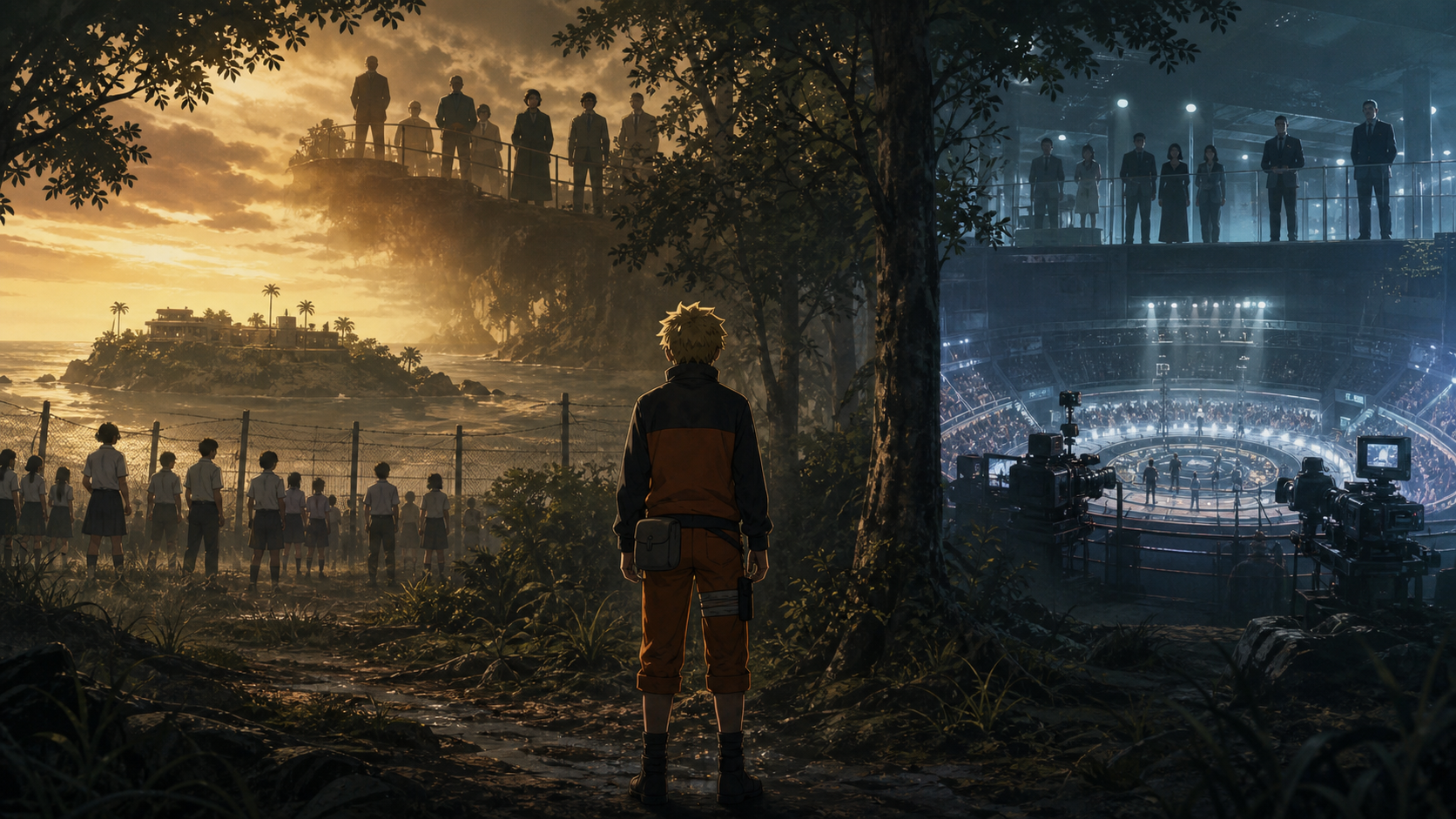
The Hunger Games Was Never New. America Was Just Late.
Before Panem turned children into political theater, Japanese fiction had already put a school class on an island and young ninja inside a death forest. The real story concerns who receives credit, why adults keep building these arenas, and why audiences keep buying tickets.
I like The Hunger Games. That sentence needs to come first because criticism on the internet has trained everyone to expect a knife fight between fandoms. Suzanne Collins wrote an effective political story about class, propaganda, war, celebrity, and the sale of a young woman’s image. Katniss Everdeen earned her place in popular culture. None of that makes the central machinery new.
Battle Royale reached Japanese readers in 1999 with a government program that forced junior-high students to kill their classmates. The film followed in 2000. Naruto also began publication in 1999, and the Chunin Exams soon sent young soldiers from rival states into a monitored forest where death counted as an accepted occupational risk. The Hunger Games appeared in 2008, after those works had already circulated through novels, manga, film, television, fan communities, and international home video.
The point is not that Collins stole a manuscript from Koushun Takami or took notes while watching the Forest of Death. Collins has said that she had not encountered Battle Royale before submitting her book. Her documented inspirations include the myth of Theseus, Roman gladiators, reality television, and news coverage of the Iraq War. No reliable evidence connects Kishimoto’s Chunin Exams directly to Takami’s novel either. Similarity does not prove a private chain of influence.
The more useful question asks why so many American readers called The Hunger Games revolutionary. Their first encounter with an idea became the moment when they assumed the idea began. Earlier Asian stories were reduced to trivia, accusations, or awkward recommendations phrased as “the Japanese Hunger Games,” even when the Japanese work came first.
My actual first reaction
When the first Hunger Games movie became a cultural event, my reaction was not shock at the premise. I had already watched young ninja enter a forest where consent forms treated death like a field-trip hazard. I knew the shape of Battle Royale. Government adults creating the danger, children forming unstable alliances, and an audience treating survival as evidence of character felt familiar.
Familiarity did not make Collins’s work worthless. Panem brought a specific American anxiety into focus. The Capitol turns violence into branding, edits rebellion into television, assigns stylists to doomed children, and teaches viewers to confuse emotional access with moral action. Citizens learn a tribute’s favorite color and then accept the tribute’s death as scheduled programming.
Collins’s version matters because the Capitol shows how easily sympathy can become part of the sales package. Earlier versions matter for the same reason: each one exposes a different method adults use to turn young people into instruments of public power.
What Panem did not invent
The basic components of The Hunger Games belong to a much older cultural archive. States have displayed punishment in public. Empires have used captives and marginalized people as spectacle. Myths have sent selected young people to monsters. Adventure stories have turned human beings into prey. School stories have treated peer competition as a miniature society. War stories have asked children to inherit conflicts created before their births.
Collins combined those materials with modern broadcasting and American class politics. That combination gave Panem a distinct identity. The annual reaping turns regional poverty into a national ritual. Sponsorship teaches competitors to sell a version of themselves. Editing controls which deaths count as tragedy. Fashion creates emotional investment without changing the underlying power relationship. The Capitol invites sympathy as long as sympathy remains entertaining and politically harmless.
Takami’s government uses a different method. The Program in Battle Royale does not need a glamorous national broadcast. Fear, uncertainty, and the destruction of trust do the political work. A class enters the arena with years of shared history. Every friendship becomes a possible trap. Every private wound becomes dangerous information. The government does not merely threaten bodies. The government attacks the possibility that young people might trust one another enough to resist.
Konoha uses another version. The Chunin Exams present danger as professional assessment. Participants already belong to military institutions. Their villages call them volunteers, but childhood inside a shinobi state offers limited alternatives. Adults praise courage, intelligence, endurance, and loyalty while the exam quietly measures how well children can function under conditions created by adult conflict.
Battle Royale
An authoritarian state weaponizes classmates against one another. The central pressure is distrust.
Naruto
Military villages normalize childhood danger through training, rank, duty, and national competition. The central pressure is usefulness.
The Hunger Games
An empire turns punishment into television and teaches the public to consume suffering as culture. The central pressure is performance.
The three stories share a basic machine, but the comparison becomes useful only when we notice the different fuel. Takami studies distrust, Kishimoto studies usefulness, and Collins studies performance. Treating all three as interchangeable “kids fight” stories removes the political argument that gives each arena a reason to exist.
Battle Royale did not begin as a movie
Koushun Takami’s Battle Royale began as a novel, published in Japan in April 1999. The story follows a junior-high class selected for a government survival program. Students receive weapons, rules, and explosive collars. Only one student may leave alive unless the class finds a way to defeat the system.
The premise can sound simple when reduced to a sentence. The novel’s force comes from the number of interior lives Takami places inside that structure. Students carry crushes, grudges, abuse histories, ambitions, private loyalties, and ordinary misunderstandings into the Program. Government violence does not create every fracture. Government violence finds existing fractures and makes them lethal.
That difference matters. A government does not need to transform every child into a monster. The government needs enough fear to make cooperation feel unsafe. One frightened student strikes first. Another assumes betrayal. Someone with a history of violence recognizes an opportunity. Someone who might have helped hesitates for a few seconds. The system converts uncertainty into self-destruction and then blames the young people for behaving badly.
Research on the franchise often connects the Program to generational warfare. Adults fear youth, blame youth for social decline, and punish youth for problems produced by national institutions. The fictional government presents children as dangerous while holding every weapon, writing every rule, and controlling every exit.
Battle Royale does not ask whether teenagers are naturally cruel. The novel asks how quickly a state can make cruelty look like common sense.
The manga adaptation made every death harder to dismiss
The manga adaptation was written by Takami and illustrated by Masayuki Taguchi. Serialization ran in Akita Shoten’s Young Champion from 2000 through 2005 and produced fifteen collected volumes. English-language volumes followed through Tokyopop.
Fifteen volumes change the emotional math. A feature film must move through a large cast quickly. The manga has room to expand faces, memories, motives, friendships, and terror. Students who might pass through the film in minutes receive more personal history. Readers spend longer with people whose names still appear on the death count.
Taguchi’s art is exaggerated, graphic, and often physically uncomfortable. The bodies do not remain neat symbols inside a political essay. Fear distorts faces. Injury becomes difficult to ignore. The series can cross into exploitation, and readers can reasonably argue that some sexualized or violent choices weaken the critique. A story condemning spectacle can still profit from spectacle.
That contradiction belongs at the center of any honest discussion. The manga wants readers to mourn children while using escalating violence to keep those readers turning pages. The same tension follows nearly every successful death-game story. Creators criticize audiences for watching, but the criticism arrives inside a product designed to hold attention.
The manga also gives the class more social density. Trust feels precious because the students knew one another before the island. Betrayal hurts because relationships existed before the rules demanded suspicion. The Program forces each student to decide whether survival means preserving a moral self, protecting another person, surrendering to fear, or learning how to exploit fear faster than everyone else.
Calling the manga “the Japanese Hunger Games” erases that history twice. The phrase places the later American work at the center and treats a major adaptation of an earlier Japanese novel as a derivative curiosity.
The film carried a war survivor’s anger
Kinji Fukasaku directed the 2000 film adaptation late in a career shaped by stories about postwar violence and failed authority. Fukasaku had worked in a munitions factory as a teenager during World War II. Air raids killed other young workers, and surviving students had to deal with the bodies. That background does not make Battle Royale a literal memoir, but the experience helps explain why the film distrusts adults who send young people into danger and later describe sacrifice as necessary.
The film compresses Takami’s large web of interior stories into a faster, harsher structure. Takeshi Kitano’s teacher gives adult resentment a human face. His presence turns the Program into more than distant policy. An unhappy adult punishes a generation he cannot understand, then demands emotional recognition from the same children he helps terrorize.
The movie’s violence attracted controversy, but Fukasaku’s target was never simply teenage cruelty. His film looks at the collapse of trust between generations. Adults accuse young people of disorder while offering them economic insecurity, emotional abandonment, and institutions built around obedience. The Program becomes a grotesque answer to an adult fear: if the young cannot be controlled, force them to destroy one another.
No ripped footage belongs on this page. A film still used for close criticism may sometimes qualify as fair use, but a downloaded sequence or decorative clip creates unnecessary copyright risk. The generated hero captures the comparative argument without pretending that CVM Sekai owns frames from Toei’s film.
Naruto sent children into the Forest of Death and called the process promotion
Naruto enters the Chunin Exams as a young genin. He and his peers already perform missions for a military village, but the exam makes the political structure visible. Teams arrive from different hidden villages. Their uniforms, abilities, and bodies advertise local military strength. Promotion depends on judgment under pressure, not merely victory.
The first test rewards covert information gathering. The Forest of Death tests survival, mission completion, and team behavior. The preliminary and final matches turn individual bodies into public evidence. Feudal lords and clients watch the later fights. A strong performance can increase confidence in a village and influence future contracts.
The exam therefore serves two audiences. Shinobi leaders evaluate candidates, while political and economic observers evaluate villages. Children carry both burdens. They must survive their opponents and represent an institution whose reputation may shape adult money and power.
The Forest of Death comes closest to the survival arena. Teams need paired scrolls. Rival groups can steal them through deception or violence. Anko warns participants about death and collects consent forms, a bureaucratic detail so absurd that the joke nearly hides the horror. A signature does not make a twelve-year-old equal to the adults who designed the test.
Orochimaru then enters the exam, attacks children, marks Sasuke, and exposes a catastrophic security failure. The institution does not respond by questioning whether the test should continue. Adults contain the immediate threat, gather intelligence, and return to the schedule. The exam system protects continuity more reliably than childhood.
The individual matches make the exam’s hidden sorting process easier to see. The adults claim to evaluate leadership and field judgment, but each child enters with private damage that the institution either exploits or ignores:
- Gaara arrives as a traumatized jinchuriki trained to treat killing as proof of existence. Adults respond to his instability as a weapon-management problem.
- Neji carries rage produced by a hereditary caste system. The tournament frames much of that rage as a personal worldview for Naruto to defeat.
- Hinata nearly dies while trying to prove worth within a family that has already ranked her as a failure.
- Rock Lee destroys his body because recognition from admired adults feels more valuable than physical safety.
- Sasuke enters with unresolved trauma and becomes a target for an adult predator who recognizes exactly which wound to exploit.
- Naruto turns relentless endurance into a moral victory, even though the same village praising that endurance helped create the loneliness behind his need for recognition.
Shikamaru receives promotion after surrendering because evaluators value judgment over victory. That choice proves the exam can recognize leadership. The same choice also exposes the weakness of the surrounding spectacle. If leadership matters most, fewer corpses and stadium matches could measure leadership more directly.
The death game was old before 1999
Ancient myth: Athens sends young people to Crete as tribute in the story of Theseus and the Minotaur.
Public punishment and arena culture: societies turn controlled violence into state messaging and entertainment.
1924: Richard Connell publishes “The Most Dangerous Game,” with a human hunted as elite sport.
1954: William Golding publishes Lord of the Flies, placing schoolboys inside a collapsing social order.
1979: Stephen King publishes The Long Walk under the name Richard Bachman, presenting a deadly state spectacle built around young competitors.
1999: Battle Royale and Naruto enter Japanese publishing.
2008: The Hunger Games reaches American readers.
No single work owns children in an arena. The pattern survives because the arena provides a compact model of society. Rules become visible. Resources become scarce. Authority becomes distant but absolute. Friendship competes with survival. The audience can watch morality change under pressure.
Originality comes from the questions asked inside that structure. Lord of the Flies worries about civilization and masculine social order. Battle Royale attacks authoritarian control and generational mistrust. Naruto explores military socialization, inherited conflict, clan hierarchy, and the longing for recognition. The Hunger Games focuses on empire, class extraction, propaganda, and media performance.
Calling one story a copy because several children enter a dangerous space is less useful than asking what each society believes the children are for.
Child warriors, shinobi history, and the danger of convenient folklore
Naruto draws on Japanese history and folklore, but the hidden-village system is fiction. Historical shinobi did not attend international promotion tournaments. They did not organize around chakra ranks, matching forehead protectors, or standardized three-person child squads.
Research from Mie University’s International Ninja Research Center presents a more complicated social history. Shinobi worked for domains and the shogunate in different roles and came from several social positions. Popular culture later compressed espionage, scouting, local knowledge, guerrilla tactics, folklore, stagecraft, and modern fantasy into the familiar black-clad “ninja.”
Japanese warrior history still matters to the world Kishimoto built. Hereditary military families, obligations to lords, clan knowledge, adoption, household service, and loyalty across competing domains provide recognizable historical material. Modern conscription and national military institutions add another layer. Japanese school and employment examinations offer a third language for advancement through testing.
The Chunin Exams combine those histories without reproducing any one of them. A feudal military market meets a modern standardized exam. Clan inheritance meets bureaucratic rank. Children enter a professional pipeline whose dangers are treated as necessary preparation for future duty.
Real child warfare also reaches far beyond Japan. European aristocratic boys trained for military roles. Empires recruited young people. Modern armed groups have used children across continents. Roman arena culture and Greek tribute myths sit inside the Western tradition that Collins openly draws upon. No civilization owns the exploitation of youth, and no region gets to place that violence safely in somebody else’s history.
Japanese audiences were not numb. They had a different vocabulary.
The phrase “Eastern culture was already desensitized” feels tempting because Japanese media had normalized violent youth narratives for many international fans before Panem. The phrase also turns billions of people and many national histories into one psychological claim. Evidence does not support that shortcut.
A better explanation concerns cultural vocabulary and media circulation. Japanese readers could encounter child-warrior stories through historical drama, manga, anime, school competition narratives, postwar cinema, and survival fiction. They might recognize the exam system, the clan system, the senior-junior hierarchy, or the tension between group duty and private loyalty. Recognition does not mean approval. Familiar language can make criticism sharper because audiences understand the institution being distorted.
Battle Royale caused controversy in Japan. The film faced political criticism and rating disputes. A numb culture would not have argued so fiercely about the portrayal of children. Fukasaku used shocking violence because he wanted to reach viewers who understood generational conflict but might ignore a polite lecture.
Naruto uses another strategy. The series places military childhood inside an exciting adventure. Readers cheer for victories, collect favorite characters, and anticipate matchups. The emotional bond grows before the political structure receives sustained examination. By the time the audience recognizes the cruelty, the audience already loves the children and has enjoyed the tournament.
That contradiction does not belong only to Japanese media. American audiences watch school sports through injury, turn young performers into public property, consume true crime as bedtime entertainment, and move from war footage to reality television without leaving the couch. Collins has directly described the disturbing blend she felt while switching between a reality program and Iraq War coverage.
Desensitization cannot be divided neatly between an innocent West and a hardened East. Japanese and American media traditions gave audiences different points of recognition, but both cultures had long histories of turning competition, war, punishment, and childhood pressure into entertainment.
Why do we keep enjoying the arena?
The uncomfortable answer begins with structure. Death-game stories make social rules easy to see. Real institutions spread responsibility across policies, departments, budgets, customs, and years. An arena compresses power into a map, a countdown, and a person holding the controls. Viewers can identify injustice without reading a government report.
Scarcity also produces fast intimacy. Characters reveal values through choices about food, medicine, shelter, trust, and risk. A friendship that might take years to test in ordinary life faces a decision within minutes. Audiences receive emotional clarity at a speed that everyday relationships rarely provide.
Competition creates prediction. Readers choose favorites, calculate alliances, and imagine personal survival strategies. The same mental game that makes the story gripping can recreate the spectatorship being criticized. We condemn the Capitol while ranking tributes. We criticize the Program while debating who would win. We object to the Chunin Exams while remembering the tournament as one of the most exciting arcs.
Violence also permits moral distance. Fiction gives viewers a controlled encounter with fear and grief. Research on media desensitization remains more complicated than the slogan “violent stories make violent people.” Some studies find reduced short-term physiological response or associations with lower sympathy, while other studies do not find lasting reductions in empathy. The safest conclusion is not that watching Naruto damages compassion. Repeated framing can change what feels narratively normal, and context affects whether viewers identify with victims, aggressors, or spectators.
These stories can increase empathy when they restore individuality to people whom institutions treat as units. Battle Royale gives names and memories to students listed by number. The Hunger Games forces Panem to see Rue as a child rather than a district tribute. Naruto turns jinchuriki from strategic assets into people carrying loneliness, anger, and histories.
The ethical difference lies in what happens after excitement. A story can invite viewers to enjoy danger and then question why danger felt entertaining. A weaker story treats bodies as disposable obstacles and calls the body count depth.
We do not return to the arena only because humans enjoy cruelty. We return because the arena makes power visible, relationships urgent, and moral choices easy to recognize. The danger begins when recognition ends at entertainment.
Why the plagiarism fight misses the better argument
Suzanne Collins has said that she had not heard of Takami or Battle Royale before her manuscript was submitted. Readers may believe or doubt that statement, but no public evidence proves otherwise. A serious article cannot turn suspicion into fact.
Kishimoto’s timeline also does not establish direct borrowing. Naruto and Battle Royale both began in 1999, while the Chunin Exam chapters appeared later. Similar timing creates a question, not an answer. Survival tests, martial tournaments, school competition, war fiction, and human-hunt stories already existed.
The credit problem remains even without plagiarism. English-language media often places the most commercially successful Western example at the center of a global history. Earlier work becomes “similar to” the later hit. Translation lag, distribution limits, marketing budgets, and reviewer familiarity shape which story appears original.
Battle Royale did not need to be Collins’s private inspiration to deserve a place in the public history of the genre. Naruto did not need to invent the survival test to prove that millions of readers had already encountered children used as military symbols before Panem.
The argument should not shrink into “Japan did this first, therefore America loses.” Culture does not move through a scoreboard. The argument asks readers to stop confusing visibility with origin and marketing power with invention.
What each story understood
Battle Royale understood that fear destroys solidarity
The Program succeeds when classmates cannot trust one another. Government power becomes strongest when victims perform the government’s violence for free.
Naruto understood that institutions can make exploitation feel honorable
Konoha rarely presents childhood service as punishment. Duty, teamwork, promotion, sacrifice, and belonging make the system emotionally attractive. Children volunteer because the village has shaped the available meaning of a successful life.
The Hunger Games understood that sympathy can become another product
The Capitol packages suffering through interviews, costumes, romance narratives, and sponsorship. Viewers feel close to the tributes without surrendering the system that kills them.
Together, the stories describe three stages of institutional control: isolate the young, train the young to measure worth through service, and sell their suffering back to the public.
Final take
The Hunger Games was never new. That judgment does not reduce Collins’s achievement. Panem gave old machinery a powerful American form and used that form to examine empire, media, class, and war.
Battle Royale had already made a government destroy youth solidarity through fear. The manga had already expanded that destruction across fifteen volumes of faces, histories, and escalating spectacle. Fukasaku had already connected the premise to generational betrayal and memories of adults sending young people into wartime danger.
Naruto had already placed military children inside an exam that converted survival into rank and bodies into village advertising. The series made the arrangement exciting enough that audiences could cheer before noticing what the adults had normalized.
America did not invent the arena in 2008. America received a version that American publishing could market as a revelation. The delayed recognition tells us less about who first imagined children in danger and more about which cultures receive permission to define a genre.
The final discomfort belongs to the audience. We recognize the exploitation. We understand the propaganda. We know the adults are wrong. Then we choose a favorite, wait for the gates to open, and keep watching.
Sources
- VIZ: Battle Royale publication and franchise overview
- National Diet Library: 1999 Battle Royale publication record
- Naruto Official: Chunin Exams and Forest of Death retrospective
- Suzanne Collins: reality television and Iraq War inspiration
- Midnight Eye: interview with Kinji Fukasaku
- Mie University International Ninja Research Center
- University of Nebraska at Kearney: child exploitation in young-adult dystopia
- Illinois State University: educational and political logic in Battle Royale
- Research review: emotional responses and media violence
- Research review: media violence and desensitization