
Memory, Sorrow, and Thorn · Canonical Character Profile
Hotvig
Hotvig enters as one of the horsemen surrounding Josua’s exhausted fugitives and grows into something far more dangerous to bad leadership: a man who knows the law, recognizes a loophole dressed as honor, and decides his loyalty belongs to the people keeping faith rather than the chief exploiting it.
At a Glance
The horseman who knows obedience is not the same thing as honor
- People
- Thrithings-folk of Clan Mehrdon
- Calling
- Randwarder, scout, cavalry leader, and clan dissenter
- First allegiance
- March-thane Fikolmij and the laws of the Free Thrithings
- Chosen allegiance
- Josua’s cause, after Fikolmij abuses custom and betrays his guests
- Signature strength
- Horse knowledge, open-country reconnaissance, tactical judgment, and public moral courage
- End-of-series status
- Alive at his last confirmed appearance after serving through the final campaign
The Visual Receipt
Built for the saddle, not a polished court portrait
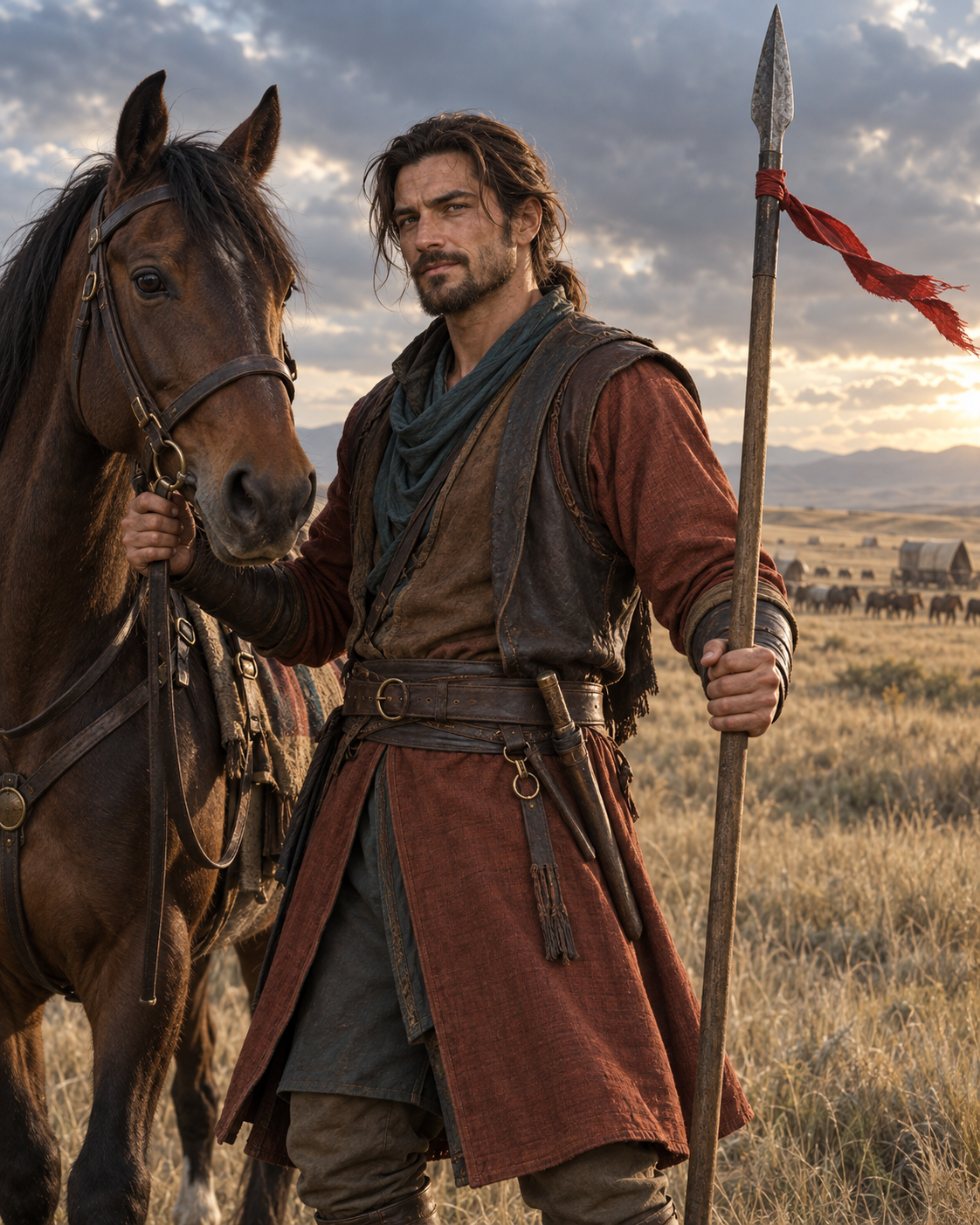
Hotvig’s identity should begin with the material life of a Thrithings rider: an adult man made lean and powerful by years on horseback, dressed for wind, grass, mud, cold, and sudden violence rather than for a stone hall’s approval. His strongest recurring visual marker in battle is the scarlet ribbon associated with him as he fights from horseback with a long spear. Nothing in the finished art should turn him into a generic plate-armored knight. His competence belongs to speed, balance, reins, weather, and the living intelligence of horses.
The approved identity makes that attraction a matter of presence rather than cosmetic nobility: a tall, lean-powerful adult rider with a weathered angular face, dark hazel eyes, wind-tanned skin, shoulder-length dark chestnut hair, short beard, layered rust-and-teal riding clothes, one horse, one long spear, and one scarlet ribbon. He looks like a man who can assess a horse, hear a distant harness, read a leader’s face, and make a decision before somebody with a title finishes explaining why obedience is supposedly sacred.
The books establish Hotvig as an adult Thrithings randwarder, horse expert, scout, dissenter, cavalry leader, long-spear fighter, and scarlet-ribboned rider. His exact age, face, coloring, hair, beard, body proportions, wardrobe, horse, tack, spear design, grassland camp, and light are editorial reconstruction. His Book 2 identity under Fikolmij and later commander identity must remain this same face, body, coloring, and plausible age progression.
The Complete Journey
He begins inside Fikolmij’s power and leaves when power empties the law of meaning
Book 2 · Stone of Farewell
The arresting rider becomes the witness Fikolmij cannot control
Hotvig first appears leading Clan Mehrdon randwarders who surround Josua’s worn company in the pale grasslands. The capture is disciplined, quiet, and decisive. He is not introduced as a secret rebel waiting for a cleaner hero to arrive. He works within the clan structure and brings the strangers to Fikolmij, the March-thane whose authority shapes the riders’ immediate world.
Fikolmij treats Josua as a stone-dwelling thief who stole Vorzheva and treats Vorzheva’s earlier arranged marriage as a transaction already completed without her consent. Geloë finds the law that prevents a simple execution: Vorzheva’s pregnancy creates a recognized High Thrithings form of betrothal. Josua wagers his sword, honor, and remaining hand in the trial Fikolmij’s public pride cannot refuse.
Hotvig’s importance sharpens after Josua wins. He accompanies the injured prince while the thirteen horses owed by the wager are chosen. Josua could strip Fikolmij’s herd of its best animals and call the humiliation lawful. Instead, he deliberately leaves the March-thane enough wealth and standing to keep his word without destroying the clan. Hotvig openly admires that restraint. The scene gives him a standard by which to judge leadership: victory becomes legitimate when the winner refuses needless ruin.
He also supplies intelligence unavailable to castle-born companions. Hotvig reports poor, largely horseless western refugees settling along the Ymstrecca and notices wagons leaving a chief who is feared rather than loved. The grasslands are not empty scenery between fortresses. They contain law, migration, family economies, factional memory, and consequences visible first to the people who ride through them.
Fikolmij then betrays his guests by alerting Fengbald while insisting no exact spoken promise prohibited it. Vorzheva hears the difference between technical innocence and recognizable treachery. So do the clan families. Hotvig and other dissenters delay Fengbald, enforce their understanding of Free Thrithings law, and eventually catch Josua’s party with nearly eighty men, women, and children who have chosen to leave. The apparent pursuit becomes a migration. Hotvig does not merely switch employers; he helps people withdraw the consent that made Fikolmij powerful.
Book 3 · To Green Angel Tower, Part I
The dissenter becomes the experienced eye beside an inexperienced knight
At Josua’s refuge, Hotvig’s field knowledge becomes military infrastructure. When Simon receives his first scouting command, Josua sends Hotvig with him. Simon correctly understands the arrangement: a newly knighted young man may hold authority, but experience should stand close enough to catch a mistake before pride turns it fatal. Hotvig does not use that role to humiliate Simon. His presence lets responsibility become teachable instead of ceremonial.
The scouts estimate an enemy force of at least a thousand. Hotvig identifies Lake Thrithings mercenaries by the sound of their harnesses and judges that nearly half the host consists of unclanned grasslanders. Simon can count tents and banners; Hotvig hears social history in tack. The episode makes expertise collaborative. Rank supplies the mission, but knowledge supplies the truth.
Hotvig later offers Simon a faster clan horse. Simon refuses to abandon the tired mare he has named Homefinder. That small exchange lets both men reveal their ethics through an animal rather than a speech. Hotvig sees the practical need for speed; Simon recognizes an obligation to the creature that carried him. Neither competence cancels the other.
In the battle plan at Sesuad’ra, Hotvig’s riders are not decorative cavalry waiting for a heroic charge. Their horses are fitted to the ice, and their intervention depends on timing with Freosel’s arrow volley and Josua’s larger trap. When the plan becomes imperfect, Hotvig crosses the frozen lake under a scarlet ribbon, fights with a long spear, and helps split Fengbald’s line while his riders sing. The people Fikolmij treated as property of his authority have become a force capable of changing the war.
Book 4 · To Green Angel Tower, Part II
He carries grassland mobility into a war built around walls
Hotvig remains part of Josua’s campaign as the struggle moves away from Sesuad’ra and toward the Hayholt. When faint unfamiliar horns sound from the north, Josua sends his riders toward Aldheorte because mobility is now reconnaissance, warning system, and protection against encirclement. The open ground behind the Kynslagh could turn any arrival into another trap; Hotvig’s work is to know which kind of arrival it is before the army commits.
He fights beside Camaris against Varellan’s cavalry and later helps strike the young duke’s flank at Onestrine Pass. Their partnership is visually dramatic—legendary sword and long spear—but the tactical point is cleaner than the legend. Seriddan’s pikemen hold. Varellan overcommits. Hotvig and Camaris punish the exposed flank. The victory belongs to discipline and timing rather than a single shining weapon.
Hotvig survives his last confirmed campaign appearances. The ending does not hand him a coronation scene or a tidy administrative title, and the profile should not invent one. His completed arc is already substantial: he moves from enforcing one chief’s authority to choosing a coalition whose legitimacy must be earned repeatedly through restraint, reciprocity, and shared danger.
The People Around Him
Every allegiance tells us what kind of leader he believes deserves riders
Fikolmij
Hotvig begins within the March-thane’s order and leaves when Fikolmij turns hospitality, paternal control, and clan law into instruments for preserving his own pride.
Josua
Josua earns respect by limiting his own victory, trusting expertise, and allowing dissenters to become allies rather than trophies. Hotvig’s loyalty is a judgment, not a spell.
Vorzheva
Her public refusal of Fikolmij’s ownership gives the clan’s argument a human center. Hotvig’s break helps make that refusal materially survivable.
Simon
Hotvig is the experienced rider beside Simon’s new authority. Their scouting partnership shows that mentorship can protect a young commander without stripping him of responsibility.
Freosel
Arrow volley and ice cavalry become one coordinated defense at Sesuad’ra. Different communities survive because their specialties are allowed to remain distinct and useful.
Camaris
The old legend and the grassland commander break cavalry together. Hotvig prevents the scene from becoming proof that only enchanted swords decide history.
Why He Works
He is what happens when a supporting character is permitted a political conscience
Hotvig works because his change of allegiance is neither instant hero worship nor convenient defection. He watches law performed, watches mercy practiced, watches betrayal defended, and makes a public choice with consequences for whole families. The saga lets a rider outside the royal bloodlines decide what legitimacy means from the ground up.
His competence also resists the fantasy habit of treating mounted cultures as atmospheric menace until a prince needs reinforcements. Hotvig reads horses, harness, migration, terrain, morale, and clan division. He knows things Simon cannot know and does things Camaris cannot do alone. The narrative becomes richer whenever it admits that a kingdom is held together by people whose intelligence does not resemble court scholarship.
On the Record
Scope, spoilers, and the recovered identity
This is Hotvig’s one canonical profile across Books 2, 3, and 4 of the four-volume published edition. It is intentionally full-spoiler and draws from the completed owned-edition reading ledger. His absence from the earlier Book-1-centered registry was a coverage defect. Franchise and volume directories must filter this post rather than create separate versions of Hotvig.
Visual state: approved and locked. One attractive adult Thrithings rider with this exact angular face, dark chestnut hair, short beard, lean saddle-built body, rust-and-teal riding vocabulary, long spear, and scarlet ribbon governs randwarder, clan dissenter, scout, ice-cavalry commander, and final-campaign milestones. He must remain horse-built, weathered, mobile, and culturally specific—not transformed into a generic castle knight. The same local attachment must remain the WordPress featured image, visible hero, directory card, and Rank Math social image.