
Frosch Profile
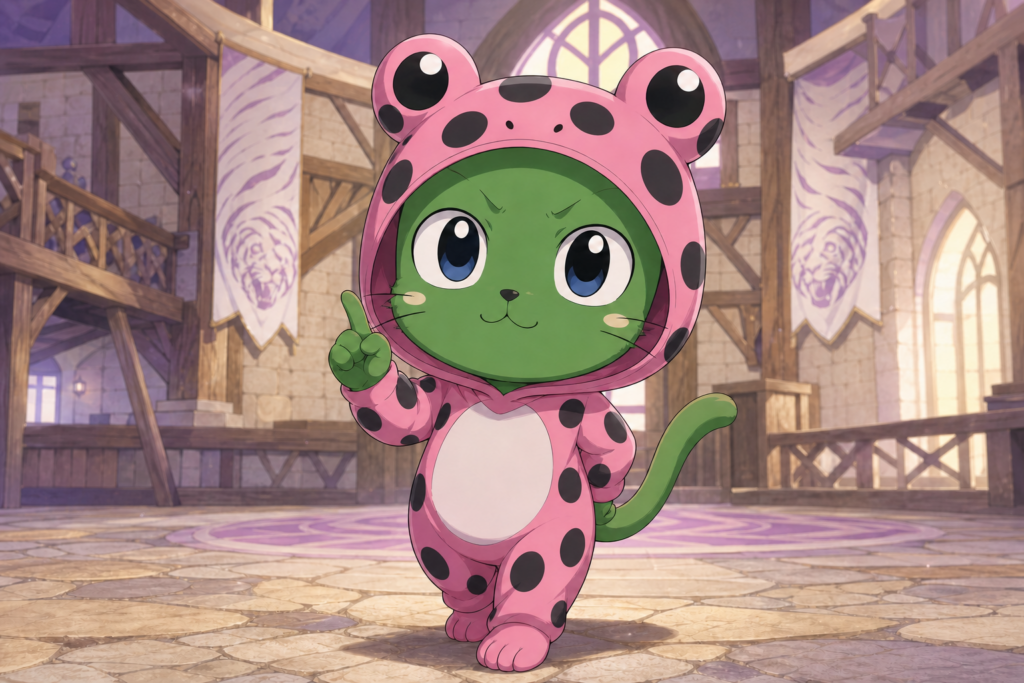
CVM Sekai character profile
Bottom line
Frosch is not important because Fairy Tail secretly made the little green Exceed in a pink frog suit a battle monster. Frosch matters because the series lets softness carry consequences.
Rogue Cheney can fight dragons and disappear into shadows. The future that breaks him, however, begins with losing one small friend in a frog suit. That is not power-scaling trivia. It is a receipt for what Rogue values when strength cannot fix grief.
Then Episode 202 does something even better. Frosch gets lost, tries to walk home alone and turns Sabertooth’s strongest members into a quiet support team. They search hard. They find Frosch. They do not immediately grab the child-sized cat and carry them home like luggage. Rogue suggests watching from the shadows so Frosch can finish.
Yes, the episode is aggressively cute. It is also a clean story about dignity. Protection is not always taking over. Sometimes it is staying near enough to help while letting somebody prove the thing to themself.
Fast facts and canon boundaries
TV Tokyo’s official 2014 cast page credits Satomi Kōrogi as Frosch. The Dragon Cry official character and cast pages do not list Frosch among the featured or credited roster, so this profile does not manufacture a film role from a crowd shot or a fan database.
That kind of boundary matters for supporting characters. Completeness means telling fans what exists without turning every possible background speck into a résumé bullet.
Design: the frog suit is funny, but it is also identity
Frosch is a green Exceed with large blue eyes and an established pink frog costume. The hood has two raised frog-eye bumps and dark spots, while the pale belly panel makes the outfit readable even in a busy guild scene.
The joke is obvious. Frosch dresses like a frog and speaks with a simple, repetitive confidence. The design is cute on purpose.
But cute does not mean interchangeable. Frosch is not a random pink cat in a green hoodie. The green feline body, frog-eye hood, dark spots, round face, tiny paws, green tail and gentle proportions carry the identity.
The costume also says something useful about the character. Frosch’s identity is not built around armor, rank stripes or a weapon. Sabertooth first sells itself as Fiore’s strongest guild. Frosch walks through that brand dressed like a frog and never needs to apologize for it.
Honestly, good. Not everybody in a battle series needs spikes.
Episode 151: entering Sabertooth beside Rogue
Frosch enters the anime in Episode 151, Sabertooth, with Lector, Sting and Rogue. TV Tokyo’s original October 6, 2012 program record lists Satomi Kōrogi as Frosch in the speaking cast, so this is a verified animated debut rather than a fan-database estimate. The episode introduces the Twin Dragons as part of the guild that rose while Fairy Tail‘s Tenrou group was missing.
That placement defines Frosch’s public role. Frosch is Rogue’s partner inside Sabertooth, just as Lector is tied closely to Sting. The Exceeds are not tournament combatants standing in the arena bracket, but they are present for the guild’s claims, losses and changes.
Frosch’s recurring agreement, often rendered as a variation of “Fro thinks so, too,” can look like a throwaway catchphrase. Sometimes it is a joke. Sometimes it exposes the room.
When Frosch repeats what somebody says, the line can confirm loyalty, confusion or the safest available position. That makes performance timing important. A fast agreement after Lector’s bragging lands differently from a soft response to Rogue. The official credit identifies Satomi Kōrogi, while the available written records do not support pretending an English subtitle reveals her exact pitch, pacing or pauses.
Sabertooth under Jiemma: what does the smallest member witness?
The Grand Magic Games show a Sabertooth culture obsessed with strength, image and punishment. Jiemma treats loss as disloyalty. Yukino‘s defeat becomes public humiliation and expulsion. Lector’s apparent death becomes a tool Minerva uses against Sting.
Frosch exists inside that institution.
The anime does not need to show Jiemma privately abusing Frosch for the structural question to matter. What does a guild teach when its smallest members watch belonging become conditional? What does “strongest” mean when a master can terrorize his own people and call that discipline?
Frosch does not hold equal power in that room. Neither does Lector. Their limited authority matters when we discuss silence. We can name the culture without pretending every witness had the same ability to stop it.
That distinction keeps accountability honest. Jiemma leads the harm. Minerva makes choices inside the culture and remains responsible for them. Sting and Rogue eventually help change the guild. Frosch is not evidence that the old system was secretly wholesome because the mascot looked happy between matches.
Rogue: partner, home and the future built around loss
Rogue and Frosch are the profile’s central relationship. Calling Frosch “Rogue’s mascot” would flatten both characters.
Rogue protects Frosch, travels with Frosch and listens when Frosch speaks. Frosch also gives Rogue an emotional anchor that his public Dragon Slayer identity cannot replace.
Future Rogue makes that bond frightening. At the end of the Eclipse crisis, he warns Natsu about Frosch’s death one year later and connects that loss with his surrender to the shadows. Public official summaries available for this draft do not preserve his exact killer wording, so this profile does not turn a remembered line into a quotation or a settled present-timeline accusation.
The wording needs care because the main timeline does not fulfill that death.
Gray does not canonically murder Frosch in the present anime chronology. Future Rogue reports an event from his own altered future. That report becomes a warning. Natsu later sees Gray’s apparent move toward darkness and remembers it.
TV Tokyo’s official Episode 280 summary directly frames Gray’s disappearance and dark appearance as recalling what Future Rogue told Natsu one year earlier. Natsu takes Lucy to Sabertooth because he wants to test the danger, not because the current Gray has already harmed Frosch.
That is the clean causal chain:
- Future Rogue loses Frosch in his timeline.
- He says that loss helped the shadows consume him.
- He warns Natsu about a death one year later. The surviving official summaries do not preserve the exact killer wording, so this profile keeps the accusation inside Future Rogue’s altered timeline.
- The main timeline reaches the Avatar period.
- Natsu remembers the warning when Gray appears to have entered a dark guild.
- The present team intervenes in Avatar’s plan, and the predicted death does not occur.
The exact unseen circumstances behind the reported future death are not licensed room for fan fiction. The anime gives the warning and the consequence. It does not owe us a made-up murder scene to make the stakes real.
Episode 202: getting home is the mission
TV Tokyo’s official summary for Episode 202 gives Frosch the clearest solo objective in the anime.
Rogue proposes following from the shadows.
That choice is the episode.
The easy version of protection would be instant retrieval. Pick Frosch up. End the search. Roll credits.
Instead, the group recognizes that Frosch is doing something. This is the first solo outing. The route is messy and funny, but the goal is real. Frosch wants to get home.
Rogue does not stop caring when he steps back. He changes the form of care. Everybody stays close enough to catch a real danger while Frosch keeps ownership of the task.
That is why the story should not be dismissed as filler in the insult sense. Episode 202 adapts Hiro Mashima’s creator-written short story WELCOME HOME, FROSCH, collected in Fairy Tail S. Television gives that compact story a full episode’s timing and room for detours, including the licensed summary’s larcenous frog traders. Rebuilt Sabertooth is no longer proved only by speeches after Jiemma. It organizes around one missing member and then respects that member’s small act of independence.
The mission is not defeating a monster. The mission is making it home without having the achievement stolen.
Sting, Lector and Yukino: the search party says who Sabertooth became
Sting is the new guild master when Frosch goes missing. His participation matters because leadership is often clearest in low-status emergencies.
Nobody gets tournament points for finding Frosch. Nobody earns an S-Class promotion. The guild responds because Frosch belongs there.
That is a direct contrast with Jiemma’s Sabertooth. The old system asks what a member’s victory adds to the brand. The rebuilt guild asks where the missing member is.
Lector starts the search by raising the alarm. He is Frosch’s peer, not merely the red mascot standing beside the pink mascot. His worry gives the episode urgency before the group turns the route into comedy.
Yukino’s presence matters too. She was expelled when the old guild made failure unsafe. Now she helps search for another member under Sting’s leadership. Her participation is not proof that all prior harm vanished. It is evidence that she chose to rejoin a different set of conditions.
Frosch’s episode quietly lets those larger repairs appear in the background. No speech explains the thesis. People show up.
Gray: keep the accusation inside the correct timeline
Gray belongs in Frosch’s relationship atlas because the warning changes how Natsu reads Gray during Avatar.
He does not belong there as “Frosch’s killer” without a timeline label.
That shortcut is inaccurate and lazy. It takes a possible-future event, drops the condition and sticks the crime onto present Gray’s name. The main chronology prevents the death.
The warning still carries weight. Gray’s Devil Slayer Magic and undercover work make his behavior look dangerous. Natsu’s fear is not random. But suspicion is not a conviction, and a possible future is not a present biography. The available official record supports the warning and the changed outcome, not a present-timeline murder label. That is enough to keep the accusation where it belongs.
This is where fandom timelines can get sloppy because the dramatic sentence is easier to remember than the repair. Future Rogue’s world suffered the loss. The main anime turns that knowledge into prevention.
Magic: Exceed does not automatically mean combat résumé
Frosch is an Exceed, and Aera is the species-associated wing magic used for flight. The anime shows Exceed characters producing magical wings rather than carrying permanent bird anatomy.
That does not give us permission to copy Happy’s full move set onto Frosch.
Frosch does not receive invented attack names, passenger limits borrowed from somebody else’s exact scene or a fake combat rank. Aera belongs to the Exceed magic framework, while Frosch is not developed as a front-line fighter.
Episode 202 proves a different competence. Frosch navigates, persists, asks questions and keeps moving after getting lost. None of that is a spell. It still matters.
Final Series and the Avatar prevention
The Final Series returns to Future Rogue’s warning during the Avatar storyline.
TV Tokyo’s Episode 280 summary confirms that Natsu connects Gray’s disappearance to the warning and goes to Sabertooth. Episodes 281 through 283 then expose Gray’s dark-guild role as part of the larger Avatar conflict rather than a completed betrayal of Fairy Tail.
Episode 283, Ikusatsunagi, brings the Avatar operation to its decisive stage. The present timeline reaches the period Future Rogue feared without repeating his result. Frosch survives. Rogue does not become the same future man.
The prevention is structurally important even though Frosch is not the person throwing the finishing attack. A saved future does not require the saved person to win the battle personally.
That is the consequence lens. The Avatar victory is not only one cult stopped. It also removes the path that was supposed to turn private grief into a much larger disaster.
Films, OVAs, specials and 100 Years Quest
Frosch is not listed on the official Dragon Cry character or principal cast pages. This profile therefore does not sell the movie as a Frosch chapter.
No OVA or special is added to Frosch’s record without an official roster or a visible animated appearance. A fan database list is a discovery tool, not final proof.
The animated 100 Years Quest continues directly from the original series. Crunchyroll’s licensed Episode 1 cast announcement includes Frosch, which clears a speaking appearance in the sequel’s opening episode. It does not turn Frosch into a quest-team member or a major Dragon God participant. The profile records the appearance and stops there unless later aired episodes supply a larger role.
This is a supporting character. Proportional coverage is part of completeness.
Japanese performance: the credit is firm, the adjectives are not
TV Tokyo’s official 2014 cast roster credits Satomi Kōrogi as Frosch. That fact belongs in the profile. A pile of generic adjectives does not.
CVM Sekai does not call the performance cute, innocent or surprisingly emotional without a verified Japanese-audio moment showing what Kōrogi actually does with pitch, tempo, repetition or silence. The credit is published as a credit. Performance interpretation waits for audible evidence instead of pretending a cast list contains acting analysis.
Episode 202’s production credits are firmer. TV Tokyo names Shōji Yonemura for the script, Shinji Ishihira for the storyboard, Yūshi Suzuki for episode direction, and Masanori Iizuka with Hatsue Nakayama as animation directors. Those names explain who shaped the television version without pretending a staff list supplies the missing vocal observation.
What Frosch changes
Frosch gives Sabertooth a test that strength branding cannot answer.
Can the guild care about a member who is not winning its public battles? Can Rogue protect somebody without owning every choice? Can friends follow quietly instead of turning help into control? Can a possible future be changed because people take one small life seriously?
Episode 202 answers with conduct. The Avatar storyline answers with prevention.
Frosch does not need a hidden transformation, a secret rank or a dramatic kill count. The character already carries a real function. Frosch makes the strongest people in Sabertooth practice tenderness without condescension.
That is plenty.
Source shelf
- TV Tokyo official program page for Episode 151, Sabertooth, October 6, 2012.
- TV Tokyo official 2014 staff and cast page, including Satomi Kōrogi as Frosch.
- TV Tokyo official Episode 202 archive and program page, Welcome Home, Frosch, October 4, 2014.
- TV Tokyo official Final Series Episode 280 summary, The Black Magic Cult (Avatar).
- TV Tokyo official Final Series Episode 283 summary, Ikusatsunagi, November 11, 2018.
- Official Dragon Cry character and cast pages for the film-credit boundary.
- Official TV Tokyo and Avex 100 Years Quest pages for sequel scope and central-cast boundary.
- Crunchyroll’s licensed 100 Years Quest Episode 1 cast announcement for Frosch’s sequel-anime appearance boundary. The profile does not name or analyze the English performer.
- Licensed Kodansha volumes corresponding to Frosch’s debut, Eclipse warning and Avatar prevention chronology.