
Sting Eucliffe
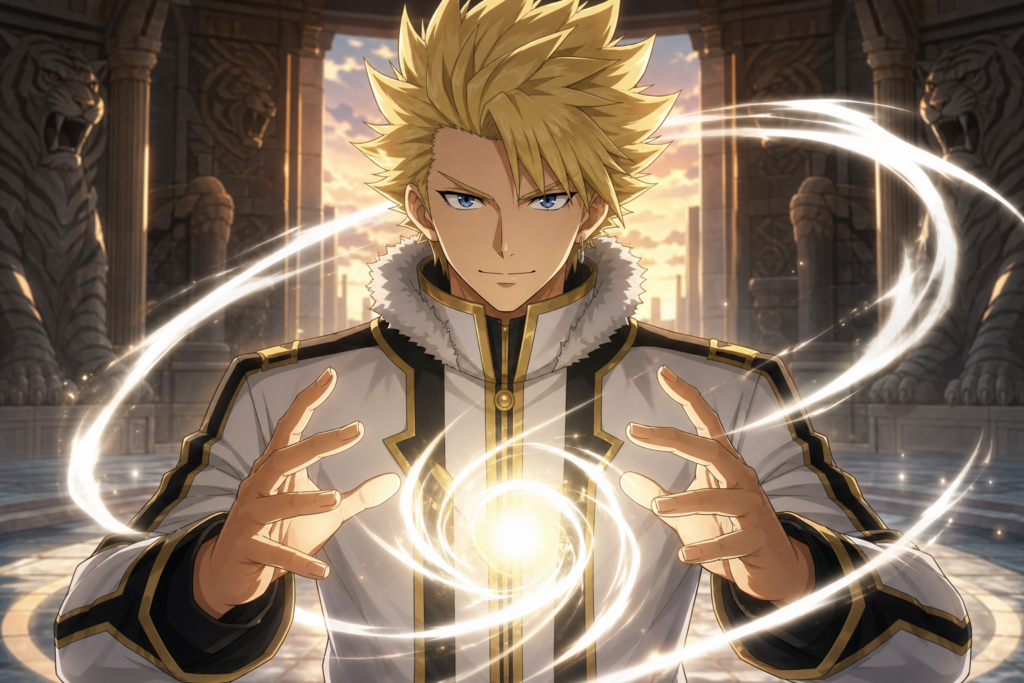
CVM Sekai character profile
Bottom line
Sting Eucliffe does not become a better man because Natsu punches the arrogance out of him. If one beating could fix an institution, Fairy Tail would have solved government by episode twelve.
Sting changes because Sabertooth finally makes the cost of its strength culture personal.
Under Jiemma, losing means humiliation, expulsion or violence. Sting benefits from that system long enough to confuse surviving it with proof that it works. Yukino is stripped of her guild mark and cast out after a public loss. The guild keeps moving. Then Minerva turns Lector into leverage, and suddenly Sabertooth’s little meritocracy is not an abstract problem happening to somebody lower in the rankings. Winning now requires Sting to accept that a person he loves can be treated like equipment.
He refuses.
That refusal is the first useful leadership decision Sting makes, and he makes it before anybody gives him the title of guild master. The rest of his story asks whether he can turn one moral awakening into a safer institution. A new master standing in nicer light is not reform. Reform is Yukino being allowed to choose whether she returns. Reform treats Lector as family instead of a motivational hostage, Rogue as a partner instead of half of a brand, and Sabertooth members as people who still have a home on the day they lose.
Sting begins as Jiemma’s success story. He becomes worth following when he realizes the success model was abusive.
Sting Eucliffe fast facts
No reliable public primary guide reviewed for this file gives Sting a canonical age, birthday, height or weight. I am not filling those spaces with a number that has been copied around fandom so often it learned to wear a tie. Unknown is a fact boundary, not a formatting emergency.
Who Sting is before the biography starts arguing
Sting is a White Dragon Slayer raised and trained by Weisslogia. He also carries a Dragon Lacrima, so the series groups him with Rogue as a third-generation Dragon Slayer. That label describes how their power was acquired. The label does not create a permanent ranking above Natsu, Gajeel or Wendy, and the Grand Magic Games goes out of its way to embarrass anybody who treats generation labels like power levels printed on a box.
He enters the story as one of Sabertooth’s Twin Dragons. He is blond, blue-eyed, athletic, openly confident and much louder about his ability than Rogue. His white clothing, fur-trimmed collar and light-based magic build a clean visual identity around the White Dragon. That color language is easy to overcook. Sting is not an angel, priest or holy knight. The “holy” language belongs to the vocabulary of his magic, not to evidence of moral purity.
That distinction matters because early Sting looks polished while participating in a rotten system. White light does not make a person righteous. Sometimes it just makes the mess easier to see.
Design evolution: the coat stays, the meaning changes
Sting’s basic silhouette remains recognizable across the Grand Magic Games and later arcs: sharp blond hair, earring, confident posture and Sabertooth clothing built around white, black and fur trim. Later designs mature the presentation without turning him into a different person.
The more important design change is contextual. Under Jiemma, the Sabertooth coat represents conditional membership. The coat says you may stand with the strongest guild as long as you keep proving that you deserve the floor beneath you. Under Sting, the same guild identity can begin to mean home.
Costume design is not only fabric. Institutions put meanings on uniforms. Sting’s arc asks whether he can keep Sabertooth’s pride while removing the threat hidden inside it.
Four hundred years, one protective plan and a very ugly memory
Sting comes from four hundred years before the main story. Weisslogia raises him, teaches him White Dragon Slayer Magic and participates in the guardian dragons’ plan to defeat Acnologia in a future era rich enough in Ethernano to support the attempt.
The dragons enter the bodies of their adopted children. Their presence helps stop dragonification, the same process that turned Acnologia from a human Dragon Slayer into a dragon. The children pass through the Eclipse Gate and arrive in the year 777.
Sting carries a memory that he killed Weisslogia to prove himself. The later revelation changes the factual history. The later revelation does not magically refund the years in which Sting believed love and killing belonged inside the same test of strength.
That false memory fits Jiemma’s Sabertooth too well. Jiemma teaches that attachment is acceptable only when it does not interfere with victory. Weakness deserves removal. A boy who believes his beloved dragon asked him to demonstrate strength through death arrives at a guild already fluent in the lesson.
Weisslogia’s plan protects Sting’s body and helps deliver him to the future. Weisslogia’s plan also depends on secrecy, altered memory and a child living with a violent explanation he did not choose. Loving intent and harmful consequence can occupy the same decision. Fairy Tail keeps handing parents that uncomfortable receipt and hoping nobody looks too closely. I looked.
Lector is family before he is plot leverage
Lector is Sting’s Exceed partner. He talks, chooses, worries, boasts, travels and belongs to Sabertooth’s social world. He is not a pet, accessory or floating confidence coach.
Their bond exposes the lie inside Sting’s early performance. Sting praises a culture built around dominance, but his safest relationship is based on affection. Lector admires him loudly, and Sting lets that affection remain visible. The swagger is real. So is the need to be known by somebody who does not require a ranking sheet first.
When Minerva makes Sting believe Lector has been killed, then uses Lector’s survival as leverage, Sabertooth’s governing logic reaches its natural endpoint. A person becomes a tool for producing a result. The system does not care that Lector is loved. Love only makes the leverage more efficient.
Sting’s decision during the final day of the Games is therefore not “friendship power” replacing strategy. Sting makes an ethical ranking. A person matters more than a trophy. He accepts public loss instead of allowing care to be treated as weakness.
That is not soft. That is the first time Sting is strong in a way Jiemma cannot measure.
Rogue Cheney: partner, not matching merchandise
Sting and Rogue arrive as the Twin Dragons of Sabertooth. White and shadow. Blond and dark hair. Lector and Frosch. Two third-generation Dragon Slayers packaged so neatly that the guild might as well have printed collectible cards.
They are not interchangeable.
Sting is more openly competitive and eventually becomes the public leader. Rogue is quieter, more suspicious of Sabertooth’s culture and burdened by the possibility represented by Future Rogue. That future version shows what grief, control and despair can do. Present Rogue is not guilty for a future he actively resists.
Their best partnership allows difference. Sting does not need Rogue to function as his dark half. Rogue does not need Sting to serve as permanent moral insurance. They are peers shaped by the same institution who make different adjustments once its authority breaks.
The Larcade battle later depends on that partnership without erasing either person. Rogue transfers shadow power. Sting uses it with his own white magic. White Shadow Dragon Mode is cooperation made visible, not proof that Sting permanently owns Rogue’s element.
Jiemma builds a guild where belonging expires
Sabertooth rises to become Fiore’s strongest guild during Fairy Tail’s seven-year absence. Under Jiemma, strength is not merely valued. Jiemma’s system controls who may belong.
Yukino loses a Grand Magic Games match and is publicly humiliated, stripped of her guild mark and expelled. That is not high standards. Public humiliation is abuse performed as quality control.
The spectacle teaches every member the same lesson: rank is temporary, so safety is temporary. The master can convert shame into performance whenever fear stops working on its own.
Sting holds high status inside this structure. That does not make him its architect, but it does make him a beneficiary. His later growth works only if the profile keeps that fact visible. Surviving an abusive hierarchy can demand silence. Enjoying its rewards can also make silence convenient.
Yukino’s treatment should have been enough to expose the system. That exposure was not enough. Sting needs the machine to reach Lector before he fully rejects it. That delay is part of his accountability.
The Grand Magic Games: a power claim meets a different kind of guild
Sting and Rogue enter the Games with reputation, Dragon Force, generation language and all the confidence of men who have never had to wonder whether the building behind them will still claim them after a loss.
Natsu and Gajeel challenge more than their attacks.
Fairy Tail’s fighters are powered by a guild that allows failure, conflict and return. Nobody is pretending the guild is healthy in every respect. This is still the institution that treats property damage like weather. But its members do not have to win in order to come home.
Sabertooth’s members fight under social threat. Victory proves they belong. Defeat puts the mark itself at risk.
During the Twin Dragons match, Sting and Rogue use White Drive, Shadow Drive and Dragon Force while Natsu and Gajeel keep breaking the grand theory attached to those forms. The loss does not automatically teach humility. What it does is remove Sabertooth’s favorite excuse: the claim that its cruelty is justified because it produces unbeatable strength.
Natsu and Gajeel do not win because “first generation” is secretly a higher category. The match rejects category worship altogether. Origin explains magic. Conduct, experience, conditions, teamwork and judgment determine what happens with it.
The fandom shortcut says Natsu humbled Sting. The better reading is that Fairy Tail exposed Sabertooth’s business model. One guild created strength through belonging. The other rented belonging to whoever kept winning.
Minerva, coercion and the final-day surrender
Minerva is Jiemma’s daughter and one of the people most visibly shaped by his abuse. Her history explains how control, fear and humiliation became ordinary tools. Her history does not excuse her use of Lector.
That distinction matters because explanation often gets dressed up as absolution when a villain is charismatic enough.
Sting enters the final stage of the Games carrying grief and coercive pressure. He is expected to defeat Fairy Tail’s remaining competitors and secure Sabertooth’s position. Instead, he withdraws rather than keep treating the tournament as more important than Lector.
The decision costs public status. Sting’s decision also breaks Jiemma’s central rule.
Early Sting performs masculinity through confidence, dominance and claims of superior power. Here he accepts being seen as a loser because protection matters more than spectacle. The emotional growth is not that he becomes less strong. The growth comes when he stops letting an audience define strength for him.
Eclipse: Dragon Slayer power leaves the tournament bracket
The Eclipse crisis brings dragons into Crocus and forces tournament rivals into a real defense. Sting joins the Dragon Slayers and other guilds protecting the city.
The purpose of his magic changes. This is no longer a contest that decides which guild gets applause. People need to survive.
The battle also complicates his inherited dragon story. A boy who believed killing a beloved dragon proved strength now faces dragons while learning that species does not settle morality. The guardian dragons, the attacking dragons and Acnologia cannot be flattened into one category.
Sting’s courage matters, but the defense remains collective. Multiple Dragon Slayers, Celestial Spirit mages, guilds and royal actors shape the outcome. Shared labor does not become less impressive when the résumé stays honest.
Becoming guild master does not make the reform complete
After Jiemma’s fall, Sting becomes master of the rebuilt Sabertooth. Official TV Tokyo episode material identifies him in that role and shows Yukino’s return to the guild’s orbit.
Leadership gives him authority. Leadership also gives him responsibility for whatever survives the old regime.
Members have learned to hide fear, celebrate humiliation and connect worth to victory. Removing Jiemma does not delete those habits. A reforming leader has to change what happens on ordinary days, especially after failure.
Inviting Yukino back is a necessary act. The invitation is not a favor that erases what happened to her. She gets to decide whether the new Sabertooth is safe enough to rejoin. Her dignity cannot depend on forgiving the institution on its preferred schedule.
Confucian leadership
A title does not create moral authority. The leader earns legitimacy by modeling right relationship. Sting has to show that a guild master protects the conditions under which people can act well together.
Buddhist boundary
Attachment is not the source of harm here. Lector and Rogue help Sting resist harm. The poison is possessive control: people treated as extensions of guild prestige or devices for producing victory.
Anime-expanded guild life: useful, but label the continuity
The television adaptation spends additional time inside the post-Games Sabertooth. Episode 202, for example, places Sting, Rogue, Yukino and Lector in the search for Frosch. These scenes are useful because institutional reform is hard to show through one appointment announcement. Shared errands, awkward reunions and ordinary concern reveal whether the hall feels different.
They are also anime-expanded material and should be labeled that way.
The distinction is not a downgrade. Adaptation can add texture without rewriting manga canon. The honest move is to tell readers where the texture comes from.
Tartaros: Jiemma returns as the old system made flesh
During Tartaros, Sting and Rogue reach Natsu’s fight against Mard Geer, then face Jiemma after the former master has become an Etherious.
The matchup is almost too direct. The abusive institution returns as a literal monster and demands another performance from the people it trained.
Sting and Rogue struggle. That matters. Escaping an abusive leader does not mean his power disappears the moment the victims understand him correctly. They have to fight somebody who shaped their idea of strength before they had language for the damage.
TV Tokyo’s official episode summary frames their stand around the desire to make Sabertooth strong in a different, Fairy Tail-like sense. They are no longer competing for Jiemma’s approval. They are protecting a guild whose meaning they have chosen to rewrite.
The battle rejects the gross little nostalgia that says abuse was worthwhile because it made them powerful. Sting and Rogue become stronger by refusing Jiemma’s definition of strength, not by thanking him for the trauma.
The arc also returns Weisslogia. The guardian dragons explain their hidden plan and stop Face before their remaining time ends. Sting receives the truth about his dragon parent and loses him again, this time without the false story that love required murder.
The truth explains the past. The truth does not turn absence into time together.
Alvarez: Larcade and power that works because it is compatible
Sting joins Sabertooth and the wider alliance during the Alvarez war. His most important individual contribution comes against Larcade Dragneel.
Larcade’s magic overwhelms fighters through bodily desire and sensory control. Sting’s White Dragon Slayer Magic gives him an unusual compatibility with Larcade’s white magic. He can consume that power and continue fighting.
Compatibility is not immunity to everything and it is not proof that Sting secretly outranks the battlefield. Compatibility creates a matchup advantage that becomes useful because other people are there.
Rogue supplies shadow power. Sting enters White Shadow Dragon Mode. Kagura also participates materially in the fight. The victory belongs to the group.
This is a better test of the adult Sting than another tournament bracket. He accepts help, uses a partner’s power without claiming it as his identity and contributes the tool his team needs. Jiemma’s version of strength demanded solitary proof. This strength is relational and specific.
Sting later joins the seven Dragon Slayers in the final confrontation with Acnologia’s time-rift form. The wider plan depends on Lucy and the continent’s mages restraining Acnologia’s physical body with Fairy Sphere while the Dragon Slayers fight the separated spirit. Natsu delivers the finishing attack with the others’ power behind him.
Again: shared win. Fairy Tail has enough giant speeches without résumé fraud.
White Dragon Slayer Magic: what Sting can do
White Dragon Slayer Magic lets Sting generate and control white, light-like power through his body. He can use it at close range, fire it across distance and replenish himself by consuming compatible white power or material shown by the canon.
The important word is compatible. “He eats anything white” is funny until somebody asks whether he can consume a wedding cake, a cloud and an unfortunate bedsheet with equal results. The manga gives specific examples. The manga does not hand him unlimited color-based vacuum privileges.
His core techniques include the White Dragon’s Roar, White Dragon’s Iron Fist and White Dragon’s Claw. The claw can leave a stigma that restricts movement, but Natsu demonstrates that the effect has counterplay. Holy Ray spreads multiple beams. White Drive amplifies Sting’s magic and physical performance.
Dragon Force is a separate state that brings a Dragon Slayer closer to dragon-like power. Sting and Rogue present their ability to activate it as proof of third-generation superiority during the Games. Their loss is the narrative footnote printed directly under the boast.
White Shadow Dragon Mode appears when Rogue transfers shadow power during the Larcade battle. White Shadow Dragon Mode gives Sting combined white-and-shadow techniques for that situation. The transfer does not erase Rogue’s ownership of his magic or turn the form into Sting’s default setting.
| Ability or condition | What it does | Limit that keeps it honest |
|---|---|---|
| Elemental consumption | Restores or fuels him through compatible white power or material demonstrated by canon. | Color alone is not permission to invent unlimited consumption. |
| White Drive | Amplifies magic and physical performance. | White Drive remains distinct from Dragon Force. |
| Dragon Force | Raises a Dragon Slayer toward dragon-like combat power. | Generation and activation do not guarantee victory. |
| White Dragon’s Claw | Leaves a stigma that can restrict movement. | Natsu demonstrates counterplay. |
| White Shadow Dragon Mode | Combines Sting’s white magic with Rogue’s transferred shadow power. | White Shadow Dragon Mode depends on Rogue and is not Sting’s permanent ownership of shadow. |
| Dragon Slayer physiology | Heightened senses, elemental adaptation and severe transport trouble when applied. | Sting can still be exhausted, outmatched and emotionally disrupted. |
His biggest early limit is cultural. He spends power proving that he deserves a place instead of asking what that place should protect.
Relationship atlas
Lector
Partner, family and the clearest proof that Sting’s emotional life was never as ruthless as his guild performance. Lector’s agency matters before his value as leverage.
Rogue Cheney
Twin Dragon partner and co-survivor of Jiemma’s Sabertooth. Their partnership grows when the matching branding stops being the whole relationship.
Weisslogia
Dragon parent and teacher. His plan saves Sting from dragonification and delivers him to the future, while secrecy leaves Sting living inside a violent false memory.
Jiemma
Abusive guild master whose rules reward Sting before threatening the people he loves. Sting’s reform is measured by how completely he rejects Jiemma’s conditional belonging.
Minerva Orland
Guildmate and Jiemma’s daughter. Her own abuse explains learned coercion but does not excuse using Lector or reproducing her father’s methods.
Yukino Agria
Expelled member whose dignity exposes Sabertooth’s old culture. Her return is a choice and a concrete test of whether Sting’s leadership means more than a new nameplate.
Natsu Dragneel
Admired rival, opponent and later ally. Natsu’s strength matters because it grows from belonging that already exists, not membership held hostage by victory.
Gajeel Redfox
The other half of the Twin Dragons match and a later Dragon Slayer ally. Any retelling that turns the Games into Sting versus Natsu deletes half the labor.
Kagura Mikazuchi
Co-combatant against Larcade whose contribution keeps that victory from becoming a Sting solo highlight reel.
Sabertooth
The institution Sting inherits. Sabertooth becomes his largest relationship because leadership makes every member’s safety part of his conduct.
Japanese performance and adaptation
TV Tokyo credits Takahiro Sakurai as Sting. His casting supports the character’s movement between polished confidence, open grief and later authority. The performance works best when the swagger is allowed to crack rather than being replaced by a completely different “redeemed” voice.
The anime also uses framing to distinguish the two Sabertooths. Jiemma-era scenes emphasize rank, audience and public spectacle. Later guild-life scenes create more room for shared space, awkwardness and concern. That visual shift helps reform become something viewers can feel rather than a title card they are ordered to accept.
Specific episode direction and line readings belong in episode Reacts, where the full credits and Japanese audio can be handled scene by scene. A character profile should not pretend one broad observation is a substitute for a production file.
Films, OVAs, games and continuity boundaries
Sting appears across licensed Fairy Tail media beyond the core manga and television chronology, including game rosters and supplemental animation. Those appearances can show how the franchise markets the Twin Dragons, Sabertooth and Dragon Slayer combat.
They do not all share the same continuity weight.
This profile treats Mashima’s original manga and the continuing 100 Years Quest manga as the primary narrative record. The television adaptation is identified when it expands or rearranges material. Films, OVAs, specials and games should be discussed by title only when an official roster or credit confirms Sting’s presence, and no side-media appearance gets promoted into life-changing canon because the costume looked good.
100 Years Quest: keep the scope honest
Sting remains Sabertooth’s master and a White Dragon Slayer during 100 Years Quest. Published sequel material brings Sabertooth back into the story and gives Sting concrete action, including another demonstration of his ability to consume compatible white power or material.
He is not a member of Team Natsu’s core Dragon God mission.
That boundary matters. A character can remain important without being inserted into every central quest. Running Sabertooth is character work. Supporting allies when the story reaches his guild is character work. The profile does not need to invent secret Dragon God importance to prove Sting still exists.
Final verdict
Sting’s story is not “cocky rival loses and learns humility.” That version is technically shaped like an arc and emotionally shaped like a paper plate.
His real story is about what institutions teach people to call strength.
Jiemma teaches that victory purchases belonging. Yukino’s expulsion shows the human price. Lector proves belonging matters before victory. Natsu and Gajeel expose the lie that cruelty made Sabertooth unbeatable. Rogue shows partnership can survive without hierarchy. Becoming master gives Sting the chance to turn insight into policy.
The reform is not Sabertooth becoming friendlier to Fairy Tail. Real reform makes Sabertooth safer for its own people when they fail.
Sting’s white light looks impressive in battle. His best work is making sure nobody has to earn the right to walk back through the guild door.
Source shelf
- Hiro Mashima, Fairy Tail, primary manga volumes and chapters 258 through 545.
- Hiro Mashima and Atsuo Ueda, Fairy Tail: 100 Years Quest, published manga chapters.
- TV Tokyo: Fairy Tail 2014 story overview
- TV Tokyo: Fairy Tail 2014 staff and Japanese cast
- TV Tokyo: post-Grand Magic Games episode archive
- TV Tokyo: Tartaros episode archive
- Kodansha: Fairy Tail series catalog
- Fairy Tail: 100 Years Quest official anime character index