
Memory, Sorrow, and Thorn · Canonical Character Profile
Freosel
Freosel is a resistance leader whose politics can be summarized without making them simple: defend home, count the arrows, trust the people who earned it, and do not confuse a prince’s grand explanation with the work that keeps frightened families alive.
At a Glance
The commander who turns “home” into a military doctrine
- People
- Erkynlander resistance leader associated with Stanshire and New Gadrinsett
- Calling
- Organizer, archer, field commander, craftsman, and protector of displaced communities
- Signature resources
- Scarce arrows, household troops, local trust, practical intelligence, and willingness to do the unglamorous work
- Defining battle
- The defense of Sesuad’ra and prepared lake-ice trap against Fengbald
- Political priority
- Erkynland and the defense of the home his people have rebuilt
- End status
- Alive through his final confirmed campaign role
The Visual Receipt
A working leader, not another polished knight
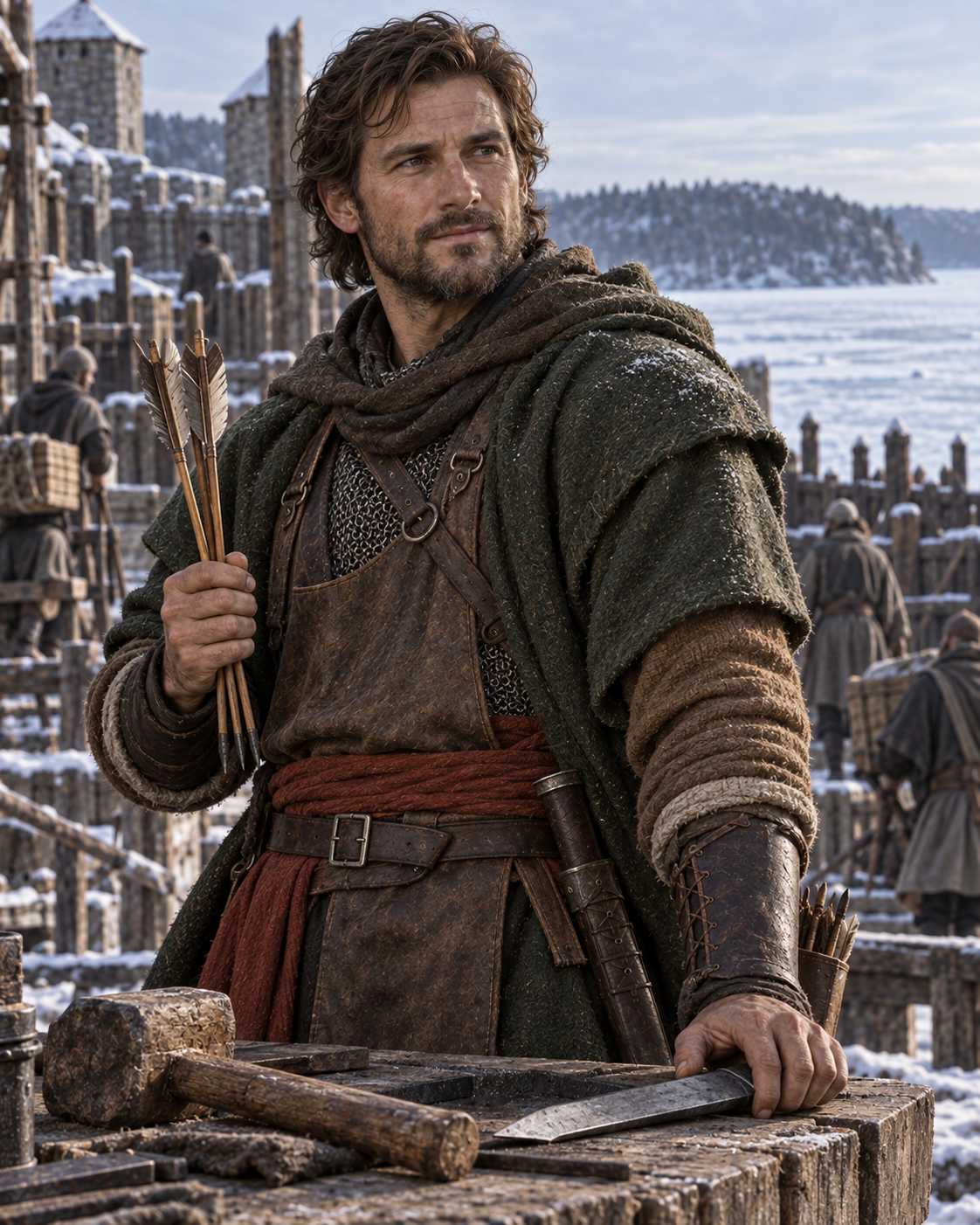
The ledger establishes Freosel through action rather than a fixed portrait inventory. His approved identity therefore begins with what the text earns: an attractive adult Erkynlander shaped by resistance labor, archery, weapon maintenance, winter defense, and command among civilians. He looks capable of making a shortened sword, conserving arrows, lifting a heavy mallet, and standing where frightened neighbors can see him.
The portrait fixes one medium-tall compact working build, broad-oval face, brown eyes, fair-olive skin, collar-length ash-brown hair, short beard with a lighter patch beneath the lip, forest-green and brown layers, and rust-red sash. Those specifics are editorial reconstruction, not prose evidence. The same face, age, build, hair, and material culture must persist across New Gadrinsett, Sesuad’ra’s barricades, the lake trap, council, and Onestrine Pass. Scene-specific clothing can change; identity cannot.
The Complete Journey
The defense begins with neighbors and expands without forgetting them
Book 3 · To Green Angel Tower, Part I
He knows what the larger war means because he can name the home inside it
At New Gadrinsett, Josua explains Fengbald as the tool of a greater evil and Strangyeard worries that he is no war-priest. Freosel gives the cause its shortest usable form: they are defending home. The line is not anti-intellectual. It translates prophecy, legitimacy, and supernatural war into the obligation that makes farmers and refugees stand on bare stone.
He trusts Helfgrim’s intelligence about Fengbald even after Geloë senses a shadow in the man’s mind. The decision does not become blind vindication. Helfgrim’s apparent knowledge is partly disguise, but the trap is real: he is the former mayor’s brother and has helped prepare revenge for Falshire.
Josua’s defense layers different communities’ specialties. Deornoth supplies the mounted feint, Freosel husbands scarce arrows, Hotvig brings ice-shod cavalry, and Simon positions the Qanuc flank. Fengbald’s caution forces the defenders to spring an imperfect plan. Freosel’s volley breaks the enemy front long enough for Hotvig’s riders to cross and split the line.
The deeper trap waits underfoot. Helfgrim guides Fengbald onto prepared lake ice while Freosel and fewer than a dozen survivors use heavy mallets to break it. The secret has been held by a small circle because anyone captured on the ice might have been tortured. Survival depends upon ordinary bodies doing coordinated work nobody can display in a heroic portrait without lying about how cold and terrifying it was.
Afterward, Freosel and Josua stage an execution threat to pressure captured Erkynguards into accepting work and possible future service. The tactic is coercive even if it avoids slaughter. Their prisoner policy distinguishes useful incorporation from forced loyalty imperfectly, making governance after battle as morally complicated as winning it.
Freosel also works beyond spectacle. He makes a shortened sword for Miriamele, adapting equipment to the person who will actually carry it. Isgrimnur sends him toward her tent when camp security collapses after the Talons’ attack. Practical care arrives ahead of speeches.
Book 4 · To Green Angel Tower, Part II
He takes the argument for Erkynland into a coalition marching elsewhere
At the Raed, Freosel favors moving toward Erkynland while Sludig and Isgrimnur favor Nabban. His position follows the same logic as Sesuad’ra: the war becomes meaningful through the homes and people exposed to it. Coalition does not erase regional priorities; leadership must decide among legitimate dangers.
Freosel remains embedded in Josua’s military structure through the final campaign. At Onestrine Pass, Seriddan’s Metessan pikemen hold a disciplined wall while Varellan overcommits. Josua deliberately delays Freosel’s household troop by counting ten after the main signal, preserving the reserve until Camaris and Hotvig strike the exposed flank. Freosel’s force matters precisely because it is not spent at the first dramatic moment.
The ledger does not assign him an invented coronation, estate, or sentimental epilogue. His completed contribution is clearer than that: he helps transform displaced civilians into a defended community, local knowledge into strategy, and household strength into coalition warfare without losing sight of why the war was worth fighting.
The People Around Him
Trust becomes useful only when somebody knows what to do with it
Josua
Freosel translates the prince’s cause into local obligation and supplies the people, craft, and judgment that turn legitimacy into defense.
Helfgrim
Freosel trusts him through a suspicious story. The trust leads to a real plan, but Geloë’s warning keeps the alliance from becoming a neat intuition fable.
Hotvig
Arrow volley and ice-shod cavalry become one coordinated blow. Neither leader’s specialty is sufficient alone.
Miriamele
The shortened sword he makes is a small but revealing act: equipment should fit the fighter rather than force the fighter to perform somebody else’s shape.
Isgrimnur
The duke trusts Freosel with anticipatory protection when danger enters the camp. Competence is recognized across rank.
New Gadrinsett
The settlement is not a backdrop. Its farmers, women, refugees, defenders, food, walls, and children are the “home” inside Freosel’s politics.
Why He Works
Epic fantasy needs the person counting the arrows
Freosel works because he converts scale into tasks. Prophecy may explain why the winter exists; somebody still has to decide when to fire, whom to trust, how to arm a smaller fighter, where to hide the mallets, and when a reserve must wait ten more heartbeats.
He also gives “home” political texture. It is not bloodline nostalgia or a castle inherited through destiny. New Gadrinsett becomes home because displaced people build, feed, bury, argue, and defend there.
Home as Logistics
His plainest sentence carries the settlement’s entire supply chain inside it
“Defending home” sounds emotionally simple only if home is treated as a flag. Freosel’s actions give the word inventory. Home is a defensible position with too few arrows. It is ice that can be prepared without warning the people who may later fight above it. It is a frightened population that still needs leaders visible among them. It is prisoners who must be fed, watched, persuaded, or released after the cheering stops.
The lake battle makes that politics physical. Freosel’s archers cannot spend ammunition as if heroic abundance will replenish the quivers. The first volley must create a specific opening for Hotvig. The hidden workers and mallets must wait until Fengbald commits. Josua’s larger strategy succeeds because local people understand what can be changed in their terrain and accept the danger of changing it.
That labor also complicates Helfgrim’s role. Geloë correctly senses concealment, while Freosel correctly recognizes usable knowledge. Neither fact cancels the other. The plan works because the defenders verify enough of the intelligence, distribute responsibility, and preserve the secret against capture. Trust is not magical intuition rewarded by the plot; it becomes a risk managed collectively.
Even the shortened sword belongs to this worldview. Miriamele does not need ceremonial approval that she is a warrior. She needs equipment sized to her body. Freosel solves the material problem. Later, when she and Simon trade archery and sword instruction, the weapon participates in a relationship built through adapting inherited skills rather than merely admiring them.
At Onestrine Pass, his household troop becomes the same lesson at coalition scale. Josua withholds the reserve past the emotionally obvious moment. Freosel’s value lies partly in being ready and not yet used. Epic battle often celebrates the charge; disciplined survival also depends on the force that can tolerate waiting.
After the Ice
Winning does not make every next choice clean
Freosel helps stage an execution threat to push captured Erkynguards toward labor and possible service. Avoiding immediate slaughter matters; manufacturing terror to obtain consent matters too. A community defending home can still reproduce coercion when deciding what defeated enemies owe it.
On the Record
Scope, spoilers, and identity continuity
This is Freosel’s one canonical full-spoiler profile across Books 3 and 4. It is grounded in the completed owned-edition reading ledger and corrects his omission from the earlier Book-1-centered registry. Franchise and volume directories must filter this post rather than duplicate his biography.
Canon establishes his Erkynlander resistance leadership, archery, weapons craft, shortened sword, scarce-arrow discipline, lake sabotage, home-centered politics, security work, and household command, but supplies no reliable physical description. The approved age, face, body, coloring, hair, beard, clothes, arrows, blade, tools, barricade, civilians, lake, weather, and light are editorial reconstruction. Every future scene must preserve this exact identity without promoting visual invention into textual fact.