
Memory, Sorrow, and Thorn · Canonical Character Profile
Frekke Grayhair
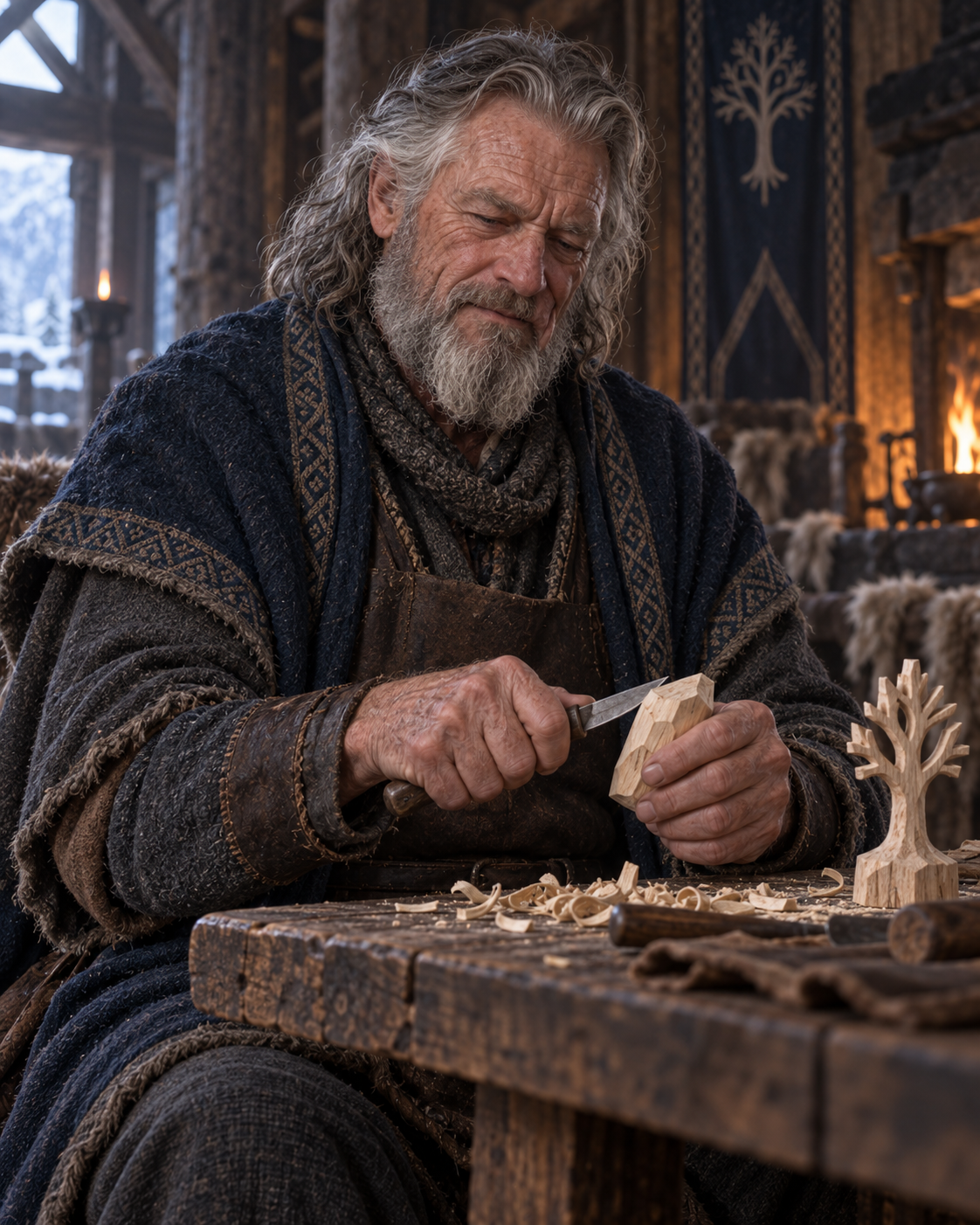
Frekke Grayhair is an old Rimmersman soldier who once served Isgrimnur’s father and now teaches an impatient duke how to look at a block of wood until the shape inside announces itself. The lesson seems almost comic when Isgrimnur burns another failed carving. Two books later, Frekke is dead at Naglimund, and the memory of his kindness helps Isorn reach the son he left behind. He is proof that gentleness can survive inside a warrior’s legacy—and become political power after the warrior is gone.
At a Glance
The old soldier who teaches a duke to stop fighting the grain
- Name
- Frekke Grayhair
- People
- Rimmersman
- Role
- Veteran soldier and woodcarving teacher
- Service
- Served Isbeorn before remaining loyal to Isgrimnur
- Family
- Father of Ule Frekkeson
- Appearance
- Old, with gray hair and a scarred lip
- Fate
- Dies at Naglimund; reported in Book 3
A Long Northern Memory
Frekke’s loyalty predates the duke who now depends on him
Frekke served Isbeorn, Isgrimnur’s father. By the time he enters the active story, he is not merely another armed retainer attached to a famous household. He is a living connection between generations of Rimmersgard leadership.
That history helps explain the ease with which he teaches Isgrimnur. The relationship can bear irreverence. Frekke does not flatter the duke’s terrible carving or convert every exchange into court ceremony. He has known the family too long for performance to replace usefulness.
The text describes an aged soldier rather than a retired artisan who happens to know nobles. His body carries time and service: gray hair, a scarred lip, a shambling or shambolic shadow. Yet his concentration at the wood is exact. His eyes nearly close as he searches the grain.
That combination is the key to him. The old soldier’s discipline has not disappeared; it has changed medium. A man shaped by arms now practices attention through knife, grain, and patience.
The record does not specify Frekke’s battles under Isbeorn, military rank, birthplace, wife, or the circumstances of his scar. Giving him a credible old-warrior presence does not require inventing medals for campaigns the novels never name.
The Figure in the Wood
His lesson is about discovery, which is exactly why Isgrimnur keeps failing
While Isgrimnur is effectively detained at the Hayholt, Frekke teaches him woodcarving. The craft offers the duke something politics will not: the possibility that confusion contains a form patient hands can uncover.
Frekke’s method is to look into the grain and find what is already there. He concentrates until his eyes nearly close, showing Isgrimnur that carving begins before the knife does. The artist does not bully the block into obedience. He recognizes its limits and follows them toward a figure.
Isgrimnur understands the promise and lacks the temperament. His world is coming apart through royal suspicion, unnatural weather, threatened family, and blocked roads. He wants the wood to surrender meaning on command.
It does not. The piece intended as a Tree for Gutrun refuses to become what he imagines. Frekke dryly expects the duke will burn another failure, and Isgrimnur obliges.
The humor works because Frekke’s patience is real. He can watch a powerful, frustrated man ruin the lesson repeatedly without pretending the failure is success. His dry expectation is affectionate enough to avoid humiliation and honest enough to deny vanity.
What the Tree Means
A failed gift still reveals the tenderness the lesson made possible
Isgrimnur intends the carving for his wife, Gutrun. The planned Tree turns the exercise into more than distraction. He wants to make something for the woman whose safety he cannot secure from the Hayholt.
Frekke’s craft therefore creates a space where homesickness, marriage, and political helplessness can become physical work. Isgrimnur cannot cross the snow to Gutrun. He can sit with wood and try to uncover a symbol of continuity.
The attempt fails, but failure is not emptiness. It reveals what Isgrimnur wants: order that can be discovered, a family bond made tangible, and an action his own hands can complete.
Frekke matters because he recognizes that a soldier and duke may need this kind of labor. Teaching him does not soften the crisis into therapy language the novel never uses. It simply gives a furious man a disciplined practice and lets the reader see why discipline is harder than force.
The eventual burning also sharpens Frekke’s absence. After the old man dies, there will be no further patient correction from the scarred lip, no amused certainty that the latest block is headed for the flames. The lesson remains unfinished because the teacher’s life does.
Death at Naglimund
The novel reports the loss later and refuses to manufacture a private heroic finale
Frekke travels with Isgrimnur in Book 1 and later reaches the resistance stronghold at Naglimund. By Book 3, Isorn tells Ule that his father died there.
The completed reading record does not preserve a direct death scene, exact location inside Naglimund, killer, weapon, or final words. It does not prove whether Frekke fell during a particular assault, died of wounds afterward, or met some other end within the catastrophe.
That uncertainty must remain visible. “Died at Naglimund” is the fact. “Died heroically defending the wall” would be attractive filler masquerading as canon.
The absence of a staged farewell fits the scale of Naglimund’s devastation. People disappear into siege, sorcery, battle, and collapse faster than the narrative can award each one a spotlight. Frekke’s death reaches the reader through the person who must tell his son.
That reporting structure shifts attention from spectacle to consequence. The question is not whether Frekke looked magnificent in his final second. The question is what his name does among the living when grief and resistance need to recognize each other.
Ule Frekkeson
His son inherits grief, a name, and evidence that kindness was remembered
In Book 3, Isorn and Eolair are led to a hidden hall occupied by displaced Rimmersmen. Among them is Ule Frekkeson, Frekke’s son.
Ule initially rejects Isorn’s appeal. He suspects a trick and insists the outlaws are free men. Isorn answers with material reality rather than empty loyalty language: hiding without homes or families is not freedom, and land reclaimed from Skali can become a future.
The political argument does not complete the recruitment. Frekke does.
When Ule demands news of his father, Isorn tells him plainly that Frekke died at Naglimund. He also remembers Frekke’s kindness. Ule’s anger breaks into an embrace; Isorn cries with him; the camp moves forward to welcome Isorn’s cause. Ule answers loss with a blood-feud vow against Skali.
The scene works because Isorn does not treat Frekke as a useful dead soldier whose son can be harvested. Remembered kindness proves relationship. Isorn knows the man behind the service record, and his grief costs him composure.
Frekke’s legacy therefore travels through character rather than property. The woodcarving teacher’s patience and dry warmth become evidence that Isorn’s household remembered ordinary loyalty personally. That recognition helps transform suspicion into alliance.
Two Kinds of Inheritance
Isgrimnur receives a craft; Ule receives the proof that his father mattered
Frekke leaves two especially visible inheritances. To Isgrimnur, he gives the discipline of looking for a figure inside resistant material. To Ule, he leaves a name whose remembered kindness can still open another person’s grief.
Neither inheritance is complete or easy. Isgrimnur repeatedly fails at the craft. Ule receives news of death instead of reunion. The series does not make legacy a magical object that solves the next generation’s problem.
Instead, Frekke’s influence changes how people act. Isgrimnur briefly searches chaos for form rather than swinging at it. Isorn speaks to Ule as the son of someone he genuinely mourns. Ule permits shared grief to become shared purpose.
The old soldier’s importance lives in those changed behaviors. He is not central because a genealogy chart says he served two generations. He is central because people learned something in his presence and reveal it after he is gone.
Connections
The household, pupil, and son who carry Frekke beyond his final appearance
Isgrimnur
Frekke’s impatient carving pupil and the son of the lord Frekke served before him.
Isbeorn
Isgrimnur’s father and Frekke’s former lord, connecting Frekke to an older Rimmersgard generation.
Gutrun
Intended recipient of the Tree carving Isgrimnur cannot complete.
Ule Frekkeson
Frekke’s son, who learns of his death from Isorn and turns grief toward the struggle against Skali.
Isorn
Remembers Frekke’s kindness, shares Ule’s grief, and makes that memory part of an earned alliance.
Skali Sharp-nose
The enemy against whom Ule directs his blood-feud vow after hearing that Frekke died.
Why Frekke Matters
He lets the series define an old warrior through patience instead of accumulated violence
Frekke could have been written as a bundle of veteran shorthand: scar, drink, loyalty, death. Tad Williams gives him the scar and drink, then makes the memorable action a lesson in seeing.
His soldier’s history lends weight to gentleness rather than canceling it. The same man who survived long service can almost close his eyes over the wood grain and wait. When drink makes him unusually formal, the detail adds comic humanity without swallowing the rest of him.
His later death expands that small portrait. Isorn does not recruit Ule by reciting Frekke’s military usefulness. He remembers kindness. That single choice tells us what survived most powerfully in another person’s mind.
A complete fandom profile should protect that proportion. Frekke is not secretly the architect of the resistance. He is an old loyal man whose patient craft, humor, service, and kindness persist in a duke’s failed Tree and a son’s grief.
On the Record
Books 1 and 3 only, with the death scene left honestly unresolved
This is Frekke Grayhair’s one canonical full-spoiler profile. He appears directly in the Book 1 record through Isgrimnur’s carving lesson and northern company. Book 3 identifies Ule as his son, reports Frekke’s death at Naglimund, and makes Isorn’s memory of his kindness central to Ule’s recruitment. No direct Frekke receipt occurs in Book 2 or Book 4; the inherited Book 4 scope has therefore been removed.
The record confirms that Frekke is old and gray-haired, has a scarred lip, nearly closes his eyes while concentrating on carving, drinks enough to become unusually formal, served Isbeorn, loyally remains with Isgrimnur, teaches the duke to find figures in wood grain, expects failed carvings to be burned, fathers Ule Frekkeson, and dies at Naglimund. It does not confirm his exact age, eye color, full facial structure, spouse, birthplace, rank, named battles, cause of the lip scar, exact death circumstances, killer, weapon, or final words.
The approved portrait fixes one attractive age-correct living identity: roughly seventy-two, long-square weathered face, pale blue-gray eyes, shoulder-length iron-gray hair, full gray beard, scarred upper lip, stooped veteran build, and broad capable hands at a carving table. Exact age, facial geometry, eyes, hair length, beard, body, clothing, hall, table, knife, unfinished Tree, weather, and light are editorial reconstruction. Every later scene must preserve this identity, and any Naglimund art must avoid inventing a death tableau the books do not give us.