
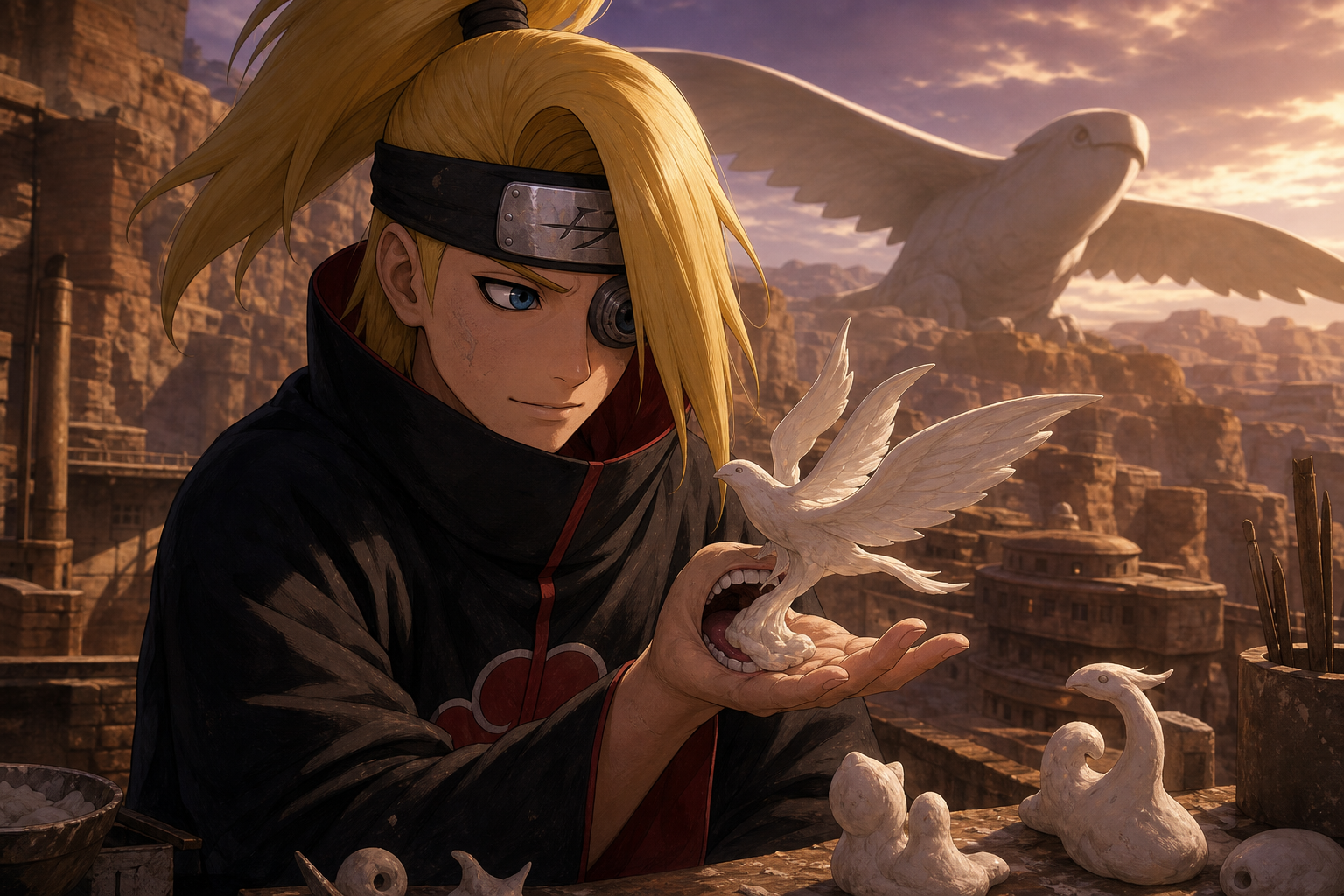
Deidara
Bottom line
Deidara is a terrorist with an artist statement. The sculptures are clever. The flying clay birds are gorgeous. The tiny spiders are nightmare fuel with excellent branding. None of that changes the business model. He makes beautiful objects, packs them with chakra, sells destruction to clients, kidnaps a Kazekage and treats civilian terror like audience participation.
His philosophy sounds simple: art is the instant an object explodes. The deeper truth is less flattering. Deidara needs the explosion because an explosion forces attention. Nobody gets to look away, shrug or ask whether the sculpture was actually good. Shock becomes applause he can control.
That is why the Uchiha brothers break him. Itachi defeats him without granting the reaction he wants. Sasuke survives while treating the art as a technical problem. Deidara can tolerate injury. He cannot tolerate indifference.
Deidara Essential File
Identity. Deidara is an Iwagakure missing-nin, former Explosion Corps member, Akatsuki operative, clay sculptor and long-range demolition specialist. His Akatsuki partners are first Sasori and later Tobi, whose clowning drives him up the wall while hiding a far more dangerous agenda.
Age and birthday. Reference guides place Deidara at nineteen when he dies. His birthday is May 5. The official Naruto birthday column lists his favorite food as oden “bombs,” hard-boiled eggs wrapped in surimi. Even lunch has to stay on theme.
Debut. Deidara enters the manga in chapter 247 as Akatsuki moves against the Hidden Sand. His anime debut comes at the beginning of Naruto Shippuden. He arrives as an established criminal, so the story reveals his earlier Iwa life later. Original Japanese performance. Katsuhiko Kawamoto performs Deidara in the original Japanese anime. His performance carries the artist’s swagger, irritation and panic as Deidara’s need for recognition overwhelms his control.
Iwagakure Built the Foundation
Deidara comes from the Village Hidden in the Stones and serves in its Explosion Corps. His Explosion Release gives him a military vocabulary before Akatsuki gives him an international platform. The village teaches him that controlled destruction is skilled labor. He leaves Iwa and begins taking bombing commissions in neighboring countries. The official Naruto retrospective describes terrorist bombings carried out for clients. Art and contract work become the same transaction. Somebody pays. Deidara chooses a target. The blast supplies both product and signature.
The shinobi economy makes this possible. Villages train specialists to create force, then act shocked when specialists discover private buyers. Missing-nin are not accidents outside the system. They are exports from the system. The Forbidden Technique and the Mouths in His Hands. Deidara steals a kinjutsu from Iwa that creates mouths on his palms and another on his chest. The palm mouths chew clay while he kneads explosive chakra into the material. Shape, chakra amount and tactical purpose determine the result.
The mouths make artistic production bodily. He does not hold a separate tool. His hands eat raw material and return weaponized form. The technique turns craft into metabolism. That intimacy does not make the work innocent. Deidara romanticizes process because process gives violence an aesthetic name. A clay bird carrying a bomb is still carrying a bomb.
Itachi Recruits Him by Wounding His Pride
Akatsuki sends Itachi, Kisame and Sasori to recruit Deidara. Itachi Uchiha proposes a fight. If Deidara loses, he joins. Itachi catches him in genjutsu. Deidara briefly perceives the Sharingan display as art, and that involuntary admiration humiliates him more than the defeat. He joins Akatsuki while nursing an obsession with defeating the Sharingan.
He later trains one eye to resist genjutsu and develops C4 with Itachi in mind. This is not calm artistic research. A teenager reorganizes years of work around one person who made him feel small.
Sasori and the Argument About Art
Sasori believes art should endure. Deidara believes art reaches perfection in the instant it disappears. Their arguments are funny because both murderers insist the disagreement is professional. Deidara respects Sasori and calls him master, but respect does not turn the partnership into a safe friendship. They work together inside an organization built on extraction, coercion and death. Shared artistic language makes them compatible coworkers, not wholesome studio mates.
The contrast clarifies both men. Sasori wants control so complete that the object never changes. Deidara wants a climax so overwhelming that nobody can control the response. One freezes time. The other detonates it.
The Hidden Sand Invasion
Deidara infiltrates Sunagakure from the air and targets Gaara. The battle establishes his greatest strength: he does not need to stand where his target can reach him. Gaara’s sand defense crushes one of Deidara’s arms. Deidara adapts. He studies the village, threatens the civilians below and forces Gaara to divide attention between protecting himself and protecting everyone else.
The tactic wins because Gaara is Kazekage. Deidara exploits leadership as a vulnerability. He does not overpower Gaara in a neutral arena. He turns the people Gaara loves into leverage. Capturing Gaara Is Not an Art Critique. Fans often reduce the battle to a power-scaling receipt. The real consequence is political. Akatsuki breaches a sovereign village, abducts its head of state and extracts a living weapon from his body.
Deidara treats the operation as a chance to display craft. Suna experiences a national emergency. Gaara experiences death. Calling the attack art lets Deidara center his experience while everybody else handles the rubble, fear and funeral preparations. Branding is doing moral labor for him. Naruto and Kakashi’s Pursuit. After the extraction, Deidara carries Gaara’s body away and deliberately provokes Naruto. He understands the jinchūriki bond well enough to use the corpse as bait. Kakashi unveils Kamui and removes Deidara’s remaining arm. Naruto catches him and attacks with rage before discovering that the body is a clay substitute. Deidara survives by planning escape layers. He loses both arms during the wider mission, yet his mouth-based art system and Akatsuki support let him return. Injury has consequences, but the organization has recovery infrastructure. Tobi Becomes the New Partner. After Sasori’s death, Tobi enters the partnership. Deidara treats him as an incompetent junior, scolds him and repeatedly becomes the straight man in Tobi’s comedy routine.
The joke works because the power relationship is fake. Tobi is performing foolishness while steering Akatsuki’s deeper agenda. Deidara thinks he is managing an irritating subordinate. He is sharing missions with the person manipulating the organization. Their pairing turns artistic vanity into camouflage. Deidara looks at behavior, decides the clown is harmless, and misses the controller behind the mask.
The Three-Tails Operation. In anime-expanded material, Deidara and Tobi participate in the operation around the Three-Tails. The anime gives their partnership more room for comedy and action than the manga’s narrower record. That material belongs in an adaptation shelf, not smuggled into manga biography. The distinction does not make the episodes worthless. That choice tells fans which version supplied the event.
Sasuke Is the Audience Who Refuses the Show
Deidara chooses to fight Sasuke Uchiha while Sasuke is pursuing Itachi. Sasuke wants information. Deidara wants recognition. The mismatch destroys him emotionally. Sasuke analyzes clay types, range, chakra signatures and lightning weakness. He keeps asking about Itachi. Every practical question tells Deidara that the art is secondary. Deidara escalates from clay creatures to C4 and finally self-detonation because technical survival feels like aesthetic disrespect. Sasuke is not reviewing the exhibit. He is trying to leave alive. Lightning Release Is the Unromantic Counter. Sasuke discovers that Lightning Release can neutralize the Earth-natured explosive clay. He runs lightning chakra through his own body and attacks to disable bombs.
The counter is devastating to Deidara’s self-image because it reduces “ultimate art” to elemental mechanics. Beautiful names do not remove chakra properties. Sasuke’s victory still costs him. He uses significant chakra, escapes through a dangerous summoning maneuver and is pushed hard. The matchup advantage matters without turning the fight into effortless humiliation. C1: Small Forms, Large Anxiety. C1 uses small clay creatures such as birds, insects and spiders. The forms support scouting, ambush, diversion and close-range surprise. Lower output does not mean harmless. The artistry is functional. Wings carry bombs. Legs let clay crawl into protected spaces. A small sculpture can exploit the moment an opponent dismisses it as decoration.
C2: The Dragon and the Minefield. C2 deploys a large clay dragon capable of flight and repeated bomb production. Deidara combines aerial pressure with mines placed through Tobi’s assistance. The technique turns the battlefield into a layered installation. The visible dragon directs attention upward while the ground punishes movement. Deidara’s best work is tactical composition, not raw blast size.
C3: A Village as the Canvas. Deidara’s large C3 creation carries enough destructive power to threaten Sunagakure. The official retrospective describes it as his strongest work by sheer power at that point. Gaara blocks the blast by protecting the village. Deidara uses the defense to contaminate Gaara’s sand with smaller clay explosives. The public attack is both weapon and distraction. A city-sized canvas means civilians become involuntary viewers. Nobody bought a ticket.
C4 Karura and the Terror of Invisible Scale
C4 Karura resembles a huge Deidara figure, but the visible body is delivery packaging. When ruptured, it releases microscopic clay bombs that spread through the air and enter living bodies. The bombs detonate at cellular scale. The technique makes breathing dangerous and converts the opponent’s body into the exhibition space.
Deidara develops C4 for the Sharingan problem, particularly Itachi. Sasuke survives by seeing the chakra and using lightning to neutralize the particles. Vision meets invisibility, which is exactly the argument Deidara has been trying to win since recruitment.
C0: Suicide Framed as the Final Masterpiece
Deidara’s chest mouth consumes clay and turns his body into a bomb with a ten-kilometer blast radius. He calls death the completion of his art. The performance is grand. The logic is desperate. Deidara would rather destroy himself and the landscape than accept an audience member leaving unconvinced. Sasuke escapes. Deidara dies without securing the reaction he demanded. C0 becomes the ultimate proof that spectacle cannot force meaning. Reanimation and the Second Humiliation. Kabuto brings Deidara back through Edo Tensei during the Fourth Shinobi World War. The artist who chose a spectacular death returns as somebody else’s reusable weapon.
Reanimation damages his philosophy. A final explosion should be final. Edo Tensei turns the once-only performance into repeatable labor. Kankurō’s unit captures him. Deidara remains furious that his art and death have been denied the permanence of memory he expected. Sasori learns to release control. Deidara keeps demanding the review.
Technique and Equipment Shelf
Explosion Release. Deidara combines chakra nature and stolen kinjutsu with sculpted clay. Range, preparation, clay supply and chakra remain limits. Palm mouths. The mouths chew clay and knead chakra into it. They expand production speed but do not eliminate the need for material or intact hands. Clay flight. Birds and larger creations give him superior mobility, reconnaissance and attack angles. Air advantage can be disrupted by faster opponents, ranged counters or damage to the mount. Left-eye scope. The scope supports long-range observation. Deidara also trains the eye against genjutsu after Itachi’s defeat, though training does not create universal immunity.
Clay clones. Explosive substitutes create escape routes and punish pursuers. A clone can deceive attention without making the original invulnerable. C1 through C4. The numbered scale organizes output and delivery style rather than a simple ladder where every later form solves every problem. C0. The final detonation kills the user and devastates a vast area. A technique that requires death has a very clear usage limit. What Deidara Cannot Do. Deidara cannot make admiration compulsory. He cannot keep Itachi from becoming the standard in his head. He cannot make lightning stop countering his clay by calling the clay beautiful. He cannot detonate C0 twice while alive. He cannot erase civilian cost through an artist statement.
Those limits are why he works. Without them, Deidara would be a blond special-effects machine. With them, he becomes a portrait of talent starving for recognition. Design and Visual Language. Long blond hair covers one eye while the scope sharpens the other. The composition turns looking into identity. Deidara is obsessed with who sees, how they see and whether they react correctly.
The mouths in his hands make creation uncanny. Sculpture emerges from chewing flesh. The Akatsuki cloak gives institutional branding to somebody who insists he is an individual artist. White clay against the black-and-red cloak makes every creation readable before detonation. The art is designed for contrast because Deidara never wanted a quiet audience. Original Japanese Performance. Katsuhiko Kawamoto voices Deidara in the original Japanese anime. The role spans swagger, irritation, comedy with Tobi, professional sparring with Sasori and increasingly raw fury against Sasuke. This profile names the verified performer and the scenes defining the role without inventing technical claims about pitch or breath from an unavailable direct audio review.
Manga, Anime, Games and Canon Boundaries. The manga establishes Iwa, Akatsuki recruitment, Gaara’s capture, Sasori partnership, Tobi pairing, Sasuke battle, death and war reanimation. The anime adapts that spine and expands selected missions and partnership comedy. Games make Deidara especially visible because aerial clay attacks translate well into large arenas. Game-only combinations and cinematic explosions belong to the game record unless manga or anime supplies the same technique. Movies and OVAs may use cameos or alternate-continuity appearances. None replaces the core biography.
Creative Labor, Terror and the Audience Problem
Deidara is right about one thing: destruction can be aesthetically overwhelming. Cinema, fireworks and performance art all understand the power of a brief event. He is wrong that intensity settles ethics. A work can be technically brilliant and morally rotten. Calling victims an audience does not create consent. The industry lens is ugly and familiar. Shock travels. Destruction gets attention. The creator starts chasing a larger reaction because the last spectacle has already become old content. Deidara scales from insects to villages to his own body. Buddhist Impermanence Without Wisdom. Deidara celebrates impermanence. His art exists in a flash and disappears. That sounds almost Buddhist until we notice the attachment underneath. He is fiercely attached to recognition, superiority and control over interpretation. He accepts the artwork’s disappearance while refusing to release his ego. Impermanence becomes branding instead of liberation.
Fandom Misreadings
“Deidara beat Gaara fairly.” He wins through skill and strategy, but exploiting the village Gaara protects is part of the strategy. A neutral-arena claim erases the actual battle. “Sasuke only survived through plot armor.” The fight establishes lightning as a counter, Sasuke’s visual analysis and a costly escape. Fans can debate convenience without deleting the mechanics.
“Deidara and Sasori are best friends.” They are respected partners with opposing philosophies. Canon does not require a friendship label. “Tobi is Deidara’s harmless junior.” Tobi performs that role while hiding authority and power.
“C0 proves Deidara won.” Sasuke survives. Deidara dies. The final piece fails its stated goal. “Calling it art excuses the terrorism.” No. The art can be real while the crime remains a crime. Essential Deidara Reading and Viewing Path. Begin with the Sunagakure infiltration and full Gaara battle. Continue through extraction, the Naruto and Kakashi pursuit, and Deidara’s escape. Then read the Itachi recruitment flashback, Sasori partnership material and Tobi missions. The Sasuke battle is essential from C1 and C2 through C4 and C0. Finish with his Fourth War reanimation and capture to see what happens when a self-declared final artwork gets recycled.
Consequence Ledger
Deidara terrorizes neighboring countries, helps Akatsuki capture Gaara, threatens Suna’s civilians, contributes to a Kazekage’s death, wounds opponents and destroys landscapes. His work gives Akatsuki range, mobility and spectacle. He loses arms, loses Sasori, loses the argument with Sasuke and loses his life. Reanimation then removes ownership of his body and turns his supposed finale into repeatable military labor.
Why Deidara Matters
Deidara matters because he is entertaining enough to make the audience feel the seduction of his excuse. The designs are cool. The strategy is smart. The catchphrase lands. Then Naruto shows the village underneath the explosion. Deidara wants art to exist for one perfect instant. His victims live with the aftermath. That is the part his philosophy keeps editing out. Art may be an explosion. Responsibility is what remains after the smoke clears.
An audience under threat is not an audience
Deidara talks about art as if the explosion creates one pure instant between maker and witness. The people below his clay bird do not receive an invitation. Sunagakure civilians cannot leave a review, refuse the exhibition, or decide that the work does not interest them. Their fear becomes part of his composition without their consent.
That is why the beauty matters without becoming a defense. Deidara has real craft. He models recognizable creatures at speed, changes scale, plans flight paths, hides traps, and understands how shape directs attention. The clay birds and dragons are not random ammunition with a fancy label. They demonstrate imagination, control, and technical fluency. The problem begins when he treats those gifts as permission to own everybody else’s reaction.
An explosion settles the argument by destroying the room where criticism could happen. Anyone impressed becomes proof of genius. Anyone horrified still gives him the intensity he wanted. Anyone killed cannot answer. Deidara calls that instant eternal because the audience loses the ability to revise its judgment after the smoke clears.
The body becomes a workshop and a contract
The mouths in Deidara’s palms and chest make his artistic practice physically inseparable from his body. He does not carry a neutral tool kit. He feeds material into altered flesh, kneads chakra through living mouths, and produces weapons through a process that is intimate, grotesque, and efficient. The design turns creation into consumption before the object even exists.
That bodily modification deserves more than a cool-power summary. Iwagakure’s forbidden technique gives Deidara a production system that can travel, scale, and attack from the air. It also narrows the distance between artist and weapon until self-destruction becomes the logical final medium. C0 is already waiting inside his chest while he argues that art belongs to a fleeting instant.
Akatsuki benefits from that arrangement. The organization does not need to convince Deidara that bombing is labor. It lets him call the mission art, gives him targets large enough to satisfy his pride, and collects the strategic result. His identity becomes the motivational system for work other people want performed.
Akatsuki turns an artistic feud into operational value
The partnership with Sasori looks like comic bickering because their philosophies oppose each other so neatly. Sasori wants art that remains. Deidara wants the instant that disappears. Underneath the argument, both men convert bodies into material and both produce value for a criminal organization. One preserves corpses. The other erases landscapes. Akatsuki can use either theory as long as the target ends up captured or dead.
Their disagreement therefore has limits. Deidara respects Sasori’s skill and seniority even while insisting the puppet master’s definition is wrong. Sasori insults the explosions and still plans missions around Deidara’s flight, range, and demolition capacity. Art talk gives them a language for ego. The organization gives that ego a payroll, a uniform, and a list of jinchūriki to hunt.
When Tobi replaces Sasori, Deidara loses the partner who could challenge his artistic claims with expertise. The comedy gets broader, but the need for recognition gets sharper. Tobi’s apparent foolishness denies him the serious audience he believes he deserves. Deidara responds by performing authority louder, which is funny until the same hunger drives him toward a blast meant to settle his worth permanently.
C0 is the final demand, not the final proof
Deidara’s last fight with Sasuke becomes unbearable to him because survival keeps functioning as criticism. Sasuke analyzes the clay’s elemental weakness, uses lightning to neutralize explosives, reads range and timing, and refuses to look spiritually defeated. Deidara does not merely want to win. He wants the Uchiha gaze to admit that his art is superior.
C0 tries to remove every remaining possibility of refusal. Deidara turns his whole body into the bomb, makes death the signature, and expects the scale of the blast to force a final verdict. Sasuke survives. The intended witness escapes. The artist is gone. The landscape carries the consequence, but the argument remains unsettled because destruction cannot manufacture agreement.
There is tragedy in that choice without innocence. Deidara is young, enormously skilled, and consumed by a wound to his pride that Akatsuki keeps feeding. He could have made objects nobody had to fear. He could have allowed craft to survive criticism. Instead, he builds a philosophy where disagreement feels like erasure and answers that feeling by trying to erase the person disagreeing.
His legacy is not that ephemeral art loses to eternal art. Naruto gives no tidy winner to that debate. Sasori dies releasing his strings. Deidara dies detonating himself. What remains is the ethical question both men avoid: can creation still count as art when another person’s body is treated as disposable material for the artist’s idea? The series leaves wreckage where the answer should be. CVM Sekai is comfortable saying the quiet part. Skill does not cancel consent, and spectacle does not pay the bill.
Sources and canon boundary
Manga chronology controls this profile. Anime staging, databook material, novels, films, games, and reanimation-era appearances are labeled instead of being blended into one false continuity.
Primary franchise references: Naruto Official and VIZ Media Naruto. CVM Sekai’s conclusions about explosive clay, Iwagakure, Sasori, Akatsuki, Gaara, Itachi, Sasuke, artistic coercion, C0, and accountability are editorial analysis, not invented creator quotations.