
Memory, Sorrow, and Thorn · Canonical Character Profile
Craobhan
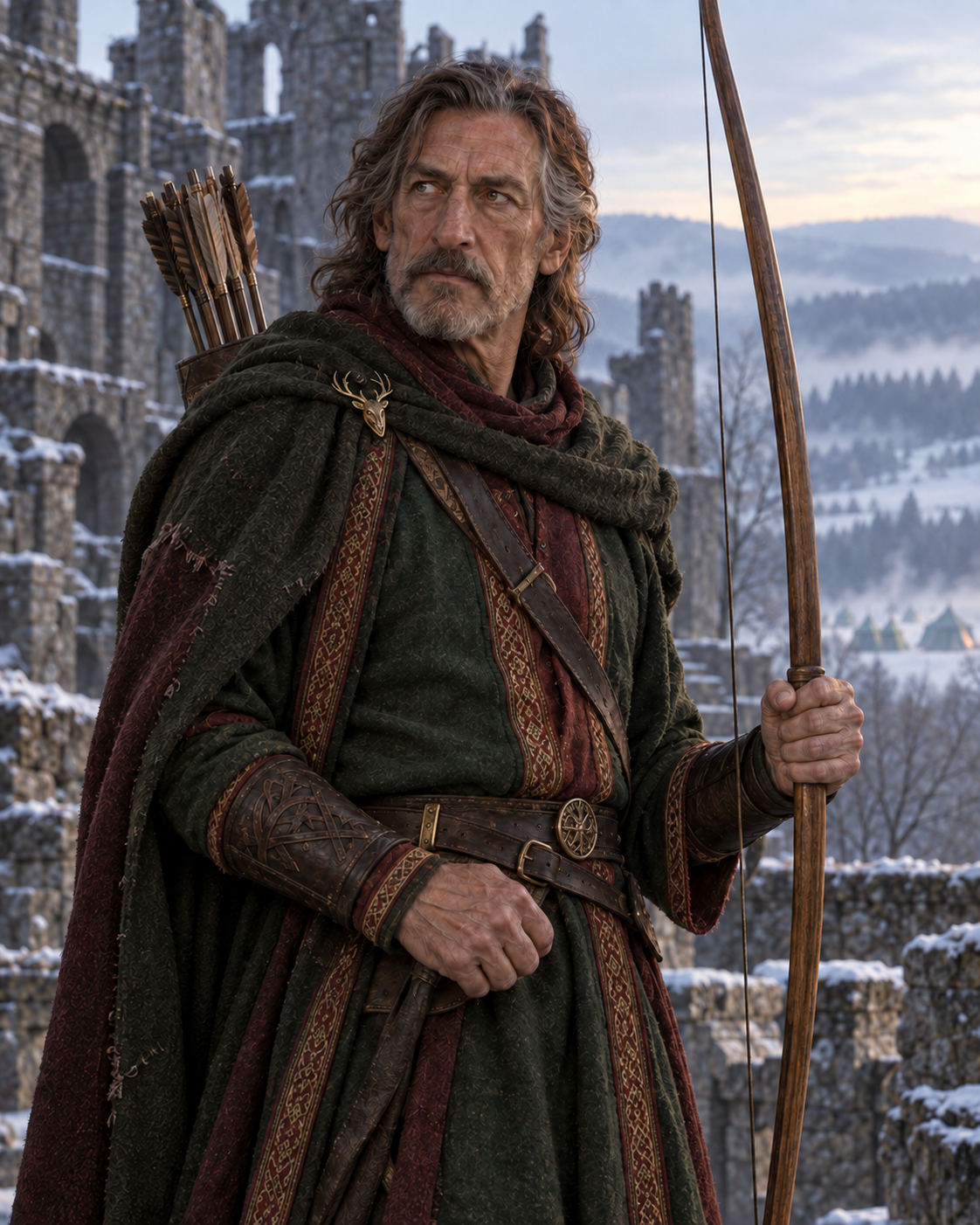
Craobhan is an elder Hernystiri archer who survives the Taig, exile beneath Grianspog, Maegwin’s revelation, and the astonishing return to Hernysadharc. He first appears ready to put an arrow through a soldier after a tavern fight. Later, he becomes one of the few older voices willing to ask what Maegwin’s certainty will cost. He cannot stop her authority from hardening into theology, but his skepticism keeps the refugees’ consent from looking effortless.
At a Glance
The elder archer who keeps asking whether survival has become obedience
- Name
- Craobhan
- People
- Hernystiri
- Role
- Elder archer and survivor-adviser
- First recorded action
- Nearly shoots a Guthwulf soldier after a tavern fight
- Refuge
- Lives with the displaced Hernystiri beneath Grianspog
- Political function
- Raises skeptical questions during Maegwin’s rule
- Last confirmed state
- Alive at reclaimed Hernysadharc in Book 3
The Taig
His first entrance is an arrow almost loosed into a political disaster
Craobhan enters the record at the Taig as an old Hernystiri archer. After a tavern fight involving one of Guthwulf’s soldiers, he comes close to shooting the man. Prince Gwythinn restrains him before anger becomes an international killing.
The moment is small, but it locates Craobhan precisely. He is not a distant council elder preserved behind ceremony. He is armed, angry, and close enough to ordinary soldiers’ conflict that his own bow nearly turns a brawl into bloodshed.
Gwythinn’s intervention also shows the political pressure surrounding Hernystir. Elias’s agents and soldiers do not arrive as neutral guests. Every insult or altercation sits inside a larger campaign of coercion. Craobhan’s reaction is dangerous, yet the anger behind it is not irrational.
The text does not identify the tavern fight’s full cause in Craobhan’s personal record, whether the arrow was drawn, or what he said. It does show the old archer needing restraint from a younger prince. Age has not made him passive, and service has not trained the outrage out of him.
That introduction becomes useful later. When Craobhan questions Maegwin, skepticism is not coming from a timid man who always resists action. It comes from someone demonstrably willing to act too fast when he believes Hernystir has been insulted.
Beneath Grianspog
The kingdom collapses, and an armed elder becomes part of a refugee government
After Skali’s invasion and the destruction of Hernysadharc, the surviving Hernystiri take shelter in the caves beneath Grianspog. King Lluth and Prince Gwythinn die. Maegwin becomes the last active daughter of the royal house among people facing snow, hunger, raids, and displacement.
Craobhan survives into this narrowed world. The old structures around his service have been stripped away: no functioning court, no secure capital, no healthy king whose decision can settle an argument.
Maegwin proposes moving the refugees deeper into the mountain, surviving through hunting, gathering, and raids, then emerging stronger. When questions of leadership and allegiance arise, Craobhan invokes Eolair and Inahwen as constraints on what Maegwin can decide alone.
The objection is politically meaningful. Eolair is Lluth’s trusted count and envoy; Inahwen is the young surviving queen. Craobhan is trying to keep authority connected to people and offices beyond Maegwin’s grief.
Maegwin answers that Eolair swore himself to her father’s house and must obey its last daughter when he returns. The logic converts dynastic survival into personal supremacy. Craobhan’s question does not defeat it, but it records that the transition was challenged.
The Gods Have Spoken
His skepticism is used as a rung in Maegwin’s ladder of proof
By Book 3, Maegwin addresses several hundred survivors beneath Grianspog. She claims the gods have spoken to her three times and assembles experiences at Mezutu’a, Bradach Tor, and her encounter with the figure she calls Brynioch into a cumulative revelation.
Craobhan again supplies the skeptical voice. Diawen prompts him, smiles through the exchange, and repeatedly steadies Maegwin when doubt surfaces. Rather than allowing his question to open inquiry, the assembly uses it to stage Maegwin’s answer.
This is a subtle but important distinction. Craobhan is permitted to speak, yet the meeting’s emotional architecture is already arranged around conversion. Skepticism becomes proof that every objection has been considered and overcome.
Maegwin teaches that winter and war reflect a conflict among divine powers, that mortal struggle affects the heavenly struggle, and that love of Hernystir is the greatest magic. She asks for total trust and willingness to place lives in the gods’ hands.
Craobhan’s presence prevents the scene from reading as spontaneous unanimity. At least one elder remembers that extraordinary claims can redirect food, movement, warfare, and every remaining life. His doubt is not abstract theology. Refugee belief is becoming policy.
The text does not give Craobhan a private diagnosis of Maegwin or show him naming her condition. A responsible profile should not turn him into a modern clinician. He asks constraint questions because the consequences of unbounded authority are visible.
What He Cannot Prevent
Being right about the danger does not give him the power to stop it
Craobhan’s role is not a fantasy of the wise elder who says one perfect sentence and restores collective reason. He is old, experienced, and capable of objection. Maegwin remains the royal survivor around whom grief, loyalty, nationalism, and religious expectation have gathered.
The refugees also have reasons to need her story. Their king and prince are dead. Their capital is occupied. Their survival underground feels temporary and humiliating. A promise that gods have noticed Hernystir gives suffering a cosmic audience and provides direction when ordinary strategy offers little.
That need makes Craobhan’s position harder. Skepticism can sound like surrender to people who have converted hope into obedience. Challenging Maegwin risks challenging the last visible continuity of Lluth’s house.
His failure to stop the process should not be mistaken for consent. Nor should his doubts be inflated into a documented resistance faction the books do not provide. Craobhan’s importance lies in holding the question open on the page even as the assembly moves past it.
Hernysadharc Reclaimed
The impossible rescue arrives, but it does not prove Maegwin’s interpretation
The Sithi ride west to Hernystir to repay a five-century debt owed to Prince Sinnach. Their arrival collapses Skali’s occupation with breathtaking speed. Likimeya destroys a recent fortification because it stands in the way, and the Sithi establish a bright cloth city across Hern’s Hill.
Craobhan and the surviving Hernystiri are alive at Hernysadharc, dazed by the day’s events. They have moved from hidden caves back into a capital transformed by powers most mortals understand only through song and legend.
For Maegwin, the return appears to validate her claim that she made the gods come. The woman attending her reinforces that belief. The truth is more complicated: the Gardenborn are not Hernystiri gods obeying Maegwin. They are a people honoring their own old bargain.
Craobhan’s earlier skepticism therefore remains valuable after apparent deliverance. A prediction can be followed by a matching event without its explanation becoming true. Hernystir is freed, but not because Maegwin commanded divinity.
The record does not show Craobhan confronting her afterward or receiving a private explanation from Eolair or Jiriki. His last confirmed state is survival amid collective astonishment. The man who asked for political constraints now stands in the result everyone else may read as supernatural vindication.
The Archer and the Question
His bow and his doubt belong to the same instinct
At the Taig, Craobhan nearly answers threat with an arrow. Beneath Grianspog, he answers unchecked certainty with a question. Both acts arise from protective vigilance, but the later one is more disciplined.
The old archer’s development is not given through viewpoint confession. It appears in the difference between intervention and restraint. Earlier, Gwythinn must stop him from escalating violence. Later, Craobhan tries to slow political and spiritual escalation by invoking absent authorities and asking for proof.
That pattern gives him more than the generic function “skeptical elder.” His suspicion has heat behind it. He cares enough about Hernystir to be dangerous and eventually careful.
The bow is also a useful metaphor only if we do not pretend the text supplies it. An archer survives by deciding when not to release. Craobhan’s later questions perform that kind of pause for a community rushing toward certainty.
Connections
The royal survivors and witnesses around Craobhan’s long emergency
Prince Gwythinn
Restrains Craobhan before the elder archer can shoot a Guthwulf soldier at the Taig.
Maegwin
Becomes the surviving royal authority whose plans and divine claims Craobhan questions.
King Lluth
The dying king whose broken household leaves Craobhan and the refugees without stable rule.
Queen Inahwen
Named by Craobhan as one of the living constraints Maegwin’s claim to sole authority must address.
Count Eolair
Lluth’s sworn man, invoked as an absent political counterweight and later present at the reclaimed capital.
Diawen
Prompts Craobhan during the assembly, helping convert his skepticism into a platform for Maegwin’s certainty.
Why Craobhan Matters
He keeps a desperate community from being rewritten as a unanimous congregation
Craobhan never becomes a viewpoint protagonist, army commander, or secret magician. His value is civic. He marks the moments when protective anger can become reckless violence and when grief-backed authority can become compulsory belief.
Without him, Maegwin’s rise beneath Grianspog would look smoother and more consensual than it is. His questions reveal that alternative loyalties and institutional memories still exist among the refugees.
Without his first scene, those questions might look like simple caution. The old archer who nearly shoots a soldier cannot be dismissed as someone constitutionally afraid of commitment. He knows how to act. He also knows action without restraint can create a larger disaster.
His survival at Hernysadharc closes the profile on ambiguity rather than triumph. The refugees are home, the Sithi are real, and Maegwin’s explanation is still wrong. Craobhan lives inside all three truths.
On the Record
Books 1–3, one canonical elder, and no invented private rebellion
This is Craobhan’s one canonical full-spoiler profile. Book 1 records the elder archer at the Taig and Gwythinn restraining him after a tavern fight. Book 2 places him among the Grianspog survivors raising Eolair and Inahwen as constraints on Maegwin’s authority. Book 3 places him in Maegwin’s assembly and confirms him alive at reclaimed Hernysadharc. No direct Craobhan receipt appears in Book 4.
The record confirms that Craobhan is old, Hernystiri, an archer, protective enough to nearly shoot a Guthwulf soldier, skeptical of Maegwin’s unbounded claim, present among the refugees, and alive after the Sithi free Hernysadharc. It does not confirm his exact age, face, hair, family, rank, named battles, private thoughts, opinion of the Sithi after liberation, later fate, or leadership of an organized opposition.
Visual state: approved and locked. The portrait preserves an attractive, visibly older Hernystiri archer with a lean, weathered long-service body, long rectangular face, gray-green eyes, iron-gray beard, heavily silvered auburn hair, practical yew bow, repaired green-and-burgundy wool, and restrained bronze stag clasp. The books establish only his age, people, bow, protective temper, skepticism, refuge, and survival; the exact age, face, coloring, hair, beard, build, clothing, clasp, bow design, quiver, snowy ruins, and light are editorial reconstruction. Taig, cave-refuge, assembly, and reclaimed-capital imagery must preserve this exact face and body while allowing truthful wear and clothing evolution. The same local attachment must remain featured image, visible hero, directory card, and social image; never invent royal heraldry, supernatural markings, or a glamorous rebellion the text never gives him.