
SPILL THE TEA • JULY 29, 2026
All seven members posted the same statement and declined to submit their music for the 2027 Grammy Awards. That is not a scheduling conflict. That is seven men looking at a shiny new category labeled “Asian Pop” and asking why their pop music suddenly needs a separate shelf.
What happened
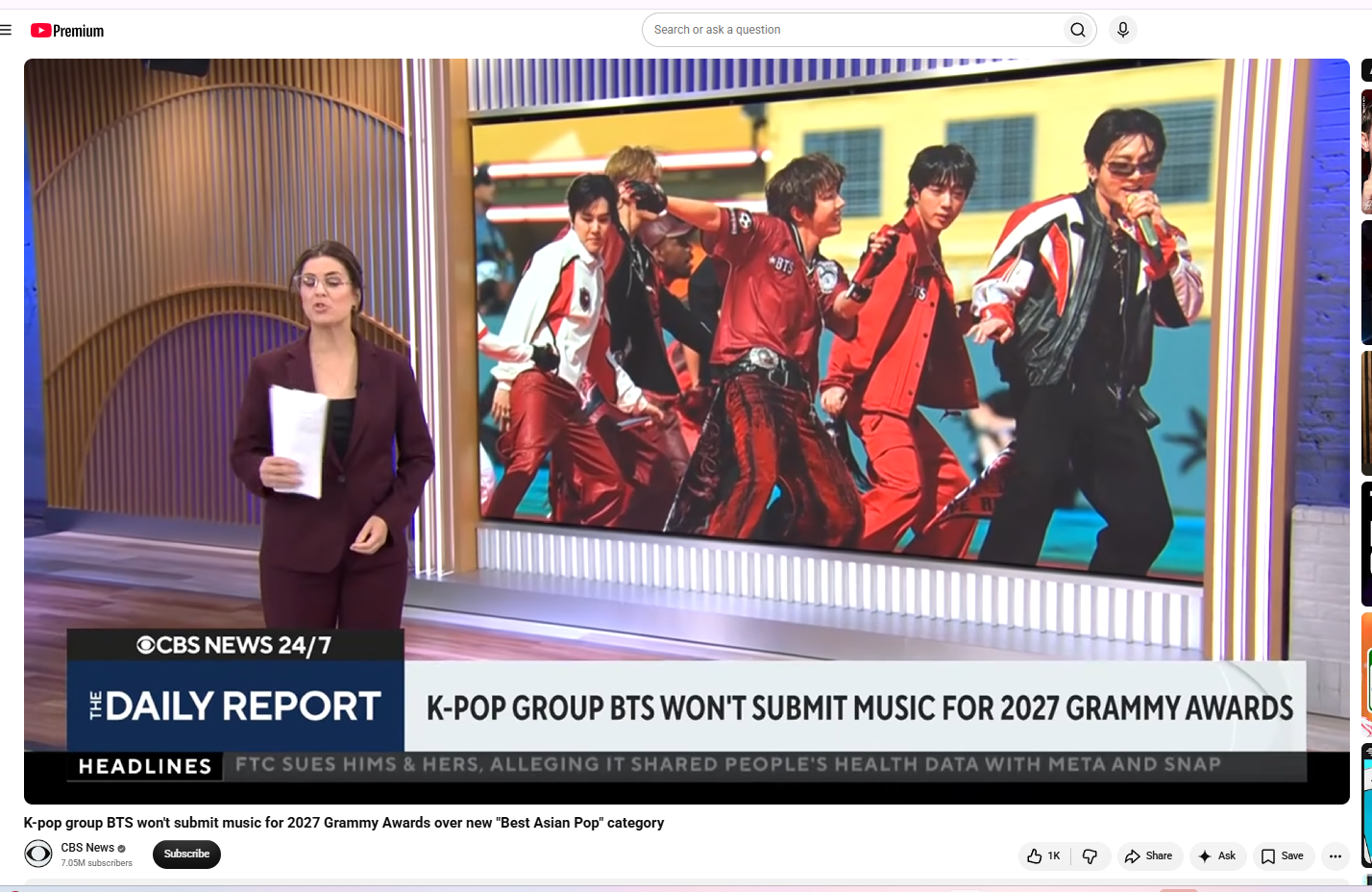
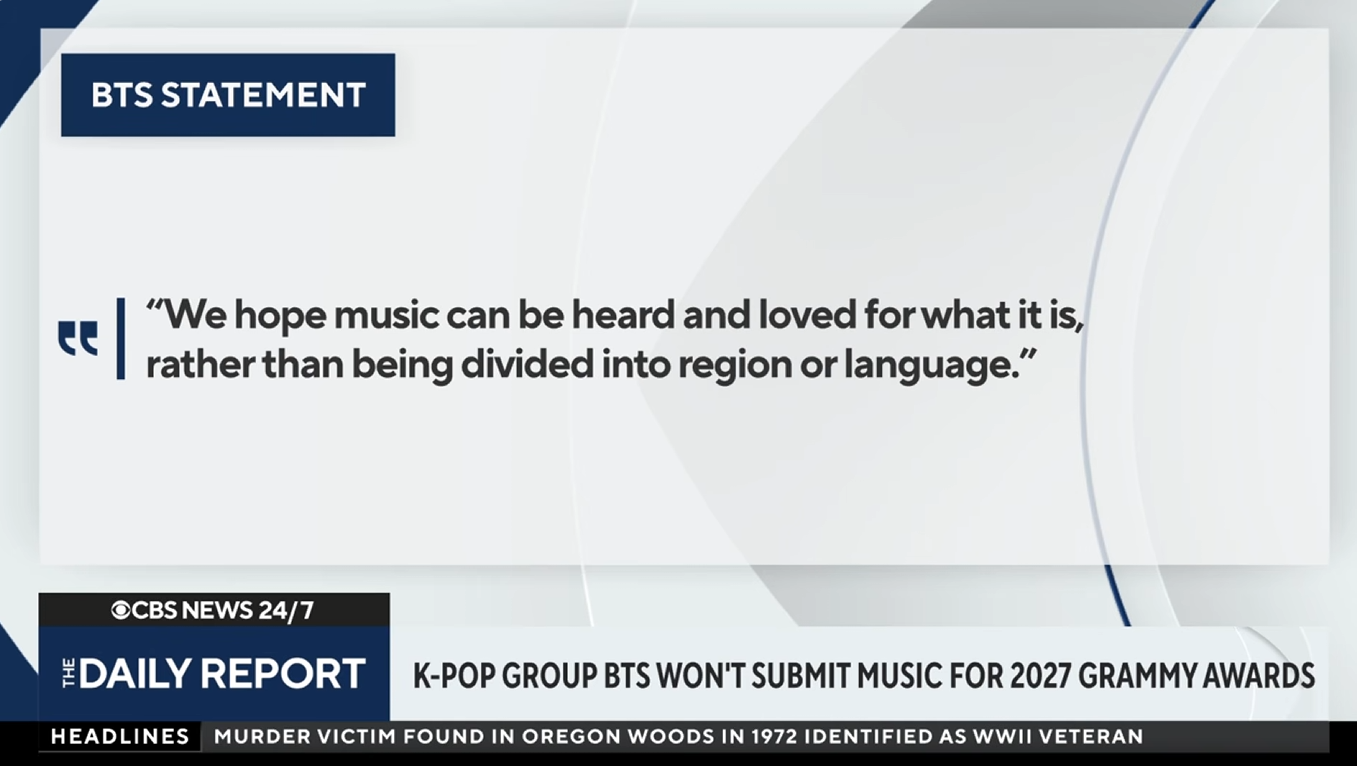
On July 29, RM, Jin, SUGA, j-hope, Jimin, V, and Jung Kook posted the same message to their individual Instagram stories: “We have decided not to submit to the Grammys this year.” They followed it with the sentence that made the whole thing land: “We hope our music can be heard and loved for what it is, rather than being divided by region or language.”
That wording matters. They did not complain about losing. They did not demand an award. They did not say Asian artists should receive less recognition. They objected to the sorting system itself. According to the Associated Press, a BTS representative gave no extra explanation. The seven matching statements were the explanation.
Korean media called it a boycott
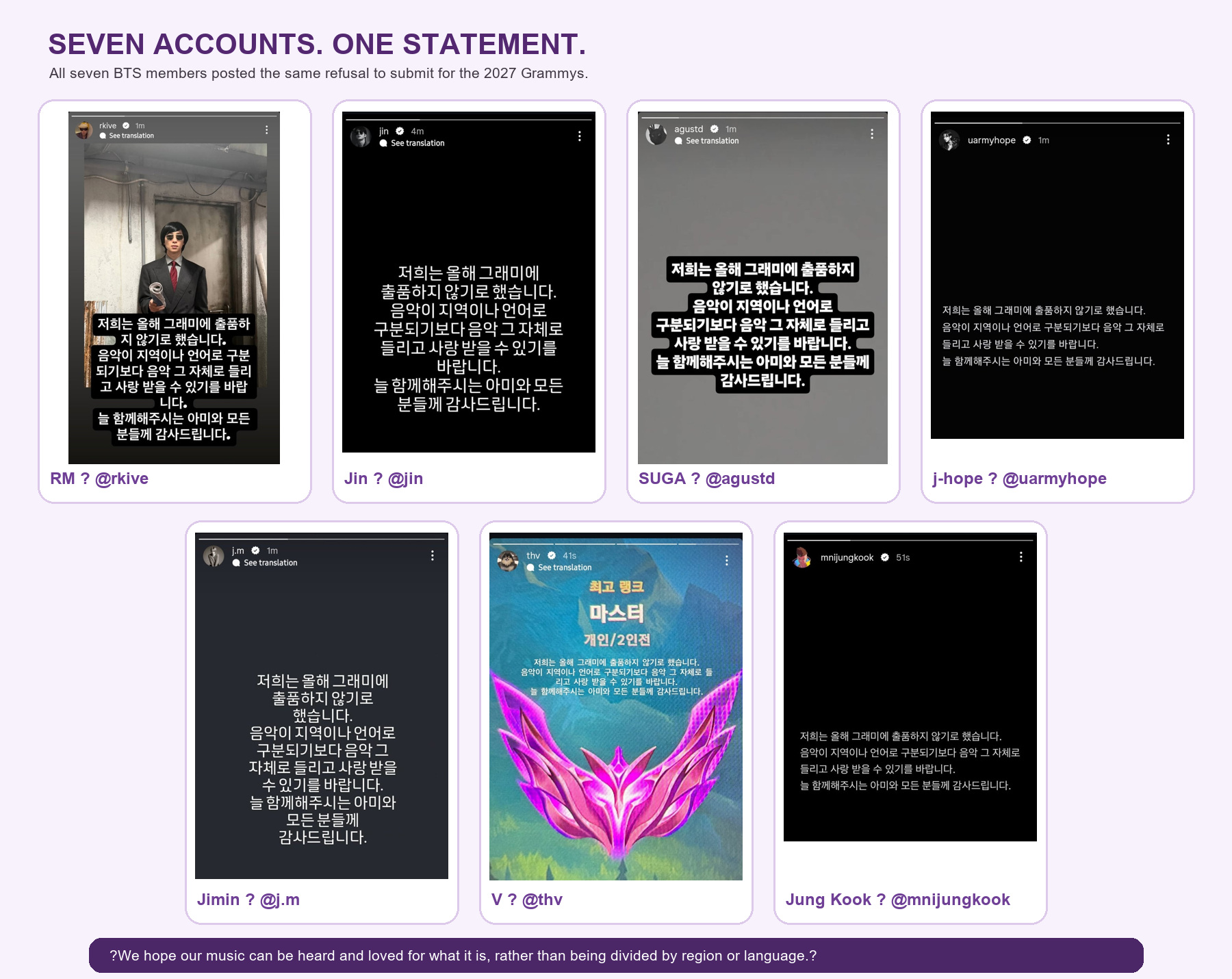
This was not only an American entertainment-news interpretation. Chosun Ilbo’s report on Naver News described BTS as declining to submit for the 2027 Grammys and called the move a boycott in response to changes in the Grammys’ K-pop judging criteria. That language matters because Korean coverage did not treat the seven matching posts as a vague scheduling choice or fan theory. It treated them as an industry protest.
The perfect institutional escape hatch
This is the part that makes the whole arrangement feel especially convenient. BTS was already being predicted as the obvious first winner. The Grammys could place BTS inside Asian Pop, celebrate the first trophy as historic inclusion, promote a BTS appearance to millions of viewers, and avoid another year of explaining why the group lost in ordinary pop or the General Field.
That does not prove the category was designed in a secret room specifically to contain BTS. It does explain why people see a glass ceiling with a commemorative plaque attached. The institution gets the headline, the performance clips, the international social traffic, the advertising inventory, and a defense against criticism: “How can we be excluding BTS? We gave them Best Asian Pop.”
If BTS performed while refusing to submit, the broadcast would still receive the views without facing the possibility of snubbing them at the podium. If BTS submitted to Asian Pop, the Academy could award them without confronting the deeper voting pattern. Either route protects the ceremony more than it protects BTS.
This is why their complete refusal matters. They did not merely decline a likely trophy. They removed the cleanest public-relations solution the Academy had available.
The new category is where this gets uncomfortable
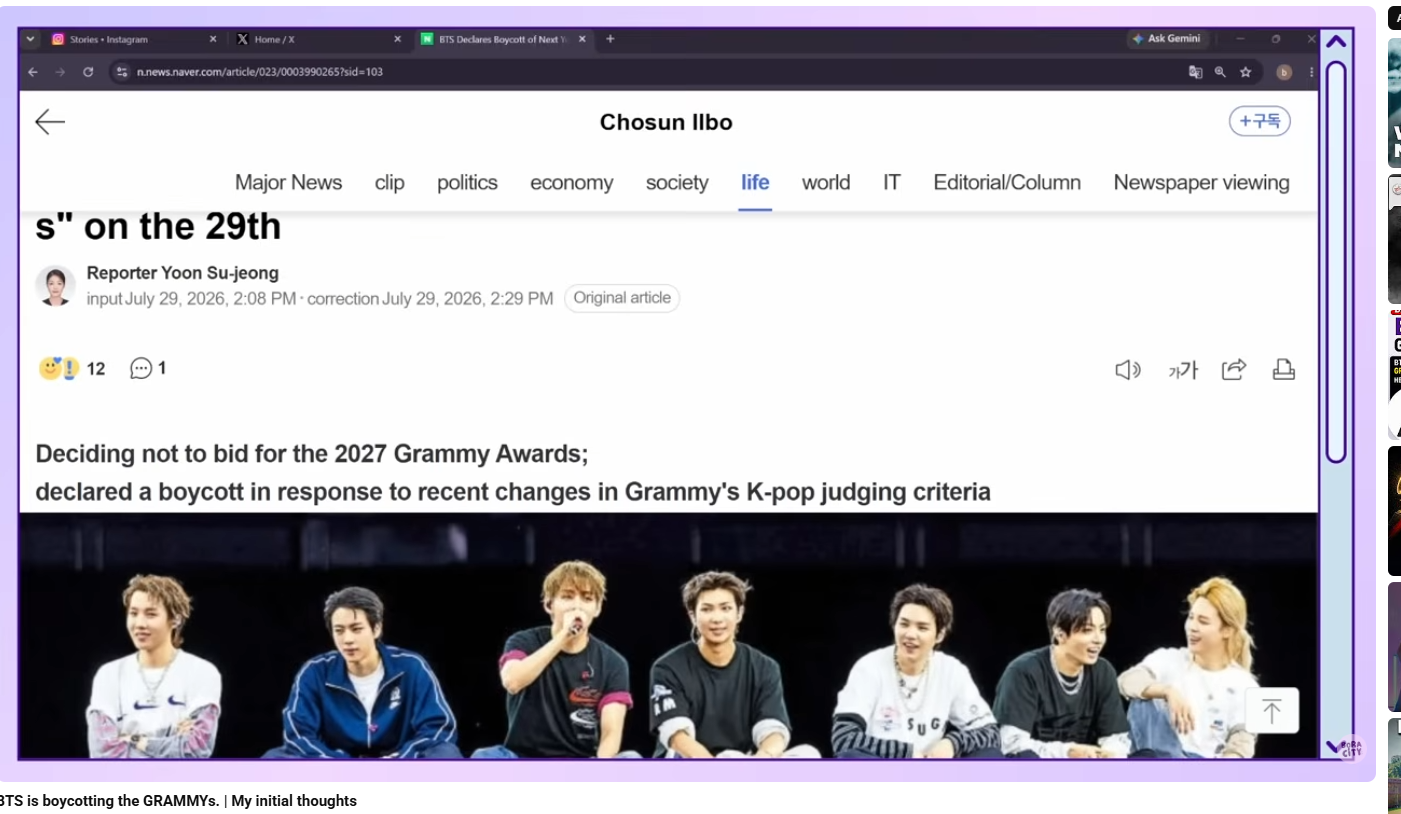
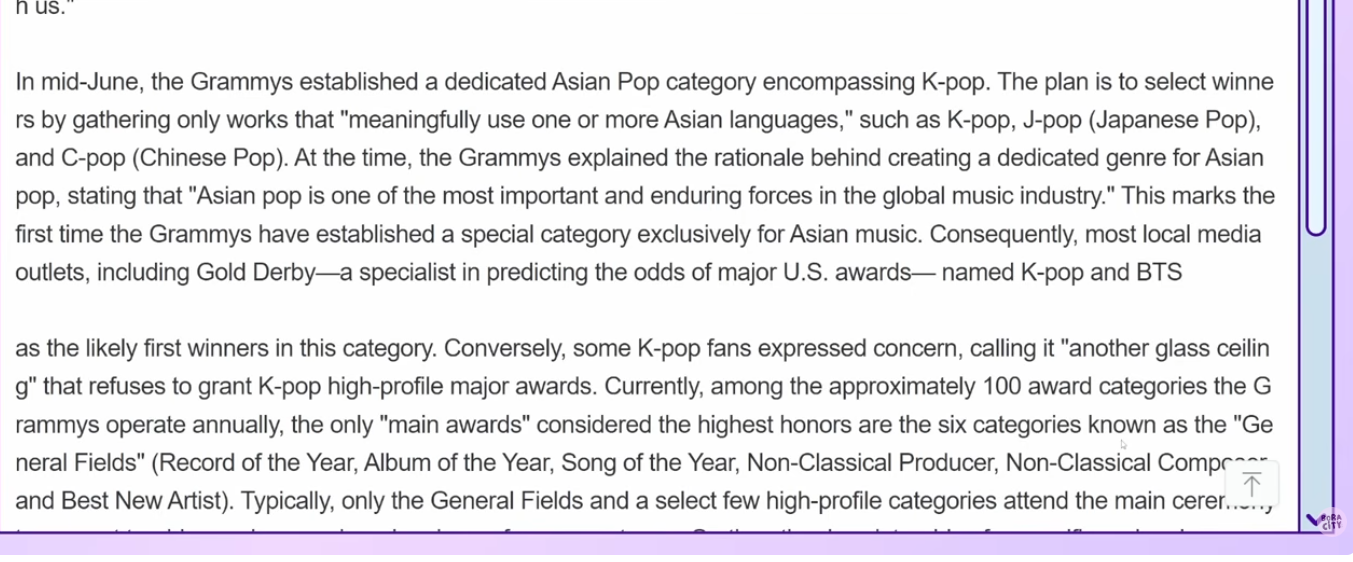
The Recording Academy announced five new categories for the 2027 Grammys, including Best Asian Pop Music Performance. Its own description says the award recognizes performances originating from or widely recognized in Asian markets, including K-pop, J-pop, and C-pop, with meaningful use of one or more Asian languages. The Academy also says eligible music can still compete in the general field where appropriate.
On paper, that sounds inclusive. More artists can be nominated. Music in Korean, Japanese, Chinese, Thai, Tagalog, Hindi, and many other languages has a dedicated route into a ceremony that has historically paid weak attention to Asian popular music. That part is worth acknowledging.
Then you reach the language test and the giant geographic bucket. Asia is not a genre. K-pop, J-pop, C-pop, Indian pop, Thai pop, Filipino pop, Indonesian pop, and every other market do not share one sound simply because Western award organizers can locate them on the same side of a map. A Korean industrial dance track and a Japanese city-pop revival are not musical cousins by default. The category risks treating ethnicity, geography, language, and genre as if those words mean the same thing.
The Recording Academy’s announcement even used language about music that cannot be properly “intermingled” with present forms of pop. That is the phrase that makes my eyebrow climb. Pop has been borrowing, trading, stealing, remixing, translating, and traveling since pop existed. BTS did not become a global act by remaining neatly inside an Asian market. BLACKPINK did not headline Coachella because the audience needed a geography lesson.
Asian Pop is not an actual genre
A genre tells me something about the music. Rock, hip-hop, R&B, country, jazz, metal, house, and trot carry recognizable musical histories, structures, scenes, or traditions. “Asian Pop” tells me where the artist comes from, where the record is recognized, and which language appears in it. That is classification by identity and market, not classification by sound.
The category can place Korean dance-pop, Japanese city pop, Chinese ballads, Thai hyperpop, Filipino pop-rock, Indian electronic pop, and dozens of unrelated traditions into one competition. Those records may share no production language, rhythmic lineage, vocal style, or audience. Their common feature is that the Academy considers them Asian enough.
That is why calling it a genre feels like an excuse. The category gives the institution somewhere to place commercially undeniable Asian artists without deciding whether those artists beat the biggest pop records in the world.
It also removes BTS’s real competition
BTS’s actual commercial peers are not limited to K-pop groups. The IFPI rankings already put them in the same global race as Taylor Swift, Drake, Adele, Bad Bunny, The Weeknd, and the largest recording artists on Earth. Their songs competed on the Hot 100 against American, British, Canadian, Latin, and other global releases. Their tours, streams, physical sales, and cultural reach did not happen inside an Asian-only economy.
Inside Best Asian Pop Music Performance, BTS would not be tested against that full global field. They would be compared only with other artists placed inside the geographic bucket. That creates two dishonest outcomes at once. If BTS wins, the Academy can celebrate them without admitting they beat mainstream pop competitors. If BTS loses, another Asian act inherits a trophy from a field missing the non-Asian records that actually competed with both artists in the marketplace.
That is not equality with better lighting. It is a protected side bracket. The artists inside it may be extraordinary, but the structure makes their trophy easier for the institution to contain and easier for critics to discount.
Remember how the Grammys treated BTS
BTS has five Grammy nominations and no wins. Three of those nominations were for Best Pop Duo/Group Performance, the ordinary pop category, for “Dynamite,” “Butter,” and “My Universe.” They were also recognized through Coldplay’s album nomination and for the “Yet to Come” music video. They performed on the Grammy stage, delivered the kind of television moment that people argued about for days, and proved repeatedly that an American audience would show up for Korean artists.
The problem was never whether BTS could function inside mainstream pop. The Grammys already answered that every time the group was useful as a performer, presenter, nominee, headline, or ratings conversation. The problem was whether the institution would treat them as peers once the envelopes opened.
That history is why the new category does not arrive in a vacuum. If BTS had never crossed into the main field, an Asian Pop category might feel like a new doorway. After five nominations, stadium tours, Hot 100 records, and years of the Grammys placing them inside pop whenever it suited the broadcast, it can feel like the doorway has been replaced with a side entrance.
The KPop Demon Hunters contradiction
The category argument gets even harder to defend when you look at KPop Demon Hunters. Here was an original, Korean-rooted animated musical that became too enormous to dismiss as a niche streaming movie. Hollywood eventually recognized it with Oscars for Best Animated Feature and Best Original Song. The Grammy response was much more revealing.
The Grammy ledger is where the contradiction survives. “Golden” received five Grammy nominations and lost the major Song of the Year prize. Its single win came through Best Song Written for Visual Media. I love that win. It was historic. It was also the safest possible place to honor a song that had already escaped the movie, conquered the charts, entered homes without children, and become a pop event on its own.
So yes, Hollywood eventually admitted the movie was a Frozen-level phenomenon. The music establishment still placed its one Grammy inside a category that kept “Golden” attached to a screen. The song could compete for Song of the Year, but when the trophy arrived, it came from the visual-media room.
“Golden” behaved like the bigger song because it was the bigger song.
| Public record | “Golden” | “WILDFLOWER” |
|---|---|---|
| Billboard Hot 100 peak | No. 1 for eight weeks | No. 17 |
| Global reach | No. 1 on the Global 200 for 18 weeks | A durable global hit, but not a comparable chart leader |
| Streaming milestone | Fastest song to enter Spotify’s Billions Club | More than two billion Spotify streams after a long, remarkable run |
| Cultural footprint | Carried a record-breaking soundtrack, a film narrative, choreography, children, adults, and global singalongs | A major slow-burn album track with extraordinary longevity |
Charts do not decide Song of the Year. It is a songwriting award, and popularity is not a substitute for craft. Fine. Then let us talk about the songs instead of hiding behind that sentence.
“Golden” is not a boast about being prettier, richer, or more famous. It begins inside shame. Rumi is hiding part of herself, frightened that the truth will destroy the people she loves and the identity she built. The song transforms that fear into acceptance. By the climax, three women are no longer performing perfection for approval. They are choosing their own voices together. The A5 is not vocal decoration. It is the emotional release of the entire movie.
That is the girl-power song Hollywood should have eaten with a spoon. It is about defeating the demon inside you without pretending the demon was never there. It gives children an enormous hook they can sing, adults an emotional meaning they can recognize, and the story its final act of transformation.
“WILDFLOWER” is an intimate, well-written guilt song about dating a friend’s ex and wondering whether a friendship boundary was crossed. Billie’s restraint works for that story. Its 72-week Hot 100 run is genuinely impressive. I am not calling it a failure because it peaked at No. 17. I am asking how private romantic guilt became the supposedly greater songwriting achievement than a global empowerment anthem whose words, melody, vocal climax, and narrative function all move together.
Ranking receipts: Netflix’s Billboard and Spotify record ledger for “Golden” · The Recording Academy notes “WILDFLOWER’s” 72-week Hot 100 run · The Academy’s own descriptions of both songs
The screen was never an automatic barrier to Song of the Year. Disney’s “A Whole New World” won that exact Grammy in 1994. Billie Eilish’s “What Was I Made For?” from Barbie won Song of the Year in 2024 and Best Song Written for Visual Media. The Academy has already demonstrated that a movie song can leave the soundtrack room when voters decide it belongs in the main conversation.
That is why “Golden” feels less like the barrier finally breaking and more like a containment test that worked. Honor the unavoidable Asian phenomenon inside a specialized category, celebrate the milestone, and leave the general-field trophy elsewhere. Months later, the Academy introduced Best Asian Pop Music Performance. I cannot prove somebody planned that sequence in a conference room. I can say the precedent is extremely convenient: Asian music can keep making history, as long as the institution always has a smaller room ready for the photograph.
More receipts: “A Whole New World” wins Song of the Year · “What Was I Made For?” wins both Song of the Year and Visual Media · The Recording Academy’s own “Golden” Song of the Year profile
That does not make the Grammy meaningless. It makes the boundary obvious. Frozen was allowed to become animation, cinema, music, merchandise, childhood memory, and mainstream culture all at once. KPop Demon Hunters achieved that same kind of reach with more cultural specificity and an entirely new world. Asian work should not have to become mathematically impossible to ignore before institutions stop calling it a niche.
Receipts: Netflix’s record and award ledger · TIME’s Frozen comparison · Recording Academy nominations and winners
And remember BLACKPINK
BLACKPINK became one of the largest pop groups on Earth without receiving a Grammy nomination as a group. Rosé finally broke through as a soloist with three 2026 nominations for “APT.”, including Record of the Year and Song of the Year, but left without a win. That does not prove a conspiracy. Awards are subjective and brutal. It does prove that Asian pop performers were already capable of appearing in the biggest categories when voters chose to see them.
So what happens now? Does the new category help less-established Asian acts reach Grammy voters, or does it become the place where voters send Asian artists so they no longer have to imagine them winning Pop Duo/Group, Record of the Year, or Song of the Year? The category itself does not force that outcome. Voting habits can.
The Grammys responded, and the wording did not fix the problem
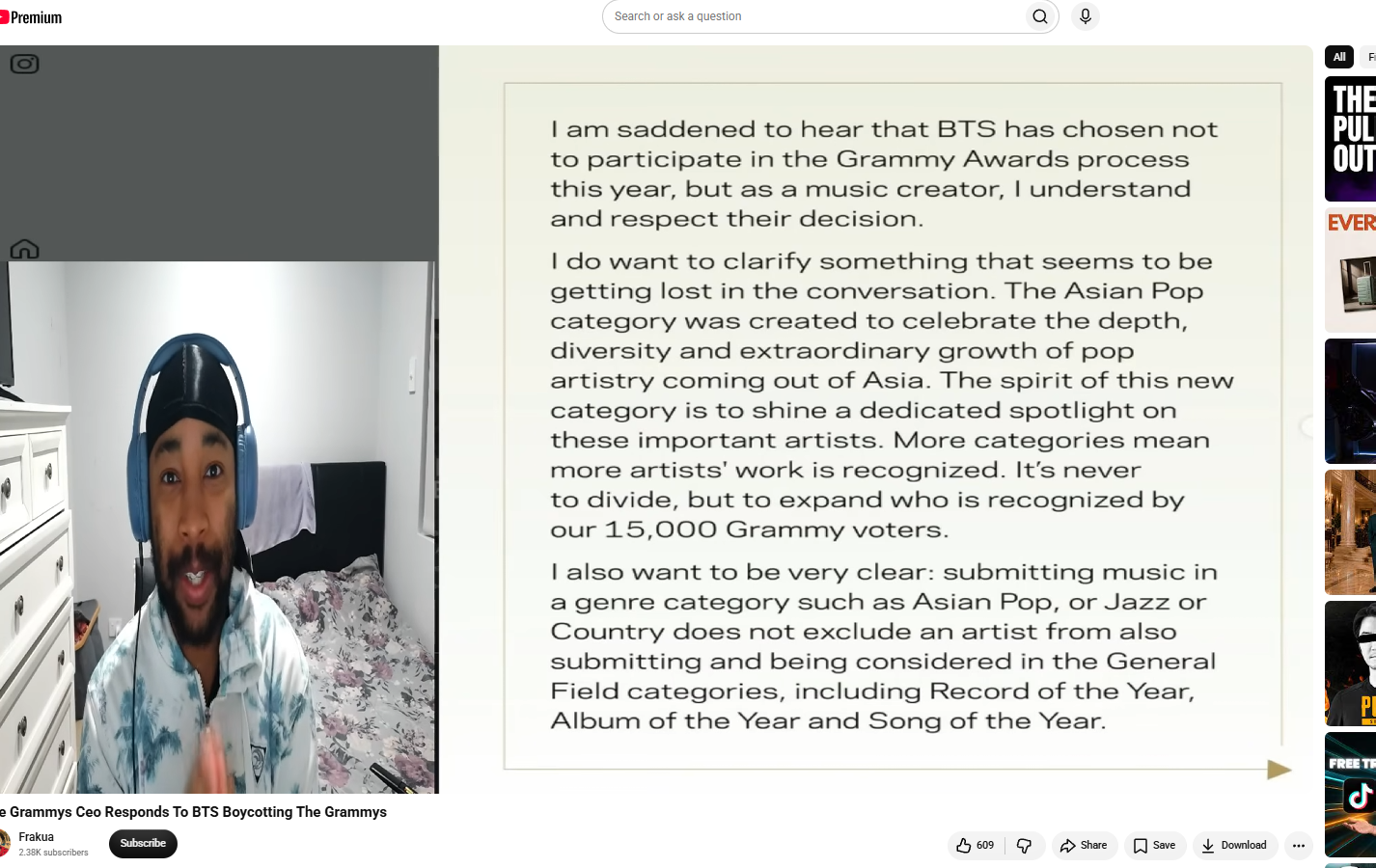
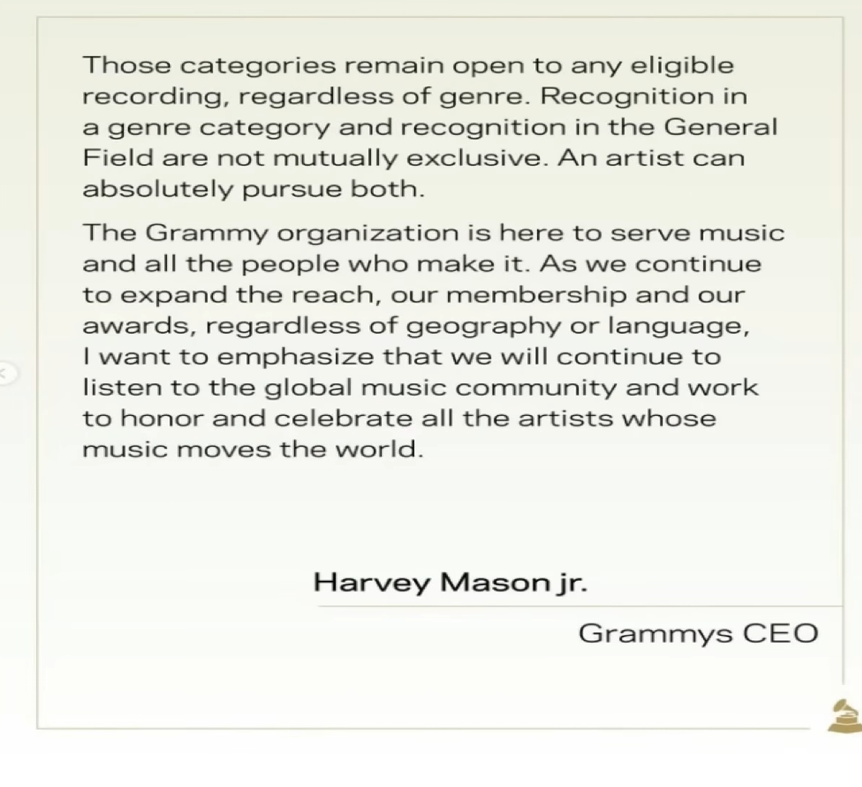
Recording Academy CEO Harvey Mason Jr. said he was saddened by BTS’s decision and respected it. He explained that the category was meant to celebrate the depth and growth of Asian pop, not divide it. He also stressed that an artist may pursue a genre category and the general field at the same time.
That is a useful clarification. It is not a complete answer. Eligibility for two rooms does not guarantee voters will see an Asian act as belonging in both. The concern is not that the rulebook physically locks BTS out of Album of the Year. The concern is that a new regional category gives voters an easy place to put Asian artists while telling themselves they recognized them.
And “more categories mean more recognition” dodges the actual objection. BTS did not say fewer Asian artists should be honored. They said music should not be divided by region or language. Explaining that the division was designed with good intentions does not make it stop being a division.
Honestly, the response is rude. It treats a clear objection from seven experienced Recording Academy members like a misunderstanding that can be corrected with a patient little explanation. BTS said, “Do not divide music by region or language.” The answer was essentially, “You seem confused, so let us explain why our regional and language division is generous.” That is public-relations hot air wearing a sympathy cardigan.
About the allegedly deleted BTS performance
Fans also noticed that a BTS Grammy performance upload was no longer available on the Grammys’ YouTube channel and read the timing as retaliation. I understand the suspicion. I cannot verify retaliation, and the available evidence does not support printing it as fact. Older Grammy performance videos by other artists have disappeared too, commonly because broadcast and music-performance licenses expire or the channel rotates its archive.
The important receipt is that BTS’s official BANGTANTV upload of the 2022 “Butter” Grammy performance remains online. So yes, the Grammys-channel copy appears to be gone. No, we do not currently have proof that it was removed because BTS declined to submit. The timing deserves a raised eyebrow, not a fake conviction.
The fan response was not subtle
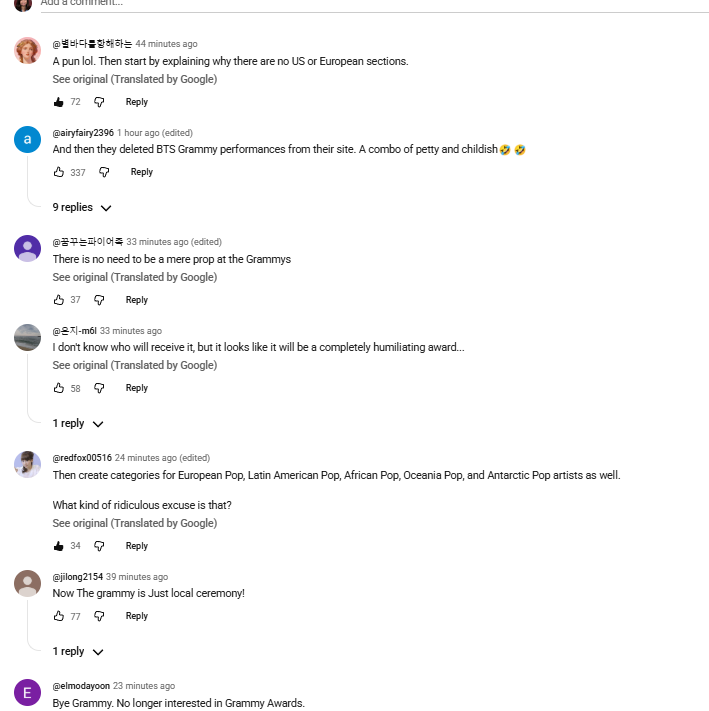
The comments repeat the same objection in different accents: if regional sorting is normal, where are Best U.S. Pop and Best European Pop? Why does “global” music remain the unmarked default until the artist is Asian? Several fans said BTS no longer needed to function as a Grammy prop. Others called the proposed award humiliating because it could look like the institution finally giving BTS a trophy only after moving them away from the category where they had already competed.
The sarcasm is doing real analytical work. One commenter suggested adding European Pop, Latin American Pop, African Pop, Oceanian Pop, and Antarctic Pop. Ridiculous? Yes. That is the point. The category becomes easier to question when the same geographic logic is applied to the regions Western pop treats as culturally neutral.
Another comment repeats the claim that the Grammys deleted BTS performance videos. As noted above, the absence of a Grammys-channel upload is observable, but the motive is not. Other artists’ old Grammy performances have also disappeared, and licensing is a plausible explanation. The screenshot stays here because it is part of the fan response, not because repetition turns suspicion into proof.
The accusations: racism, segregation, and monetizing BTS without honoring them
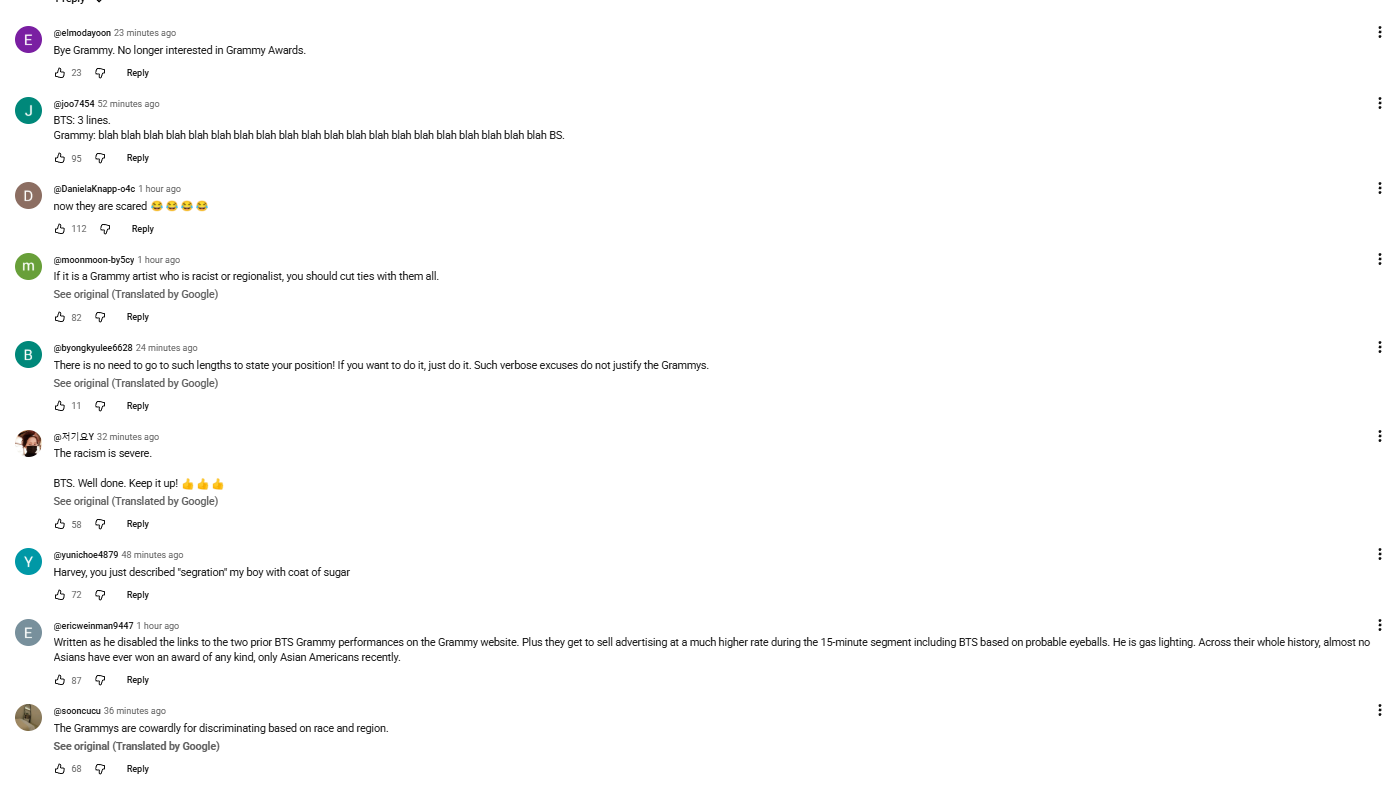
By July 29, the vocabulary had moved beyond “snub.” Fans and published commentators were openly using racism, regional discrimination, segregation, and othering. That is serious language. It deserves more than a defensive press release and more than a fandom pile-on.
Why people are calling the Asian Pop category segregation
The accusation is not that every dedicated category is automatically racist. Genre categories can preserve musical traditions and create space for work ignored by the general field. The accusation is that “Asian” is being used as if it were a genre, while Western pop remains simply “pop.”
Teen Vogue called the new category “another form of segregation”. The argument was direct: a voter can place BTS in Asian Pop, feel that the group has been recognized, and never seriously consider ARIRANG for Album of the Year. The Korea JoongAng Daily framed the same issue as a red carpet or a velvet rope, and noted the Grammys’ longer history of racial-bias criticism. The Associated Press reported that some fans saw the category as a racialized barrier.
The word “segregation” lands because the distinction is not purely musical. Eligibility requires meaningful use of one or more Asian languages, and the Academy’s own examples foreground K-pop, J-pop, and C-pop. A Korean act singing in English may be ordinary pop. The same act using Korean may become Asian Pop. The performer did not change race, but the institutional box changes when the language becomes visibly Asian.
That invites ugly questions. Is an English-language song by a singer from Singapore Asian Pop? Is a Korean-language song by a white American artist Asian Pop? What connects Indonesian pop, Japanese idol pop, Indian film music, Korean hip-hop, Mandarin ballads, and Thai dance music besides an enormous continent? If the category cannot answer those questions using music rather than geography and identity, critics are justified in asking whether it is recognition or administrative othering.
The racism accusation did not begin in 2026
BTS’s Grammy history sits inside a much older American argument about Black, Latino, and international artists being celebrated in specialty fields while struggling in the general categories. Tyler, the Creator famously criticized “urban” labeling after IGOR was routed into rap. The Weeknd accused the Academy of corruption and demanded transparency after After Hours received zero nominations. Critics have repeatedly asked why artists of color can dominate culture and still be contained inside genre categories.
Asian artists have their own version of that pattern. In 2019, TIME called the absence of BTS, BLACKPINK, Bad Bunny, and J Balvin glaring and described the old global categories as outdated. BTS later received five nominations, but the first nominations came through English-language crossover singles. Their Korean-language catalog had already sold globally, topped albums charts, and built the audience that made those English singles possible.
I cannot read the private mind of 15,000 voters and stamp every ballot “racist.” I can say the structure produces racialized outcomes, the new category explicitly sorts music through Asian markets and languages, and credible publications are using the words racism and segregation because softer vocabulary has failed to explain the pattern.
Did the Grammys use BTS for advertising revenue?
This accusation has a factual foundation and an unproven final step.
Verified: Grammy telecasts are commercial broadcasts. Ratings support advertising revenue. MediaPost reported that the postponed 2022 ceremony delayed millions of dollars in advertising and that the prior broadcast contained 78 equivalent 30-second commercial units. The Washington Post likewise noted that television ratings remain central to generating advertising dollars for award shows.
Verified: BTS was heavily promoted during Grammy broadcasts. TIME reported that viewers waited until the end of the nearly four-hour 2021 ceremony for BTS’s “Dynamite” performance. Forbes documented complaints that the show repeatedly teased BTS throughout the night, leaving fans feeling held hostage until the closing stretch. ELLE reported ARMY accusations that the Grammys used BTS to increase viewership.
Also verified: The 2021 telecast averaged roughly 8.8 million viewers, and the 2022 show averaged about 8.9 million in early Nielsen reporting. Those were weak totals by historic Grammy standards. BTS did not magically rescue the entire broadcast from a broader collapse in live award-show viewing.
Not verified: I found no reliable public accounting that isolates how many advertising dollars BTS personally generated, no credible rate card showing that commercials in a “BTS fifteen-minute segment” sold at a special premium, and no proof that producers placed BTS late solely to maximize revenue. The commercial incentive is obvious. The exact BTS revenue figure is not public.
So the fair conclusion is sharper than a conspiracy claim. The Grammys knew BTS could retain a large international audience, promoted them throughout the telecast, placed their long-awaited performance near the end, and sold advertising across that waiting time. Fans are reasonable to describe that as monetizing BTS attention. What cannot yet be proven is a specific dollar amount or a written scheme to exploit ARMY.
Why the Academy’s response made people angrier
Harvey Mason Jr. said the new category was never intended to divide. But critics were not confused about the Academy’s intent. They were describing its effect. Telling people that a separate category is a “dedicated spotlight” sounds uncomfortably close to telling them the side room has excellent lighting.
The response also emphasized that general-field categories remain available. Technically true. Historically unpersuasive. A door being unlocked does not prove voters will walk an Asian artist through it, especially when the institution just gave them a convenient place to stop.
The strongest counterargument
A dedicated category can create real wins. Plenty of excellent artists will never have BTS-level name recognition, American radio support, or a massive English-speaking fandom. A Grammy category that teaches voters to listen beyond the same five globally marketed acts could widen the field. The Academy also clarified that submitting in Asian Pop does not block consideration in the general categories.
Fine. Keep that door open. But watch what actually happens. If Asian artists receive nominations in the new category while disappearing from mainstream pop fields, the concern will have been correct. If the category becomes an additional honor while artists continue crossing into Record, Song, Album, and general pop categories, then it may become useful instead of limiting.
The test is not the Academy’s press release. The test is the nomination list.
Why BTS saying no matters
Submitting would have been the easy move. “ARIRANG,” “Swim,” and “Normal” were already being discussed as possible contenders. BTS could have entered, collected a likely nomination, attended the ceremony, lifted the broadcast’s global attention, and accepted the first trophy in a category many people assumed had been built with them in mind.
Instead, they refused the consolation logic before anyone could hand them the consolation prize.
I do not think every Asian artist should follow them. A newer act may reasonably want the visibility, the nomination, and the career leverage. BTS can make this protest because BTS already has the numbers, the audience, and enough institutional scars to survive it. That makes the decision more useful, not less. Someone powerful enough to say no finally said it.
Did Grammy winners ever reach BTS-level sales?
Short answer: some absolutely did. Taylor Swift, Adele, Drake, and other Grammy giants have reached or exceeded BTS on major commercial measures. Pretending otherwise would weaken the entire argument. The Grammys are also not supposed to be a sales trophy. They are a peer-voted award for what members consider artistic excellence.
Now for the part the Academy cannot wave away: during BTS’s first three nomination years, BTS was not merely “popular for a K-pop act.” IFPI, the organization that measures recorded-music consumption across physical sales, downloads, and streaming worldwide, named BTS the best-selling global recording artist of 2020 and 2021. They were the first act in the chart’s history to win in consecutive years. In 2022, they still ranked second worldwide behind Taylor Swift.
That means BTS entered three consecutive Grammy races while ranking first, first, and second among the world’s recording artists. Five nominations. Zero wins.
| Grammy year | BTS nomination | Winner | What the numbers actually say |
|---|---|---|---|
| 2021 | “Dynamite” | Lady Gaga and Ariana Grande, “Rain on Me” | “Dynamite” ranked No. 10 on IFPI’s 2020 global digital singles chart with 1.28 billion subscription-stream equivalents. “Rain on Me” did not appear in that global top ten. BTS also finished 2020 as IFPI’s No. 1 global recording artist. |
| 2022 | “Butter” | Doja Cat featuring SZA, “Kiss Me More” | This race is not a clean robbery by numbers. “Kiss Me More” had stronger U.S. year-end longevity, ranking No. 6 on Billboard’s 2021 Hot 100 year-end chart while “Butter” ranked No. 11. Globally, “Butter” ranked No. 4 on IFPI’s digital singles chart with 1.76 billion equivalents, and BTS again ranked No. 1 among all recording artists. |
| 2023 | Coldplay and BTS, “My Universe” | Sam Smith and Kim Petras, “Unholy” | Both songs reached No. 1 on the Hot 100. “Unholy” was a legitimate global smash, so sales alone do not prove “My Universe” deserved the trophy. BTS still ranked No. 2 on IFPI’s 2022 global artist chart and collected three nominations that year without a win. |
The Billboard Hot 100 ledger
Here is the U.S. all-genre chart record in plain numbers. These are not fan estimates. The Hot 100 combines U.S. streaming, radio airplay, and sales data tracked by Luminate.
No. 1 debut. Three total weeks at No. 1. It became the first Hot 100 No. 1 by an all-South Korean act.
No. 1 debut. Seven consecutive weeks at No. 1, then ten total nonconsecutive weeks. Billboard’s 2021 year-end No. 11 song.
No. 1 debut. A bilingual English-Korean collaboration reached the top of the U.S. all-genre chart.
The comparison is uncomfortable. “Rain on Me” also debuted at No. 1, but its Hot 100 reign lasted one week. “Kiss Me More” peaked at No. 3 and had excellent longevity, finishing above “Butter” on the U.S. year-end chart. “Unholy” spent one week at No. 1 and became a legitimate global hit. These were not flops. The point is that BTS’s nominated records were fully competitive by the same U.S. mainstream chart the industry treats as proof of crossover.
“Butter” is the loudest receipt. A song does not accidentally spend ten weeks at No. 1. It was the longest-running No. 1 of 2021, and BTS performed an elaborate spy-themed version on the Grammy broadcast. The Academy had the year’s dominant Hot 100 song in its category, put the group on its biggest stage, and awarded the trophy elsewhere.
- Billboard: “Butter” led seven consecutive weeks and ten total weeks
- Billboard: “Dynamite” led the Hot 100 for three weeks
- Billboard: BTS’s five group Hot 100 No. 1 songs
- Billboard: “Unholy” spent one week at No. 1
- Billboard: “Kiss Me More” peaked at No. 3
The honest conclusion from the sales receipts
Commercial performance does not prove artistic superiority. “Kiss Me More” was huge, excellent, and had stronger staying power in the United States than “Butter.” “Unholy” was not some tiny song that wandered into the wrong envelope. Good faith people can prefer every winner.
But the numbers destroy one lazy excuse: BTS was never too niche, too regional, too dependent on a small fandom, or commercially unproven. For two of their Grammy campaigns, the recorded-music industry’s own global trade body measured them as the biggest-selling act on Earth. Not the biggest Korean act. Not the biggest Asian act. The biggest act.
If the Grammys are not a sales contest, fine. Then explain the artistic standard consistently. If global impact matters, BTS had it. If songwriting and involvement matter, BTS members participated in writing and production throughout their catalog. If performance matters, the ceremony trusted them with major stages. If cultural impact matters, we are still discussing the doors they opened years later.
The problem is not that every BTS nomination had to win. The problem is that five different nominations across pop performance, music video, and an album contribution produced zero wins, while the explanation for their absence keeps changing depending on which metric they dominate.
Sales do not prove bias, but patterns demand scrutiny
I cannot calculate prejudice from a chart position. Grammy voters are thousands of individuals, not one cartoon villain holding a golden envelope. A commercial mismatch is evidence worth examining, not a mathematical conviction.
Still, institutions reveal themselves through repeated outcomes. BTS’s global numbers earned attention, nominations, performances, and promotional value. The wins never arrived. Then, after K-pop became impossible to ignore, the Academy created a category defined partly by Asian markets and Asian languages. You do not need a conspiracy board to understand why BTS looked at that sequence and declined to participate.
The sales cannot convict anyone. The way the Grammy interprets an album is more revealing. Bad Bunny gives us a clean test. What happens when the Academy decides a non-English artist deserves the whole room instead of a regional shelf?
It reads the complete record. It finds the culturally serious album cuts, connects them to the commercial singles, and treats the entire project as art. That is exactly the generosity BTS never received.
The double standard in one win
Bad Bunny got the whole-album reading BTS never received.
Also, streaming albums do not have a literal Side A and Side B. I am using front-facing tracks for the songs used as the album’s commercial doorway, and album cuts for the songs critics dig up when they want to explain why the full project matters.
Bad Bunny: what the public was actually sold
- “EL CLúB”: a nightclub, an ex, substances, loneliness, and the familiar bad-decision fog that follows heartbreak.
- “PIToRRO DE COCO”: holiday drinking and romantic misery. It has atmosphere. It is still a drinking-and-heartbreak song.
- “DtMF”: regret over not taking enough pictures and not appreciating people while they were present. This is the most emotionally substantial of the giant commercial tracks, and I understand why it connected.
- “BAILE INoLVIDABLE”: lost love through salsa. Stronger musically than lyrically, but the traditional arrangement gives the heartbreak real texture.
- “EoO”: swagger, sex, status, and reggaeton lineage. Fun if this is your thing. It is absolutely not a philosophical emergency.
The album has seventeen tracks. A large portion lives in romance, sex, partying, drinking, jealousy, flexing, and breakup territory. That is allowed. Pop music has lived there forever. What irritates me is watching critics take the handful of culturally serious cuts, spread their prestige across the whole album, and then discuss every club record as if it arrived carrying a dissertation.
The album cuts that gave the project its critical armor
- “LO QUE LE PASÓ A HAWAii”: the clearest political song, warning Puerto Rico about displacement, privatization, and becoming a paradise that no longer belongs to its own people.
- “NUEVAYoL”: Nuyorican identity, migration, and Puerto Rican presence in New York.
- “CAFé CON RON”: community and Puerto Rican musical tradition, especially plena.
- “LA MuDANZA”: family, roots, identity, and cultural memory.
- “TURiSTA” and “DtMF”: stronger uses of regret, distance, memory, and the fear that something meaningful was treated as temporary.
Those songs are not fake depth. They are real parts of the album. The problem is proportion and treatment. The political and heritage material became the explanation for why the entire album deserved the biggest prize in American music, even though the commercial front door remained nightlife, romance, alcohol, sex, and heartbreak.
| Question | Bad Bunny | BTS |
|---|---|---|
| Commercial doorway | Club music, drinking, romance, sex, status, and heartbreak, with “DtMF” carrying the strongest mainstream emotional hook. | “Boy With Luv,” “Black Swan,” and “ON”: affection, fear of losing one’s artistic soul, pain, endurance, and choosing to keep moving. |
| Deeper album work | Puerto Rican identity, migration, gentrification, cultural loss, family, and memory. | Identity, ambition, burnout, rage, fame, lost youth, friendship, self-acceptance, artistic fear, and the cost of becoming a public object. |
| Writing | Benito Martínez is credited as a writer across the album, usually beside multiple collaborators and sample/interpolation credits. | RM, SUGA, and j-hope have extensive writing involvement; other members also contribute. Outside writers exist, but the group’s inner life is not supplied entirely by a committee. |
| Production | The album’s listed production is led by Tainy, MAG, La Paciencia, and other producers. Bad Bunny’s authorship is strongest in writing, voice, curation, and persona. | BTS works with outside producers too, while SUGA, RM, j-hope, Jimin, and others have documented writing and production participation across their catalog. |
| Vocals | A recognizable low, conversational tone. His appeal is texture and attitude, not a large demonstrated range or a broad display of vocal technique. | Four distinct vocal colors, harmonies, falsetto, belts, low-register work, and live singing during demanding choreography. |
| Rap | Cadence, slang, tone, and rhythmic looseness do most of the work. The blurred diction is part of his style, but style should not automatically be mistaken for technical range. | Three rappers with clearly different tools: RM’s conceptual writing and flow changes, SUGA’s speed and percussive attack, and j-hope’s syncopation, tonal play, and dance-linked phrasing. |
| Dance and stagecraft | Charisma and body language. He is not selling himself as an elite synchronized dancer, so I am not going to invent that skill for him. | Seven-member precision, formation changes, stamina, storytelling through choreography, and the ability to keep vocals and rap functioning inside the movement. |
| Languages | Primarily Spanish, by choice. He has every right to center Puerto Rican Spanish. | A Korean group with substantial Korean, Japanese, and English releases, plus earlier Mandarin-language work. They repeatedly crossed linguistic markets instead of asking the market to meet them in only one place. |
About the “even Spanish speakers cannot understand him” claim
There is a real point hiding inside a sloppy internet insult. Many native Spanish speakers outside Puerto Rico say Bad Bunny can be difficult to follow. Linguists and language educators point to Caribbean Spanish features, consonant dropping, rapid elision, regional slang, Anglicisms, and highly local pronunciation. That does not prove he is making up random nonsense because he needs a rhyme. Some spellings and titles are stylized, some expressions are local, and rap has always bent language. My criticism is simpler: blurred diction and local slang can be an artistic choice, but the Grammy cannot praise that opacity as authenticity while treating Korean language as a reason to place BTS on a regional shelf.
What Map of the Soul: 7 did with its album cuts
If Grammy voters wanted a complete album rather than a pile of singles, BTS had one sitting in front of them. “Intro: Persona” examines the self that performs for other people. “Interlude: Shadow” turns ambition into something frightening. “Black Swan” asks what happens when an artist stops feeling music. “My Time” mourns a youth accelerated by fame. “UGH!” attacks performative rage. “00:00” gives exhausted people permission to begin again. “We Are Bulletproof: the Eternal” transforms years of ridicule into community. “Outro: Ego” chooses acceptance without pretending the past was painless.
That is not filler. It is not emotional wallpaper placed behind a catchy single. The supposedly “deep cuts” and the promoted tracks belong to the same psychological argument. BTS made the kind of album critics claim they want, then performed hard enough to become the ratings event while the trophies went elsewhere.
So no, the question is not whether Bad Bunny was allowed to win. The question is why his heritage songs were used to dignify his entire commercial package, while BTS’s equally serious album cuts were treated as invisible whenever voters reduced them to three English singles and a television performance.
The live-stage test: Super Bowl Bad Bunny versus World Cup BTS
This comparison needs one fairness warning. Bad Bunny had a full thirteen-minute Super Bowl headline production built around him. BTS performed one song inside a crowded World Cup halftime program with Madonna, Shakira, Burna Boy, Justin Bieber, the Muppets, and a children’s chorus. One artist received an entire Puerto Rican world. The other had a few minutes to walk onstage, detonate “Dynamite,” and leave.
| Performance test | Bad Bunny, Super Bowl LX | BTS, 2026 World Cup Final |
|---|---|---|
| Assignment | Headline a thirteen-minute halftime show and build a cultural statement around Puerto Rico. | Deliver one compact “Dynamite” segment inside the first World Cup Final halftime show. |
| Staging | A bodega, casita, wedding party, laborers, street scenes, electrical-pole imagery, Lady Gaga, and Ricky Martin. Visually rich and culturally specific. The production team earned its check. | A tighter stadium stage with BTS themselves carrying the visual momentum through formation, movement, timing, and seven recognizable personalities. |
| What the voice did | Part live vocal, part highly produced stadium spectacle, delivered in his familiar low, blurred, conversational style. The cadence is recognizable. The articulation is not suddenly clearer because the stage got larger. Call it rhythmic texture if you want. I am not calling mumbling a high-level vocal or rap technique. My husband’s snores have cleaner diction. | Clear English lyrics, distinct vocal colors, audible rap and singing parts, and a chorus designed for immediate stadium participation. |
| Movement | Crowd energy, swagger, walking through environments, guest interaction, and the pelvic-thrust school of stagecraft. The dancers and scenic action supply much of the kinetic detail. | Synchronized choreography, formation changes, footwork, spacing, and vocals performed while the members are actually moving with precision. |
| Accessibility | The cultural story was legible even when the words were not. That is a legitimate visual achievement. It also means much of the meaning depended on staging, prior context, and later explanation. | The song was in English, the hook was immediately understandable, and the performance still retained BTS’s Korean group identity. Nobody needed a postgame linguistic seminar to know what was happening. |
| My verdict | A strong cultural television production surrounding a limited singer-dancer. I respect the Puerto Rican visual argument more than I enjoy the music. | A shorter assignment that exposed a much broader performance toolkit. BTS supplied the vocals, rap, choreography, personality, and instant readability themselves. |
Bad Bunny’s show mattered culturally. I am not erasing that because I dislike him. But cultural importance and musical-performance excellence are not identical categories. Critics kept reviewing the symbolism, the resistance, and the representation. Fine. Review the performer too. If we remove the casita, famous guests, dancers, political context, and production design, what remains in his personal toolkit does not approach what BTS can do as singers, rappers, dancers, writers, and live ensemble performers.
- NFL: official Super Bowl LX halftime show page
- Los Angeles Times: the thirteen-minute Puerto Rican staging and set
- FIFA: BTS performing “Dynamite” at the World Cup Final halftime show
- FIFA and Global Citizen: official co-headliner announcement
Receipts for this comparison
- Recording Academy: 68th Grammy winners
- GRAMMY.com: the Academy’s own reading of DeBÍ TiRAR MáS FOToS
- Associated Press review: the album’s romance, partying, family, and Puerto Rican politics
- Associated Press: why Bad Bunny’s rapid Puerto Rican diction can be difficult to follow
- Harvard Gazette: Puerto Rican slang, global reach, and cultural specificity
- Reed College sociolinguistics: Bad Bunny and Caribbean Spanish
- BIGHIT: official Map of the Soul: 7 album concept and track list
- GRAMMY.com interview: BTS discussing the album, genre, and creative work
My call to the global pop industry: do not submit
BTS should not have to make this refusal alone. If the industry agrees that pop music should be judged as pop music, then artists, labels, managers, producers, and songwriters need to prove it with more than supportive Instagram captions.
Especially if the artist already competes in the global pop market. K-pop, J-pop, C-pop, P-pop, T-pop, Indian pop, Indonesian pop, and every other Asian industry should refuse to help the Academy turn a continent into a genre.
This is not an attack on the artists who may need Grammy visibility. Newer acts do not have BTS’s financial power or institutional leverage. I will not blame a young group for accepting an opportunity its company demands. The pressure belongs higher up, with the labels and established stars who can afford to say no.
But the question for every potential nominee is unavoidable: if BTS submitted, would this record still win? If the honest answer is no, what exactly is the trophy recognizing? The best performance in Asian pop, or the best performance remaining after the most commercially proven Asian pop act removed itself from consideration?
What solidarity would actually look like
- Asian labels decline to submit their major pop releases to a geography-based category.
- Established Asian artists say publicly why, without attacking younger acts that cannot safely refuse.
- Western collaborators refuse the convenient silence and support Asian partners competing in the same pop fields.
- Music journalists track the submission lists, not merely the final nominations, so absence cannot be rewritten as irrelevance.
- Fans do not harass whoever eventually wins. The institution designed the category. A nominee did not design the system.
I would go further. Global pop artists outside Asia should ask whether they want to validate an award system that recognizes their Asian peers only after separating them. Solidarity is not posting a purple heart under BTS’s statement. Solidarity is refusing the easier path when the easier path helps build somebody else’s smaller room.
The Academy can fix this. Replace the continental category with musically coherent categories, expand and diversify the voting body, publish meaningful data about who advances from genre committees into the general field, and demonstrate through nominations that Korean, Japanese, Chinese, Thai, Filipino, Indian, Indonesian, and other Asian-language pop records are heard as music first.
Until then, refusing to submit is not rejecting recognition. It is refusing to lend credibility to a category whose first major headline came from the most obvious recipient saying, politely and in Korean, no thank you.
RaeRae verdict
I want Asian artists recognized. I do not want them recognized only as Asian artists. Give the new category room to spotlight music the Grammys ignored, but do not turn it into a velvet-lined segregation shelf. BTS did not reject recognition. They rejected the idea that their region and language should become the ceiling above their music.
Once that double standard is visible, the call for solidarity stops sounding dramatic. It becomes the only leverage artists still control: their work, their attendance, and the audience the Grammy wants to borrow.
Watch the report
Receipts
- CBS News: BTS will not submit music for the 2027 GrammysDaily+75Total views237.6K
- Associated Press: BTS confirms the decision and coordinated statement
- GRAMMYS Instagram: official category announcement
- Variety: Harvey Mason Jr.’s response to BTS
- Recording Academy: 2027 categories and rule updates
- Recording Academy Award Update Center: category eligibility language
- Korea JoongAng Daily: BTS, BLACKPINK, and K-pop’s Grammy history
- Naver News: Chosun Ilbo reports the coordinated boycott
Filed under Spill the Tea. Keep digging through the BTS profile and the rest of the CVM Sekai K-pop web.