
BTS No. 29 Audio React: A Divine Bell With an Anxiety Problem
No. 29 turns one charged number into a short, uneasy argument about fate, pressure, and what happens when symbolism starts ringing louder than certainty.
Release file
Released: March 19, 2026
Runtime: 01:38
Artist / channel: BTS / official upload
Exact-file focus: Exact official No. 29 audio upload.
BTS put a 1,255-year-old Korean bell in the center of the most watched comeback of 2026,and let its echo do the talking.
What changed every time I replayed it
First intake: I thought the stream stalled. That reaction matters because modern pop trains us to expect a reward every few seconds. “No. 29” gives one bell strike and lets decay become the event. My impatient brain kept asking when the track would begin. The track had already begun. I was the one arriving late.
Second intake: The album placement took over. Coming before “SWIM,” the bell works like a threshold. It closes one room, clears the air and sends the listener toward water. BTS did not add Korean heritage as decorative seasoning. They gave the bell its own space and made the rest of us adjust our pace.
Third intake: I heard labor inside the silence. Somebody cast that bell in the eighth century. Generations protected it. Museum workers preserved its sound. Engineers recorded it. BTS placed it inside a global pop release. The track compresses a very long chain of care into one resonance without pretending the group invented any of it.
Later replay: I stopped judging it as a standalone song. “No. 29” behaves like architecture. Nobody praises a doorway for having a catchy chorus. The doorway matters because it changes how we enter the next room. Shuffle weakens it. Album order completes it.
Hear the official recording before you call it dead air
BANGTANTV’s official album upload matters because “No. 29” is not waiting for a music video to explain itself. The bell, its decay and the silence around it are the production. A performance clip would be dishonest unless BTS eventually stages the interlude live. For now, the official audio is the canonical listening route.
Overall vibe: the album stops breathing on purpose
My first reaction was not profound. It was, “Did my stream break?” Then the absence started doing emotional work. “No. 29” is not a conventional song waiting for a chorus. It is a threshold: one strike, a long bronze resonance, and enough negative space to make impatient listeners reach for the skip button.
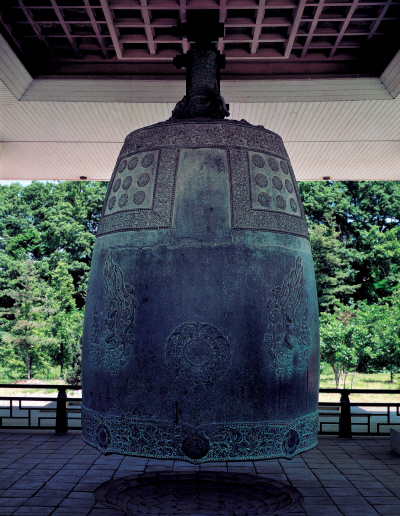
That impatience is part of the experience. Pop albums are terrified of silence because silence cannot dance, sell a challenge, or shout the hook before somebody scrolls away. BTS place ninety-eight seconds of it in the middle of a blockbuster reunion album. Then they reveal that the sound is not generic meditation-app ambience. It is the Divine Bell of King Seongdeok, cast in 771 during Unified Silla and preserved at the Gyeongju National Museum.
The hook vibe: one toll, no apology
There is no hook in the normal pop sense. The bell is the hook. Its resonance opens, blooms, thins, and keeps hanging in the air long after a modern producer would normally stuff the empty space with percussion. RM explained that the track’s length follows the time the sound needs to fade. The track does not imitate stillness. It documents a physical acoustic event.
That makes “No. 29” feel architectural. A bell of this size,about 3.66 meters tall and 18.9 tons,does not make a cute “ding.” Its sound occupies the room and then seems to leave through the floor. The National Museum describes Korean Buddhist bells as instruments whose resonance symbolically carries teachings down to souls in the underworld. You do not need to share the religious belief to understand why this sound was made to travel beyond ordinary human conversation.
What I love
The nerve. The cultural specificity. The refusal to explain Korea in English over a trap beat. The way one historic sound divides the album more effectively than another giant transition song could.
What gets side-eye
Mystery attracts nonsense. Fans will assign cosmic meaning to every millisecond, and the old child-sacrifice legend around the bell often gets repeated as fact. The verified history is already extraordinary. It does not need a dead child invented for drama.
Where it sits on ARIRANG matters
“No. 29” comes after the album’s first pressure-heavy stretch and before “SWIM,” the lead single built around moving through difficulty at your own pace. That sequence is the argument. Modern rap tension gives way to an eighth-century bell; the bell clears the room; then “SWIM” enters with breathing space and water.
This is why I would rarely play “No. 29” alone and still defend its place on the album. A doorway is not useless because nobody vacations in it. Shuffle mode turns the interlude into dead air. Album order turns it into a hinge.
The choice also answers a question hanging over ARIRANG: how does a global group engage Korean identity without turning heritage into costume? BTS do not paste a traditional instrument over every chorus and announce that authenticity has been achieved. Here, they let one specific Korean object sound like itself. No lecture. No tourism brochure. No decorative hanbok sprinting past the camera for three seconds.
The real backstory: museum archives met a pop album
The National Museum of Korea confirmed that the collaboration grew from an agreement among the museum, its cultural foundation, and HYBE. After HYBE requested material, the museum provided a high-quality sound recording of the Divine Bell that had been released under Korea’s public cultural-use framework. That actual recording became part of “No. 29.”
The same collaboration extended into merchandise built from the bell’s decorative motifs. I normally side-eye merchandise lore because a tote bag does not automatically deepen an album. Here, however, the process shows the cultural reference was not reverse-engineered by fans after release. The museum, the recorded bell, the track title, and the design work all connect through a documented partnership.
The bell itself took decades to complete. King Gyeongdeok commissioned it to honor his father, King Seongdeok, but the casting was finished in 771 during King Hyegong’s reign. It survived temple relocation and centuries of history before arriving at the Gyeongju National Museum. That is already enough drama. Please leave the sensational “Emille” sacrifice legend in the folklore drawer unless you label it as a legend.
No music video, and that is the correct decision
There is no official “No. 29” music video, and I do not want one forced into existence just because every track now needs vertical content. A literal video would be tempted to explain the bell to death: mist, slow-motion hands, historical costumes, seven symbolic doors, three timelines, and a comment section demanding a university course.
The sound makes you supply the space. That is the visual presentation. Close your eyes and the resonance changes the size of the room. Open another app and you destroy the experiment. For once, BTS give fans less to screenshot and more to hear.
The official museum photographs of the bell are still important because the object should not become an anonymous “ancient sound.” It has a body, inscriptions, floral and Buddhist ornament, a dragon-shaped suspension structure, and an immense bronze surface weathered into green. Seeing it after hearing the track makes the small digital file feel almost ridiculous. An eighteen-ton bell crossed 1,255 years to become a ninety-eight-second album track on your phone.
What “No. 29” says about BTS
BTS have spent years being translated, summarized, and marketed for people who may never learn much about Korea beyond food, beauty products, and entertainment headlines. “No. 29” refuses to flatten itself for instant access. You can enjoy the resonance without research. If you do research, a whole heritage file opens underneath it.
That is the good version of a panda side quest. The track does not punish you for not knowing. It rewards curiosity. You start with “why is this called No. 29?” and end up reading about Unified Silla metalwork, Buddhist bell acoustics, museum preservation, public cultural archives, and why the bell is no longer casually struck. That is organized chaos with receipts.
My actual reaction file
The moment I leaned in
When I stopped waiting for the “real song” to start. The bell’s decay became the song, and my impatient little brain had to sit there without being rewarded every four seconds.
The part fans may fight about
Whether an interlude this minimal deserves its own track. Yes. The alternative is burying the bell inside another song where most listeners would call it a cool sample and move on.
I do not need to pretend “No. 29” is something I blast in the car. It is not. It is one of those album choices that makes the songs around it better. The first half gains an ending. “SWIM” gains an entrance. The title ARIRANG gains a material connection to Korean heritage instead of floating as a vague symbol above the track list.
A national treasure is not a sample pack with better branding
The museum collaboration matters because heritage objects are not free-floating aesthetics. The Divine Bell of King Seongdeok carries religious, political, artistic and material history. Recording its sound with institutional cooperation respects that history more than downloading an anonymous “Asian bell” effect and calling the mood Korean.
That distinction should be basic, but global pop still treats culture like a buffet. A symbol gets detached from location, ritual and people, then returns as decoration for somebody else’s concept. “No. 29” works because the source is named, the museum is part of the public record and the bell remains more important than the celebrity borrowing its sound.
The number also refuses instant comprehension. Listeners have to ask what it means, then leave the entertainment platform and enter a museum archive. That movement is valuable. BTS does not replace the institution. The song points toward it.
Silence gives the bell authority
A typical idol album teaches listeners to expect voices, hooks and recognizable member distribution. “No. 29” interrupts that habit. The absence of a conventional performance is the performance choice. Seven famous voices step back so one historic sound can occupy the center.
That restraint fits BTS better than a giant heritage spectacle. RM has long treated museums and Korean art as living intellectual spaces, but the track does not turn his interest into a solo ownership claim. Jin, SUGA, j-hope, Jimin, V and Jung Kook remain part of the album architecture without needing to crowd this sound with proof of presence.
From a Buddhist lens, the bell is not background decoration. A struck bell marks time, gathers attention and lets vibration decay into silence. The disappearance of the sound is part of the sound. The track asks a streaming audience trained to skip empty seconds to notice that ending.
No music video protects the scale
I agree with the decision not to manufacture a glossy official video. A camera crew could easily turn the bell into heritage tourism, dramatic robes and drone footage. The official artwork and documented museum routes keep the object anchored to its own record.
If BIGHIT ever creates a visual, the responsible version should be documentary, not fantasy. Show the museum work, the recording process, the conservation context and the people who protect the bell. The celebrity should guide attention toward the artifact, not stand in front of it until the artifact becomes a prop.
The lack of a YouTube video ID is therefore not missing content. It is part of the editorial fact pattern. The React should point readers to the museum, Weverse and official album route instead of inventing a tracker entry for a video that does not exist.
Final verdict
“No. 29” is ninety-eight seconds of nerve, heritage, and negative space. Shuffle listeners will call it dead air. Album listeners get a threshold. History nerds get a side quest. I get to appreciate a K-pop act trusting one bell to hold the center of a comeback without adding a dance break.
RaeRae rating: 9/10 as album architecture; absolutely unhinged as a workout playlist choice.
Receipts and deeper reading
- National Museum of Korea , confirmation that the bell recording was provided for BTS’s “No. 29”
- Gyeongju National Museum , Divine Bell of King Seongdeok collection record
- Weverse Magazine , BTS, the bell motifs, and the museum collaboration
- BangtanSubs , “No. 29” translation notes and RM’s timing explanation
- BANGTANTV: “No. 29” official audioDaily+37.2KTotal views27.8M
- BTS , ARIRANG on Apple Music
- BIGHIT MUSIC , corrected lyric and credit notice
Keep falling through the panda pile: BTS profile · “SWIM” reaction · RaeRae Reacts
RaeRae verdict
The exact file earns its place because BTS keep seven individual roles audible inside one shared argument. The production supplies scale, but the members supply the reason to replay it.