
Memory, Sorrow, and Thorn · Canonical Divine Profile
Brynioch
Brynioch is a Hernystiri sky god invoked in gratitude by King Lluth—and the divine identity Maegwin repeatedly assigns to Jiriki after trauma, starvation, and visionary experience fracture her ability to distinguish Sithi allies from the gods she expects to save Hernystir. The trilogy never verifies a bodily manifestation. His importance lies in devotion, political interpretation, and the dangerous distance between a sacred name and the living person forced to wear it.
At a Glance
A sacred name made politically dangerous when metaphor becomes mistaken identity
- Name
- Brynioch
- Tradition
- Hernystiri religion
- Sphere
- Sky god
- Known invocation
- Thanked with Murhagh One-arm by King Lluth
- Major believer
- Maegwin
- Mistaken identity
- Jiriki, whom Maegwin interprets as Brynioch
- Manifestation status
- No literal physical appearance verified
Book 1 · A King’s Thanks
Lluth invokes Brynioch inside military reality, not as a replacement for it
After Eolair’s party discovers Skali’s raiders before they reach the Taig, King Lluth thanks Brynioch and Murhagh One-arm. The gratitude belongs to a recognizable Hernystiri devotional vocabulary. Gods receive thanks; scouts, soldiers, warning systems, and political judgment still do the visible work.
Eolair’s group has suffered. Five men remain able, two are gravely wounded, and four are dead. The warning reveals that Elias has placed a knife against Hernystir’s back while preparing to move against Josua, forcing Lluth to keep troops at home.
Brynioch’s invocation therefore occurs where faith and strategy coexist. Lluth does not say the sky god has solved the war. He names divine gratitude while Eolair explains the human trap and Rhynn’s Cauldron carries warning across the land.
This is the cleanest evidence for Brynioch’s ordinary religious place before Maegwin’s visions transform the name into a claim about who is physically standing in front of her.
Book 3 · Bradach Tor
Maegwin is starving, frozen, near the abyss—and certain the gods have come
After three days on Bradach Tor, Maegwin is found starving, frozen, and jubilant. She has come close to stepping into the abyss. Simon, Jiriki, and armored Sithi gather within her field of vision.
She interprets the scene through Hernystiri sacred expectation. The red-haired figure becomes a divine messenger; Jiriki becomes Brynioch; the assembled Sithi become the gathered gods preparing to save Hernystir.
The experience is emotionally coherent. Maegwin’s country has been invaded, her family shattered, her people displaced, and her earlier contact with Mezutu’a and the Niskies has already destabilized the boundary between legend and present crisis. She desperately needs the universe to declare that Hernystir has not been abandoned.
Emotional coherence is not factual verification. The figures are Simon, Jiriki, and Sithi warriors. No independent witness identifies a god. Jiriki remains Jiriki.
The Third Vision
A private misrecognition becomes a public proof structure
Maegwin later tells the Hernystiri gathered beneath the Grianspog that the gods have spoken to her three times. She combines Mezutu’a, Niskie aid, survival on Bradach Tor, and the “Brynioch” encounter into cumulative evidence.
She briefly remembers that she has misread signs before. That flicker of doubt is important: the movement from experience to certainty is not entirely unconscious. It requires interpretation and reinforcement.
Diawen supplies that reinforcement. She calls Maegwin’s experience a Witnessing, says the gods favor boldness, and encourages the belief that the Sithi are gods ready to fight for Hernystir if the people prove worthy.
Maegwin then teaches that winter and war reflect divine conflict, mortal struggle affects the heavenly one, and love for Hernystir is the greatest magic. Several hundred listeners are asked for complete trust and willingness to place their lives in divine hands.
Brynioch’s name has now moved from devotion to political authorization. A sky god thanked by Lluth becomes the identity assigned to Jiriki; that assignment becomes proof; the proof becomes a basis for directing a displaced population.
Diawen’s Responsibility
Compassion explains validation; it does not make certainty safe
Diawen is not mocking Maegwin or cynically manufacturing a cult. Her own regret over once refusing Mircha’s frightening dream request helps explain why she wants to honor visionary experience rather than dismiss it.
But she repeatedly treats intensity as evidence. She smiles, prompts skeptical Craobhan, touches Maegwin when doubt surfaces, and arranges uncertainty into affirmation.
Brynioch’s profile must include this mechanism because the divine name is doing political work through human intermediaries. Whether or not Brynioch exists within Hernystiri theology, the specific identification of Jiriki is wrong. Diawen helps the wrong identification acquire communal authority.
The distinction is generous without becoming evasive: sincere care can still enable dangerous certainty. Respecting a person’s sacred framework does not require confirming every literal claim produced during severe mental distress.
Jiriki Is Not Brynioch
The Sitha prince recognizes illness where Maegwin sees divine arrival
Back at Hernysadharc, Maegwin calmly feeds seed corn to birds as “flowers.” She again mistakes Jiriki for Brynioch. When Eolair insists they are not among the gods, she treats him as fevered.
Jiriki does not accept worship or exploit the mistake. He recognizes grave mental distress and offers help from Aditu, his healer-cousin, without promising healing is possible.
This boundary protects both characters. Maegwin is not reduced to a silly woman failing to recognize someone. Her misidentification belongs to trauma, loss, isolation, visionary experience, and a culturally available divine story. Jiriki is not reduced to the handsome immortal who validates a mortal religion by posing inside it.
It also protects Brynioch as a subject. A devotional profile should not use Jiriki’s face as the god’s canonical portrait just because one distressed believer does. The story explicitly gives us the correction.
Theology and Evidence
The books can respect Hernystiri faith without supplying a divine attendance sheet
Hernystiri culture contains multiple sacred figures, warnings, songs, and ritual systems. Brynioch and Murhagh One-arm receive royal thanks. Cuamh Earthdog receives Eolair’s prayer. Mircha appears in dream tradition. Rhynn’s Cauldron names an ancient warning system.
None of this requires the narrative to flatten religion into either laboratory proof or foolish superstition. The characters live inside sacred language that shapes courage, mourning, gratitude, and political meaning.
The evidence boundary is narrower: no verified scene shows a material Brynioch speaking or acting. Maegwin’s “encounters” are demonstrably encounters with Jiriki and other Sithi. A profile can document belief and consequence without claiming physical manifestation.
That approach is not less generous to fandom. It is more useful. It tells readers what the books actually establish, why Maegwin’s interpretation makes sense to her, and where interpretation becomes dangerous.
Sky God in a Broken Country
Why Brynioch becomes the name Maegwin needs
Hernystir’s crisis attacks the relationship between land, people, king, and sacred order. The winter is unnatural. Skali occupies territory. Lluth is wounded. Gwythinn is killed. The Taig falls. Ordinary political restoration becomes increasingly impossible.
A sky god offers scale. If the conflict exists in heaven as well as on earth, mortal suffering may still belong to a meaningful pattern. If Brynioch has arrived, then Hernystir has not been forgotten. If the gods require courage, displacement can become a test rather than meaningless loss.
These interpretations help explain their power. They also reveal the danger. A theology that turns every worsening condition into proof of a larger divine war becomes difficult to falsify and easy to weaponize.
Brynioch’s role in the narrative is therefore partly the role of a sacred name under pressure: comfort, identity, hope, mistaken recognition, and authority all gather around it.
Connections
The believers, mistaken figure, and supporting gods around Brynioch’s name
Maegwin
Hernystiri princess whose trauma and visions lead her to identify Jiriki as Brynioch and build policy around the encounter.
Jiriki
Sitha prince mistaken for the sky god; recognizes Maegwin’s distress and refuses to exploit it.
King Lluth
Invokes Brynioch in ordinary royal gratitude after Eolair’s warning party intercepts Skali’s raiders.
Diawen
Validates Maegwin’s interpretation as a Witnessing and helps private certainty become public authority.
Eolair
Insists Jiriki is not a god and becomes classified as fevered when reality contradicts Maegwin’s heaven.
Murhagh One-arm
Hernystiri god thanked alongside Brynioch in Lluth’s Book 1 invocation.
Why Brynioch Matters
He reveals how sacred language can hold a people together—and how misidentification can steer them toward danger
Brynioch is important without appearing as a verified body. His name belongs to Hernystiri devotion before Maegwin’s crisis. That established sacred place is exactly why her identification carries weight.
The story uses him to separate belief from evidence without ridiculing belief. Lluth can thank a god while still making strategy. Maegwin can sincerely experience rescue as divine and still be wrong about who rescued her. Jiriki can respect distress without accepting the assigned identity.
The result is a richer fandom subject than a fabricated god biography. Brynioch’s page becomes a map of devotion, trauma, interpretation, and political consequence—plus a firm reminder that one character’s belief label does not overwrite another character’s canonical identity.
On the Record
Books 1 and 3, devotional status, and no Jiriki face-swapping
This is Brynioch’s one canonical full-spoiler divine profile. Book 1 contains Lluth’s invocation. Book 3 contains Maegwin’s Bradach Tor misrecognition, public theology, later repeated identification, and Jiriki’s response. The existing Books 1/3 scope is retained.
The record confirms Brynioch’s name, Hernystiri sky-god role, invocation with Murhagh One-arm, and Maegwin’s belief that Jiriki is Brynioch. It does not confirm a literal manifestation, physical appearance, voice, weapon, genealogy, temple, romantic history, or direct intervention.
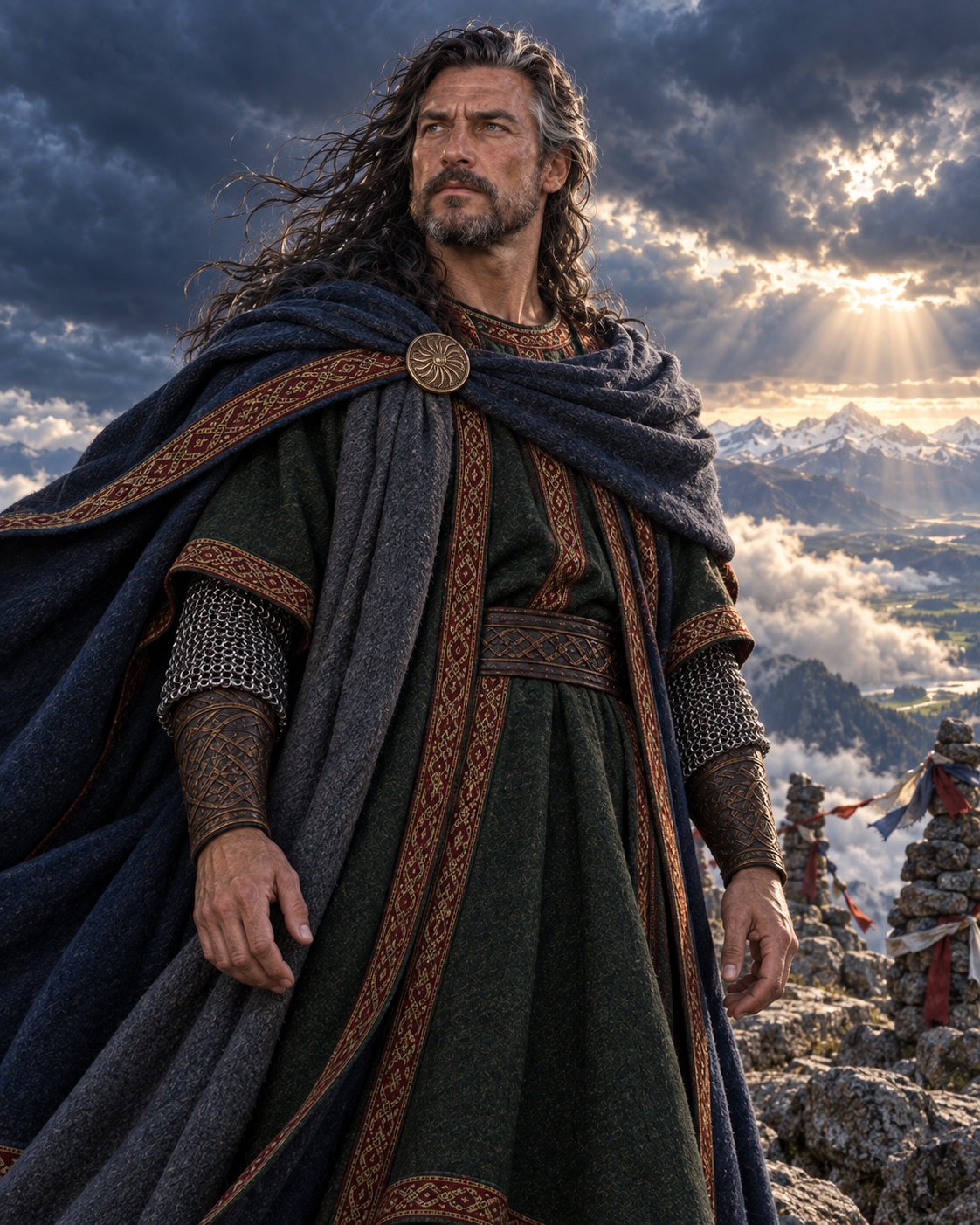
The approved devotional interpretation presents Brynioch as a magnificent humanlike mature sky figure of about forty: exceptionally tall and broad-shouldered, with a powerful athletic build, square-oval face, high cheekbones, broad straight nose, storm-gray human eyes, warm fair weathered skin, long blue-black hair streaked with silver, and a close silver-threaded dark beard. His body, face, coloring, hair, eyes, clothing, mail, sky-disc clasp, mountain ridge, clouds, prayer ribbons, and light are editorial reconstruction—not a literal manifestation claim. This exact interpretation now governs devotional profile, directory, hero, social, and contextual imagery. Scenes of Maegwin’s misrecognition must show locked Jiriki as Jiriki, with her belief explained in framing or caption rather than endorsed through face-swapping.