
Memory, Sorrow, and Thorn · Canonical Character Profile
Baron Brindalles
Brindalles is the Nabbanai noble who refuses to replace one convenient certainty with another. He demands evidence before condemning Benigaris, recognizes the debt Nabban owes Josua, and finally makes himself visible as the prince’s decoy while the real mission enters Asu’a.
At a Glance
The ally who understands resemblance can become battlefield service
- Title
- Baron of Nabban
- Family
- Father of Pasevalles; connected through family to Baron Seriddan
- Political role
- Nabbanai noble supporting the exposure of Benigaris and Josua’s coalition
- Core ethic
- Evidence before judgment, followed by action when the case is established
- Final service
- Impersonates Josua during the siege so the hidden infiltration remains secret
- End status
- Dead; found among those killed during the final Hayholt battle
The Visual Receipt
The face must plausibly carry Josua’s silhouette without becoming Josua’s clone
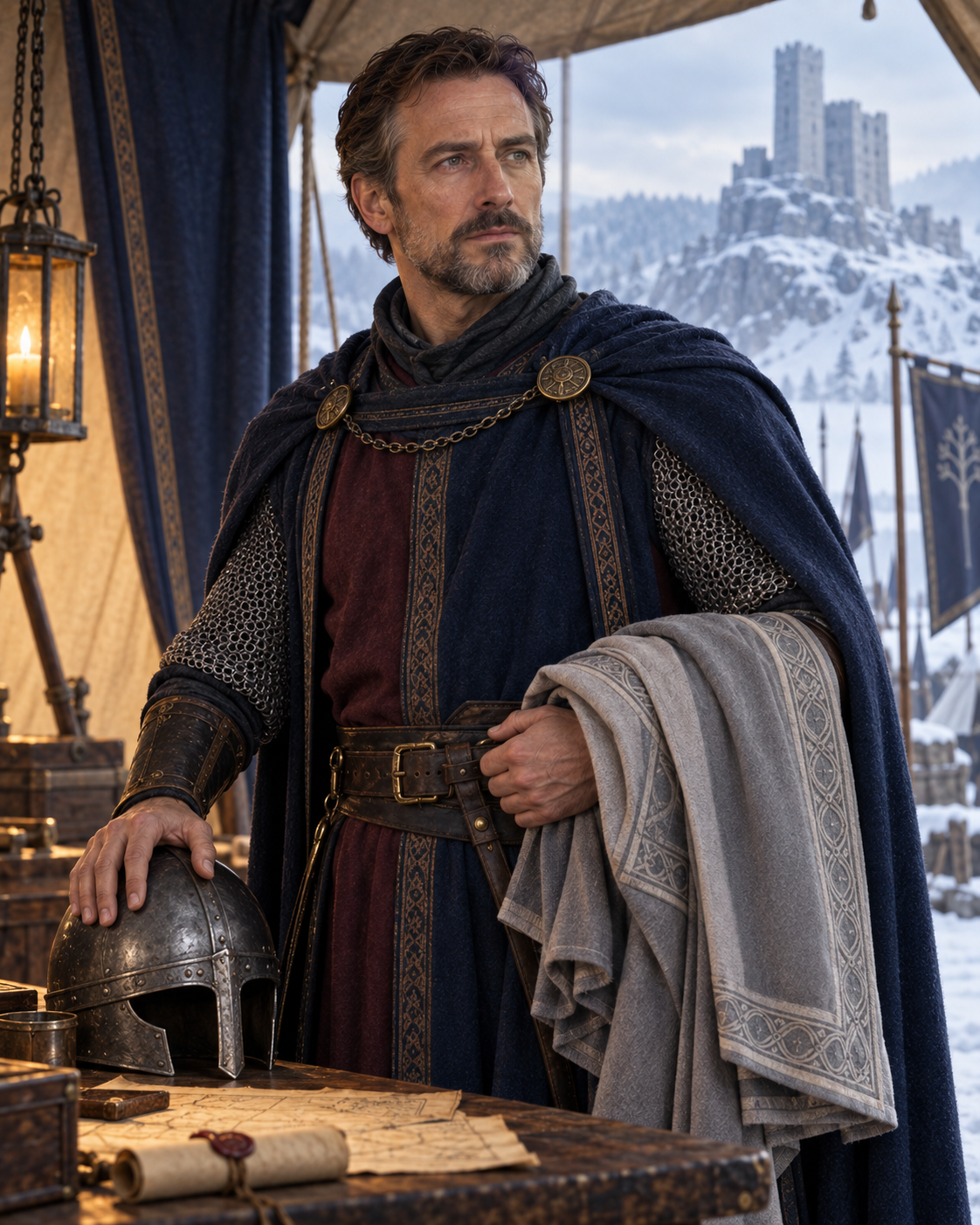
The ledger does not provide a defensible standalone inventory of Brindalles’s coloring or facial marks. It does establish that he can serve as Josua’s visible substitute at battlefield distance. Future art therefore needs an attractive adult Nabbanai noble whose build, bearing, and silhouette can support that decoy while remaining a distinct person at portrait range.
Do not copy Josua’s canonical face, hand difference, costume, or exact body. The disguise works through armor, distance, movement, and expectation. Once approved, Brindalles must retain one face, age, build, coloring, and Nabbanai material culture across council, family scenes, decoy armor, and death. The image lock must make the impersonation legible without erasing the man who volunteers.
The Complete Journey
He moves from careful judgment to a risk that depends upon being misjudged
Book 3 · To Green Angel Tower, Part I
One dead witness is evidence, not automatic certainty
Brindalles enters the political reckoning around Benigaris. Josua receives the sworn account Strangyeard recorded before New Gadrinsett: Deornoth saw Benigaris stab Duke Leobardis during the Bullback Hill trap. Brindalles notices the suspicious evenness of the wound but refuses to condemn a ruler on one dead witness alone.
The caution is not cowardice or secret loyalty to Benigaris. It recognizes how easily accusation becomes a weapon during succession crisis. Deornoth deserves belief; Nabban also deserves a judgment capable of surviving scrutiny. Brindalles’s position helps separate evidence-minded deliberation from the convenient skepticism powerful men use to bury truth.
His family connection brings the war into a younger generation. Pasevalles, pale-haired and eager for knighthood, refuses his mother’s order to avoid Isgrimnur’s men and will not betray information that might endanger his uncle Seriddan. Brindalles later interprets the recovery of Anitulles’s sea-dragon helm with a practical line: old things sometimes must be dusted off and used. The remark applies to Camaris, inherited symbols, and Nabban’s need to decide which past can still serve.
Book 4 · To Green Angel Tower, Part II
He repays political courage by lending the siege his own body
When Josua and Camaris disappear into the hidden mission, Isgrimnur creates visible substitutes so the siege continues to look conventional. Isorn wears black-painted steel as Camaris. Brindalles volunteers to resemble Josua.
He explains the choice as a Nabbanai debt. Josua and his family risked imprisonment and execution to bring truth into Nabban and expel Benigaris. Brindalles does not repay that action with ceremonial gratitude. He makes himself the target defenders are expected to track.
The disguise contains no comic escape hatch. It must remain visible enough to mislead the enemy while thousands fight as though the siege itself is the only plan. Pryrates is later found among Isorn, Brindalles, and other dead soldiers. The baron’s decoy service ends in the death it was always designed to risk.
His corrected ending matters. Marking Brindalles alive would turn sacrifice into temporary cost and erase the body underneath the borrowed silhouette. Josua survives the hidden route partly because Brindalles agrees to be seen in his place.
The People Around Him
Family, evidence, and political debt all become reasons to act carefully
Pasevalles
His son’s hunger for war carries courage and danger. Brindalles’s own final service reveals what adult knowledge of that danger looks like.
Seriddan
The family connection ties Brindalles to the Metessan resistance and gives Pasevalles a loyalty he refuses to betray.
Josua
Brindalles first insists the case against Benigaris be sound, then risks death because Josua’s family accepted the same danger to expose the truth.
Deornoth
The dead knight’s testimony deserves serious examination rather than automatic sanctification or convenient dismissal.
Isorn
They become the two visible substitutes, carrying the silhouettes of Camaris and Josua while the real men disappear into the hidden mission.
Benigaris
The ruler’s alleged patricide tests whether Nabban’s nobles want truth badly enough to require evidence and act on it.
Why He Works
The careful man is not less brave when he finally commits
Brindalles works because skepticism and courage belong to the same arc. He does not rush to condemn on a single account, but once the political case and debt are clear, he risks more than reputation. Deliberation becomes the foundation for action rather than an excuse to avoid it.
His decoy role also exposes how war consumes identity. Strategy needs the enemy to see “Josua,” while the person inside the armor remains Brindalles: father, baron, witness, and volunteer. The death matters because the disguise did not make him interchangeable.
Evidence Before Judgment
Refusing instant certainty protects the truth only if inquiry eventually leads somewhere
Deornoth’s sworn account carries enormous moral force. He witnesses Benigaris stab Leobardis during a trap and records the claim before his own death. The surrounding evidence—the wound, the succession, Benigaris’s conduct, and the larger political pattern—makes the accusation grave. Brindalles still refuses to convert one dead witness into an automatic verdict.
That hesitation sits on a dangerous line. Powerful people often demand impossible proof precisely so they never have to act. Brindalles avoids that trap because his standard is not “nothing can ever be known.” He notices the suspiciously even wound, weighs the testimony inside a broader case, and remains engaged in the coalition that removes Benigaris. Caution is a stage of judgment, not its permanent burial ground.
The distinction matters in a series saturated with false dreams, manipulated prophecy, political rumor, disguise, magical voices, and testimony delivered after the speaker can no longer answer questions. Evidence-minded characters must hold two truths together: extraordinary claims require testing, and endlessly raising the threshold can become collaboration with whoever benefits from doubt.
Brindalles’s later service proves what his earlier caution was for. Once he accepts the case and recognizes what Josua’s family risked to expose it, he treats political truth as a debt requiring bodily action. He does not merely applaud the verdict from a safer chamber.
The Borrowed Silhouette
A decoy works by erasing the volunteer from enemy sight—and the profile must put him back
Isgrimnur’s strategy requires the siege to remain believable while Josua and Camaris disappear into Asu’a. Isorn becomes a black-armored Camaris. Brindalles becomes the prince. At distance, armor, bearing, movement, expectation, and battlefield confusion do more work than exact facial resemblance.
That is why his canonical art cannot simply reuse Josua’s face. The tactic asks enemy observers to make a fast category error; it does not transform one man into another. A portrait must show Brindalles as himself. A decoy scene must preserve that same identity beneath the equipment that encourages distant witnesses to see Josua.
His explanation removes any temptation to treat the substitution as pageantry. Josua and Miriamele risked imprisonment and execution to confront Nabban with truth. Brindalles understands repayment as accepting the danger their actions created for them. The debt is political, but the body paying it belongs to a father.
Pasevalles’s earlier hunger for knighthood gives the choice a quiet generational ache. Isgrimnur warns the boy that war is terrible. Brindalles later demonstrates that warning without receiving a speech to his son or an invented farewell. He volunteers knowingly, becomes visible in the prince’s place, and is found dead among the soldiers Pryrates has passed through. The boy who wanted war survives a lesson his father cannot narrate afterward.
On the Record
Scope, spoilers, and the corrected ending
This is Baron Brindalles’s one canonical full-spoiler profile across Books 3 and 4. It is grounded in the completed owned-edition reading ledger and corrects his omission from the earlier Book-1-centered registry. The ledger’s final-battle receipt also corrects the shell’s previous “alive after the campaign” status: Brindalles is among the dead when Josua encounters Pryrates. The book identifies the result without staging a separate, invented death scene.
The approved identity presents Brindalles at about forty-six: an attractive, medium-tall, lean but battle-capable Nabbanai father with a warm olive complexion, high thoughtful forehead, straight prominent nose, gray-green eyes, short dark-auburn hair silvering at both temples, and a close silver-touched beard. His exact age, face, build, coloring, hair, beard, clothing, armor, helmet, gray-silver decoy surcoat, testimony parchment, map, pavilion, and winter light are editorial reconstruction. This exact identity now governs council, family, evidence, volunteer, decoy, battle, death, directory, hero, social, and later scene imagery. Decoy scenes may borrow Josua’s distant silhouette through equipment and bearing, but never his face or missing hand.