
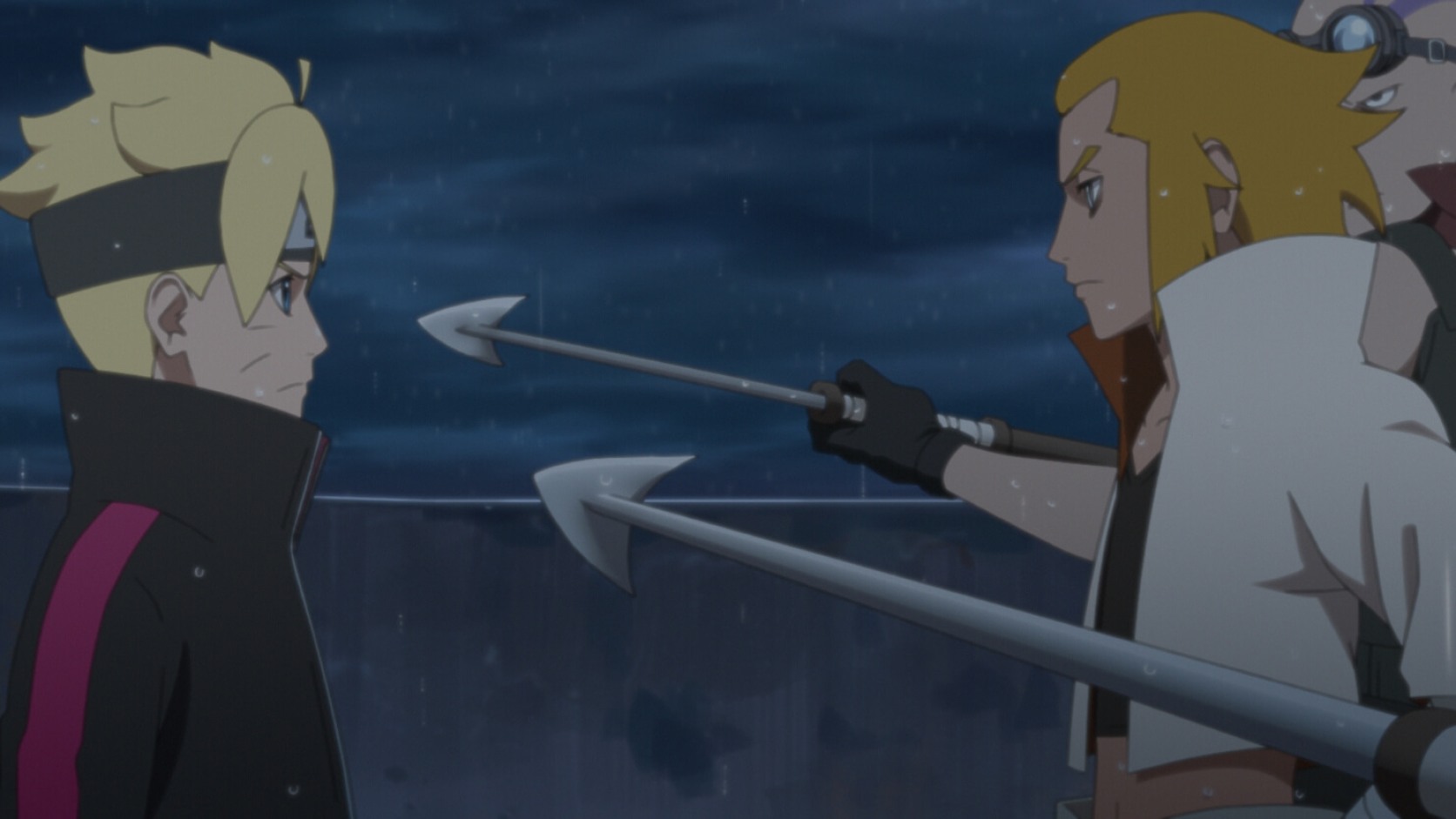
Conflicting Feelings
Boruto reaches Ikada and asks him to stop the war, but grief for Seiren and the Funato dead turns their reunion into a condition no life should satisfy.
Series: Boruto: Naruto Next Generations
Episode: 253 · Conflicting Feelings
Arc: Great Sea Battle of the Hidden Mist Village
Release: June 12, 2022
Previous: Episode 252 · The Desire to Believe
Directory: All 293 Boruto episodes
Bottom line
Boruto Episode 253 finally puts Boruto and Ikada on the same deck, but proximity does not restore the friendship they had before Seiren’s injury, Funamushi’s death, and Ikada’s return to the Funato. Boruto asks him to stop the war. Ikada refuses because Boruto’s plea reaches him through the faces of dead and wounded family members. Then Ikada offers a condition built around another life.
The conversation matters precisely because the attempt fails. Boruto cannot talk around Ikada’s grief, and Ikada cannot turn grief into a fair demand by speaking calmly. Peace requires listening, accountability, and practical guarantees. Peace cannot require murder or self-sacrifice as emotional payment. If the only imaginable bridge is a body, neither side has built a bridge at all.
RaeRae’s one-minute verdict
Boruto should apologize without defending himself, listen without agreeing to lies, and refuse any condition requiring Chojuro’s death or his own. Ikada deserves the truth about Seiren, Funamushi, Tenma, Isari, and every command decision that placed his family in danger. He does not deserve a substitute victim.
Sarada should hold the team’s boundary. Mitsuki should protect without escalating. Chojuro should maintain the pause and offer verifiable terms. Ikada should be invited into a process where grief can be heard without controlling who dies next.
Team 7 reaches the Funato fleet
Boruto, Sarada, and Mitsuki approach on one of Kajiki’s ships. The borrowed vessel carries evidence of Ikada’s earlier life as a builder.
That visual history creates an opening, but the fleet surrounding them makes clear that the conversation occurs under armed power.
Ikada allows them to approach
He could order an attack before Boruto speaks. Allowing contact shows that some part of him still wants to hear or test what Boruto will say.
The opening should not be romanticized. Ikada controls the deck, the fighters, and the terms of access.
Safe passage remains fragile
Every weapon, movement, and shouted command could collapse the meeting. Both sides need a visible agreement about distance, defensive posture, and withdrawal.
Team 7 should not depend on Ikada’s mood as their only protection.
Boruto speaks as a friend
He tries to reach the person who once wanted to build ships and connect islands. Friendship gives his words personal meaning.
Friendship does not give Boruto authority to define which version of Ikada is real. The commander standing before him also belongs to Ikada’s current experience.
Ikada hears an enemy first
Boruto is connected to Seiren’s injury and Funamushi’s death. Whatever warmth existed before now arrives through those losses.
Expecting Ikada to separate the friend from the fighter instantly would ignore how trauma reorganizes trust.
Seiren stands between them
She is absent from the deck but central to every sentence. Ikada remembers the sister who protected him and believed in his power.
Boruto needs to acknowledge her injury directly rather than treat the event as one regrettable detail in a larger argument.
An apology should begin cleanly
Boruto can say he is sorry for the harm and fear Seiren endured. He should not attach a defense to the same breath.
Context matters later. Immediate recognition tells Ikada that Boruto understands a person was hurt, not merely that strategy became complicated.
Apology cannot demand forgiveness
Boruto may hope that honest remorse restores enough trust to stop the attack. Ikada is not obligated to relieve Boruto’s guilt.
An apology remains worthwhile when offered because harm deserves acknowledgment, even if reconciliation never follows.
Ikada names inferiority
He describes feeling like the only Funato without the power expected by his family. That shame shaped the story he told himself about shipbuilding.
The clan taught him to measure worth through inherited combat ability. Araumi’s standard turned difference into deficiency.
Shipbuilding was not an excuse
Ikada claims the dream may have been something he made himself believe. Grief and family pressure can make a genuine desire look childish in hindsight.
Building vessels, connecting communities, and mastering a craft formed a coherent life. The dream deserves more respect than Ikada can give the vision in this moment.
People can hold conflicting desires
Ikada may truly love shipbuilding and also want recognition from his family. He may hate combat and still feel compelled to protect relatives.
Contradiction does not prove dishonesty. Human choices often contain several real wants that cannot all survive together.
The clan offered conditional belonging
Araumi and other Funato treated Ikada’s refusal to fight as failure. Returning with power earns the approval withheld from the builder.
That reward structure makes military command feel like acceptance. Conditional love can be more coercive than an explicit order.
Seiren protected Ikada
His sister represented safety, belief, and connection inside a family that judged him. Her injury threatens more than one relationship.
Ikada may feel that fighting is the only remaining way to prove her faith was justified. That conclusion deserves compassionate challenge.
Honoring Seiren should center Seiren
Medical care, safety, accurate updates, privacy, and respect for her wishes would honor her directly. Destroying Shinonome 1 does not treat her wounds.
Nobody should claim her unconscious body as an endorsement of war.
Funamushi’s death deepens the grievance
Funamushi was Kobuna’s father and Ikada’s relative. Boruto cannot reduce him to the commander who killed Kagura and expect that description to satisfy his family.
The complete truth includes his harmful decisions and the people who loved him.
Kagura’s death matters too
Boruto watched a friend die because of Funamushi’s attack. Asking him to ignore that loss would reproduce the same emotional erasure Ikada rejects.
Peace must hold both griefs without declaring one family’s dead more human.
Tenma’s death has its own facts
Ikada’s family may group every death under enemy cruelty. Individual circumstances and command choices differ.
An independent account should establish who ordered what, who attacked, what alternatives existed, and how each person died.
Isari cannot disappear from the story
He sought negotiation and represented dissent inside the Funato. His fate and choices matter because they challenge Araumi’s claim that war was unanimous.
Selective mourning can become propaganda when only the deaths useful to escalation receive attention.
Ikada speaks from cumulative loss
No single argument will untangle several bereavements, family shame, political grievance, and battlefield pressure. Boruto should stop searching for one perfect sentence.
The conversation needs time, repetition, and people equipped to support grief rather than exploit the pain.
Boruto speaks from cumulative guilt
He connects himself to Seiren, Funamushi, Kagura, and Ikada’s transformation. That guilt makes him willing to accept unreasonable burdens.
Sarada and Mitsuki must distinguish responsibility from self-punishment before Boruto volunteers his body as a solution.
Guilt is not jurisdiction
Feeling responsible does not grant Boruto authority to trade lives, promise political outcomes, or decide accountability alone.
Chojuro and lawful institutions remain responsible for public decisions. Boruto can advocate and testify without becoming judge or currency.
Ikada rejects the easy memory
Boruto invokes the builder he knew. Ikada answers from the commander he believes circumstances forced him to become.
Neither version erases the other. The goal should not be restoring a simpler past but creating a future where Ikada can choose without coercion.
A plea for peace needs material terms
Boruto says more people will die if the war continues. Ikada already knows that and may regard the deaths as necessary.
The stronger proposal identifies a ceasefire length, troop positions, accountability process, development review, and protection for Funato civilians.
Moral truth alone may not persuade
The cycle of revenge is real, but naming the cycle does not answer fears about land, sea, power, or punishment.
Peace advocates must connect moral principle to security and political survival.
Ikada’s condition is not negotiation
A demand centered on another person’s death is coercion, not reciprocal problem-solving. The condition tries to convert grief into an exact body count.
Boruto should refuse without insulting the grief underneath the demand.
Chojuro cannot become payment
The Mizukage’s choices deserve scrutiny, but assassination would bypass evidence, defense, judgment, and the people affected by succession.
Killing one leader cannot settle a conflict involving institutions and communities.
Boruto cannot become payment either
Offering his own life may feel morally pure because he refuses to kill somebody else. Self-sacrifice still leaves family, friends, and political consequences behind.
A teenager’s death is not a lawful peace treaty.
Self-sacrifice repeats the same logic
The war treats people as bodies spent for family, village, or honor. Boruto risks accepting that premise while changing only whose body gets spent.
Ending the cycle requires rejecting human payment altogether.
Sarada should say no clearly
As captain and friend, Sarada must oppose any agreement involving murder or Boruto’s death. Her boundary should be immediate and public.
She does not betray Boruto by protecting him from a decision made under guilt.
Mitsuki should not threaten Ikada
Hearing a demand against Boruto may trigger protective rage. A threat would validate the Funato belief that force is the only honest language.
Mitsuki should maintain defense, watch surrounding fighters, and follow Sarada’s signals.
The fighters surrounding them matter
Ikada performs leadership before people who expect strength. Backing down publicly could threaten his authority and safety.
Negotiators should give him a face-saving route toward a pause rather than demand instant surrender before his entire force.
A private channel could change the tone
Ikada may speak differently without Araumi’s loyalists watching. A neutral meeting with limited participants could reveal which demands are personal and which are political theater.
Privacy needs safeguards so neither side can misrepresent the exchange afterward.
Public statements should avoid humiliation
Chojuro and Boruto should not call Ikada a coward, puppet, or failed friend. Humiliation binds a leader more tightly to escalation.
They can condemn threatened attacks while leaving room for him to change course with dignity.
The Funato need a credible future
If stopping means prison, dispossession, or cultural erasure for everyone, fighters will see no reason to accept peace.
Terms should distinguish leaders, individual conduct, civilians, coerced participants, and people willing to demobilize.
The Land of Water needs security guarantees
Chojuro cannot withdraw forces while Shinonome 1 and nearby communities remain exposed. A pause must include verified fleet positions and protection of civilian infrastructure.
Security can be reciprocal without declaring both sides equally responsible.
Shinonome 1 needs continued evacuation
The conversation may fail or stall. Workers and residents should keep moving to safety regardless of hopeful reports from the deck.
Emergency planning cannot wait for Boruto to succeed.
Medical corridors should stay open
Wounded Funato and Land of Water personnel need protected treatment routes. Care can become the first practical cooperation between enemies.
Attacking medical transport should trigger investigation and renewed safeguards, not abandonment of the corridor.
Prisoner information can build trust
Each side should provide names, condition reports, and access for detained people. Families need verified information.
A limited exchange or communication arrangement may prove more achievable than an immediate political settlement.
Missing people must remain visible
Denki and Iwabe’s earlier disappearance showed how quickly individuals can vanish inside a campaign. Every missing civilian and fighter deserves a documented search.
Peace talks should include a joint mechanism for tracing people and returning remains.
Kobuna cannot be used as evidence
Ikada may invoke Funamushi’s son as proof that revenge is necessary. Kobuna’s grief is real, but a child cannot authorize a war.
He needs care and distance from commanders, not a place in their argument.
Buntan’s grief deserves the same protection
Hebiichigo’s death could be used to demand violence from the Mist side. Buntan should not be reduced to an avenger any more than Kobuna should.
Support must allow anger without turning anger into orders.
Dialogue does not erase accountability
Meeting Ikada does not absolve attacks or threatened infrastructure destruction. Negotiation can stop immediate harm while evidence and lawful review continue.
Justice delayed for safety should be scheduled and documented, not quietly abandoned.
Accountability does not require vengeance
Facts, individual responsibility, proportionate consequences, repair, and institutional reform can answer harm without another retaliatory killing.
That process is slower than revenge because fairness requires more than identifying a target.
Boruto should ask what Ikada needs
He spends much of the conversation telling Ikada why war must stop. A direct question could reveal fear, demand, grief, or constraint that speeches miss.
Listening does not promise agreement. Listening improves the accuracy of any response.
Ikada should be asked what Seiren wanted
If he claims to fight for her, the conversation should distinguish her actual words from assumptions made after injury.
The question may expose tension between loving Seiren and using her as justification.
The ship dream offers a policy idea
Ikada wanted trade and connection among islands. Negotiators could propose reconstruction, maritime access, shared shipbuilding, or civilian transport governance.
Peace becomes more believable when tied to work and identity, not merely disarmament.
Kajiki’s role should remain voluntary
His ship enabled the meeting, but he should not be forced to testify, negotiate, or remain in danger. Civilian assistance needs boundaries.
Authorities owe him fuel, repair, protection, and honest recognition of risk.
The weather increases pressure
Rain, rough water, fatigue, and poor visibility make every gesture harder to read. Participants may mistake movement for attack.
The meeting should pause when conditions prevent safe communication rather than forcing a dramatic conclusion.
An abort signal should be honored
Sarada needs a clear signal that ends contact and triggers safe separation. Funato fighters must know that withdrawal is not an attack.
Without an exit, Boruto may remain because failure feels morally unbearable.
Boruto must survive his own compassion
His willingness to bear pain for others is genuine. Adults and teammates must prevent compassion from becoming self-erasure.
The world needs him alive enough to learn, repair, and keep showing up after this conversation.
Ikada must survive his own grief
Command may give him purpose while consuming every other identity. He needs a route back to caregiving, building, friendship, and personal choice.
Peace should return possibilities rather than demand instant emotional healing.
Neither boy can settle national policy alone
Their relationship may unlock a ceasefire, but communities, officials, workers, families, and affected islands must shape the final agreement.
Personal reconciliation is not democratic consent.
Chojuro must keep the pause credible
If Land of Water forces advance while Boruto speaks, Ikada will treat every word as deception. Orders must match the diplomatic message.
Any defensive exception should be communicated through the agreed channel.
Araumi’s influence must be addressed
Even if Ikada pauses, Araumi or loyal commanders may order continued attacks. Negotiators need to know who controls each unit.
A ceasefire without command mapping can collapse through competing orders.
Dissent inside the Funato matters
Isari’s negotiation shows the clan was never unanimous. Other fighters may prefer survival, care, or political talks.
Protected surrender and communication routes can turn hidden dissent into de-escalation.
Dissent inside the Mist matters too
Residents and shinobi may question Chojuro’s strategy without supporting Araumi. Their concerns should not be treated as treason.
Open review helps prevent defensive necessity from expanding into revenge.
The condition should be documented
Ikada’s exact demand, context, witnesses, and Boruto’s response should enter the record. Later propaganda may distort what happened.
Documentation supports accountability and protects participants from false claims.
No child should sign away a life
Boruto is a shinobi, but he is still young and acting under trauma. Any agreement involving his safety requires adult review and lawful authority.
The team should remove him from negotiations if self-harm becomes the proposed solution.
Failure can still produce information
The conversation reveals Ikada’s grief, self-concept, demands, and command position. Even without agreement, those facts can shape a better second attempt.
Negotiators should debrief before rushing into another dramatic gesture.
A second attempt needs different people
Ikada may need to hear from a neutral mediator, caregiver, Funato dissenter, infrastructure representative, or someone who knew his shipbuilding work.
Repeating Boruto’s plea louder will not make the underlying barriers disappear.
The title refuses a simple villain
“Conflicting Feelings” applies to both young men. Boruto carries guilt, grief, friendship, and duty. Ikada carries love, rage, shame, memory, and coercion.
Complex emotion explains why the encounter is hard. Complexity does not excuse harmful choices.
Family notification should not depend on rumor
Relatives on every side need verified notice about injury, detention, death, and missing people. A person should not learn that somebody they love is gone through a military broadcast designed to inflame anger.
Named liaison teams should provide private notification, interpreters, written confirmation, and continuing contact. Humane information practices reduce panic and make manipulation harder.
Grief support should be independent of command
Funato fighters may avoid counseling if Araumi’s officers control access or receive reports. Mist shinobi may fear that asking for help will affect assignments.
Confidential support needs professional independence and protection from retaliation. People should be able to describe anger, doubt, or regret without becoming intelligence sources.
A ceasefire monitor needs real access
Neutral observers cannot verify compliance from a distant office. They need safe access to fleet positions, civilian routes, medical corridors, alleged attack sites, and command contacts.
Both sides should agree how evidence will be collected and disputes reviewed. Monitoring without access becomes another decorative promise.
The next proposal should include repair
Ikada may hear “stop fighting” as a demand that the Funato accept every prior loss without remedy. Negotiators should include compensation, reconstruction, environmental review, and lawful claims procedures.
Repair cannot restore the dead, but practical commitments show that peace means more than returning to the conditions that produced grievance.
Community leaders should join the process
Fishing communities, workers, displaced families, caregivers, elders, and young people all live with decisions made by Araumi and Chojuro. Their representatives need formal seats in later talks.
Armed power should not remain the only qualification for shaping the sea’s future.
Both teams need a written debrief
Team 7 should record Ikada’s language, the condition, surrounding forces, possible openings, and moments when danger increased. Chojuro’s command should compare that account with other intelligence.
A disciplined debrief turns a painful failure into evidence for safer action. Memory alone will bend under guilt, fear, and later political pressure.
What responsible leadership looks like now
Reject every death-based condition. Keep forces paused. Continue evacuating Shinonome 1. Move the conversation to a safer, smaller setting with neutral mediation and written reciprocal steps.
Provide trauma support, preserve evidence, protect children, publish surrender routes, and schedule a second meeting. The first failed conversation should improve the process, not trigger a final attack.
RaeRae’s final word
Boruto Episode 253 gives us the uncomfortable version of talking: honest words do not automatically reach a person whose whole family system is built around injury and obligation. Boruto cannot say “cycle of revenge” and make Seiren’s bed, Kobuna’s grief, Kagura’s death, or Ikada’s shame disappear.
Ikada also cannot name his pain and invoice the world for another corpse. Chojuro’s head is not peace. Boruto’s life is not peace. Peace begins when everybody refuses that accounting, keeps civilians alive, and builds terms strong enough to hold grief without obeying the pain.
Sources and lawful viewing
Official episode reference: Naruto Official episode guide
Licensed episode route: Crunchyroll licensed series page