
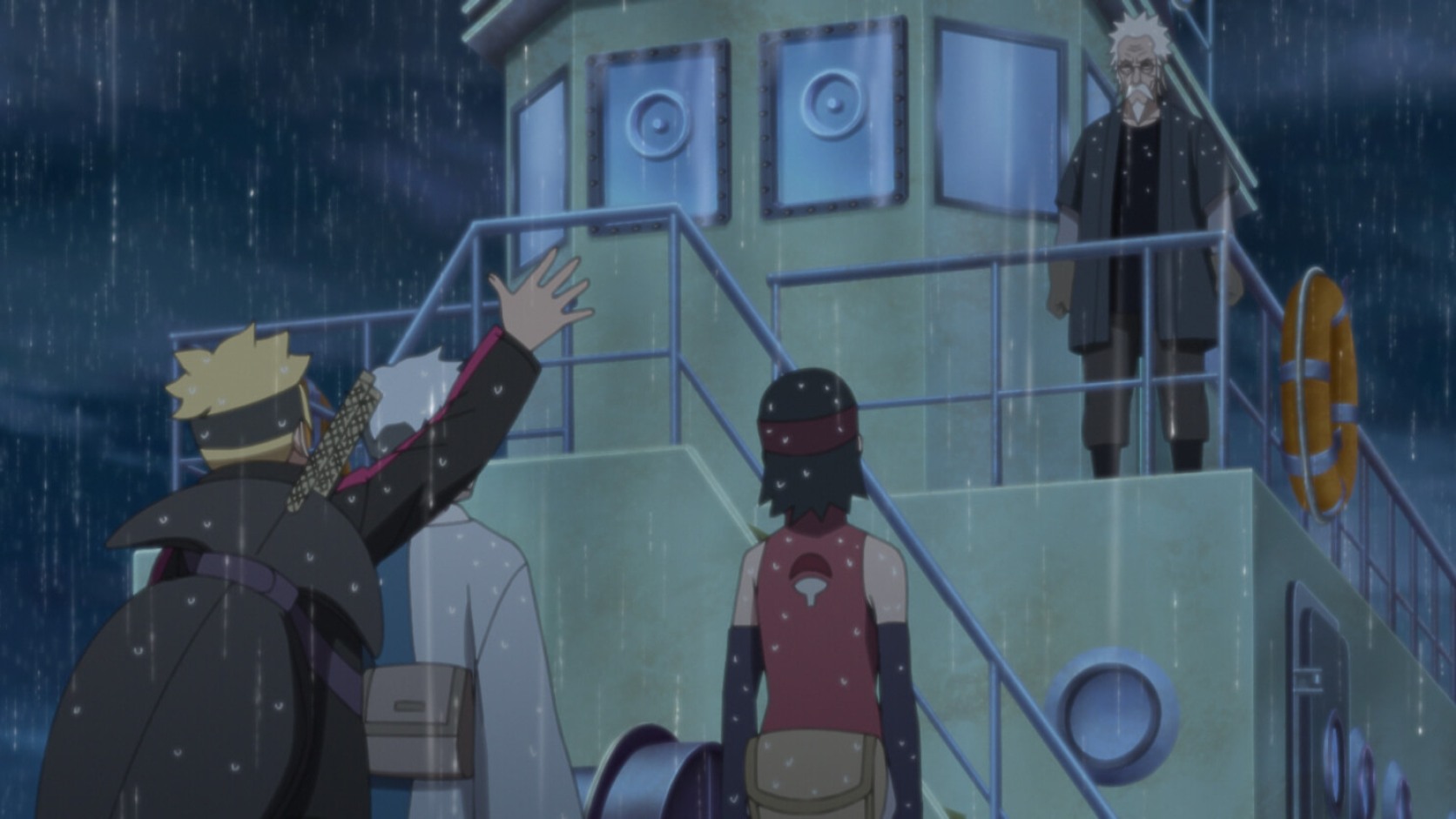
The Desire to Believe
Team 7 races to persuade Chojuro while Ikada leads the Funato toward Shinonome 1, testing whether belief can become a real route away from war.
Series: Boruto: Naruto Next Generations
Episode: 252 · The Desire to Believe
Arc: Great Sea Battle of the Hidden Mist Village
Release: June 5, 2022
Previous: Episode 251 · Their Resolve
Directory: All 293 Boruto episodes
Bottom line
Boruto Episode 252 puts belief under pressure from two fleets moving toward the same disaster. Boruto, Sarada, and Mitsuki chase Chojuro because they believe the Mizukage can still stop the battle. Kajiki helps them reach him. Across the water, Ikada leads the Funato toward Shinonome 1, the Land of Water’s new power plant, with destruction now treated as proof of loyalty.
Belief is not evidence, authority, or a complete plan. Belief does matter because somebody has to imagine an alternative before institutions will build one. Team 7’s hope becomes useful only when paired with transport, access, clear demands, civilian protection, and leaders willing to pause. The episode asks whether trust can survive grief. My answer is yes, but trust needs more than a speech and a boat racing through bad weather.
RaeRae’s one-minute verdict
Boruto is right to try. Chojuro is responsible for protecting the Land of Water, but protection should include exhausting a credible route away from mass casualties. Ikada’s plan to destroy Shinonome 1 threatens workers, nearby communities, essential services, and any future he once imagined building on the sea.
Kajiki should carry Team 7 only under a documented safe-passage plan. Chojuro should authorize a limited ceasefire and direct contact with Ikada. The power plant should be evacuated and isolated. Believing in somebody is beautiful. Making every civilian depend on that belief without backup would be negligence.
Team 7 chooses the Mizukage first
Boruto, Sarada, and Mitsuki decide to reach Chojuro before confronting Ikada. That sequence recognizes a basic truth: the leader controlling one military force can reduce danger immediately.
They should ask for a pause, safe passage, and authority to communicate. Approaching Ikada while Chojuro’s forces continue advancing would make Boruto’s peace message sound empty.
Chojuro is already heading into battle
The team must catch a moving command structure. Once forces deploy, changing course becomes harder because units, supplies, signals, and expectations all point forward.
That difficulty is not a reason to give up. The difficulty is a reason every military operation needs a standing process for reassessment and recall.
A leader must remain reachable
Chojuro cannot become inaccessible simply because deployment has begun. Civilian officials, negotiators, field commanders, and trusted messengers need reliable channels to reach him.
Leadership during crisis includes receiving information that challenges the plan. A sealed command bubble turns confidence into blindness.
Kajiki provides the missing route
Team 7 needs a boat, and Kajiki helps them. His practical knowledge converts conviction into movement.
The episode remembers something war stories often ignore: mechanics, builders, pilots, and navigators make every operation possible. Their consent and safety matter too.
Kajiki is not transportation equipment
Boruto’s urgency does not give him ownership over Kajiki’s vessel, labor, or life. Kajiki should know the danger, purpose, destination, and extraction plan before agreeing.
Consent given under friendship or moral pressure still needs room for refusal. The mission must not turn another civilian worker into an expendable resource.
The boat needs a safety plan
Severe weather, hostile fleets, poor visibility, and uncertain communications create overlapping risks. Life jackets, emergency signals, navigation backups, medical supplies, and alternate routes should be checked before departure.
Rushing without those protections could turn a peace mission into another rescue crisis.
Weather does not care about resolve
The raging sea will not reward courage or moral purpose. Conditions can capsize the best intention.
Kajiki’s expertise should control navigation decisions. Boruto cannot demand that a civilian pilot exceed safe limits because the political clock feels urgent.
Sarada should lead the briefing
As captain, Sarada can present the request to Chojuro clearly: current facts, predicted casualties, proposed pause, contact plan, and safeguards.
That structure helps separate Boruto’s guilt from the operational case. Chojuro needs both the human reason and a credible alternative.
Boruto should name his personal stake
He believes his actions pushed Ikada toward the Funato. Hiding that connection would undermine trust if Chojuro discovers the history later.
Boruto should explain what happened without claiming sole responsibility. Transparency allows the Mizukage to evaluate bias and usefulness together.
Mitsuki should watch the room
Mitsuki can monitor security, emotional escalation, and whether officials treat Boruto as a threat rather than a messenger.
His role should remain protective rather than intimidating. The team needs Chojuro listening, not preparing for a confrontation inside his own command post.
The request must be specific
“Stop the war” expresses the goal but leaves Chojuro without an implementable order. Team 7 should request a defined pause, route, duration, personnel limit, and communication channel.
Specificity lets a leader say yes to one controlled step even when full peace remains uncertain.
A temporary pause is not surrender
Chojuro may fear that stopping movement rewards Araumi or gives the Funato time to attack. A monitored pause can include defensive positions, observation, and consequences for violations.
The difference between surrender and restraint should be stated publicly so political pride does not sabotage safety.
Chojuro has reasons to distrust the Funato
The Funato have attacked, captured people, endangered villages, and announced an offensive against critical infrastructure. The Mizukage cannot base security solely on Boruto’s memory of Ikada.
Distrust should shape verification, not eliminate diplomacy. Negotiation was invented for people who do not already trust one another.
Boruto has reasons to believe Ikada
He knew Ikada as a builder who valued connection and disliked combat. That history suggests the current commander contains more than Araumi’s war identity.
Past character is relevant evidence, though not a guarantee. Boruto should present the evidence honestly without promising an outcome he cannot control.
Belief must tolerate disappointment
If Ikada refuses, Boruto’s faith should not collapse into rage or self-destruction. Belief in someone’s capacity to choose differently is not a contract forcing them to do so.
The team needs a plan for rejection, delay, manipulation, and partial agreement.
Ikada sails toward Shinonome 1
The Funato target a new power plant developed by the Land of Water. The target is strategic, symbolic, and civilian all at once.
Destroying infrastructure can darken homes, halt clinics, disrupt water systems, damage communication, and erase livelihoods far beyond the blast site.
A power plant is not an abstract symbol
Leaders may describe Shinonome 1 as modernization, occupation, environmental harm, or enemy control. Workers and communities experience machinery, electricity, wages, risks, and dependence.
Any decision about the facility needs those people at the table. Armed groups do not become legitimate representatives merely by targeting the site.
Workers need immediate warning
Anyone operating or maintaining Shinonome 1 should receive a verified threat notice and evacuation order. Contractors, cleaners, guards, technicians, and nearby residents all count.
Security secrecy cannot justify leaving ordinary workers inside a known target.
Shutdown procedures matter
Power infrastructure cannot always be abandoned by flipping one switch. Operators may need to stabilize systems, isolate fuel, preserve cooling, and protect connected networks.
Emergency engineers should determine the safest shutdown sequence while security creates time and transport.
Nearby communities need evacuation routes
An attack could cause fire, debris, contamination, flooding, or prolonged loss of service. Residents need routes, shelters, transport assistance, and accessible warnings.
Plans should include children, elders, disabled residents, patients, and people without private boats.
Hospitals need backup power
If Shinonome 1 supplies medical facilities, backup generation and fuel must be confirmed before any shutdown. Critical equipment cannot wait for political negotiations.
Health officials should know how long reserves last and which patients require transfer first.
Communication systems need redundancy
An infrastructure attack may disable the same networks used for evacuation and ceasefire contact. Radio, signal, messenger, and satellite alternatives should be tested now.
Redundancy prevents technical failure from looking like deliberate silence.
The Funato may see development as dispossession
Shinonome 1 may represent a Land of Water future built without meaningful Funato consent. That grievance deserves examination.
Legitimate concerns about land, sea access, environment, or political exclusion do not justify attacking workers. Addressing the grievance and stopping the attack can happen together.
Development requires consent
Large projects should involve affected communities before construction, not after armed resistance begins. Consultation must include real influence, accessible information, and ways to challenge decisions.
A presentation followed by a predetermined approval is not consent.
Environmental review belongs in the record
Power generation can affect water, fisheries, navigation, habitats, and sacred places. Independent environmental findings should be public.
If the Land of Water skipped or manipulated review, officials should correct that failure without accepting military destruction as the remedy.
Workers should not pay for policy failures
The people inside Shinonome 1 may have had no role in choosing the site or negotiating with communities. Targeting them transfers political anger onto accessible bodies.
The Funato should communicate demands through protected channels and allow evacuation regardless of whether negotiations succeed.
Ikada understands construction
As a shipbuilder, Ikada knows what skilled labor creates and how long rebuilding takes. That knowledge should make the plan to destroy infrastructure feel especially tragic.
War is forcing a builder to use technical understanding against the very idea of building.
His old values may still create an opening
Boruto can appeal to Ikada’s concern for people, craft, and the sea without pretending the past erases present anger.
The strongest message will connect a pause to Ikada’s own values rather than demand that he become the cheerful friend Boruto remembers.
Do not weaponize friendship
Boruto should never imply that Ikada owes peace because they shared trust. That approach would turn relationship into leverage.
He can say what the friendship meant, acknowledge harm, and offer another choice. Ikada retains the right to respond.
An apology needs no defense attached
Boruto can acknowledge Seiren’s injury and Ikada’s pain before explaining anything else. A sentence beginning with sorrow should not end by arguing why the harmed person must understand.
Context can come later if Ikada asks. The first task is recognition.
Ikada may distrust every promise
The Funato have reasons to view Land of Water assurances skeptically, and Ikada now connects Boruto to personal loss. A single promise will not repair that history.
Verification, written terms, neutral observers, and phased actions make trust less dependent on emotion.
Chojuro should offer a verifiable first step
He could halt advancement for a set period, pull weapons outside a marked zone, permit medical passage, or release information about captives.
A visible action gives Boruto something concrete to carry to Ikada.
Ikada should be asked for a matching step
The Funato could stop approaching Shinonome 1, identify civilian vessels, hold fire, or permit evacuation. Reciprocity reduces fear that only one side is exposed.
The first steps should be small enough to verify quickly and meaningful enough to save lives.
Kajiki can witness the exchange
As a civilian shipbuilder connected to Ikada’s earlier life, Kajiki may provide credibility. He should choose whether to participate and should not be forced into intelligence work.
If he witnesses an agreement, his account could help communities understand what was promised.
Civilian witnesses need protection
Participation may expose Kajiki or other workers to retaliation from both sides. Their identities, routes, and families should be protected.
Peace processes fail when civilians carry risk while leaders retain all authority.
The meeting place matters
A vessel, neutral island, or marked water zone should provide visibility and escape without placing civilians nearby. Both sides must agree on distance, weapons, and personnel.
Bad geography can turn a misunderstanding into an ambush.
Weather may force postponement
Storm conditions can disrupt signals and navigation. A postponed meeting should automatically extend the ceasefire rather than create uncertainty.
Contingency language needs agreement before the weather decides for everyone.
Every side needs an abort signal
Team 7, Kajiki, Chojuro’s forces, and the Funato should know the signal ending contact safely. The signal should trigger separation, not attack.
An exit protects participants from staying too long because leaving feels embarrassing.
Sarada must be able to overrule Boruto
Boruto’s emotional connection may keep him talking after the meeting becomes unsafe. Sarada should hold explicit authority to call the retreat.
That boundary protects friendship by preventing desperation from becoming command.
Mitsuki must not retaliate automatically
If Ikada threatens Boruto, Mitsuki may move faster than negotiations can recover. Prearranged defensive rules and nonlethal options are essential.
Protecting Boruto should not accidentally begin the battle Boruto came to stop.
Chojuro needs intelligence beyond Team 7
Scouts should verify the Funato fleet’s location, weapons, speed, and proximity to Shinonome 1. Engineers should assess the plant’s vulnerability.
Better information allows narrower defensive measures and reduces pressure for a sweeping attack.
Intelligence must distinguish people
The fleet may include combatants, coerced workers, medics, children, or civilians. Treating every vessel as an identical target would multiply harm.
Identification procedures should precede force whenever time permits.
Defensive force needs limits
If the Funato attempt immediate destruction, Chojuro may need to intervene. Rules should prioritize stopping the attack, protecting evacuation, and accepting surrender.
Punishing the clan after the threat ends would cross from defense into revenge.
The plant should not become a human shield
Land of Water forces should not keep workers inside to deter attack or stage military assets among civilian crews. Protection requires reducing civilian presence.
The Funato likewise cannot use nearby communities to constrain Chojuro’s response.
Public information should reduce panic
Officials need to announce the threat, protective actions, and service contingencies without broadcasting tactical details. Silence encourages rumor and chaotic evacuation.
Scheduled updates should continue even when negotiations produce no visible change.
Families need reunification points
Workers evacuating Shinonome 1 may lose contact with relatives. Named reception centers should record arrivals, medical transfers, and missing people.
Nobody should spend the night searching multiple docks for a family member already safe somewhere else.
Displaced people need material support
Evacuation costs money, shelter, food, medication, transportation, and lost wages. Authorities should provide aid without demanding proof people cannot retrieve during an emergency.
Protection that leaves families destitute is incomplete.
The desire to believe is not childish
Cynicism often presents itself as maturity because expecting failure feels safer. Boruto’s willingness to imagine change is not the problem.
The responsibility is building safeguards around hope so one refusal does not doom everyone.
Adults should not mock the proposal
Chojuro can challenge assumptions and demand specifics without humiliating Boruto. Dismissal would teach young shinobi that leaders value them only as fighters.
Taking the proposal seriously models the political responsibility the academy rarely teaches.
Boruto should not promise Ikada immunity
He lacks authority to erase accountability for attacks or command decisions. Offering impossible terms would destroy credibility.
He can promise advocacy, lawful treatment, and a fair hearing only if Chojuro has authorized those commitments.
Ikada should not demand civilian sacrifice
The Funato cause cannot justify killing power-plant workers or depriving communities of essential services. Grievance does not transform civilians into acceptable targets.
Boruto should say that boundary clearly while keeping the channel open.
Peace needs a political destination
Stopping one attack will not resolve authority over the sea, development, representation, losses, or accountability. A follow-up process needs dates, participants, and independent facilitation.
Without a destination, the ceasefire becomes only time to reload.
Isari’s earlier negotiation matters
Evidence that a senior Funato sought peace challenges Araumi’s claim that total war represents the whole clan. Chojuro should preserve and examine that channel.
People willing to negotiate may still exist inside the fleet, even after Ikada assumes command.
Dissenters need a protected signal
Funato members who oppose the attack need a way to communicate or leave without exposing themselves publicly. A coded surrender route can save lives.
Command should prevent informants from being exploited and then discarded.
Accountability can wait for safety, not disappear
Immediate de-escalation may require sequencing arrests or hearings after weapons are secured. Delay for safety is different from immunity.
All sides should preserve records so later justice does not depend on the winner’s memory.
Reconstruction should shape today’s choices
Every destroyed boat, dock, clinic, home, and power system will demand labor and resources after the fighting. Leaders should measure operations against that future cost.
Ikada’s generation deserves more than rebuilding damage created by their parents’ pride.
What responsible leadership looks like now
Evacuate Shinonome 1 and stabilize critical systems. Authorize a short monitored ceasefire. Give Team 7 safe passage and a precise proposal. Protect Kajiki as a civilian participant. Establish reciprocal steps and an abort plan.
Power restoration needs priorities
If Shinonome 1 loses capacity despite every precaution, officials need a published restoration order based on life and safety rather than political influence. Hospitals, water treatment, shelters, communication, and vulnerable households should come before prestige projects.
Residents deserve realistic timelines and conservation guidance. Leaving the public uninformed will create panic buying, unsafe generators, and suspicion that favored districts received secret protection.
Environmental damage needs monitoring
An attack or emergency shutdown could release fuel, chemicals, debris, or heated water into the sea. Independent monitors should establish baseline conditions and collect samples before access disappears.
Fishing communities need immediate notice about contaminated areas and compensation for closures. Environmental harm cannot be hidden as a military detail when families depend on the water for food and income.
Emergency decisions need a public record
Chojuro’s orders, engineering recommendations, evacuation timing, Funato warnings, and Team 7’s proposal should be preserved. Crisis does not remove the duty to explain later why risks were accepted.
A public review can protect necessary secrets temporarily while still naming failures, lessons, deadlines, and responsible offices after immediate danger passes.
Young messengers need aftercare
Even a successful meeting may leave Boruto, Sarada, and Mitsuki carrying threats, rejection, or knowledge of deaths they could not prevent. Command should schedule medical checks, confidential debriefing, rest, and contact with trusted adults.
The village should not celebrate them on a stage and then assume applause repaired the experience. Young shinobi need sustained care after the mission ends.
Success should be measured in lives protected
Neither side should define success through territory, damaged ships, or a leader’s public image. The meaningful measures are civilians evacuated, attacks prevented, wounded people treated, fighters demobilized, services restored, and families reunited.
Those measures should guide every decision during the pause. What leaders count reveals what they actually value.
A second meeting should already be scheduled
One conversation cannot settle years of grievance and weeks of bloodshed. Before the first pause expires, both sides should set the time, participants, agenda, and neutral location for the next meeting.
Continuity keeps a difficult exchange from becoming a one-time performance. Peace needs a calendar, not merely a hopeful memory.
Then move negotiations beyond Boruto and Ikada toward community representation, environmental review, lawful accountability, demobilization, and repair. Belief can start the work. Institutions have to finish the job.
RaeRae’s final word
Boruto Episode 252 earns its title because believing has become risky. Boruto may reach Ikada and hear no. Chojuro may pause and watch the Funato keep moving. Kajiki may take them through the storm only to arrive too late. None of those risks make trying foolish.
The foolish choice would be making hope carry everything alone. Give Boruto the meeting, give Sarada the plan, give Mitsuki clear limits, give Kajiki protection, give Chojuro verified options, and get every worker away from Shinonome 1. Belief becomes leadership when somebody builds the safe route underneath hope.
Sources and lawful viewing
Official episode reference: Naruto Official episode guide
Licensed episode route: Crunchyroll licensed series page