
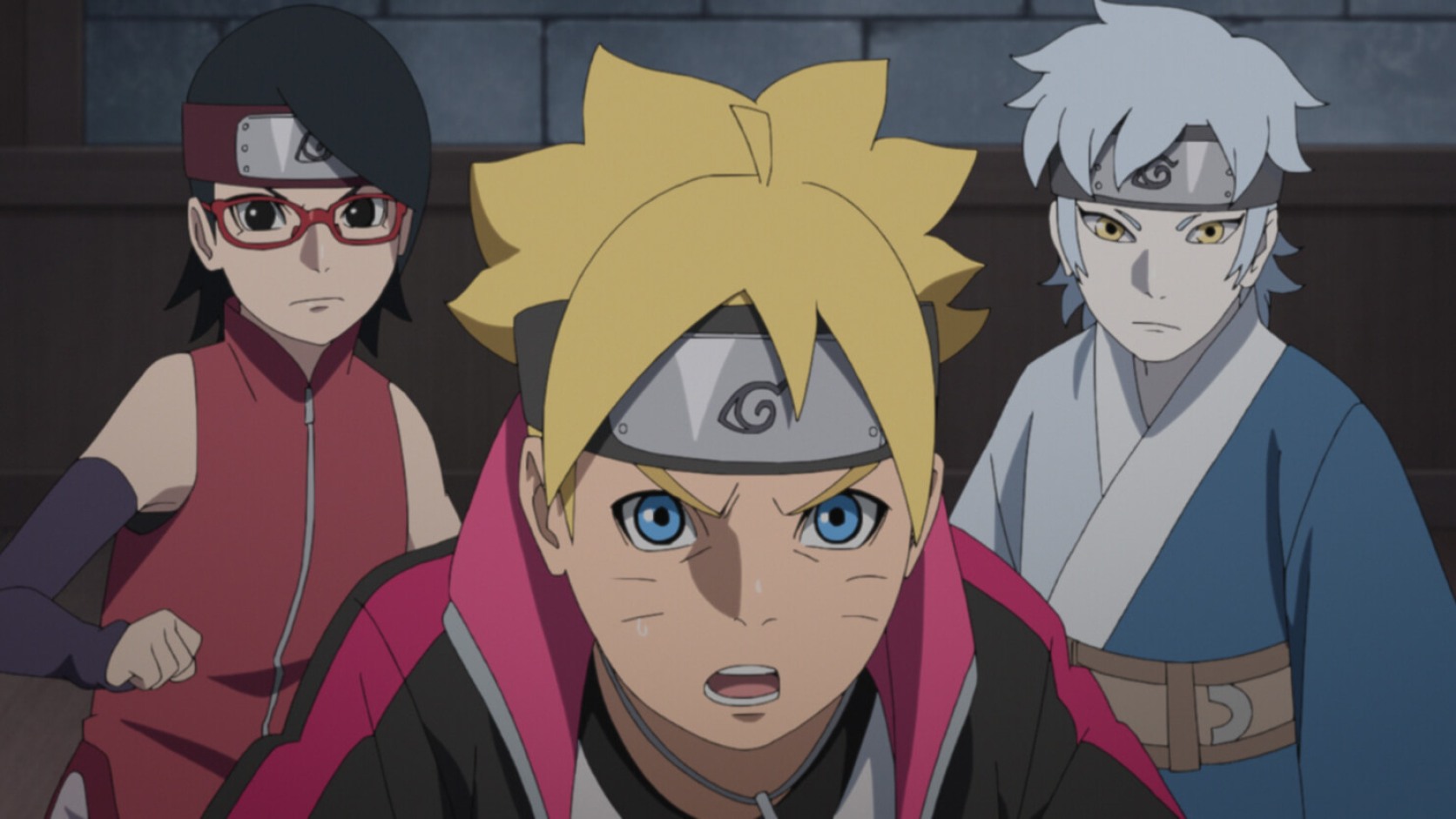
Their Resolve
Ikada leads the Funato army, Araumi and Chojuro prepare for total war, and Boruto chooses to reach his friend with Sarada and Mitsuki beside him.
Series: Boruto: Naruto Next Generations
Episode: 251 · Their Resolve
Arc: Great Sea Battle of the Hidden Mist Village
Release: May 29, 2022
Previous: Episode 250 · The Blood of the Funato
Directory: All 293 Boruto episodes
Bottom line
Boruto Episode 251 gives two grieving young men a resolution and lets adult leaders aim both of them toward catastrophe. Ikada accepts command of the Funato army after Seiren’s injury and the deaths tearing through his family. Boruto decides he must reach Ikada because he believes his own actions helped push his friend into the war. Meanwhile, Araumi declares war and Chojuro prepares to answer him to the bitter end.
Everybody sounds resolved. Almost nobody has defined a humane outcome. Ikada’s grief becomes military authority. Boruto’s guilt becomes a rescue mission he wants to carry personally. Araumi and Chojuro turn accumulated loss into permission for more loss. Sarada and Mitsuki provide the vital difference: they help Boruto act without leaving him alone inside his guilt.
RaeRae’s one-minute verdict
Resolve is not automatically wisdom. Araumi can declare war with a steady voice and still be wrong. Chojuro can answer firmly and still owe civilians a better plan. Ikada can lead with terrifying power and still be acting under grief, family coercion, and a collapsed sense of choice.
Boruto should try to reach him, but not as a solo act of atonement. Team 7 needs authority, adult mediation, a ceasefire proposal, safe passage, and an extraction plan. Friendship can open a conversation. Friendship cannot carry an entire peace process on one teenager’s back.
Araumi declares war
Araumi responds to dead relatives and subordinates by expanding the conflict against the Land of Water. The declaration converts private grief into public danger.
A leader must show necessity, legal authority, defined objectives, civilian protections, and an achievable end state before ordering more people into battle. Anger supplies none of those requirements.
Loss does not grant unlimited authority
Araumi has suffered real losses. Leadership does not require emotional numbness, but grief cannot become an exemption from scrutiny.
The more personally invested a commander becomes, the more independent review matters. Araumi instead treats personal pain as proof that his judgment should control everyone.
Isari tried to negotiate
Isari’s attempt at peace offered the family an alternative before the declaration. That choice matters because the war was not inevitable.
Araumi rejects a route that could preserve lives and continues presenting escalation as duty. History should record that a less violent option existed inside his own command.
Negotiators need protection
People who propose compromise during a family war risk being called weak, disloyal, or treacherous. A credible peace structure must protect their communication and physical safety.
If negotiators can be silenced by commanders, diplomacy becomes a performance rather than a real alternative.
Chojuro answers to the bitter end
The Mizukage prepares to fight Araumi without retreat. His responsibility to protect the Land of Water is real. The phrase “bitter end,” however, should terrify every civilian who may be trapped inside that promise.
Defense needs limits, off-ramps, and ongoing reassessment. A leader cannot make total commitment sound noble while other families absorb the consequences.
Mutual certainty creates a trap
Araumi says war. Chojuro says the fight will continue. Each declaration makes compromise look like surrender to the other side.
That symmetry does not make their causes identical. Their public absolutism does show how leaders become trapped after conditions change.
Civilians are missing from the declarations
Neither grand statement begins with fishing families, children, patients, displaced residents, or workers whose homes and livelihoods lie near the fighting.
Any operational plan should publish evacuation routes, shelters, medical access, family reunification procedures, and protected supply corridors before the first attack.
Ikada accepts command
Ikada moves from reluctant caregiver and shipbuilder to leader of the Funato army. The change is not proof that war revealed his authentic self.
Seiren’s injury, Funamushi’s death, Araumi’s pressure, family expectation, and Boruto’s involvement all narrow his perceived choices. Context does not erase agency, but those pressures change how freely that agency operates.
Grief can look like clarity
After devastating news, a single course of action can feel like the first solid ground available. That feeling may be intense and sincere without being stable.
Major command decisions should not depend on a newly bereaved person’s immediate need for direction. Cooling-off time and independent counsel are safeguards, not insults.
Ikada’s power changes the battlefield
The Funato value Ikada because his command of the sea can make their campaign more dangerous. His ability turns family pressure into a strategic calculation.
That makes coercion more likely. The clan does not merely want his presence; the leadership wants access to a living weapon.
A person is not a weapon system
Ikada’s power belongs to him. Neither ancestry nor emergency transfers ownership to Araumi.
Any use of that power should require informed consent, lawful purpose, clear limits, and responsibility for predictable harm. Bloodline cannot replace those standards.
Seiren’s injury shadows the decision
Ikada knows Boruto’s side played a role in the event that left Seiren near death. Friendship now sits beside betrayal, whether Boruto intended that outcome or not.
Ikada needs space to name anger without being pushed directly from that anger into command. The family gives him no such space.
Funamushi’s death adds another demand
Kobuna has lost his father, and the clan has lost a commander. Ikada may feel that refusing to fight would abandon both the child and the dead.
Real support for Kobuna would mean care, safety, truth, and a future. Sending more relatives into battle only risks giving him more funerals.
Ikada’s old dream still matters
He wanted to build boats that connected people. That dream revealed values of craft, travel, and relationship beyond the clan’s military identity.
Destroying or rejecting the dream under pressure does not prove the dream was false. Grief can make a person attack the part of himself associated with the people who hurt him.
Builders can be pulled into destruction
War often takes knowledge designed for connection and repurposes that knowledge for targeting, transport, or blockade. Ikada’s maritime skill now serves the opposite of his earlier vision.
That reversal should be treated as loss, not dramatic maturation.
Boruto learns Ikada chose the Funato
Boruto struggles to understand how the friend he knew could lead the opposing force. His confusion exposes how little he understood Ikada’s family pressure and grief.
Friendship gave Boruto access to one part of Ikada. That bond did not grant complete knowledge or ownership over the choices that followed.
Boruto blames himself
Boruto believes he helped push Ikada into war. Some responsibility is real: his actions affected Seiren, Funamushi, and Kobuna. Sole responsibility is not.
Araumi’s command, Funato ideology, prior attacks, and years of conflict existed before their friendship. Accurate accountability must resist both denial and total self-blame.
Guilt can produce reckless repair
When Boruto feels responsible, immediate action promises relief. He may believe reaching Ikada personally can undo the harm.
That urgency risks another unplanned confrontation. Repair should center what reduces danger, not what makes Boruto feel less guilty fastest.
Wanting to apologize is not a peace plan
Boruto should acknowledge the harm Ikada connects to him. An apology can open a door when the speaker does not demand forgiveness.
A ceasefire still needs terms, authority, communication channels, monitoring, and consequences for violations. Emotional sincerity cannot substitute for structure.
Boruto needs to listen first
He may arrive prepared to explain self-defense, Kagura’s death, and the danger posed by the Funato. Ikada already knows his own losses.
Listening should come before persuasion. Boruto needs to hear what Ikada believes happened, what he wants, and what conditions might change his course.
Ikada does not owe immediate forgiveness
Friendship does not require him to resolve grief on Boruto’s schedule. He may reject the apology, refuse contact, or remain angry.
Boruto can respect that boundary while still opposing attacks and protecting civilians. Compassion does not require agreement.
Sarada joins the effort
Sarada does not leave Boruto to chase a dangerous idea alone. Her presence adds tactical judgment, emotional honesty, and another person capable of challenging him.
That is what leadership among friends should look like: support without surrendering independent thought.
Mitsuki joins too
Mitsuki’s loyalty can become absolute when Boruto is threatened, yet he chooses to help rather than simply encourage retaliation.
He should retain authority to stop the mission if Boruto’s guilt overwhelms judgment. Loyalty includes preventing a friend from becoming another casualty.
Team 7 distributes the burden
Boruto may feel the harm belongs to him alone, but Sarada and Mitsuki refuse that isolation. Shared planning reduces impulsive choices and makes room for competing perspectives.
The team still needs adult backing. Three young shinobi cannot be the only bridge between national leaders and an armed clan.
Friends are not an entire support system
Sarada and Mitsuki can listen, challenge, and accompany Boruto. They should not become his therapists, legal advisers, commanders, and peace envoys at once.
Adults must provide trauma care, operational review, and diplomatic authority. Friendship works best when institutions do their own jobs.
Chojuro should hear Boruto’s information
Boruto knows Ikada personally and may understand openings unavailable to military intelligence. Chojuro should receive that information before finalizing battle plans.
Listening does not require handing Boruto command. The Mizukage can integrate local knowledge while remaining responsible for the decision.
A young witness deserves respect
Adults often dismiss Boruto’s judgment because he is young, then rely on him when danger becomes inconvenient. Both patterns are exploitative.
He should be heard through a formal briefing, asked clear questions, and told how his information affects the plan.
The mission needs authority
Team 7 should not cross active lines with only personal conviction. They need safe-passage requests, identification, communication protocols, and clear rules if either side attacks.
An unauthorized encounter could be mistaken for infiltration and trigger the battle they hope to prevent.
Safe passage must be reciprocal
Both forces should agree on a route, time, visible markers, allowed personnel, and restrictions on weapons. Observers can document compliance.
If either side uses the meeting for attack or capture, the breach should be investigated rather than immediately converted into unlimited retaliation.
A neutral mediator would help
Boruto and Ikada are emotionally entangled in the deaths and injuries driving the conflict. A trusted neutral party could keep the meeting focused and restate proposals when anger takes over.
Neutrality should mean independence from command pressure, not indifference toward civilian harm.
The first goal should be a pause
Ending the entire conflict in one conversation is unrealistic. A limited pause can stop movement, permit medical access, locate missing people, and establish communication.
Small agreements create evidence that cooperation is possible. Grand promises without implementation create another betrayal story.
Denki and Iwabe need closure
Their disappearance and fate still affect every decision around the group. Families and teammates deserve confirmed information, recovery, and an honest account.
Missing young shinobi cannot become background while leaders debate strategy. Search and identification work must continue through negotiations.
Kagura and Hebiichigo must be named
Their deaths shape Boruto, Buntan, Metal Lee, the Mist forces, and the wider conflict. Peace should not demand that survivors pretend those losses never happened.
Memorialization and investigation can coexist with de-escalation. Forgetting is not reconciliation.
Seiren needs protection from symbolism
The Funato may use her injury to justify Ikada’s command and Araumi’s declaration. Her medical reality disappears when her body becomes a flag.
Care teams should protect privacy and communicate only verified information. Seiren should not be announced as recovering, dying, or demanding revenge unless evidence supports that claim.
Kobuna needs protection from the army
The child’s grief gives the Funato a powerful image, and that visibility places him at risk. He should not attend strategy meetings, deliver recruitment messages, or appear in propaganda.
Child protection means creating a life where mourning is possible without military usefulness.
The Funato fighters need choices
Not every person behind Ikada shares Araumi’s objectives. Some may follow family, fear punishment, need resources, or believe no safe exit exists.
Surrender and demobilization options should be public, credible, and individually reviewed. Collective guilt will strengthen the commanders who say outsiders want every Funato dead.
The Mist forces need restraint
Defending the Land of Water does not authorize revenge against anyone carrying a Funato name. Fighters must distinguish immediate threats, surrendering people, wounded people, and civilians.
Commanders should issue written rules and investigate violations. Discipline is most important when anger feels justified.
Declaring war does not erase law
Captives, medical workers, children, civilian boats, and people no longer fighting retain protection. Neither leader can suspend those duties through rhetoric.
Evidence preservation should begin now because later accountability depends on records made during the crisis.
Communication channels save lives
The two sides need reliable contact for ceasefires, prisoner information, medical evacuation, and allegations of violations. Depending on messengers crossing active combat is needlessly dangerous.
Named contacts and backup routes reduce the chance that a missed message becomes a new attack.
Rumor can trigger the battle
Stories about Seiren, Ikada, Chojuro, or an approaching fleet may move faster than verified orders. One false claim could make frightened units act first.
Both commands should publish correction procedures and require confirmation before responding to unverified reports.
The battlefield is also an information war
Araumi can frame every loss as proof of Mist cruelty. Mist leaders can frame every Funato as a pirate beyond reason. Each simplification supports escalation.
Independent reporting, witness protection, and preserved records can prevent the loudest command narrative from becoming the only history.
Ikada may become a symbol
The clan can present his return as destiny fulfilled, proof that Funato blood always answers the call. That story erases pressure and makes future dissent look unnatural.
Ikada is a person making choices under extreme conditions. Turning him into a symbol makes changing course harder because withdrawal would threaten everybody’s story about him.
Boruto may become a symbol too
The Mist could present Boruto as the heroic friend who alone can redeem an enemy. That burden flatters him while excusing institutions from diplomacy.
He can contribute without becoming the face of peace. Sustainable agreements must survive even if Boruto and Ikada cannot reconcile.
Reconciliation is not compulsory friendship
The boys may never return to the easy relationship they had as shipbuilder and passenger. Peace does not require emotional restoration.
They need enough recognition to stop harming one another and support broader safety. Friendship afterward would be a gift, not a condition.
Ikada deserves a way back
If he changes course, neither side should demand humiliation as proof. Public shaming would make Araumi’s warning about betrayal come true.
A lawful review can address actions while preserving dignity, safety, and the possibility of constructive work.
Accountability must follow conduct
Grief and coercion explain parts of Ikada’s decision without granting immunity for harm he directs. Review should examine orders, intent, pressure, alternatives, and outcomes.
The same standard applies to Chojuro, Araumi, and every commander. Rank should increase accountability.
Boruto must accept limits
He may do everything responsibly and still fail to persuade Ikada. Another person’s choice cannot be controlled through perfect words.
Boruto should define what he can offer, what he cannot promise, and when the team must withdraw. Accepting limits protects everyone from desperation.
Sarada should own the abort call
Because Boruto is emotionally invested, Sarada or another designated teammate should have authority to end the meeting when danger crosses agreed limits.
That arrangement is not distrust. The abort call is a safeguard created before emotions and threats narrow judgment.
Mitsuki should protect without escalating
Mitsuki may respond instantly if Ikada threatens Boruto. Rules should define defensive steps, signals, and nonlethal options before contact.
The goal is to leave alive with the possibility of another conversation, not win an argument through force.
Chojuro needs an off-ramp
The Mizukage should publicly state conditions under which forces will pause, withdraw, or enter talks. Without an off-ramp, every concession looks improvised and politically weak.
Clear conditions allow firmness and flexibility to coexist.
Araumi needs consequences and an exit
Araumi should face accountability for attacks and coercive leadership. Negotiators also need a realistic mechanism for him to stop fighting without gambling every follower’s life.
An exit does not mean immunity. A negotiated route separates immediate de-escalation from the lawful process that follows.
The sea needs civilian governance
Armed leaders cannot be the only people deciding access, development, fishing, transport, and sacred use. Residents, workers, environmental stewards, and local communities need representation.
A political settlement should reduce the power of anyone who can start a war through family command.
Reconstruction belongs in the peace plan
Boats, villages, clinics, livelihoods, and trust have been damaged. Repair funding and transparent distribution should be negotiated alongside security.
People who see no future after disarmament will remain vulnerable to recruitment.
Trauma care belongs in the peace plan
Boruto, Ikada, Kobuna, Buntan, Metal Lee, families, civilians, and fighters carry grief that will outlast any ceasefire. Support must be long-term, confidential, and culturally accessible.
Untreated trauma can become family violence, isolation, substance use, or renewed recruitment. Care is conflict prevention.
Their resolve should change
Resolve should mean protecting life, telling the truth, accepting accountability, and refusing to hand grief to the next child. Stubbornness is not the only form of commitment.
Ikada and Boruto can remain determined while changing the action attached to that determination.
What responsible leadership looks like now
Authorize Team 7’s contact attempt through a monitored safe-passage channel. Ask for a limited ceasefire. Continue searches and medical access. Protect children and civilians. Publish surrender terms. Preserve evidence.
Then bring Ikada, Isari, noncombatant Funato representatives, Mist communities, and neutral mediators into negotiations that do not depend on Araumi or Chojuro winning a personal contest.
RaeRae’s final word
Boruto Episode 251 is not about one brave resolution defeating another. The episode shows what happens when grief hardens faster than institutions can build another choice. Araumi turns loss into war. Chojuro answers with total resistance. Ikada turns pain into command. Boruto turns guilt into a promise to reach him.
Families need emergency communication
People on both sides need reliable notice about evacuations, missing relatives, injuries, detention, and deaths. Command secrecy cannot justify leaving families to assemble truth from rumors.
Named liaison teams should publish scheduled updates and private contact routes. Accurate family notification can reduce panic, prevent dangerous searches, and deny propagandists the uncertainty they exploit.
Medical corridors need visible protection
Wounded people, caregivers, and supply boats need routes clearly marked and agreed by both commands. The corridors should have published schedules, neutral monitoring, and procedures for reporting interference.
One alleged violation must be investigated quickly. Leaders should not use confusion around a medical movement as an excuse to destroy every protection built for civilians.
Young shinobi need a return plan
Team 7’s mission cannot end at reaching Ikada. Command should define extraction signals, rendezvous points, medical support, and what happens if negotiations succeed only partially.
The teenagers should know who will recover them and which adult owns the decision after contact. Sending them toward a fleet without a return plan would repeat the same institutional neglect the arc keeps exposing.
Sarada and Mitsuki are the reason Boruto’s resolution has a chance to become something better. They stand beside him without pretending a heartfelt conversation fixes everything. Let friendship open the door, then bring in the adults, terms, protections, and accountability required to keep that door from slamming shut on more bodies.
Sources and lawful viewing
Official episode reference: Naruto Official episode guide
Licensed episode route: Crunchyroll licensed series page