
The Spiral of Revenge
Boruto offers his own life to stop Ikada, but the episode only reaches peace after the people around both boys refuse to keep converting grief into another body.
Series: Boruto: Naruto Next Generations
Episode: 254 · The Spiral of Revenge
Arc: Great Sea Battle of the Hidden Mist Village
Release: June 19, 2022
Previous: Episode 253 · Conflicting Feelings
Directory: All 293 Boruto episodes
Bottom line
Boruto Episode 254 brings the Funato war to a stop, but Boruto does not win because offering his life is secretly the purest answer. He wins because everyone watching receives one final chance to decide whether grief must produce another corpse. Sarada and Mitsuki refuse revenge even while Boruto disappears beneath the sea. Buntan and Kyoho refuse revenge after losing people they loved. Ikada finally refuses revenge when he dives after Boruto instead of letting the boy drown.
That distinction matters. Boruto’s choice comes from compassion, guilt, and a frightening willingness to erase himself if somebody else might survive. A teenager standing still for a beating is not a peace process. A teenager falling into dark water is not accountability. The real victory arrives through collective restraint. Several hurting people reject the next killing, and their refusal breaks the pattern that speeches alone could not break.
RaeRae’s one-minute verdict
Boruto is brave, sincere, and completely wrong to treat his body as currency. Sarada and Mitsuki are right to object, and their decision not to retaliate after his fall carries more moral weight than his offer. They prove that grief does not control the next action. Buntan and Kyoho prove the same point from the other side of the conflict.
Ikada’s rescue is the episode’s honest turning point. He can talk about hatred all night, but his body remembers the person who wanted to build ships and save lives. Pulling Boruto from the sea does not erase Seiren, Funamushi, or the Funato dead. The rescue shows that Ikada can honor grief without feeding another child to the spiral.
Boruto accepts an impossible condition
Episode 253 ended with Ikada demanding Boruto’s life after rejecting Chojuro’s head as insufficient payment. Episode 254 opens inside that coercive condition. Boruto believes accepting death may stop the attack on Shinonome 1 and prevent more casualties. His reasoning follows a familiar shinobi habit: if one body can absorb the danger, the person with the strongest guilt volunteers first.
The arithmetic sounds clean only because the future grief remains offscreen. Hinata, Naruto, Himawari, Sarada, Mitsuki, Kawaki, and every friend waiting in the village would inherit the cost. Ikada would inherit another death connected to his command. The Funato fighters would learn that threatened mass violence can purchase a child’s life. Nobody receives peace from that bargain.
Sarada calls the bargain what the bargain is
Sarada does not romanticize Boruto’s proposal. She understands his wish to protect civilians, but leadership requires more than admiring a teammate’s resolve. A captain must interrupt a decision made under guilt when that decision destroys the person making the offer. Her anger comes from love, duty, and the knowledge that Boruto has stopped treating his own survival as part of the mission.
The scene gives Sarada an important job beyond emotional support. She names the boundary that Boruto cannot hold for himself. Team 7 did not sail into the Funato fleet so one member could become a ceremonial casualty. They came to stop an attack, preserve life, and reach Ikada. Sarada keeps those goals visible when Boruto narrows the whole mission to his own death.
Mitsuki’s protection has to include restraint
Mitsuki would rather fight every person on the deck than watch Boruto die. That response fits their bond, and nobody should pretend calm detachment would feel natural. Yet immediate retaliation would hand Ikada proof that revenge always wins. Mitsuki has to protect Boruto while honoring Boruto’s request that no fresh killing follow his sacrifice.
That demand is brutal because Mitsuki’s whole body reads the scene as an attack requiring action. Restraint does not mean a lack of feeling. Restraint means carrying rage without giving rage command authority. Mitsuki’s refusal to slaughter the Funato after Boruto falls becomes one of the clearest signs that the spiral can stop.
Ikada turns grief into a public test
Ikada does not merely threaten Boruto in private. He stages the demand before armed followers who expect a commander to avenge their dead. Public pressure makes every possible retreat harder. If Ikada accepts words too quickly, loyalists may read compassion as weakness or betrayal. The performance of strength becomes another cage around the person holding power.
That pressure explains his escalation without excusing the choice. Leaders remain responsible for conditions they announce. Ikada could pause, ask for surrender, request neutral mediation, or demand a documented investigation. He chooses a beating and a threatened death because visible suffering feels more emotionally satisfying to the crowd. Justice cannot survive that standard.
Boruto orders his friends not to avenge him
Boruto recognizes the contradiction at the center of his plan. If Sarada and Mitsuki attack after his death, his sacrifice becomes fresh fuel for the same war. He asks them to accept his decision and promise that no revenge will follow. The request reveals that he understands the mechanism even while placing himself inside the machinery.
His insight does not make the plan safe. A person facing self-destruction cannot solve every consequence by asking loved ones to remain peaceful afterward. Survivors still carry trauma, anger, guilt, and unanswered questions. Boruto transfers an enormous emotional burden to two friends who never consented to the bargain.
The beating is not proof of commitment
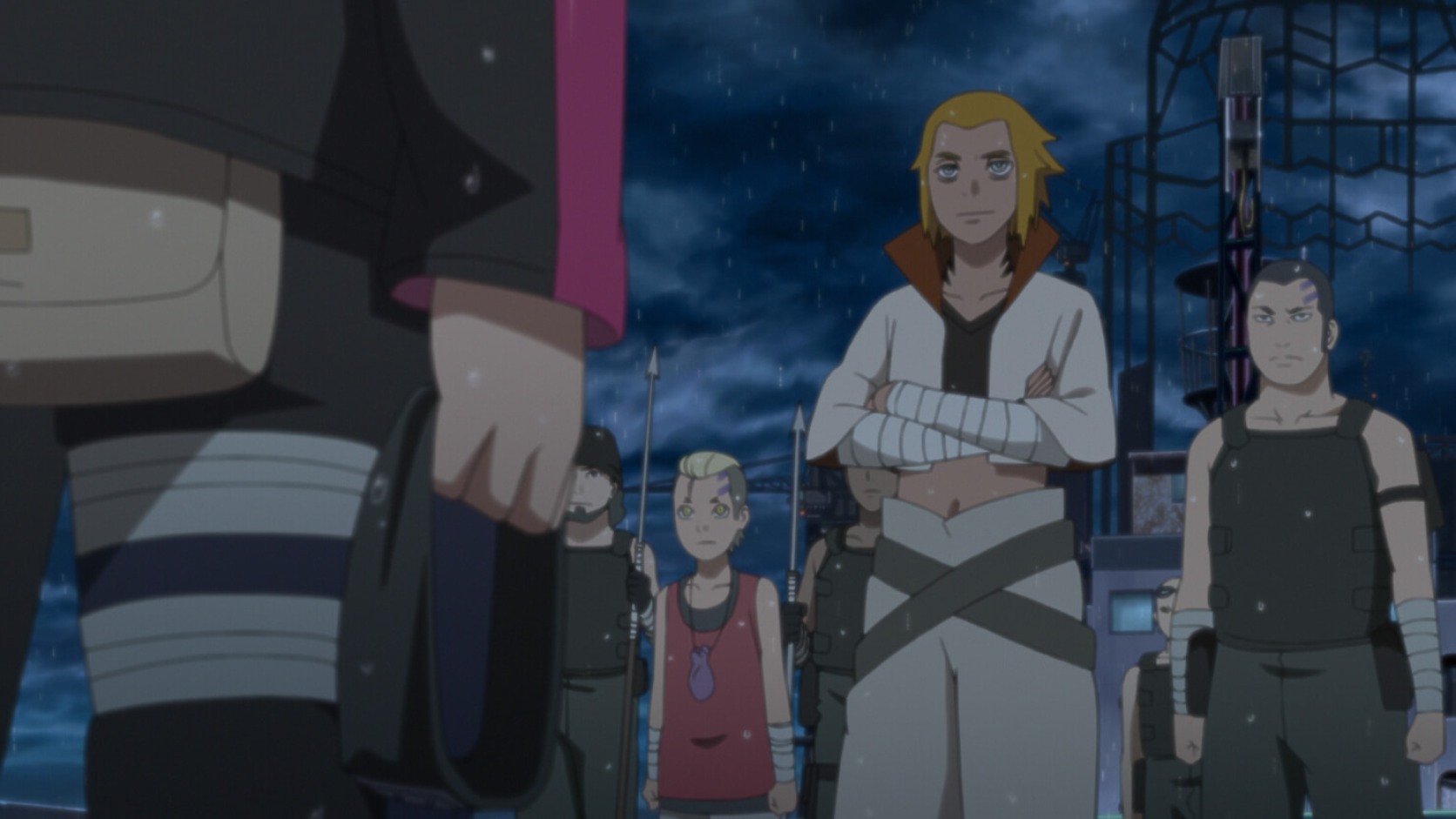
Boruto stands while Funato fighters strike him. The episode presents his endurance as evidence that his promise is sincere, but physical suffering cannot verify a political agreement. Pain proves only that Boruto will tolerate pain. The attack does not establish who controls the fleet, how Shinonome 1 will remain safe, or what happens after the fighters return home.
Watching adults and older fighters beat a teenager should remain ugly. Any heroic framing needs resistance from the audience. Boruto’s refusal to fight back may interrupt their expectations, yet the spectacle still places responsibility on the least powerful negotiator. The armed commanders should carry the burden of de-escalation.
Nobody should need to earn the right to live
Ikada keeps judging whether Boruto’s resolve reaches some invisible threshold. That structure gives the aggressor permission to decide how much suffering counts. No fair process can operate under such a rule. A person does not earn basic safety through bruises, silence, or willingness to die.
The same principle applies beyond Boruto. Funato civilians should not prove innocence before receiving medical care. Mist civilians should not prove political purity before evacuation. Prisoners should not perform remorse before humane treatment. Rights become meaningless when armed people can suspend them until a victim offers enough pain.
Sarada and Mitsuki remain witnesses
Their presence prevents Boruto’s choice from becoming a private legend told later by whichever faction controls the story. They see the demand, the blows, the fall, and the order not to retaliate. Witnesses matter because wartime narratives change quickly. A commander may call coercion consent, while grieving friends may remember restraint as helplessness.
Both teammates also carry responsibility for the record afterward. They should document names, commands, sequence, injuries, and every person who tried to intervene. Accurate testimony protects Boruto from being reduced to propaganda for either side.
Buntan remembers Hebiichigo
Buntan has every reason to hate the Funato after Hebiichigo’s death. Her anger could easily become the emotional permission slip for another attack. Instead, Buntan understands what Boruto is trying to stop. She does not forget her friend. She refuses to let memory become an order to kill the next available target.
That choice gives the episode needed weight. Boruto can preach against revenge because he believes saving everyone remains possible. Buntan speaks from a fresh loss with no such comfort. Her restraint shows that honoring the dead and refusing retaliation can exist in the same person.
Kyoho refuses the easy answer too
Kyoho’s agreement matters because peace cannot rest on one unusually forgiving person. A group begins changing when several members make the same difficult choice for their own reasons. He recognizes that another death will not return Kagura or Hebiichigo and will not repair the villages damaged by war.
Refusal does not require affection for the Funato. Kyoho can condemn their actions, demand accountability, and still reject revenge. Too many stories treat forgiveness as the only alternative to violence. Lawful restraint offers another path: preserve life now, establish facts, assign responsibility, and repair what can be repaired.
Ikada says Boruto’s life is not enough
The demand shifts because revenge has no natural stopping point. One death cannot balance several losses, especially when every side counts different names and different causes. Ikada can always add another grievance, another relative, or another humiliation. Boruto’s offer exposes the problem by failing the moment Ikada measures pain against an expanding ledger.
No body could settle that account. Chojuro would not be enough. Boruto would not be enough. The destruction of Shinonome 1 would not be enough. A revenge system survives by declaring every payment inadequate, which guarantees another round.
The sea becomes the final test
Boruto falls into the water after enduring the assault. The sea has followed Ikada throughout the arc as workplace, dream, family territory, battlefield, and escape route. Now the same water becomes a choice. Ikada can watch Boruto disappear, or he can return to the instinct that once made him save a stranger.
The visual echo lands because the rescue is physical rather than rhetorical. Ikada does not deliver a polished speech before moving. He dives. His action reveals that the shipbuilder and caregiver were never fake identities. Grief buried those parts under obligation, but grief did not erase them.
Ikada saves the person he threatened
Rescuing Boruto does not convert Ikada into an innocent person. He created the test, permitted the beating, and allowed the fall. Accountability remains necessary. The rescue still matters because a harmful actor can interrupt his own escalation before the worst outcome becomes permanent.
Stories sometimes act as though moral worth requires an untouched record. Real change usually begins after damage has already occurred. Ikada cannot undo the terror on deck, but he can prevent Boruto’s death and stop the fleet. That choice creates the first usable opening for repair.
The rescue repeats their first meeting
Ikada once saved Boruto from drowning before either boy knew how deeply their families and villages would collide. The repeated action strips away political performance for a moment. He sees the same person in the water, and his body answers before the commander persona can demand another calculation.
The parallel avoids claiming that friendship solves war by magic. Their bond creates an interruption, not a treaty. Governments, commanders, families, and communities still need terms. Personal memory opens a door that policy must walk through.
A remembered self can still be real
Ikada previously dismissed shipbuilding as a lie he told himself because he lacked Funato power. The rescue challenges that story. People do not fake years of curiosity, labor, skill, and care simply because grief later changes their priorities. His craft belonged to him even when his family refused to value the work.
Returning to that self should not mean pretending the war never happened. Ikada will carry loss, responsibility, and damaged relationships. Recovery means gaining enough freedom to choose among identities again rather than performing the one identity Araumi rewards.
The Funato fighters watch their commander change course
Ikada’s followers need to see the rescue because they also need permission to stop. Some may have doubted the campaign without believing dissent was safe. When the commander rejects the final killing, hidden hesitation can become visible restraint.
Their compliance should not erase individual conduct. People who attacked civilians or prisoners still face review. Demobilization and accountability can occur together. A fighter should have a safe route away from the fleet without receiving automatic immunity for every action.
Araumi’s authority finally loses emotional control
The conflict depended on family loyalty being stronger than personal judgment. Araumi defined strength, belonging, and vengeance for his children. Ikada’s choice to save Boruto breaks that control. He decides that his father’s pain does not get to dictate another death.
Family coercion often hides behind duty. A parent claims that refusal dishonors the dead or abandons the clan. Healthy loyalty cannot require a person to surrender conscience. Ikada’s rescue becomes a boundary against that demand.
Seiren’s injury cannot speak for Seiren
Ikada has used Seiren’s condition as moral authority for revenge. Her suffering deserves care and honest acknowledgment, but nobody should turn an injured woman into a silent endorsement of war. Seiren has her own values, relationships, and possible wishes.
The next phase needs direct medical information and her voice when recovery allows. Family members may act protectively while still choosing something she would reject. Respect means separating what Seiren said from what others imagine she would want.
Funamushi’s death remains complicated
Funamushi was a father, relative, and commander. Kobuna’s grief remains real regardless of the harm his father caused. The Mist side cannot demand that a child mourn according to an enemy’s moral summary. The Funato side also cannot use fatherhood to erase Kagura’s death or Funamushi’s command decisions.
A complete record holds both truths. Human attachment does not cancel responsibility, and responsibility does not cancel attachment. Peace becomes possible when nobody must lie about one truth to defend the other.
Kagura and Hebiichigo remain present
Stopping revenge does not ask Buntan, Kyoho, Boruto, or their friends to move on by sunrise. Grief continues after the fleet withdraws. Funerals, family contact, memorial choices, and trauma care belong to the aftermath.
The dead deserve more than becoming arguments. Kagura’s work toward reintegration, Hebiichigo’s emerging trust, and the futures they wanted should shape reconstruction. Memorials should preserve their full lives rather than only the manner of death.
Chojuro’s ceasefire has to become policy
Ikada’s decision solves the immediate attack, but a pause supported by emotion can collapse after the next rumor or command dispute. Chojuro needs written terms, verified fleet positions, protected civilian routes, prisoner information, and named contacts authorized to resolve violations.
The Mizukage also owes public accountability for policies that deepened regional grievance. Defending civilians does not place every earlier decision beyond review. Strong leadership can protect the village and submit government choices to evidence.
Shinonome 1 cannot be forgotten after the climax
The threatened power facility represents workers, surrounding communities, transport, homes, and public infrastructure. Those people spent the confrontation waiting for young shinobi to succeed. Their evacuation, medical support, lost wages, damaged property, and continuing fear require attention after the dramatic rescue.
Infrastructure decisions also deserve review. Development cannot treat affected islands as obstacles or scenery. Residents need transparent plans, environmental information, compensation routes, and real influence before another project reproduces the same resentment.
Children carried too much of this war
Boruto, Sarada, Mitsuki, Kobuna, and other young people absorb decisions made by adults and institutions. Shinobi status does not erase age. Training may prepare a child to fight, but training cannot make self-sacrifice an ordinary workplace expectation.
Adult leaders need a clear boundary against using minors as negotiators of last resort. Young shinobi can provide testimony and insight without holding sole responsibility for national peace. Chojuro, Naruto, and their administrations should review how Boruto reached a position where death looked like the most available tool.
Boruto needs care after the rescue
Physical treatment comes first: water inhalation, impact injuries, exposure, and the cumulative effects of the beating. Emotional assessment matters too. A person who calmly offers death may appear composed while operating under severe guilt and narrowed judgment.
Care should not become punishment or a lecture delivered before safety. Boruto needs warmth, medical attention, sleep, family contact, and a chance to describe what he believed would happen. Accountability for risky choices can follow once his body is stable.
Sarada deserves a real debrief
She had to watch a teammate overrule her leadership and accept possible death. That experience can produce anger toward Boruto, Ikada, herself, and every adult who allowed the situation. A captain should not be expected to absorb those feelings privately and return to duty.
Her report should include the coercive condition, her objections, the team’s tactical limits, and the factors that prevented retaliation. Commanders need to learn from her account rather than praising the outcome and ignoring the process.
Mitsuki deserves more than praise for control
Mitsuki’s restraint required him to act against his strongest protective impulse. The village should not celebrate that control while overlooking the fear underneath. He needs space to process the possibility of losing Boruto and the burden of honoring a request he believed was wrong.
Future mission planning should give Team 7 agreed emergency authority. No member should unilaterally offer a life while teammates become forced witnesses. Shared boundaries protect the group from compassion turning into command chaos.
Ikada needs accountability and protection
His rescue may place him at risk from Funato loyalists who wanted the attack completed. A transition plan should secure him without treating protection as absolution. Investigators still need his testimony about orders, deaths, internal dissent, and Araumi’s command structure.
Justice works best when cooperation changes outcomes without erasing facts. Ikada can receive credit for stopping the fleet and saving Boruto while answering for threats and violence. Both truths belong in the same record.
Kobuna needs adults who reject recruitment
Kobuna has already been pulled toward vengeance through grief for Funamushi. The end of the battle should remove him from military pressure, provide reliable family information, and connect him with caregivers who will not turn pain into loyalty training.
Nobody should demand instant forgiveness from him. A grieving child may remain furious. Safety means giving that anger somewhere to exist without placing a weapon, mission, or political slogan in his hands.
Buntan and Kyoho model grief without obedience
Their choice deserves follow-through. Both need room to mourn without being presented as perfectly healed examples for everyone else. Refusing revenge on one night does not eliminate recurring anger, nightmares, or resentment.
The village can honor their restraint by providing sustained support and including their testimony in the official review. Symbolic praise without practical care would use them almost as badly as commanders used grief during the war.
Peace requires separate tracks
One process should handle immediate security: ceasefire rules, weapons, fleet positions, evacuation, prisoners, and communication. Another should establish facts and responsibility. A third should address reconstruction, compensation, work, transport, and environmental harm. A fourth should support grief and community repair.
Trying to solve every issue in one emotional meeting guarantees failure. Separate tracks allow urgent protection to begin without demanding that every historical grievance disappear first.
Neutral monitoring would protect both sides
Mist officials cannot simply announce compliance and expect Funato communities to trust them. Funato commanders cannot police their own fleet and call the result independent. Neutral observers need access to ports, detention sites, damaged villages, medical routes, and relevant records.
Monitoring also protects people who want peace from hardliners within their own faction. Verified information makes rumor harder to weaponize. Clear reporting gives leaders a way to correct violations without treating every dispute as grounds for renewed war.
The shipbuilding dream offers a route forward
Ikada’s skill can support civilian transport, fishing safety, medical access, reconstruction, and connection among islands. Work will not cure grief, but meaningful labor can return agency and place him among people who value creation more than inherited combat power.
Any offer must remain voluntary. Forcing Ikada to build for the government as repayment would turn restoration into another form of control. A fair program needs choice, wages, safety, ownership protections, and community oversight.
The episode rejects perfect words
Boruto fails to produce a sentence that changes Ikada. He reaches the turning point through vulnerability, but even that vulnerability becomes dangerous when expressed as self-erasure. The other characters complete the moral argument through what they refuse to do.
That structure feels more honest than a miraculous speech. People trapped in grief often need repeated evidence that another response remains possible. Sarada, Mitsuki, Buntan, Kyoho, and Ikada each add one refusal until revenge loses the agreement required to continue.
The title names a system, not a mood
“The Spiral of Revenge” describes a sequence. Harm creates grief. Grief is assigned to an enemy. Retaliation creates another loss. The new loss becomes proof that retaliation was necessary. Every round recruits people who did not make the original decisions.
Breaking a spiral requires an interruption at several points. People need accurate facts, protected dissent, lawful accountability, material repair, and care for survivors. Personal restraint opens the break. Institutions must keep the opening from closing.
Self-sacrifice remains a dangerous shinobi habit
The franchise often treats willingness to die as the highest evidence of love. Boruto inherits that moral language from generations of shinobi who survived through sacrifice and memorialized the dead as examples. Courage can include risk, but a culture becomes dangerous when survival looks selfish.
Adults must teach young shinobi that returning home is part of duty. Planning, teamwork, retreat, medical care, and asking for help are not lesser forms of bravery. A village that only praises the person who stays behind will keep producing children ready to disappear.
Friendship helps because friendship preserves contradiction
Boruto remembers Ikada as a builder and rescuer. Ikada remembers Boruto as a friend and as somebody connected to family harm. Neither memory is false. Their relationship matters because each boy cannot reduce the other to one role forever.
Reconciliation may come later, but peace cannot demand immediate closeness. Ikada can save Boruto without trusting the Mist. Boruto can care about Ikada while condemning the coercion. Mature repair leaves room for that discomfort.
The Funato war ends without a clean winner
The fleet stops, civilians survive the immediate threat, and Ikada chooses rescue. Those outcomes deserve relief. Victory language would still flatten the dead, injured, displaced, and traumatized people left behind. Nobody wins a war merely because the final attack does not occur.
The honest ending is de-escalation followed by work. Bodies need treatment. Families need information. Commands need review. Communities need resources. Children need protection. The sea needs people willing to build something after so many people used the water as a battlefield.
What responsible leadership looks like next
Keep the ceasefire active and written. Separate fighters from civilians. Publish safe surrender and return routes. Exchange prisoner and missing-person information. Protect medical transport. Begin independent investigations. Include island residents, workers, caregivers, and young people in reconstruction decisions.
Chojuro should acknowledge harm without surrendering public safety. Ikada should cooperate without being turned into a decorative symbol of unity. Naruto should review why his son believed death was an acceptable diplomatic tool. Every leader should make survival easier than martyrdom.
RaeRae’s final word
Boruto Episode 254 almost asks us to applaud a child for making himself disposable. I cannot do that. Boruto’s compassion is real, and his courage is real, but love should not require Sarada and Mitsuki to watch him die quietly so a commander can feel avenged.
The episode earns its ending through the refusals around him. Buntan does not spend Hebiichigo’s memory on another corpse. Kyoho does not spend Kagura’s memory that way either. Sarada and Mitsuki hold their grief without attacking. Ikada looks at the water and chooses the boy he once saved over the vengeance his family taught him to perform. That collection of choices ends the war. Nobody’s death could have done the same work.
Sources and lawful viewing
Official episode reference: Naruto Official episode guide
Licensed episode route: Crunchyroll licensed series page